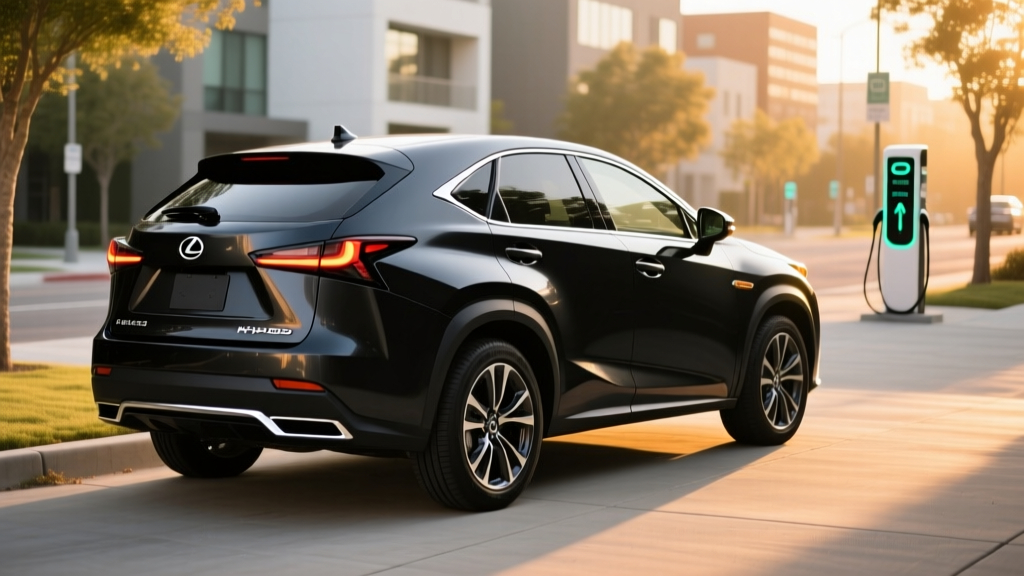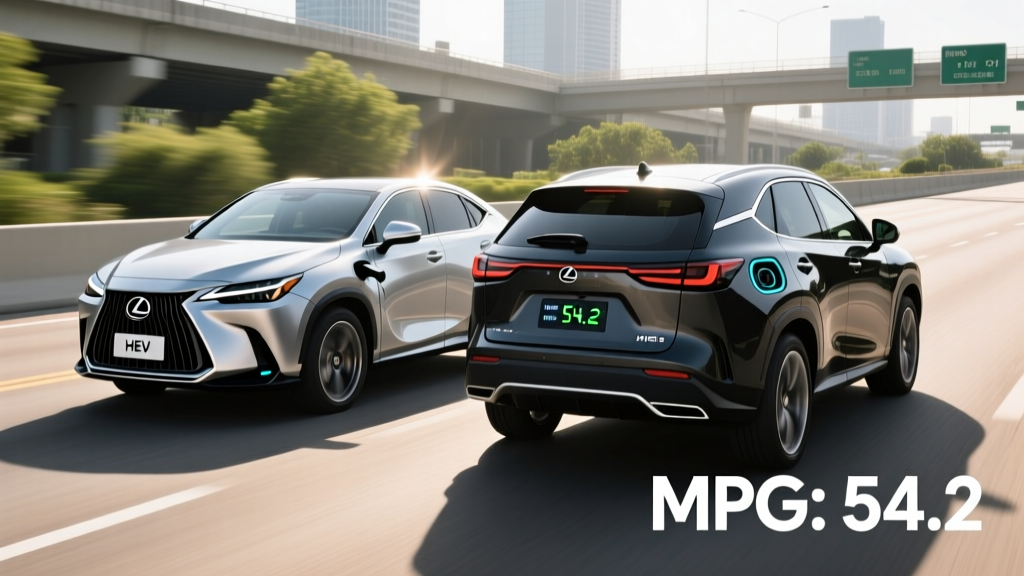
If you're researching the Lexus NX hybrid fuel economy, you're likely choosing between two distinct powertrains: the conventional NX 350h (HEV) and the plug-in NX 450h+ (PHEV). Both pair a 2.5-liter four-cylinder with electric motors, but their efficiency profiles, daily-driving behavior, and ownership costs differ significantly. This guide breaks down the 2026 model-year EPA numbers, real-world expectations, battery specs, and tax-credit eligibility so you can match the right NX hybrid to your commute.
HEV vs PHEV: Which Lexus NX Hybrid Are You Looking At?
Lexus sells the NX in two electrified flavors, and confusing them is the most common mistake buyers make at the dealership.
| Feature | NX 350h (HEV) | NX 450h+ (PHEV) |
|---|---|---|
| Plug-in required? | No — charges via regenerative braking and engine | Yes — plug in to unlock electric-only driving |
| Battery size | ~1.6 kWh (sealed NiMH) | 18.1 kWh usable (lithium-ion) |
| Electric-only driving | Brief low-speed EV mode only | Up to 37 miles at highway-capable speeds |
| Combined system output | 240 hp | 304 hp |
| 0-60 mph | 7.2 seconds | 6.0 seconds |
| Starting MSRP (2026) | $43,315 | $61,215 |
The NX 350h operates exactly like a traditional Prius-style hybrid: the engine and motors blend seamlessly, you never plug it in, and the small battery recaptures energy from braking. The NX 450h+ adds a much larger battery and more powerful motors, letting you drive roughly 37 miles on electricity alone before the gasoline engine takes over as a series-parallel hybrid.
Lexus NX Hybrid Fuel Economy: EPA Numbers and Real-World MPG
Here are the official EPA fuel-economy estimates for the 2026 NX lineup, plus what owners typically report in mixed driving.
| Model | City MPG | Highway MPG | Combined MPG | MPGe (PHEV electric mode) |
|---|---|---|---|---|
| NX 350h AWD (HEV) | 41 | 37 | 39 | N/A |
| NX 450h+ AWD (PHEV, gas mode) | 38 | 34 | 36 | 84 MPGe |
Real-world expectations: The NX 350h routinely exceeds its EPA city rating in stop-and-go traffic — regenerative braking recovers energy that a gas car wastes as heat. Many owners report 42-44 MPG in urban commuting. Highway driving is less favorable; at 75 mph, expect 33-35 MPG due to the crossover's aerodynamic profile. In cold weather (below 30°F), city MPG typically drops 3-5 MPG as the engine runs more frequently for cabin heat.
For the NX 450h+, the 36 MPG combined figure applies only after the battery is depleted. During daily commutes within the 37-mile electric range, gasoline consumption drops to zero. Owners with home charging and sub-30-mile round trips report visiting gas stations every 6-8 weeks.
NX 450h+ total range: 37 miles electric-only + approximately 380 miles on gasoline = roughly 417 miles total before needing fuel or a plug. Electric-only range drops to 28-32 miles in winter or at sustained highway speeds above 70 mph.
NX 450h+ Electric-Only Range and Charging Details
The NX 450h+ uses an 18.1 kWh lithium-ion battery pack (usable capacity). On a full charge, the EPA rates it at 37 miles of electric-only range — enough for most daily commutes without burning a drop of gasoline.
| Charging Method | Power | 0-100% Time | Miles Added per Hour |
|---|---|---|---|
| Level 1 (120V household outlet) | ~1.4 kW | ~13 hours | ~3 miles/hr |
| Level 2 (240V, 16A home charger) | ~3.3 kW | ~5.5 hours | ~7 miles/hr |
| DC fast charging | Not supported | N/A | N/A |
Critically, the NX 450h+ does not support DC fast charging — a limitation shared with the Toyota RAV4 Prime on which it's based. The onboard charger maxes out at 3.3 kW, meaning a full Level 2 charge takes about 5.5 hours. For most PHEV owners who plug in overnight, this isn't a practical problem, but it means you can't top up quickly on a road trip. The charge port is a standard J1772 connector (Level 2).
Powertrain Specs: What's Under the Hood
| Specification | NX 350h | NX 450h+ |
|---|---|---|
| Engine | 2.5L inline-4 Atkinson-cycle | 2.5L inline-4 Atkinson-cycle |
| Engine output | 181 hp / 176 lb-ft | 181 hp / 176 lb-ft |
| Front motor | 134 hp | 180 hp |
| Rear motor (eAWD) | 54 hp | 54 hp |
| Combined system horsepower | 240 hp | 304 hp |
| Transmission | eCVT | eCVT |
| Drivetrain | AWD (electronic rear axle) | AWD (electronic rear axle) |
| Towing capacity | 2,000 lbs | 2,000 lbs |
The NX 450h+ achieves its 6.0-second 0-60 time thanks to substantially more powerful electric motors, particularly the front unit. Both models use Lexus's eCVT — a planetary gearset, not a belt-driven continuously variable transmission — which contributes to the brand's strong reliability reputation.
Pricing, Trims, and Tax Credit Eligibility
The 2026 Lexus NX hybrid lineup spans a wide price range:
- NX 350h Premium: $43,315
- NX 350h Luxury: $48,550
- NX 350h F SPORT Handling: $50,050
- NX 450h+ Premium: $61,215
- NX 450h+ Luxury: $66,350
Federal tax credit status: The NX 450h+ previously qualified for a partial federal tax credit, but as of 2026, Lexus does not list it as eligible for the IRS §30D Clean Vehicle Credit. The critical-mineral and battery-component sourcing requirements under current law have eliminated eligibility for most Toyota/Lexus PHEVs. The NX 350h (conventional hybrid) has never qualified for §30D, which applies only to plug-in vehicles with at least 7 kWh of battery capacity.
§30D credit requirements (2026 rules):
- Vehicle must be a plug-in (PHEV or BEV) with ≥7 kWh battery
- MSRP cap: $80,000 for SUVs (NX 450h+ qualifies on price)
- Buyer AGI cap: $150K single / $300K joint
- Battery components must meet North American manufacturing thresholds
- Critical minerals must meet US/free-trade-agreement sourcing thresholds
- Always verify current eligibility on fueleconomy.gov before purchasing
Some states offer their own hybrid or PHEV rebates — California's CVRP, for example, has historically included PHEVs, though funding and eligibility change frequently. Check your state energy office for current programs.
Battery Warranty, Reliability, and Replacement Costs
Lexus backs both hybrid systems with robust warranties, and the brand's hybrid reliability track record — inherited from two decades of Toyota Hybrid Synergy Drive engineering — is among the best in the industry.
| Coverage | NX 350h (HEV) | NX 450h+ (PHEV) |
|---|---|---|
| Hybrid battery warranty | 10 years / 150,000 miles | 10 years / 150,000 miles |
| Hybrid system components | 8 years / 100,000 miles | 8 years / 100,000 miles |
| Basic warranty | 4 years / 50,000 miles | 4 years / 50,000 miles |
| Powertrain warranty | 6 years / 70,000 miles | 6 years / 70,000 miles |
Battery replacement cost: If the NX 350h's NiMH hybrid battery fails out of warranty, replacement runs approximately $3,000-$4,500 including labor. The NX 450h+ lithium-ion pack is substantially more expensive — estimated at $8,000-$12,000 — though the larger pack is liquid-cooled and engineered for longer cycle life. In practice, Toyota/Lexus hybrid batteries routinely last 150,000-200,000 miles with minimal degradation. The HEV battery sees shallow charge cycles (it never fully depletes or fully charges), which is gentle on cell chemistry. The PHEV battery undergoes deeper cycles but benefits from active thermal management.
Lexus consistently ranks at or near the top of J.D. Power Vehicle Dependability Studies, and the NX's powertrain shares architecture with the RAV4 Hybrid — one of the highest-volume, longest-proven hybrid systems on the road.
NX Hybrid vs Full EV vs Gas: Which Fits Your Life?
Choose the NX 350h (HEV) if:
- You can't install a home charger (apartment, street parking, no garage)
- You want zero change to your fueling habits — just fill up with gas
- Your priority is maximum MPG with minimum upfront cost
- You drive 12,000-15,000 miles/year and want ~$1,200-$1,500 annual fuel savings vs a gas NX 250
Choose the NX 450h+ (PHEV) if:
- You have home Level 2 charging and a commute under 35 miles round trip
- You want EV-like daily driving without range anxiety on road trips
- You value the 304 hp performance upgrade (6.0s 0-60 vs 7.2s)
- You want to reduce gasoline consumption by 70-90% on weekdays while keeping gas flexibility for weekend trips
Choose a full EV (like the Lexus RZ 450e or Tesla Model Y) if:
- You have reliable home charging and your longest regular trip is under 250 miles
- You want to eliminate oil changes, spark plugs, and emissions tests entirely
- You want the lowest per-mile energy cost (~$0.04/mile on home electricity vs $0.12/mile on gas)
- You're eligible for the full $7,500 federal tax credit on a qualifying BEV
For buyers who average under 30 miles a day and can charge at home, the NX 450h+ effectively functions as an EV Monday through Friday and a 36-MPG hybrid on weekend road trips — a compelling compromise if you're not ready to commit to a battery-electric vehicle.
NX 350h Pros
- 41 MPG city — exceeds EPA in real stop-and-go driving
- No plug-in required; zero lifestyle change from gas
- $18,000 less than the NX 450h+ at base trim
- Proven, simple hybrid system with low maintenance costs
NX 350h Cons
- 7.2-second 0-60 feels leisurely for a luxury crossover
- No electric-only commuting capability
- No federal tax credit eligibility
NX 450h+ Pros
- 37-mile EV range covers most daily commutes gas-free
- 304 hp and 6.0-second 0-60 — genuinely quick
- 84 MPGe in electric mode slashes energy cost per mile
- Full hybrid flexibility for long road trips
NX 450h+ Cons
- $61K+ starting price — steep premium over the HEV
- No DC fast charging; 5.5-hour Level 2 charge time
- No federal tax credit in 2026 due to sourcing rules
- 36 MPG on gas after battery depletion (lower than the HEV's 39)
Frequently Asked Questions
How many MPG does the Lexus NX hybrid get?
The NX 350h achieves an EPA-rated 41 city / 37 highway / 39 combined MPG. In real-world city driving, many owners report 42-44 MPG thanks to aggressive regenerative braking. Highway driving at 75 mph typically yields 33-35 MPG. The NX 450h+ PHEV rates at 36 combined MPG after its battery is depleted, but delivers 84 MPGe when operating on electricity.
How far can the NX 450h+ go on electric only?
The EPA rates the NX 450h+ at 37 miles of electric-only range on a full charge. In real-world conditions — particularly cold weather or sustained highway speeds above 70 mph — expect 28-32 miles. For commutes under 30 miles round trip with home charging, most owners burn little to no gasoline on weekdays.
Does the Lexus NX hybrid qualify for a tax credit?
As of 2026, neither the NX 350h nor the NX 450h+ qualifies for the federal IRS §30D Clean Vehicle Credit. The conventional HEV doesn't meet the plug-in requirement, and the PHEV fails to meet current battery-component and critical-mineral sourcing thresholds. Some state-level incentives may still apply — check your state's energy office. Always verify on the IRS website and fueleconomy.gov before purchasing.
Is the Lexus NX hybrid reliable, and what does battery replacement cost?
Lexus hybrid systems are among the most reliable in the industry, with the eCVT planetary gearset eliminating traditional transmission wear points. The hybrid battery is warranted for 10 years / 150,000 miles. Out-of-warranty replacement costs approximately $3,000-$4,500 for the NX 350h NiMH pack and $8,000-$12,000 for the NX 450h+ lithium-ion pack. In practice, Toyota/Lexus hybrid batteries commonly last 150,000-200,000+ miles.
Do I need to plug in the NX 350h?
No. The NX 350h is a conventional hybrid (HEV) that charges its small battery entirely through regenerative braking and the gasoline engine. You fuel it exactly like a gas car. Only the NX 450h+ (PHEV) requires plugging in to access its 37-mile electric-only range — though it will still operate as a hybrid if you never plug it in.
How does the NX hybrid compare to a full EV like the Lexus RZ?
The Lexus RZ 450e offers 220 miles of EPA range and qualifies for more favorable tax-credit treatment, but requires commitment to charging infrastructure and route planning on longer trips. The NX hybrids eliminate range anxiety entirely — the 350h needs only gas stations, and the 450h+ blends electric commuting with gas flexibility. If you can't charge at home or regularly drive 300+ miles, the NX hybrid is the more practical choice.