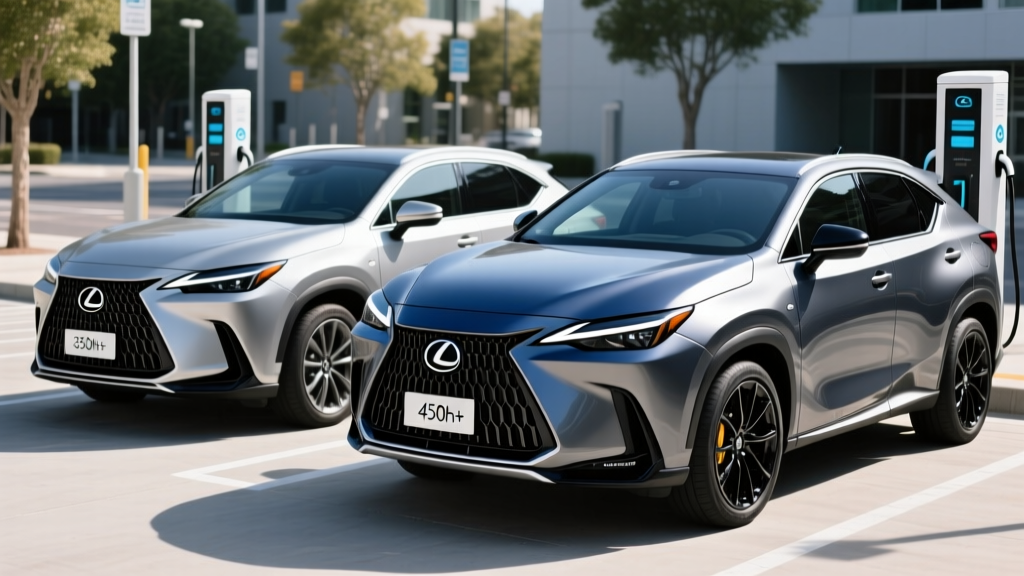
The Lexus NX has long been the entry point into luxury electrification for buyers who aren't ready to commit to a full battery-electric vehicle. For 2026, the NX lineup offers two distinct hybrid paths: the conventional Lexus NX 350h (a self-charging hybrid you never plug in) and the Lexus NX 450h+ (a plug-in hybrid with meaningful electric-only range). Understanding which one fits your driving pattern, charging access, and budget is the difference between a smart purchase and an expensive misstep.
This guide breaks down the real numbers — EPA MPG, electric range, battery specs, warranty coverage, and current tax-credit rules — so you can decide whether the NX hybrid, the NX PHEV, or a full EV is the right call.
HEV vs PHEV: What's the Difference in the NX Lineup?
Before comparing trims, it's essential to understand the fundamental difference between the two NX hybrid variants. A conventional hybrid (HEV) like the NX 350h uses a small battery recharged by regenerative braking and the gasoline engine — you never plug it in. A plug-in hybrid (PHEV) like the NX 450h+ carries a much larger battery that you charge from a wall outlet or public charger, enabling substantial electric-only driving before the gas engine ever starts.
| Feature | NX 350h (HEV) | NX 450h+ (PHEV) |
|---|---|---|
| Plug-in required? | No — self-charging | Yes — plug in to use EV range |
| Battery capacity | ~1.6 kWh (NiMH) | 18.1 kWh (lithium-ion) |
| Electric-only range | ~1 mile at low speed | EPA-est. 37 miles |
| Combined system HP | 244 hp | 304 hp |
| 0–60 mph | 7.2 sec | 6.0 sec |
| Drivetrain | AWD (e-AWD rear motor) | AWD (e-AWD rear motor) |
| DC fast charging | N/A | Not supported (Level 2 AC only) |
The practical takeaway: if you have reliable home or workplace charging and most of your daily driving falls under 37 miles, the 450h+ can operate as a pure EV on most days. If you lack charging access or take frequent long road trips where plugging in isn't convenient, the 350h delivers strong efficiency with zero behavior change.
Fuel Economy: Real MPG Numbers for Both NX Hybrids
Fuel economy is where the NX 350h makes its strongest case. According to EPA data on fueleconomy.gov, the 2026 NX 350h posts:
| Model | City MPG | Highway MPG | Combined MPG |
|---|---|---|---|
| NX 350h (HEV) | 41 | 37 | 39 |
| NX 450h+ (PHEV, gas only) | 38 | 33 | 36 |
| Nx 450h+ (PHEV, MPGe combined) | 84 MPGe (electric + gas) | ||
Real-world MPG note: Toyota/Lexus hybrids historically exceed their EPA city estimates in stop-and-go driving because regenerative braking works hardest at low speeds. In our experience and consistent owner reports, the NX 350h routinely delivers 42–44 MPG in urban commutes. Highway mileage tends to land slightly below the EPA sticker — expect 34–36 MPG at sustained 70–75 mph, especially with roof cargo or in cold weather when the engine runs more often for cabin heat.
The 450h+ returns lower MPG once its battery is depleted because it carries roughly 400 lbs of additional battery mass. That's the trade-off: you sacrifice some highway fuel economy after the electric range is spent, but you may never burn a drop of gas on typical weekday commutes if you charge nightly.
NX 450h+ Electric-Only Range and Charging Details
The NX 450h+'s 18.1 kWh lithium-ion battery pack delivers an EPA-estimated 37 miles of electric-only range. In real-world conditions, expect 30–35 miles in mixed driving, and as low as 25 miles in freezing temperatures when the battery's usable capacity shrinks and cabin heating draws extra power.
Charging is AC-only via a Level 2 (240V) connection. The onboard charger accepts up to 3.3 kW, which means:
- Level 1 (120V household outlet): ~12–14 hours for a full charge
- Level 2 (240V, 16A): ~5.5 hours for a full charge
- DC fast charging: Not available — the NX 450h+ does not support CCS or CHAdeMO DC charging
The lack of DC fast charging is a notable limitation. On road trips, you cannot top up the battery at highway fast-charging stations. However, for a PHEV whose primary use case is overnight home charging, this is less of a practical concern than it is for a full EV.
EPA vs. Real-World Electric Range: The 37-mile EPA figure assumes moderate temperatures and mixed driving. Plan for ~30 miles in summer highway use and ~25 miles in sub-30°F cold. Total combined range (electric + 14.5-gallon fuel tank) exceeds 500 miles.
Powertrain and Performance Specs
Both NX hybrids share a 2.5-liter four-cylinder Atkinson-cycle engine paired with electric motors front and rear. The difference is in output tuning and battery contribution.
| Spec | NX 350h | NX 450h+ |
|---|---|---|
| Engine | 2.5L I4 Atkinson | 2.5L I4 Atkinson |
| Combined system output | 244 hp | 304 hp |
| Front motor | 134 kW | 134 kW |
| Rear motor | 40 kW | 40 kW |
| 0–60 mph | 7.2 sec | 6.0 sec |
| Top speed | 124 mph | 124 mph |
| Towing capacity | 2,000 lbs | 2,000 lbs |
| Cargo volume (rear seats up) | 22.7 cu ft | 22.7 cu ft |
The 450h+'s extra 60 hp comes from the larger battery's ability to deliver sustained current to the motors. The result is genuinely brisk acceleration — 6.0 seconds to 60 mph is quick for a compact luxury crossover and noticeably faster than the 350h in highway merging and passing situations.
Pricing, Trims, and Tax Credit Eligibility
For the 2026 model year, Lexus prices the NX hybrid lineup as follows (MSRP before destination):
- NX 350h Premium: ~$43,500
- NX 350h Luxury: ~$49,000
- NX 450h+ Premium: ~$57,500
- NX 450h+ Luxury: ~$62,000
Tax credit situation: Under IRS §30D rules, the federal plug-in electric vehicle tax credit of up to $7,500 applies only to plug-in vehicles — meaning the NX 450h+ qualifies, while the NX 350h (conventional hybrid) does not. However, eligibility is not automatic. Per IRS guidelines, the buyer must meet income caps ($150,000 single / $300,000 joint), the vehicle MSRP must not exceed $80,000 (SUVs), and battery critical-mineral and component sourcing requirements must be satisfied. The credit amount may be $3,750 or $7,500 depending on whether the battery meets one or both sourcing thresholds. As of 2026, point-of-sale transfer is available, allowing dealers to apply the credit directly to your purchase price.
The NX 350h, while ineligible for the federal EV credit, has a significantly lower starting price — roughly $14,000 less than the 450h+. For buyers who don't qualify for the credit due to income limits, or who lack home charging, the 350h's lower upfront cost often results in a better total cost of ownership over five years.
Battery Warranty, Reliability, and Replacement Costs
Hybrid battery longevity is the most common concern among first-time hybrid buyers. Lexus addresses this with robust warranty coverage:
Lexus Hybrid Battery Warranty: 10 years / 150,000 miles (whichever comes first) for both the NX 350h and NX 450h+ hybrid battery packs. This covers capacity loss below a specified threshold and manufacturing defects. The standard vehicle warranty is 4 years / 50,000 miles, with powertrain coverage at 6 years / 70,000 miles.
Lexus (and parent company Toyota) has the deepest track record in hybrid reliability of any automaker. The Prius hybrid system, now in its fifth generation, has demonstrated battery packs lasting 200,000+ miles with minimal degradation. The NX 350h's nickel-metal hydride (NiMH) battery is a proven, conservative chemistry that degrades slowly and predictably. The 450h+'s lithium-ion pack is larger and more complex but benefits from sophisticated thermal management.
Replacement cost if out of warranty: Based on current dealer pricing and industry data, a hybrid battery replacement for the NX 350h runs approximately $3,000–$4,500 (parts and labor). The 450h+'s larger lithium-ion pack is more expensive: expect $6,000–$9,000. However, given the 10-year/150,000-mile warranty and Toyota/Lexus's reliability history, most owners will sell or trade the vehicle before facing this cost.
According to IIHS crash-test data, the NX continues to earn top safety ratings, and Lexus consistently ranks at or near the top of J.D. Power and Consumer Reports reliability surveys — a meaningful data point when evaluating long-term ownership risk.
Who Should Choose the NX Hybrid, PHEV, or a Full EV?
NX 350h (HEV) Pros & Cons
Pros:
- 41 MPG city — best-in-class for luxury compact crossovers
- No charging infrastructure needed
- ~$14,000 cheaper than 450h+
- Proven NiMH battery reliability
- Lower insurance premiums than PHEV
Cons:
- No federal tax credit
- No meaningful electric-only driving
- Slower acceleration (7.2 sec 0–60)
- Still burns gas on every trip
NX 450h+ (PHEV) Pros & Cons
Pros:
- 37-mile EV range covers most commutes gas-free
- 304 hp — genuinely quick
- Eligible for up to $7,500 federal tax credit
- 500+ mile total range eliminates range anxiety
- 84 MPGe combined when regularly charged
Cons:
- $14,000 price premium over 350h
- No DC fast charging
- Heavier — lower MPG once battery is depleted
- Requires home/work charging to realize EV benefits
- Tax credit eligibility depends on income and sourcing rules
Choose the NX 350h if: You don't have reliable access to a Level 2 charger at home or work, your daily driving exceeds 40 miles, you want the lowest purchase price, or you simply don't want to think about plugging in.
Choose the NX 450h+ if: You can install a Level 2 charger at home, your weekday round-trip commute is under 35 miles, you want to minimize gasoline consumption without committing to a full EV, and you meet the §30D income requirements to claim the federal tax credit.
Choose a full EV instead if: You want zero gasoline expenses, your daily driving is under 250 miles, you have home charging, and you're ready to access the full DC fast-charging network for road trips (e.g., Tesla Model Y, Hyundai Ioniq 5, or BMW iX).
Frequently Asked Questions
How many MPG does the Lexus NX hybrid get?
The NX 350h achieves an EPA-estimated 41 city / 37 highway / 39 combined MPG. In real-world city driving, owners frequently report 42–44 MPG thanks to aggressive regenerative braking. Highway mileage typically falls to 34–36 MPG at 70+ mph.
How far can the NX 450h+ drive on electric power alone?
The EPA rates the NX 450h+ at 37 miles of electric-only range. Real-world results vary: expect 30–35 miles in moderate temperatures and 25–28 miles in freezing cold. Once the battery is depleted, the vehicle seamlessly switches to hybrid mode with 36 combined MPG.
Does the Lexus NX hybrid qualify for a tax credit?
Only the NX 450h+ plug-in hybrid is eligible for the federal §30D tax credit (up to $7,500). The conventional NX 350h does not qualify. Eligibility depends on buyer income ($300,000 joint cap for SUVs), vehicle MSRP (under $80,000), and battery sourcing requirements. Consult a tax professional and check current IRS guidance before relying on the credit.
Is the Lexus NX hybrid reliable?
Lexus has one of the strongest reliability records in the industry, and its hybrid systems have been refined over 25+ years since the original Prius. The hybrid battery is covered by a 10-year/150,000-mile warranty. Out-of-warranty replacement costs run $3,000–$4,500 for the 350h and $6,000–$9,000 for the 450h+, but most owners will never face this expense.
Can I charge the NX 450h+ at a DC fast charger?
No. The NX 450h+ only supports AC charging (Level 1 at 120V or Level 2 at 240V) with a maximum charge rate of 3.3 kW. A full Level 2 charge takes approximately 5.5 hours. This is typical for PHEVs, which prioritize overnight home charging over public fast-charging infrastructure.
How does the NX hybrid compare to a full EV like the Tesla Model Y?
The Model Y offers 300+ miles of range, DC fast charging up to 250 kW, and lower per-mile fueling costs — but requires a higher upfront investment and reliable charging access. The NX hybrid provides flexibility (no charging needed for the 350h, gas backup for the 450h+) at a lower entry price, making it a better fit for buyers in apartments, rural areas, or regions with sparse charging infrastructure.