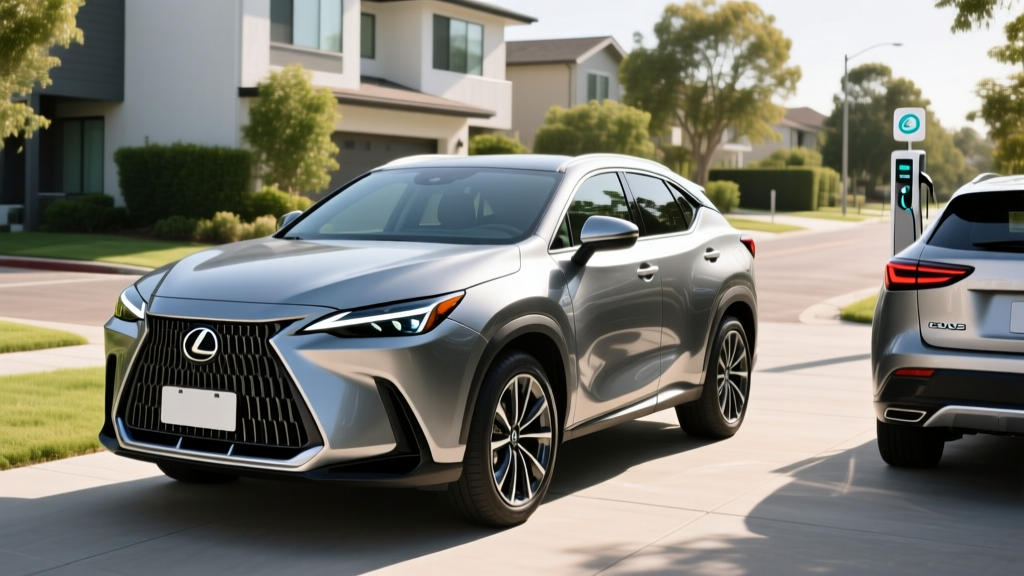
The compact luxury hybrid SUV segment has no shortage of contenders, but the Lexus NX 350h hybrid SUV occupies a distinct position: it prioritizes fuel-sipping efficiency and long-term reliability over raw performance or cutting-edge electrification. For the 2026 model year, Lexus continues to refine the NX 350h with its proven fourth-generation hybrid powertrain, all-wheel drive standard across every trim, and a cabin that punches above its price point in material quality.
If you're weighing this against a plug-in hybrid or a full battery-electric vehicle, this guide breaks down exactly what the NX 350h delivers — EPA numbers, real-world fuel economy observations, battery longevity data, and total ownership cost — so you can decide whether a conventional hybrid still makes sense in 2026.
What Is the Lexus NX 350h? HEV vs. PHEV Explained
Before diving into specs, it's critical to understand what you're buying. The Lexus NX lineup includes two electrified options:
NX 350h — Conventional Hybrid (HEV)
- No plug required. The battery recharges through regenerative braking and the gasoline engine.
- 244 combined horsepower from a 2.5L inline-4 engine paired with front and rear electric motors.
- EPA 39 MPG combined (41 city / 37 highway).
- 1.68 kWh nickel-metal hydride (NiMH) hybrid battery — too small for meaningful electric-only driving.
- Starts at approximately $43,515 MSRP (2026 base, including destination).
NX 450h+ — Plug-In Hybrid (PHEV)
- Plug-in capable. Features an 18.1 kWh lithium-ion battery for extended electric-only range.
- 304 combined horsepower with a more powerful electric motor setup.
- EPA 37 miles electric-only, then 36 MPG combined as a hybrid.
- Eligible for partial federal tax credit and some state incentives.
- Starts at approximately $60,965 MSRP (2026 base).
This article focuses on the NX 350h, the volume-selling conventional hybrid. If you need plug-in electric range and have home charging access, the 450h+ is covered in our separate PHEV guide.
Fuel Economy: EPA Ratings and Real-World MPG
The headline number for the NX 350h is its EPA-rated fuel economy. Here's the official breakdown from fueleconomy.gov:
| Driving Condition | EPA MPG | Real-World Expectation |
|---|---|---|
| City | 41 MPG | 42–45 MPG (hybrids excel in stop-and-go) |
| Highway | 37 MPG | 34–37 MPG (less regen benefit at steady speed) |
| Combined | 39 MPG | 38–42 MPG depending on driving mix |
Real-World Note: Conventional hybrids like the NX 350h typically exceed their EPA city rating in actual driving because regenerative braking recaptures energy during frequent stops. Highway driving is where hybrids lose their advantage — expect 34–37 MPG on sustained freeway runs at 70+ mph. In cold weather (below 30°F), plan for a 5–10% efficiency drop as the engine runs more frequently for cabin heat.
With a 14.5-gallon fuel tank, the NX 350h delivers roughly 540–580 miles of total range in mixed driving. That's a meaningful advantage over most EVs for road-trip flexibility — no charging stops required.
Powertrain and Performance Specs
The NX 350h uses Lexus's well-proven hybrid synergy drive system. Here's the full specification breakdown:
| Specification | 2026 Lexus NX 350h |
|---|---|
| Engine | 2.5L inline-4 Atkinson cycle |
| Engine Output | 184 hp / 168 lb-ft torque |
| Front Electric Motor | 134 hp |
| Rear Electric Motor (AWD) | 54 hp |
| Combined System Output | 244 hp |
| Transmission | eCVT (electronically controlled) |
| Drivetrain | Electronic AWD (standard all trims) |
| 0–60 mph | 7.2 seconds |
| Hybrid Battery | 1.68 kWh NiMH |
| Towing Capacity | 2,000 lbs |
| Fuel Tank | 14.5 gallons (87 octane recommended) |
The 7.2-second 0–60 time is adequate for merging and passing, but the NX 350h is tuned for smoothness and efficiency, not sportiness. The eCVT eliminates shift shock, and the transition between electric-only and engine-assisted driving is nearly imperceptible in normal conditions. If acceleration matters to you, the turbocharged NX 350 (non-hybrid) or the PHEV NX 450h+ (6.0 seconds to 60) are noticeably quicker.
Pricing, Trims, and Tax Credit Eligibility
The 2026 Lexus NX 350h is offered in four trims. Pricing below includes destination charges:
| Trim | MSRP | Key Additions |
|---|---|---|
| Base | $43,515 | 18" wheels, 9.8" touchscreen, Lexus Safety System+ 3.0 |
| Premium | $46,815 | Power moonroof, heated/ventilated front seats, power liftgate |
| Premium Plus | $50,465 | 14" touchscreen, panoramic roof, head-up display |
| F SPORT Handling | $52,215 | Adaptive suspension, F SPORT seats, 20" wheels |
Does the NX 350h Qualify for Federal Tax Credits?
No. Under current IRS §30D rules, the federal Clean Vehicle Credit applies only to plug-in electric vehicles (BEVs and PHEVs) with a minimum battery capacity of 7 kWh. The NX 350h's 1.68 kWh NiMH battery does not qualify. The plug-in NX 450h+ may qualify for up to $3,750 depending on battery-sourcing and critical-mineral requirements, subject to income caps ($150K single / $300K joint) and the $80,000 SUV MSRP cap.
Some states offer their own hybrid incentives — check your state's energy office or department of environmental quality for current programs. These change frequently and vary widely by jurisdiction.
Battery Warranty, Reliability, and Replacement Cost
Hybrid battery longevity is consistently the top concern among first-time hybrid buyers. Here's what Lexus provides:
Lexus Hybrid Battery Warranty
- Duration: 10 years / 150,000 miles (whichever comes first)
- Coverage: Defects and capacity loss below a defined threshold
- Transferable: Yes, to subsequent owners
- Hybrid System Components: Also covered under the 10-year/150,000-mile hybrid system warranty (inverter, electric motors, control module)
Lexus (and parent company Toyota) has the deepest track record in hybrid technology of any automaker, with over 25 years of production hybrid experience since the 1997 Prius. Real-world data from millions of Toyota/Lexus hybrids on the road shows that NiMH hybrid batteries frequently last 150,000–200,000+ miles before significant degradation. Unlike full EV batteries, the NX 350h's small 1.68 kWh pack operates in a narrow state-of-charge window (roughly 40–80%), which dramatically reduces stress and extends cycle life.
What Does Hybrid Battery Replacement Cost?
If the battery does fail outside of warranty, a replacement NiMH hybrid battery for the NX 350h typically runs $3,000–$5,000 including labor at a Lexus dealer. Independent hybrid specialists often offer refurbished or reconditioned packs for $2,000–$3,500. For context, this is a fraction of a full EV battery replacement ($8,000–$20,000+) and comparable to a major transmission repair on a conventional vehicle.
Lexus consistently earns top reliability marks from both IIHS and J.D. Power, and the NX has been an IIHS Top Safety Pick in recent model years.
NX 350h vs. PHEV vs. Full EV: Which Powertrain Fits You?
Choosing between a conventional hybrid, a plug-in hybrid, and a battery-electric vehicle depends on your driving patterns, charging access, and budget. Here's a practical decision framework:
Choose the NX 350h (HEV) If:
- You cannot charge at home (apartment, street parking, no garage outlet).
- You want maximum fuel efficiency with zero behavior change — just fill up with gas as usual.
- You regularly take long road trips and don't want to plan around charging infrastructure.
- Your budget is under $50,000 and you want luxury features with low running costs.
- You plan to keep the vehicle 8–10+ years and value proven reliability.
Choose the NX 450h+ (PHEV) If:
- You can charge at home (Level 2 or even a standard 120V outlet works for overnight).
- Your daily commute is under 35 miles round-trip — you could drive mostly on electricity.
- You want EV-like daily driving with gas-engine backup for longer trips.
- You want to capture a partial federal tax credit.
Choose a Full EV (e.g., Tesla Model Y, Genesis GV70 EV) If:
- You have reliable home Level 2 charging and your daily driving is under 250 miles.
- You want the lowest per-mile energy cost (electricity is typically 40–60% cheaper per mile than gasoline).
- You want to eliminate oil changes, spark plugs, and transmission maintenance entirely.
- You qualify for the full $7,500 federal EV credit and want maximum incentives.
Ownership Costs: 5-Year Projection
The NX 350h's value proposition becomes clearest when you look at total cost of ownership. Here's a 5-year / 75,000-mile estimate assuming $3.50/gallon regular unleaded and 15,000 miles/year:
| Cost Category | NX 350h (HEV) | Gas-Only Compact Luxury SUV (Avg) |
|---|---|---|
| Purchase Price (avg trim) | $47,000 | $48,000 |
| Fuel (75,000 mi) | $6,730 (39 MPG) | $10,500 (25 MPG) |
| Maintenance (5 yr) | $2,800 | $3,500 |
| Insurance (5 yr est.) | $9,500 | $9,000 |
| Depreciation (5 yr est.) | $22,000 | $24,000 |
| Estimated 5-Yr Total | $88,030 | $95,000 |
The NX 350h saves roughly $3,700–$7,000 over five years compared to a gas-only competitor, primarily through fuel savings and strong Lexus resale value. Insurance can run slightly higher than gas-only equivalents due to hybrid system repair costs, but the gap has narrowed significantly.
Pros
- 39 MPG combined — real-world city driving often exceeds 41 MPG
- Standard AWD on every trim with no fuel-economy penalty
- 10-year/150,000-mile hybrid battery warranty
- Proven Toyota/Lexus hybrid reliability with 25+ years of data
- 540+ mile total range — no charging stops needed
- Strong resale value; Lexus tops luxury-brand depreciation rankings
- Lexus Safety System+ 3.0 standard (adaptive cruise, lane centering, pre-collision)
Cons
- No federal tax credit eligibility
- 7.2-second 0–60 is adequate, not quick — competitors like the BMW X3 xDrive30i are faster
- eCVT drone under hard acceleration (common to Toyota hybrids)
- Base 9.8" touchscreen feels small for 2026; 14" screen requires Premium Plus trim
- 2,000-lb tow rating is low for the class
- Requires premium fuel (87 octane recommended, but 91 for best performance)
Frequently Asked Questions
How many MPG does the Lexus NX 350h hybrid SUV get?
The EPA rates the 2026 NX 350h at 41 MPG city, 37 MPG highway, and 39 MPG combined. In real-world city driving with frequent stops, owners commonly report 42–45 MPG thanks to regenerative braking. Highway-only driving at 70+ mph typically yields 34–37 MPG.
Does the Lexus NX 350h need to be plugged in?
No. The NX 350h is a conventional hybrid (HEV). Its small 1.68 kWh battery charges entirely through regenerative braking and the gasoline engine. You never plug it in — just fill up at any gas station. If you want plug-in capability, the NX 450h+ is the PHEV variant with 37 miles of electric-only range.
How far can the NX 450h+ go on electric only?
The plug-in NX 450h+ achieves an EPA-rated 37 miles on electric power alone before the gasoline engine engages. After that, it operates as a conventional hybrid at 36 MPG combined. Total range exceeds 550 miles when combining electric and gasoline operation.
Is the Lexus NX 350h hybrid reliable? What about battery replacement cost?
Lexus hybrids are among the most reliable vehicles on the road, backed by 25+ years of Toyota hybrid engineering. The hybrid battery carries a 10-year/150,000-mile warranty. Out-of-pocket replacement costs $3,000–$5,000 at a dealer, though independent shops offer refurbished options for $2,000–$3,500. Most hybrid batteries last well beyond 150,000 miles.
Does the NX 350h qualify for any federal tax credit?
No. Under IRS §30D rules, the federal Clean Vehicle Credit requires a minimum 7 kWh battery and plug-in capability. The NX 350h's 1.68 kWh NiMH battery does not qualify. The plug-in NX 450h+ may be eligible for up to $3,750 depending on sourcing requirements and your income level. Always consult a tax professional and verify current rules at irs.gov.
How does the NX 350h compare to a full EV like the Tesla Model Y?
The Model Y offers lower per-mile energy costs (~$0.04/mi on electricity vs. ~$0.09/mi on gas for the NX 350h), faster acceleration, and access to the Supercharger network. However, the NX 350h requires zero charging infrastructure, has no range anxiety on road trips, costs $10,000–$15,000 less upfront (before incentives), and offers proven long-term reliability. If you can charge at home and drive under 250 miles daily, the EV saves more. If you lack charging access or road-trip frequently, the hybrid is the pragmatic choice.
What maintenance does the NX 350h hybrid require?
Standard maintenance: oil changes every 10,000 miles, brake fluid, cabin air filter, and tire rotations. Hybrid-specific components (battery, inverter, electric motors) require no scheduled maintenance. Regenerative braking extends brake pad life significantly — many hybrid owners report 80,000+ miles on original brake pads.