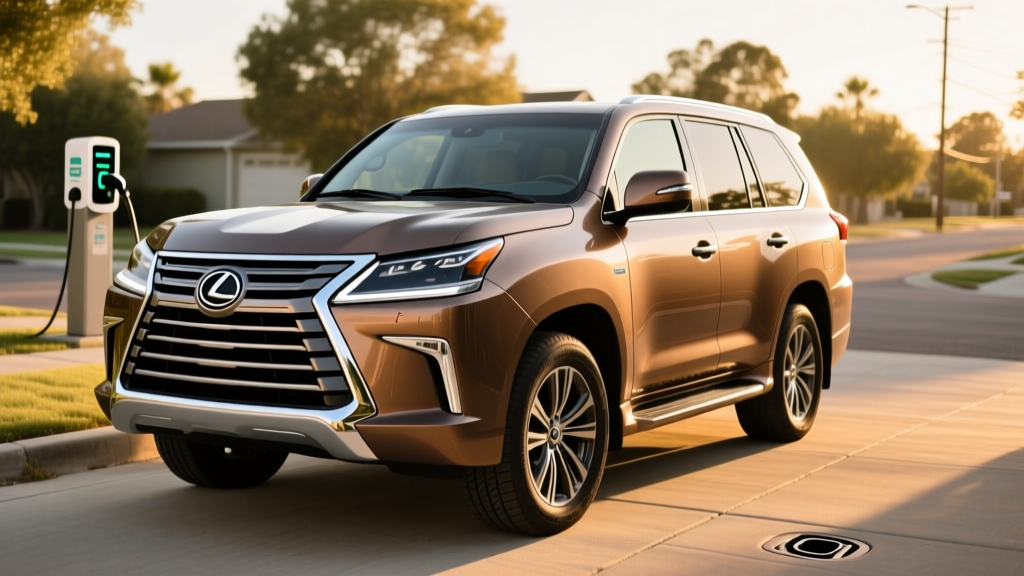
The full-size luxury SUV segment rarely prioritizes efficiency, but the Lexus LX 700h hybrid SUV attempts something unusual: pairing a twin-turbocharged V6 with a hybrid powertrain in a body-on-frame vehicle that still weighs over 6,000 pounds. For buyers who need three-row capability, genuine off-road hardware, and a tow rating above 8,000 pounds — but want to reduce fuel costs versus a pure gas alternative — the LX 700h occupies a narrow but compelling niche.
This guide breaks down the 2025/2026 Lexus LX 700h's hybrid system, real-world fuel economy expectations, battery longevity, warranty coverage, tax-credit eligibility, and whether this HEV makes more sense than a plug-in hybrid or full battery-electric alternative for your driving patterns.
What the LX 700h Hybrid System Actually Is (HEV, Not PHEV)
Before evaluating fuel economy or ownership costs, it's critical to understand what the LX 700h is not: it is not a plug-in hybrid. The LX 700h uses a conventional hybrid electric vehicle (HEV) architecture. There is no charging port, no electric-only driving range to speak of beyond very low-speed maneuvering, and no battery large enough to meaningfully drive on electricity alone.
HEV vs. PHEV: Where the LX 700h Fits
| Feature | Lexus LX 700h (HEV) | Typical PHEV SUV |
|---|---|---|
| Plug-in charging | No — self-charging via regen & engine | Yes — Level 1/Level 2 |
| Electric-only range | ~1 mile at very low speed | 20–45 miles typical |
| Battery size | ~1.5 kWh (small NiMH/Li-ion pack) | 13–25 kWh (lithium-ion) |
| DC fast charging | Not applicable | Rare; most PHEVs are AC-only |
| Gas required to drive | Yes — always | No (until battery depleted) |
| Federal tax credit (§30D) | Not eligible | Up to $7,500 if qualified |
The LX 700h's hybrid system captures energy during braking and deceleration, stores it in a small battery pack, and deploys that energy to assist the gasoline engine during acceleration, reduce engine load at steady speeds, and enable engine-off coasting in certain conditions. You never plug it in. You simply refuel with gasoline, and the system manages the rest.
EPA Fuel Economy and Real-World MPG Expectations
For a vehicle of this size and mass, the LX 700h's fuel economy represents a measurable improvement over its non-hybrid sibling, the LX 600. Here are the official EPA estimates from fueleconomy.gov:
| Driving Cycle | Lexus LX 700h (HEV) | Lexus LX 600 (Gas) |
|---|---|---|
| City | 19 MPG | 17 MPG |
| Highway | 22 MPG | 22 MPG |
| Combined | 20 MPG | 19 MPG |
The hybrid advantage shows most clearly in city driving, where regenerative braking and electric motor assist do the most work. The 2 MPG combined improvement translates to roughly 30–40 fewer gallons per year for a driver covering 15,000 miles annually — approximately $100–$140 in annual fuel savings at $3.50/gallon.
Real-World MPG: What to Actually Expect
Hybrid SUVs of this type often match or slightly exceed EPA city estimates in stop-and-go traffic because regenerative braking recovers energy that a gas-only vehicle wastes as heat. However, highway fuel economy tends to fall below the EPA sticker at sustained 75–80 mph speeds, especially with roof racks, cargo, or towing.
Expect the following in real-world use:
- City/suburban mixed driving: 18–21 MPG (close to or slightly above EPA)
- Highway cruising (70 mph, flat terrain): 19–21 MPG
- Highway cruising (80 mph, loaded or hilly): 16–18 MPG
- Towing (5,000+ lb trailer): 10–13 MPG
- Cold weather (below 30°F, short trips): 15–17 MPG (engine runs more for cabin heat)
The hybrid system's benefit diminishes significantly during sustained high-speed driving and towing, where the gasoline engine does nearly all the work. If your driving is predominantly highway miles, the LX 700h's fuel-economy advantage over the LX 600 narrows considerably.
Powertrain Specs: Twin-Turbo V6 Meets Hybrid Assist
| Specification | Lexus LX 700h |
|---|---|
| Engine | 3.4L twin-turbo V6 + electric motor |
| Combined horsepower | 457 hp |
| Combined torque | 583 lb-ft |
| Transmission | 10-speed automatic |
| Drivetrain | Full-time 4WD with Torsen® center differential |
| 0–60 mph | ~6.2 seconds (manufacturer est.) |
| Towing capacity | 8,000 lbs (properly equipped) |
| Curb weight | ~6,100 lbs |
| Fuel tank | 21.7 gallons |
| Total driving range | ~430 miles (combined) |
| Fuel requirement | Premium unleaded (91 octane recommended) |
The LX 700h's hybrid system adds an electric motor between the engine and transmission, providing torque fill at low RPM before the twin turbos spool up. This eliminates the traditional turbo lag associated with large-displacement turbocharged engines and delivers linear, immediate acceleration from a stop. The result is a full-size luxury SUV that pulls away from stoplights with authority and merges onto highways without strain.
The 10-speed automatic transmission is specifically calibrated for hybrid operation, with the electric motor enabling smoother shifts and engine-off coasting in certain deceleration scenarios. Unlike some hybrid systems that use a continuously variable transmission (CVT), the LX 700h retains a conventional geared automatic — a deliberate choice by Lexus to preserve the driving feel expected in a flagship luxury SUV.
Battery Warranty, Lifespan, and Replacement Cost
Hybrid battery longevity is consistently the top concern among first-time hybrid buyers. The LX 700h uses a relatively small hybrid battery pack — roughly 1.5 kWh of capacity — that operates within a narrow state-of-charge window (typically 40–80% SoC) managed by the vehicle's battery management system. This shallow cycling is the primary reason modern hybrid batteries last well beyond their warranty periods.
Lexus Hybrid Battery Warranty Coverage
- Hybrid battery: 10 years / 150,000 miles (whichever comes first)
- Hybrid system components (inverter, motor, ECU): 8 years / 100,000 miles
- Basic vehicle warranty: 4 years / 50,000 miles
- Powertrain warranty: 6 years / 70,000 miles
Source: Lexus official specifications
Lexus (and parent company Toyota) has the longest track record in hybrid battery durability of any automaker, with millions of hybrid vehicles on the road. Real-world data from Toyota/Lexus hybrid platforms shows that the vast majority of hybrid battery packs last 150,000–200,000+ miles before requiring service, and many exceed the vehicle's useful life entirely.
Hybrid Battery Replacement Cost
If a hybrid battery does require replacement outside of warranty, expect the following:
- New OEM battery pack: $3,000–$5,000 (parts and labor)
- Refurbished/remanufactured pack: $1,500–$3,000
- Individual cell/module replacement: $500–$1,500 (if only a subset of cells degrade)
Because the LX 700h's hybrid battery is small relative to a full EV battery (which can cost $10,000–$20,000+ to replace), the financial risk of out-of-warranty battery failure is modest. The 10-year/150,000-mile warranty also covers the majority of ownership for first and second owners.
Pricing, Trims, and Tax-Credit Eligibility
The 2025/2026 Lexus LX 700h starts at approximately $114,000 MSRP for the base Premium trim and climbs to approximately $130,000+ for the Ultra Luxury trim. Pricing positions it against the Range Rover, Mercedes-Benz GLS, and BMW X7 — though none of those competitors offer a hybrid variant at this price point.
Federal Tax Credit Status
The Lexus LX 700h does not qualify for the federal §30D clean vehicle tax credit. Under current IRS rules, only battery-electric vehicles (BEVs) and plug-in hybrid electric vehicles (PHEVs) with sufficient battery capacity and qualifying battery/component sourcing are eligible. Conventional hybrids (HEVs) like the LX 700h are excluded from the §30D credit regardless of price or efficiency.
There is also no federal tax credit for conventional hybrid vehicles. Some states may offer minor incentives or HOV-lane access for hybrid vehicles, but these vary widely by jurisdiction. Check your state's DMV and energy office for current programs.
Total Fuel Cost vs. Gas-Only LX 600
At 15,000 miles/year and $3.50/gallon premium fuel:
- LX 700h (20 MPG combined): 750 gallons/year = ~$2,625/year
- LX 600 (19 MPG combined): 789 gallons/year = ~$2,762/year
- Annual fuel savings (LX 700h): ~$137/year
- 5-year fuel savings: ~$685
The hybrid premium over the gas-only LX 600 is typically $3,000–$5,000 depending on trim. At current fuel prices, the fuel savings alone will not recoup the hybrid premium within a typical ownership period. The LX 700h's value proposition rests more on its smoother powertrain feel, reduced turbo lag, and marginally lower emissions than on pure fuel-cost payback.
Who Should Choose the LX 700h Over an EV or Gas SUV?
The LX 700h serves a specific buyer profile. It is not the most efficient choice available, nor is it the most powerful in its class. Its value lies in combining genuine body-on-frame capability with modest hybrid efficiency gains in a luxury package.
Choose the LX 700h Hybrid If:
- You need a 3-row SUV with 8,000-lb towing and serious off-road capability
- You want hybrid smoothness and torque fill without ever plugging in
- You drive predominantly city/suburban miles where hybrid benefits are maximized
- You value Lexus/Toyota hybrid reliability and long-term battery durability
- You live in an area with limited charging infrastructure and cannot rely on a PHEV or BEV
- You plan to own the vehicle 8–12 years and want the security of a 10-year hybrid battery warranty
Look at a BEV or PHEV Instead If:
- Your daily commute is under 40 miles and you have home charging (a PHEV would eliminate most gas use)
- You want the lowest possible fuel cost per mile (a BEV like the Rivian R1S or Tesla Model X costs ~$0.04–$0.08/mile vs. ~$0.18/mile for the LX 700h)
- You qualify for the $7,500 federal EV tax credit and want to offset a higher purchase price
- You drive mostly highway miles where the hybrid advantage is minimal
- You prioritize maximum acceleration and instant torque (BEVs deliver faster 0–60 in this class)
Competitive Alternatives to Consider
Within the full-size luxury SUV segment, the LX 700h has limited direct hybrid competition:
- BMW X7 xDrive40i (mild hybrid): 22 MPG combined, ~$82,000 — less off-road capability, no 3rd-row hybrid option
- Mercedes-Benz GLS 450 (mild hybrid): 21 MPG combined, ~$88,000 — similar luxury, less rugged
- Rivian R1S (BEV): 316–410 mile range, ~$80,000–$100,000 — fully electric, eligible for tax credit, but no body-on-frame and different off-road character
- Toyota Land Cruiser (HEV): The LX 700h's platform sibling with similar hybrid powertrain, lower luxury, lower price (~$58,000)
Real-World Ownership: What Daily Life Looks Like
Owning the LX 700h is functionally identical to owning a gas vehicle — you refuel at gas stations and never think about charging. The hybrid system operates transparently: the instrument cluster shows when the electric motor is assisting, when regenerative braking is active, and when the engine shuts off at stops, but the driver never needs to intervene or make decisions about energy management.
Maintenance is straightforward. The hybrid system adds no routine service items — there are no spark plugs to change more frequently, no additional fluid changes, and regenerative braking actually extends brake pad life (owners commonly report 80,000–100,000+ miles on original brake pads). Lexus recommends standard oil changes at 10,000-mile intervals and the same service schedule as the gas-only LX 600.
Insurance costs for the LX 700h are in line with other full-size luxury SUVs in the $110,000+ range. Expect annual premiums of $2,500–$4,000 depending on your location, driving record, and coverage level. Hybrid components do not typically increase insurance costs.
Frequently Asked Questions
How many MPG does the Lexus LX 700h get in real-world driving?
The EPA rates the LX 700h at 19 city / 22 highway / 20 combined MPG. In real-world mixed driving, expect 18–21 MPG. Highway-only driving at 80 mph drops to 16–18 MPG, while city-heavy commuting with frequent stops can match or slightly exceed the 19 MPG city estimate thanks to regenerative braking.
Does the Lexus LX 700h need to be plugged in to charge?
No. The LX 700h is a conventional hybrid (HEV), not a plug-in hybrid. It charges its small battery pack through regenerative braking and the gasoline engine. There is no charging port and no electric-only driving range beyond momentary low-speed assist.
Is the Lexus LX 700h hybrid system reliable?
Lexus and Toyota have produced over 20 million hybrid vehicles globally since 1997, and their hybrid systems are among the most reliable powertrains in the industry. The LX 700h's hybrid battery is covered by a 10-year/150,000-mile warranty. Real-world data shows most Toyota/Lexus hybrid batteries last 150,000–200,000+ miles.
What does it cost to replace the LX 700h hybrid battery?
Out-of-warranty replacement costs approximately $3,000–$5,000 for a new OEM pack, or $1,500–$3,000 for a refurbished unit. Individual cell replacement can cost $500–$1,500. Given the 10-year warranty and Toyota/Lexus track record, most owners will never face this expense.
Does the Lexus LX 700h qualify for any federal tax credit?
No. Under current IRS §30D rules, only battery-electric vehicles (BEVs) and plug-in hybrids (PHEVs) qualify for the federal clean vehicle tax credit. Conventional hybrids like the LX 700h are not eligible. Some states may offer minor incentives — check your state energy office.
Should I buy the LX 700h hybrid or the gas-only LX 600?
If your driving is predominantly city and suburban, the LX 700h's hybrid system provides smoother acceleration, reduced turbo lag, and a modest fuel economy benefit (1 MPG combined). If you drive mostly highway miles or tow frequently, the advantage shrinks. The hybrid premium of $3,000–$5,000 is unlikely to pay back in fuel savings alone — choose the 700h for drivetrain refinement rather than economics.
How does the LX 700h compare to a fully electric SUV like the Rivian R1S?
The Rivian R1S offers 316–410 miles of electric range, significantly lower per-mile fuel costs (~$0.05–$0.08/mile vs. ~$0.18/mile), faster acceleration, and eligibility for the $7,500 federal tax credit. However, the R1S has a unibody platform, different off-road character, and requires access to charging infrastructure. The LX 700h is the better choice if you need body-on-frame durability, maximum towing capacity, and zero dependence on charging stations.