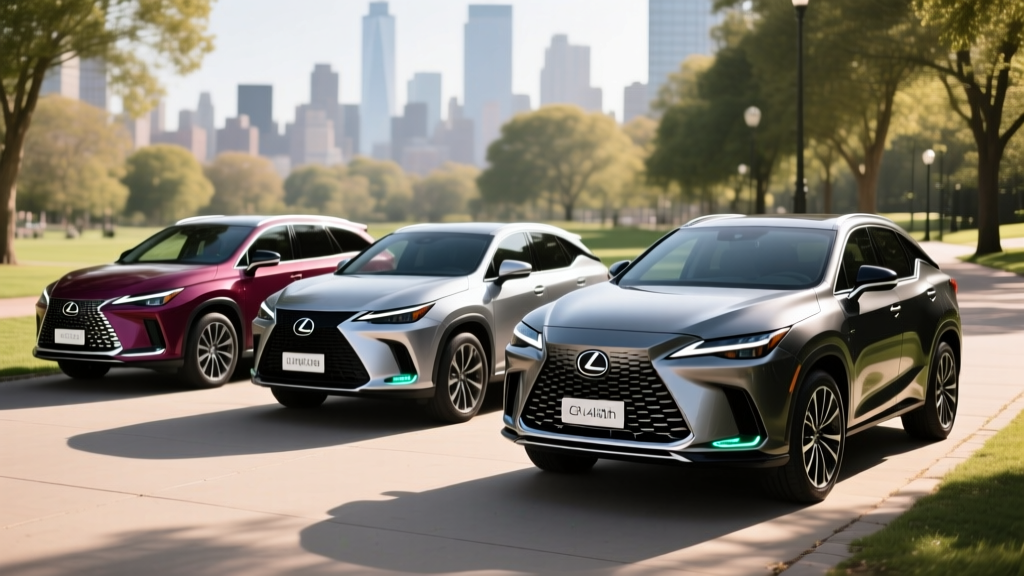
The 2026 Lexus Hybrid SUV Lineup at a Glance
Lexus offers more hybrid SUVs than any other luxury brand, spanning five nameplates from the subcompact UX to the three-row LX. For 2026, every hybrid in the lineup uses Toyota's proven Hybrid Synergy Drive architecture, pairing a gasoline engine with one or more electric motors and a small nickel-metal hydride (NiMH) or lithium-ion battery. Two models — the NX 450h+ and RX 500h — also offer plug-in hybrid (PHEV) variants with meaningful electric-only range. Below is the full breakdown by model, powertrain, EPA fuel economy, and starting price.
| Model | Type | Powertrain | HP | EPA Combined MPG | PHEV EV Range | Starting MSRP |
|---|---|---|---|---|---|---|
| UX 300h | HEV | 2.0L I4 + 2 motors | 196 | 43 | — | $39,690 |
| NX 350h | HEV | 2.5L I4 + 3 motors | 240 | 39 | — | $46,065 |
| NX 450h+ | PHEV | 2.5L I4 + 3 motors | 304 | 36 (hybrid) / 84 MPGe | 37 mi | $52,565 |
| RX 350h | HEV | 2.5L I4 + 3 motors | 246 | 36 | — | $54,950 |
| RX 450h+ | PHEV | 2.5L I4 + 3 motors | 304 | 35 (hybrid) / 64 MPGe | 37 mi | $65,470 |
| TX 500h | HEV | 2.4L turbo I4 + 2 motors | 366 | 29 | — | $68,510 |
| LX 700h | HEV | 3.5L twin-turbo V6 + 1 motor | 457 | 21 | — | $112,350 |
Source: EPA fueleconomy.gov and Lexus USA 2026 model-year specifications. MPGe figures reflect combined city/highway driving on electricity; once the battery depletes, the vehicle operates as a conventional hybrid at the MPG listed.
HEV vs PHEV: Which Lexus Hybrid Architecture Fits You?
Understanding the difference between a conventional hybrid (HEV) and a plug-in hybrid (PHEV) is the single most important decision in this buying process. Here is how they differ in practice:
| Attribute | HEV (e.g., NX 350h, RX 350h) | PHEV (e.g., NX 450h+, RX 450h+) |
|---|---|---|
| Plug-in charging required? | No — regenerative braking and engine charge the battery | Yes, for full EV range (Level 1/2) |
| Electric-only driving | Under 1 mile at low speeds | 37 miles (EPA) at highway speeds |
| Battery size | ~1.6 kWh (NiMH or Li-ion) | 18.1 kWh usable (Li-ion) |
| DC fast charging | No | No — AC Level 2 only (6.6 kW onboard charger) |
| Federal tax credit (§30D) | Not eligible | Up to $3,750 (see eligibility below) |
| Premium over gas model | ~$1,500–$2,000 | ~$6,000–$8,000 |
| Best for | No home charging; want simplicity | Home charging + short commutes |
If you cannot install a Level 2 home charger or lack reliable workplace charging, the HEV models (UX, NX 350h, RX 350h, TX 500h, LX 700h) deliver outstanding efficiency with zero behavior change. If you have a garage and a daily commute under 35 miles, the PHEV models (NX 450h+, RX 450h+) let you drive most weekdays on electricity alone, with the gas engine available for road trips — no range anxiety.
Fuel Economy Deep Dive: EPA Ratings vs Real-World MPG
| Model | City MPG | Highway MPG | Combined MPG | Real-World Expectation |
|---|---|---|---|---|
| UX 300h | 43 | 43 | 43 | 41–46 (city-favored) |
| NX 350h | 41 | 37 | 39 | 37–43 (city-favored) |
| NX 450h+ (hybrid mode) | 38 | 33 | 36 | 33–37 |
| RX 350h | 37 | 34 | 36 | 34–39 (city-favored) |
| RX 450h+ (hybrid mode) | 36 | 33 | 35 | 32–36 |
| TX 500h | 27 | 28 | 29 | 26–30 |
| LX 700h | 19 | 22 | 21 | 18–22 |
Source: fueleconomy.gov. Real-world ranges reflect aggregated owner reports and independent testing. City-favored hybrids often exceed EPA city estimates because regenerative braking recovers energy in stop-and-go traffic.
Lexus hybrids consistently deliver real-world MPG close to — or above — their EPA estimates in city driving. The planetary gearset in the Hybrid Synergy Drive allows the engine to shut off frequently at low speeds, while regenerative braking recharges the battery. Highway driving is where hybrids lose their advantage: aerodynamic drag dominates, the engine runs continuously, and the heavier hybrid system adds weight. Expect highway MPG to run 2–4 MPG below the EPA highway number at sustained 75+ mph speeds.
For the PHEV models, the 37-mile EPA electric range assumes moderate temperatures and mixed driving. In winter conditions below 30°F, expect that range to drop to approximately 28–32 miles due to cabin heating demand and reduced battery efficiency. The gasoline engine will engage for heat unless you precondition the cabin while plugged in.
PHEV Charging: What NX 450h+ and RX 450h+ Owners Need to Know
Both Lexus PHEVs share an 18.1 kWh lithium-ion battery pack and a 6.6 kW onboard AC charger. Neither model supports DC fast charging — a notable omission that means public fast-charger networks (Electrify America, EVgo) are not usable. Here is what charging looks like in practice:
| Charging Level | Power | 0–100% Time | Where |
|---|---|---|---|
| Level 1 (120V household) | ~1.4 kW | ~13 hours | Standard outlet |
| Level 2 (240V, 32A) | 6.6 kW (onboard max) | ~3 hours | Home wallbox / public L2 |
| DC Fast Charge | Not supported | — | — |
A Level 2 home charger (240V, 32-amp circuit minimum) is strongly recommended for PHEV ownership. Installation typically runs $800–$2,000 depending on panel proximity and local permitting. With a Level 2 setup, a full overnight charge takes roughly 3 hours — easily achievable during off-peak electricity hours. On Level 1 alone, the 13-hour charge time means you may not reach a full battery between evening arrival and morning departure unless you plug in immediately upon returning home.
The 6.6 kW onboard charger is the bottleneck: even if a public Level 2 station delivers 19.2 kW, the Lexus PHEVs will only accept 6.6 kW. This is standard for most PHEVs (the Toyota RAV4 Prime shares this limitation) but worth noting if you plan to charge at workplace stations during short breaks.
Powertrain Specifications and Performance
Lexus hybrid powertrains fall into three families for 2026:
- 2.5L naturally aspirated I4 hybrid (NX 350h, RX 350h, NX 450h+, RX 450h+): The volume leader. Uses an Atkinson-cycle engine for thermal efficiency, paired with front and rear electric motors for electronic all-wheel drive (e-AWD on most trims). The PHEV variants add a larger battery and more powerful rear motor, boosting combined output to 304 HP and dropping 0–60 mph to 6.0 seconds (NX 450h+).
- 2.4L turbo I4 hybrid (TX 500h): Lexus's "Hybrid Max" performance system pairs a turbocharged engine with a direct-drive 6-speed automatic (no CVT) and two electric motors. Result: 366 HP, 406 lb-ft of torque, and a 5.9-second 0–60. Fuel economy trades off for the power — 29 MPG combined is respectable for a 5,000-lb three-row SUV but not class-leading.
- 3.5L twin-turbo V6 hybrid (LX 700h): The flagship pairs the V6 with a single electric motor integrated into the bell housing, producing 457 HP and 583 lb-ft. A conventional 10-speed automatic replaces the CVT. At 21 MPG combined, the LX 700h prioritizes towing (8,000 lbs) and off-road capability over efficiency, but still beats the non-hybrid V8 predecessors by 4–5 MPG.
Pricing, Trims, and Federal Tax Credit Eligibility
Lexus hybrid SUV pricing spans from the accessible UX 300h to the six-figure LX 700h. Here is the current MSRP landscape for 2026, along with tax credit context:
| Model | Base MSRP | §30D Federal Tax Credit | Effective Price After Credit |
|---|---|---|---|
| UX 300h | $39,690 | Not eligible (HEV) | $39,690 |
| NX 350h | $46,065 | Not eligible (HEV) | $46,065 |
| NX 450h+ Premium | $52,565 | Up to $3,750* | ~$48,815 |
| RX 350h | $54,950 | Not eligible (HEV) | $54,950 |
| RX 450h+ Luxury | $65,470 | Up to $3,750* | ~$61,720 |
| TX 500h F Sport | $68,510 | Not eligible (HEV) | $68,510 |
| LX 700h | $112,350 | Not eligible (HEV) | $112,350 |
*§30D credit eligibility for the NX 450h+ and RX 450h+ is subject to IRS critical mineral and battery component sourcing requirements, buyer income caps ($150K single / $300K joint MAGI), and MSRP caps ($80,000 for SUVs). The credit amount may be $3,750 or $7,500 depending on whether the vehicle meets both critical-mineral and battery-component thresholds in the year of purchase. Consult IRS §30D guidance and a tax professional before relying on a specific credit amount. Point-of-sale transfer is available at participating dealers.
Conventional hybrids (HEVs) do not qualify for the §30D federal clean vehicle credit. Some states offer rebates for PHEVs — California's CVRP, for example, may offer up to $1,000 for qualifying PHEVs depending on income, though funding varies. Check your state energy office for current programs.
Battery Longevity, Warranty, and Replacement Costs
Lexus Hybrid Battery Warranty (2026): All Lexus hybrid and PHEV models carry a hybrid battery warranty of 10 years or 150,000 miles (whichever comes first), transferable to subsequent owners. This covers defects and capacity loss below a manufacturer-specified threshold. The broader hybrid system (inverter, electric motors, control modules) is also warranted for 8 years/100,000 miles.
Lexus hybrid battery reliability is among the best in the industry. The NiMH and Li-ion packs used in Lexus HEVs are intentionally undersized and conservatively managed — the battery never fully charges or fully discharges, which dramatically extends cycle life. Taxi fleets running Toyota/Lexus hybrid powertrains routinely exceed 300,000 miles on the original battery.
When replacement is eventually needed out of warranty:
- HEV battery replacement (UX, NX 350h, RX 350h, TX, LX): $2,500–$4,500 for the battery module, plus $500–$1,000 labor. Refurbished units are available for $1,500–$2,500.
- PHEV battery replacement (NX 450h+, RX 450h+): $6,000–$9,000 for the larger 18.1 kWh pack. This is the cost premium of PHEV ownership long-term — a factor to weigh if you plan to keep the vehicle past the 10-year warranty window.
The PHEV battery is more expensive to replace because it contains significantly more cells and requires a higher-capacity thermal management system. However, PHEV batteries also benefit from more active thermal management (liquid cooling) compared to the air-cooled NiMH packs in older HEVs, which should improve longevity.
Hybrid vs PHEV vs Full EV: Which Lexus Is Right for You?
Choose a Lexus HEV (NX 350h, RX 350h, TX 500h) if:
- You lack access to home or workplace charging
- You want maximum simplicity — no plugs, no apps, no charging planning
- You take frequent road trips exceeding 300 miles
- You live in an apartment or condo where installing a charger is impractical
- You want the lowest upfront cost premium over a gas vehicle
Choose a Lexus PHEV (NX 450h+, RX 450h+) if:
- You have a garage or dedicated parking spot with 240V access
- Your daily round-trip commute is under 35 miles
- You want EV-like daily driving with gas-engine flexibility for road trips
- You want to reduce (but not eliminate) gasoline consumption
- You may qualify for the §30D federal tax credit
Consider a full EV (e.g., Lexus RZ 450e) instead if:
- You have reliable Level 2 home charging
- Your daily driving is under 200 miles and you rarely tow
- You want zero tailpipe emissions and minimal maintenance (no oil changes, no spark plugs)
- You qualify for the full $7,500 §30D credit on a qualifying BEV
The honest reality: for most American drivers without home charging, a Lexus HEV is the most practical electrified choice. The fuel savings are immediate (39 MPG combined in an NX 350h vs 25 MPG in a comparable gas SUV saves roughly $800–$1,200 annually at 15,000 miles/year), and there is no infrastructure dependency. The PHEV models reward homeowners with short commutes but penalize those who cannot charge regularly — a PHEV driven without plugging in is simply a heavier, more expensive HEV.
Pros and Cons Across the Lexus Hybrid SUV Range
Pros
- Industry-leading reliability and 10-year/150,000-mile hybrid battery warranty
- HEV models require zero charging infrastructure or behavior change
- Real-world city MPG often exceeds EPA estimates
- Lexus resale value consistently tops luxury competitors
- PHEV models offer 37 miles of electric range — enough for most commutes
- Standard Lexus Safety System+ 3.0 (adaptive cruise, lane tracing, pre-collision) on all trims
- Quiet, refined cabin with strong build quality across the lineup
Cons
- PHEV models lack DC fast charging — Level 2 only at 6.6 kW
- HEV models are not eligible for the §30D federal tax credit
- PHEV battery replacement cost ($6,000–$9,000) is significant post-warranty
- TX 500h and LX 700h fuel economy is modest (29 and 21 MPG combined)
- CVT-driven models (NX, RX, UX) lack the engagement of geared transmissions
- PHEV premium of $6,000–$8,000 over equivalent HEV takes years to recoup in fuel savings
- No three-row PHEV option — TX is HEV-only
Frequently Asked Questions
How many MPG does the most efficient Lexus hybrid SUV get?
The 2026 Lexus UX 300h leads the lineup at 43 MPG combined (43 city / 43 highway). The compact NX 350h follows at 39 MPG combined (41 city / 37 highway). In real-world city driving with frequent stops, both models often exceed their EPA estimates thanks to aggressive regenerative braking. Highway-heavy drivers should expect 2–4 MPG below the EPA highway number at sustained 75+ mph.
How far can the Lexus PHEV SUVs go on electric-only power?
Both the NX 450h+ and RX 450h+ deliver an EPA-rated 37 miles of electric-only range. This is sufficient for most daily commutes under 35 miles round-trip. In cold weather (below 30°F), expect 28–32 miles of real-world electric range due to cabin heating demand and reduced lithium-ion efficiency. Preconditioning the cabin while plugged in can recover 3–5 miles of range in winter.
Is the Lexus hybrid system reliable, and what does battery replacement cost?
Lexus hybrid systems are among the most proven in the automotive industry, with the Hybrid Synergy Drive architecture refined over 25+ years since the original Prius. The hybrid battery is warranted for 10 years/150,000 miles. Out-of-warranty replacement costs $2,500–$4,500 for HEV models and $6,000–$9,000 for PHEV models. Real-world data from fleet operators and high-mileage owners shows these batteries routinely lasting 200,000+ miles before significant degradation.
Do any Lexus hybrid SUVs qualify for the federal tax credit?
Only the PHEV models — the NX 450h+ and RX 450h+ — are potentially eligible for the §30D federal clean vehicle credit. The credit amount (up to $3,750 or $7,500) depends on IRS battery-sourcing and critical-mineral requirements that change periodically. Buyer income must not exceed $150,000 (single) or $300,000 (joint) MAGI, and the vehicle MSRP must be under $80,000 for SUVs. Conventional HEV models (NX 350h, RX 350h, TX 500h, LX 700h, UX 300h) do not qualify for §30D. Always verify current eligibility at fueleconomy.gov before purchasing.
Can I charge a Lexus hybrid at home?
Conventional Lexus HEVs (UX 300h, NX 350h, RX 350h, TX 500h, LX 700h) cannot be plugged in — they charge their small batteries exclusively through regenerative braking and the gasoline engine. The PHEV models (NX 450h+, RX 450h+) can and should be charged at home using a 240V Level 2 charger for a full charge in approximately 3 hours. A standard 120V outlet also works but requires about 13 hours for a full charge.
Which Lexus hybrid SUV is best for a family with three rows?
The 2026 Lexus TX 500h is the only three-row hybrid SUV in the lineup, seating up to seven with 29 MPG combined. It uses the 366-HP Hybrid Max turbo powertrain and starts at $68,510. There is no PHEV or three-row EV option from Lexus as of 2026 — if you need three rows plus plug-in capability, you would need to look at competitors like the Mazda CX-90 PHEV or the Volvo XC90 Recharge.