Lexus Plug-In Hybrids in 2026: Two Models, One Strategy
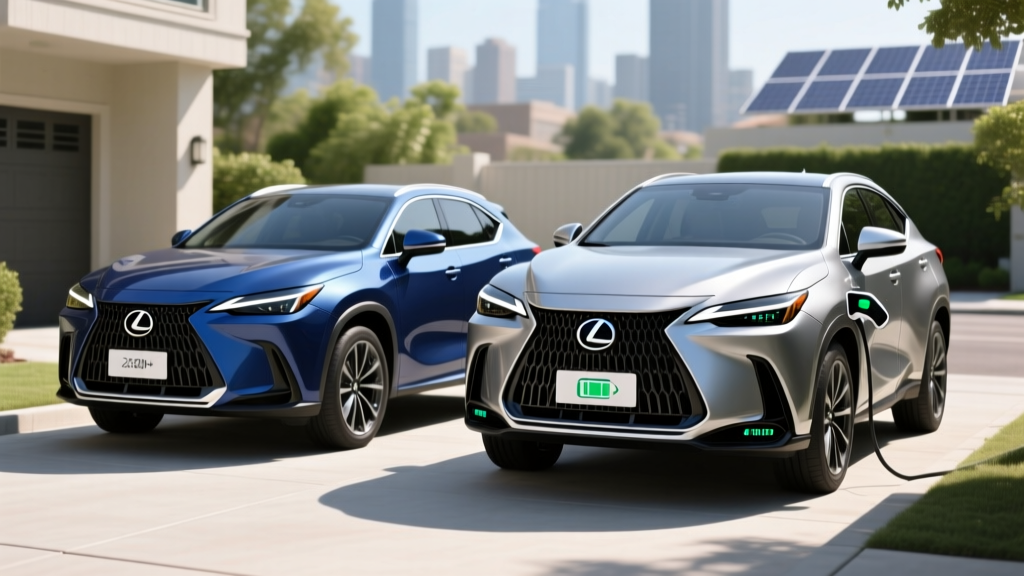
If you're researching a Lexus hybrid plug-in, the 2026 lineup narrows your decision to two vehicles: the compact NX 450h+ SUV and the three-row TX 550h+. Both pair a gasoline engine with a larger battery and electric motors you can recharge from a wall outlet, delivering 30+ miles of electric-only driving before the hybrid system takes over. Neither requires you to commit to full EV ownership, yet both cut fuel consumption dramatically compared to a gas-only equivalent.
This guide breaks down exact EPA figures, real-world expectations, battery specs, pricing, and federal tax credit eligibility so you can decide whether a Lexus PHEV fits your commute — or whether a conventional Lexus HEV or a battery-electric vehicle (BEV) makes more sense.
HEV vs PHEV: What Lexus Actually Sells
Conventional Hybrid (HEV) — Models like the NX 350h or RX 350h use a small battery (1–2 kWh) recharged entirely by regenerative braking and the gas engine. You never plug them in. They deliver strong city MPG but zero electric-only range.
Plug-In Hybrid (PHEV) — The NX 450h+ and TX 550h+ carry a much larger battery (18–20 kWh usable) that you charge via a plug. This unlocks 33–37 miles of pure electric driving, after which the car operates as a standard hybrid.
The "+" badge on a Lexus denotes the plug-in variant. If you see "450h" without the plus, it's a conventional hybrid — no plug, no electric-only mode.
Spec Showdown: NX 450h+ vs TX 550h+
| Spec | 2026 NX 450h+ | 2026 TX 550h+ |
|---|---|---|
| Body Style | Compact 2-row SUV | Midsize 3-row SUV |
| Powertrain | 2.5L I4 + 2 electric motors (AWD) | 3.5L V6 + 2 electric motors (AWD) |
| Combined Horsepower | 304 hp | 406 hp |
| Battery (usable) | ~18.1 kWh, lithium-ion | ~20.5 kWh, lithium-ion |
| EPA Electric-Only Range | 37 miles | 33 miles |
| EPA MPGe (electric + gas) | 84 MPGe | 76 MPGe |
| EPA MPG (hybrid mode, combined) | 36 MPG | 29 MPG |
| Total Combined Range | ~550 miles | ~440 miles |
| DC Fast Charging | No (Level 2 only) | No (Level 2 only) |
| Level 2 Charge Time (0–100%) | ~3 hours (240V, 32A) | ~3.5 hours (240V, 32A) |
| 0–60 mph | 6.0 sec | 5.6 sec |
| Base MSRP | $54,990 | $72,990 |
| Federal §30D Tax Credit | Up to $7,500 (eligibility varies) | Up to $7,500 (eligibility varies) |
| Hybrid Battery Warranty | 10 yr / 150,000 mi | 10 yr / 150,000 mi |
Sources: fueleconomy.gov, Lexus NX 450h+ official specs, Lexus TX 550h+ official specs.
Fuel Economy: EPA Numbers vs Real-World MPG
| Metric | NX 450h+ | TX 550h+ |
|---|---|---|
| EPA City (hybrid mode) | 38 MPG | 30 MPG |
| EPA Highway (hybrid mode) | 33 MPG | 28 MPG |
| EPA Combined (hybrid mode) | 36 MPG | 29 MPG |
| EPA Combined (charge-sustaining + electric) | 84 MPGe | 76 MPGe |
Real-world expectations: Lexus hybrids tend to match or slightly exceed EPA city estimates in stop-and-go traffic because regenerative braking recovers energy that gas cars waste as heat. On the highway at 75+ mph, expect a 2–4 MPG drop from the sticker for both models. The NX 450h+ in hybrid mode typically delivers 34–37 MPG in mixed driving; the TX 550h+, given its 5,000+ lb curb weight, lands around 27–30 MPG.
MPGe figures only apply when you start with a full battery charge and drive within the electric-only window. If you never plug in, your MPGe is irrelevant — you'll simply get the hybrid-mode MPG above, which still beats most gas-only competitors in the segment.
Electric-Only Range and Charging
The NX 450h+ delivers 37 miles of EPA-rated electric-only range; the TX 550h+ manages 33 miles. In real-world conditions — moderate temperatures, suburban speeds under 45 mph — both models can stretch 2–5 miles beyond their EPA rating thanks to aggressive regen. In cold weather (below 30°F), expect a 20–30% reduction, dropping the NX to roughly 26–30 electric miles and the TX to 23–26 miles.
Charging reality: Neither Lexus PHEV supports DC fast charging. This is deliberate — PHEV batteries are small enough that a Level 2 home charger (240V, 32 amps / 7.7 kW) replenishes the NX in about 3 hours and the TX in about 3.5 hours. A standard 120V household outlet (Level 1) takes roughly 10–12 hours, which still works for overnight top-ups if you drive less than 30 miles daily.
For context, you'll spend roughly $1.50–$2.50 per full home charge depending on your local electricity rate (assuming $0.12–$0.18/kWh), making the electric portion of your commute cost the equivalent of 80–120 MPG gasoline.
Battery Warranty, Reliability, and Replacement Cost
Lexus Hybrid Battery Warranty: 10 years or 150,000 miles (whichever comes first), covering defects and capacity loss below a defined threshold. This applies to both the NX 450h+ and TX 550h+ traction batteries.
Toyota/Lexus hybrid systems have among the strongest long-term reliability records in the industry. The brand's hybrid synergy drive architecture has been in production since the late 1990s, and real-world data shows hybrid batteries routinely lasting 150,000–200,000+ miles before significant degradation. The PHEV batteries are larger but use similar lithium-ion chemistry and thermal management.
Out-of-warranty replacement cost: If the traction battery fails after the warranty period, expect $6,000–$9,000 for the NX 450h+ pack and $8,000–$12,000 for the TX 550h+, including parts and labor. These figures are estimates based on current Lexus hybrid battery pricing; PHEV packs command a premium over conventional HEV packs due to higher capacity. Third-party refurbished options may reduce cost by 30–40%.
Pricing and Federal Tax Credit Eligibility
The 2026 NX 450h+ starts at $54,990 (Premium trim); the TX 550h+ starts at $72,990. Both carry premium pricing over their conventional hybrid siblings — the NX 350h starts around $46,000, the TX 350h around $58,000 — but the PHEV versions include more standard equipment and the larger battery system.
Federal §30D tax credit: Both models may qualify for up to $7,500 under the federal Clean Vehicle Credit, but eligibility is not automatic. Current IRS rules require:
- MSRP cap: SUVs must be priced at or below $80,000 (both models qualify at base; loaded trims may exceed the cap).
- Buyer income cap: Modified AGI ≤ $150,000 (single) / $300,000 (joint).
- Battery sourcing: Critical minerals and battery components must meet phased-in domestic/free-trade-partner thresholds that tighten annually through 2030.
- Point-of-sale transfer: You can apply the credit as a down-payment reduction at the dealer instead of waiting for tax filing.
Verify current eligibility on IRS.gov before purchasing — battery sourcing requirements shift, and a model that qualifies in January may not in June. Consult a tax professional for your specific situation.
Who Should Choose a Lexus PHEV vs a Full EV or Gas Car?
Choose the Lexus NX 450h+ or TX 550h+ PHEV if:
- Your daily commute is under 35 miles and you can charge at home overnight.
- You take regular road trips (200+ miles) and don't want to plan around DC fast chargers.
- You want electric-mode silence and torque for city driving but need gas-engine range flexibility.
- You value Lexus reliability ratings and dealer service infrastructure.
Choose a full BEV (e.g., Tesla Model Y, Hyundai Ioniq 5) if:
- You have reliable home or workplace Level 2 charging.
- Your typical daily driving is under 250 miles and you rarely exceed 300 miles in a single day.
- You want to eliminate gasoline purchases and oil changes entirely.
- You want DC fast charging (150–250 kW) for long road trips.
Choose a conventional Lexus HEV (NX 350h, RX 350h) if:
- You cannot charge at home or work (apartment, street parking).
- You want lower upfront cost ($5,000–$10,000 less than the PHEV).
- You don't want to manage plug-in routines and just want excellent MPG passively.
Pros
- 33–37 miles electric covers most daily commutes gas-free
- 36 MPG (NX) / 29 MPG (TX) hybrid mode still beats gas rivals
- 10-year / 150,000-mile battery warranty
- No range anxiety — total range exceeds 440 miles
- Strong Lexus resale value and reliability track record
- Up to $7,500 federal credit (eligibility-dependent)
Cons
- No DC fast charging — road-trip electric miles are limited
- $55K–$73K base pricing is steep for the segment
- Level 2 charge takes 3–3.5 hours (not quick-top-up friendly)
- Heavy curb weight reduces highway MPG vs lighter competitors
- Tax credit eligibility depends on sourcing rules that change yearly
Frequently Asked Questions
How many MPG does a Lexus plug-in hybrid get?
The NX 450h+ achieves 38 city / 33 highway / 36 combined MPG in hybrid mode (after the battery is depleted). The TX 550h+ gets 30 city / 28 highway / 29 combined. When factoring in electric-only driving from a full charge, the NX hits 84 MPGe and the TX 76 MPGe.
How far can a Lexus PHEV drive on electric only?
The NX 450h+ delivers 37 EPA-rated electric miles; the TX 550h+ delivers 33. Real-world range can stretch to 40+ miles in warm city driving or drop to 25–28 miles in sub-freezing highway conditions.
Does the Lexus plug-in hybrid qualify for a tax credit?
Both models may qualify for up to $7,500 under the federal §30D Clean Vehicle Credit, subject to buyer income limits, MSRP caps ($80,000 for SUVs), and battery component/critical mineral sourcing requirements. Confirm current eligibility at IRS.gov before purchase.
Is the Lexus hybrid battery reliable and what does replacement cost?
Lexus covers the hybrid battery for 10 years / 150,000 miles. Toyota/Lexus hybrid systems have demonstrated 150,000–200,000+ mile lifespans in long-term data. Out-of-warranty replacement runs $6,000–$12,000 depending on model, though refurbished packs can reduce this by roughly a third.
Do I need to plug in a Lexus plug-in hybrid?
You don't have to — if you never plug in, the NX 450h+ and TX 550h+ operate as conventional hybrids using gas and regenerative braking. However, you'll miss the electric-only range and the cost savings that make the PHEV premium worthwhile. Plugging in is where the value is.
Hybrid vs PHEV vs EV — which Lexus is right for me?
Choose a conventional HEV if you can't plug in. Choose a PHEV if you can charge at home and want electric commutes plus gas-engine road-trip freedom. Choose a full EV if you want zero gas, lower running costs, and have reliable charging access for daily use and road trips.