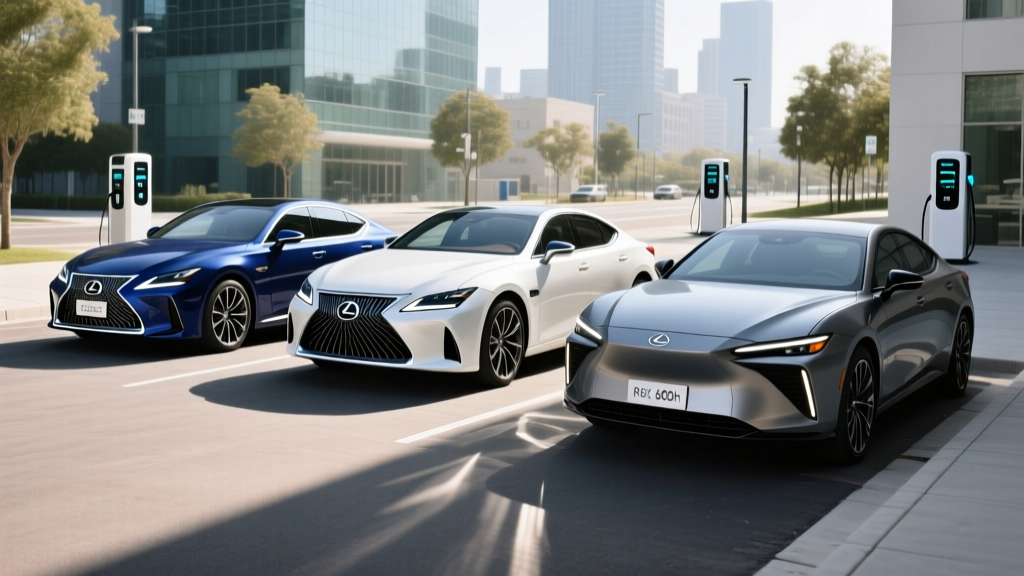
If you've searched for Lexus hybrid miles per gallon figures, you've likely noticed the lineup has grown complex. For the 2026 model year, Lexus offers hybrid powertrains across nearly every vehicle it sells — from the compact UX 300h crossover to the three-row TX 500h SUV and the luxury ES 300h sedan. Some are conventional hybrids (HEVs) that never need plugging in; one — the NX 450h+ — is a plug-in hybrid (PHEV) with meaningful electric-only range.
This guide cuts through the marketing to give you exact EPA fuel economy numbers, real-world expectations, and the data you need to pick the right Lexus hybrid for your driving pattern. All figures reflect 2026 model-year EPA estimates via fueleconomy.gov and Lexus specification sheets.
HEV vs PHEV: What Lexus Actually Offers in 2026
Before diving into MPG numbers, the distinction matters because it changes how you use the car every day.
Conventional Hybrid (HEV)
Lexus calls these models with an "h" suffix (e.g., RX 350h, ES 300h). They use a small battery (typically 1.0–1.8 kWh) that recharges through regenerative braking and the gasoline engine. You never plug them in. They deliver improved MPG over gas-only equivalents, especially in city driving, with no change in refueling habits.
Plug-In Hybrid (PHEV)
The 2026 NX 450h+ is Lexus's sole PHEV. It carries a larger 18.1 kWh battery and can drive approximately 37 miles on electricity alone before the gas engine engages. You can plug it in to recharge (Level 1 or Level 2), and doing so maximizes savings. If you never plug it in, it operates as a conventional hybrid — just with extra weight.
2026 Lexus Hybrid MPG: The Complete Lineup Table
| Model | Type | Combined HP | City MPG | Highway MPG | Combined MPG | Base MSRP |
|---|---|---|---|---|---|---|
| UX 300h | HEV | 198 hp | 43 | 41 | 42 | $38,450 |
| NX 350h | HEV | 244 hp | 41 | 37 | 39 | $43,965 |
| NX 450h+ | PHEV | 304 hp | 38 (hybrid mode) | 37 (hybrid mode) | 38 (hybrid) / 84 MPGe | $52,410 |
| RX 350h | HEV | 250 hp | 37 | 34 | 36 | $52,750 |
| RX 500h | HEV (Performance) | 371 hp | 28 | 27 | 27 | $63,350 |
| TX 500h | HEV (3-Row) | 371 hp | 27 | 28 | 27 | $63,700 |
| ES 300h | HEV | 215 hp | 43 | 44 | 44 | $46,150 |
| LC 500h | HEV (Coupe) | 354 hp | 26 | 33 | 29 | $103,000 |
Source: EPA estimates via fueleconomy.gov and Lexus USA. MPGe figures for the NX 450h+ apply when operating on combined battery + gasoline energy. All MSRP figures exclude destination charges.
Real-World MPG vs. EPA Stickers: What Owners Actually See
EPA numbers are a useful baseline, but Lexus hybrids — like most Toyota/Lexus hybrid systems — tend to outperform their EPA estimates in city driving while sometimes falling slightly short on sustained highway runs. Here's what to expect:
Real-World MPG Expectations
- City driving: Most Lexus HEVs (UX 300h, ES 300h, NX 350h) achieve or exceed EPA city estimates because regenerative braking recovers energy at every stop. Owners commonly report 2–4 MPG above the sticker in stop-and-go traffic.
- Highway driving (70–80 mph): Expect 2–5 MPG below the EPA highway figure. Aerodynamic drag and sustained high speeds reduce the hybrid system's advantage. The RX 350h, for example, may return 30–32 MPG on a flat interstate at 75 mph rather than its 34 EPA highway estimate.
- Cold weather (below 30°F): Hybrid fuel economy drops 10–15% in winter because the engine runs more frequently to provide cabin heat and because the battery operates less efficiently at low temperatures.
- Combined mixed driving: Most owners land within ±2 MPG of the EPA combined figure under normal conditions.
The ES 300h sedan is a standout: its 44 MPG combined EPA rating translates to real-world ownership where 42–46 MPG is routine on mixed commutes. The UX 300h, with its smaller footprint, delivers similar real-world results despite being a crossover.
NX 450h+ Plug-In Hybrid: Electric Range and Charging Details
For buyers considering the plug-in option, the numbers that matter go beyond MPG.
| Specification | 2026 NX 450h+ |
|---|---|
| Battery Capacity | 18.1 kWh (lithium-ion) |
| EPA Electric-Only Range | 37 miles |
| Total Combined Range (EV + Gas) | ~545 miles |
| Level 1 Charging (120V) | ~12 hours (0–100%) |
| Level 2 Charging (240V, 3.3 kW) | ~4.5 hours (0–100%) |
| DC Fast Charging | Not available |
| Combined Horsepower | 304 hp |
| 0–60 mph | 6.0 seconds |
The NX 450h+ does not support DC fast charging — a limitation worth knowing if you expected quick top-ups on road trips. Its 3.3 kW onboard charger means Level 2 charging is the practical maximum, easily handled by a standard home 240V outlet or a Level 2 wallbox. For commuters with a sub-37-mile one-way trip who can charge overnight, the NX 450h+ effectively operates as an EV on weekdays and a hybrid on weekends.
When the battery depletes, the vehicle transitions seamlessly to hybrid mode, delivering its 38 MPG combined rating. This dual personality is the PHEV's strongest selling point: no range anxiety, no dependency on public charging infrastructure.
Hybrid Battery Warranty and Long-Term Reliability
Lexus Hybrid Battery Warranty
Every 2026 Lexus hybrid and plug-in hybrid comes with a hybrid battery warranty of 10 years or 150,000 miles (whichever comes first), transferable to subsequent owners. The broader hybrid system — including the inverter, electric motors, and control modules — carries the same 10-year/150,000-mile coverage.
Lexus's hybrid powertrains, derived from Toyota's decades of hybrid engineering, are among the most proven in the industry. Nickel-metal hydride (NiMH) batteries are used in most HEVs, while the NX 450h+ PHEV uses a lithium-ion pack. Both chemistries have demonstrated strong longevity, with many Toyota/Lexus hybrids surpassing 200,000 miles on original batteries.
Hybrid Battery Replacement Cost
Should replacement be needed outside warranty coverage, costs vary by model:
- HEV models (UX, NX, RX, ES, TX, LC): $2,000–$4,500 for the hybrid battery pack, depending on model. Third-party refurbishment options exist for $1,500–$2,500.
- NX 450h+ PHEV: $6,000–$9,000 estimated for the larger 18.1 kWh lithium-ion pack. PHEV batteries carry higher replacement costs due to capacity and complexity.
For context, NHTSA and long-term ownership data suggest that hybrid battery failure before 150,000 miles is uncommon in Lexus vehicles. The 10-year warranty provides substantial protection, and the track record of the underlying Toyota Hybrid System (THS) architecture supports confidence in longevity.
Tax Credits: What Lexus Hybrids Qualify For
This is where buyers often encounter confusion. Under current 2026 IRS §30D rules (irs.gov):
- Conventional Lexus hybrids (HEVs) — UX 300h, NX 350h, RX 350h, RX 500h, TX 500h, ES 300h, LC 500h — do NOT qualify for the federal §30D clean vehicle tax credit. The credit requires a minimum battery capacity and plug-in capability, which standard hybrids lack.
- The NX 450h+ (PHEV) may qualify for up to $3,750 of the federal credit, depending on battery component and critical mineral sourcing compliance. The full $7,500 credit is unlikely due to current sourcing requirements that many PHEVs do not fully satisfy.
- Buyer income caps apply: Modified adjusted gross income (MAGI) must not exceed $150,000 (single), $225,000 (head of household), or $300,000 (married filing jointly).
- MSRP cap: The NX 450h+ starts at $52,410, which falls under the $80,000 SUV MSRP cap for §30D eligibility.
- Point-of-sale transfer: Eligible buyers can transfer the credit to the dealer at purchase, reducing the purchase price directly rather than waiting for a tax refund.
Some states offer additional hybrid or PHEV incentives. Check your state's energy or DMV website for local programs, as these vary widely and change frequently.
Which Lexus Hybrid Fits Your Situation?
Best for Maximum MPG on a Budget
UX 300h or ES 300h — Both deliver 42–44 MPG combined with starting prices under $47,000. The ES 300h offers more interior space and refinement; the UX 300h provides crossover practicality in a compact footprint.
Best for Families Needing Space + Efficiency
RX 350h — At 36 MPG combined with seating for five and 32.1 cu ft of cargo space, it balances utility and fuel savings. The three-row TX 500h sacrifices MPG (27 combined) for seven-passenger capacity.
HEV, PHEV, or Full EV — Which Is Right for You?
- Choose a Lexus HEV if: You want better fuel economy with zero changes to your routine. No charging, no plugs, no range planning. You drive a mix of city and highway and want proven reliability with strong resale value.
- Choose the NX 450h+ PHEV if: Your daily commute is under 37 miles round-trip, you have access to home or workplace Level 2 charging, and you want EV-like daily driving without giving up gasoline flexibility for road trips.
- Choose a full EV instead if: You have reliable home charging, your daily driving is under 250 miles, you want to eliminate gasoline costs entirely, and you're comfortable planning around DC fast charging on road trips. Consider the Lexus RZ 450e or a competitor like the Tesla Model Y or Hyundai Ioniq 5.
Ownership Costs: 5-Year Fuel Savings vs. Gasoline Equivalents
| Model | 5-Year Fuel Cost (est.) | Comparable Gas Model | Gas 5-Year Fuel Cost | Estimated Savings |
|---|---|---|---|---|
| UX 300h (42 MPG) | $5,950 | UX 250 (28 MPG)* | $8,925 | ~$2,975 |
| NX 350h (39 MPG) | $6,410 | NX 350 (25 MPG) | $10,000 | ~$3,590 |
| RX 350h (36 MPG) | $6,945 | RX 350 (25 MPG) | $10,000 | ~$3,055 |
| ES 300h (44 MPG) | $5,680 | ES 250 (28 MPG)* | $8,925 | ~$3,245 |
| NX 450h+ (PHEV)** | $3,200–$5,500 | NX 350 (25 MPG) | $10,000 | ~$4,500–$6,800 |
Based on 15,000 miles/year, $3.50/gallon average, 55% city / 45% highway split. *UX 250 and ES 250 are comparable non-hybrid baselines. **PHEV savings assume regular home charging covering most daily miles on electricity at $0.14/kWh national average.
Frequently Asked Questions
How many MPG does the most efficient Lexus hybrid get?
The 2026 ES 300h sedan leads the lineup at 44 MPG combined (43 city / 44 highway). The UX 300h crossover follows at 42 MPG combined. Both are conventional hybrids requiring no plug-in charging.
How far can the Lexus NX 450h+ go on electric only?
The EPA rates the NX 450h+ at 37 miles of electric-only range. In real-world conditions with moderate temperatures and speeds under 50 mph, some owners report 35–40 miles. Aggressive acceleration, cold weather, and highway speeds reduce this to approximately 28–32 miles.
Do Lexus hybrids need to be plugged in?
No — all Lexus HEVs (UX 300h, NX 350h, RX 350h, RX 500h, TX 500h, ES 300h, LC 500h) charge their batteries through regenerative braking and the gasoline engine. They never require external charging. Only the NX 450h+ PHEV benefits from plugging in, though it still operates as a hybrid if you don't.
Are Lexus hybrid batteries reliable, and what does replacement cost?
Lexus hybrid batteries are among the most reliable in the industry, backed by a 10-year/150,000-mile warranty. Many last well beyond 200,000 miles. If replacement is needed out of warranty, HEV battery packs cost $2,000–$4,500; the NX 450h+ PHEV pack is estimated at $6,000–$9,000.
Does any Lexus hybrid qualify for the federal tax credit?
Only the NX 450h+ plug-in hybrid may qualify — potentially up to $3,750 under current IRS §30D rules, subject to battery sourcing compliance, buyer income limits, and MSRP caps. Conventional Lexus hybrids do not qualify for the federal credit. Check irs.gov for the latest eligibility details.
Which Lexus hybrid is best for highway-heavy commuting?
The ES 300h sedan, with 44 MPG highway and a comfortable ride, is the strongest choice. Its highway figure actually exceeds its city rating — unusual for hybrids — thanks to efficient aerodynamics and a tuned hybrid system. Expect 40–43 MPG in real-world highway driving at 70–75 mph.
Should I buy a Lexus hybrid or a full EV?
If you lack reliable home charging, frequently drive over 300 miles between stops, or live in an area with sparse DC fast-charging infrastructure, a Lexus hybrid is the pragmatic choice. If you have home charging, a predictable commute, and want the lowest operating cost, a full EV will save more over time — though with a higher purchase price and different planning requirements.