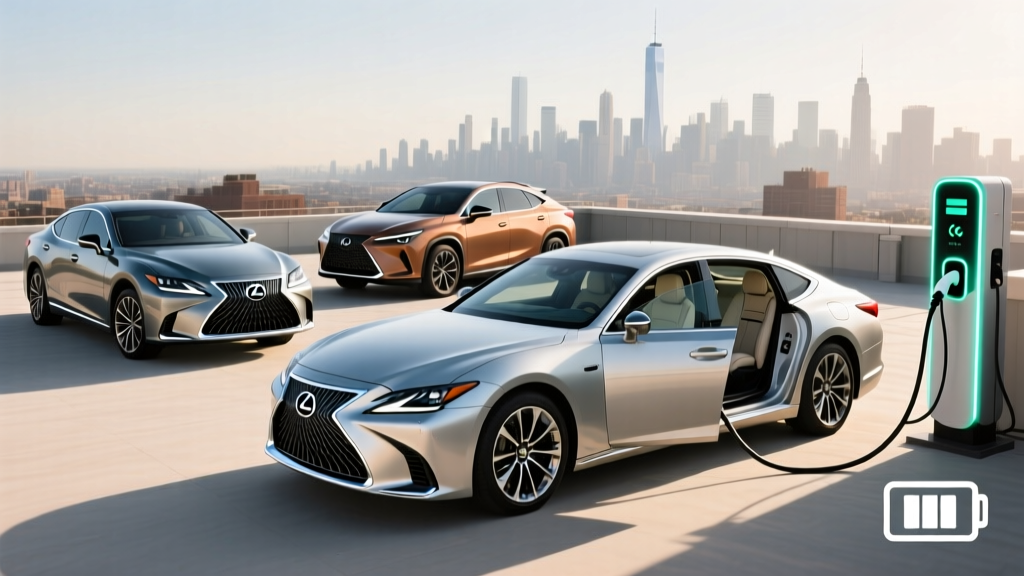
Lexus offers one of the broadest electrified lineups in the luxury segment, spanning conventional hybrids (HEVs) that never need plugging in and plug-in hybrids (PHEVs) that deliver meaningful electric-only range. For 2026, the brand fields hybrid powertrains across nearly every nameplate — from the compact UX to the flagship LX — making it critical to understand which Lexus hybrid model actually fits your driving pattern, budget, and charging situation.
This guide breaks down every current Lexus hybrid and PHEV with exact EPA figures, real-world expectations, powertrain specs, pricing, and federal tax credit eligibility under current IRS §30D rules.
HEV vs PHEV: Understanding the Lexus Hybrid Lineup
Before diving into specific models, the distinction between Lexus's two electrified categories matters for your wallet and daily routine:
Conventional Hybrid (HEV)
- How it works: A small battery (typically 1.0–2.0 kWh) paired with a gas engine and electric motor(s). The battery charges through regenerative braking and the engine — you never plug it in.
- Best for: Drivers without home charging access, apartment dwellers, or those who want better MPG with zero behavior change.
- Lexus examples: UX Hybrid, ES Hybrid, RX Hybrid, TX Hybrid, LC Hybrid, LS Hybrid, LX Hybrid.
Plug-in Hybrid (PHEV)
- How it works: A larger battery (18–22 kWh) that you can charge via a wall outlet or Level 2 charger, providing 30+ miles of electric-only driving before the gas engine engages.
- Best for: Drivers with home charging who commute under 40 miles daily but want gas-engine range for road trips.
- Lexus examples: NX 450h+, RX 500h (Performance variant), TX 550h+.
The key practical difference: an HEV is a more efficient gas car. A PHEV is a short-range EV that transforms into a hybrid when the battery depletes. Neither requires DC fast charging infrastructure for daily use, though understanding your commute pattern determines which saves more fuel.
2026 Lexus Hybrid and PHEV Specs at a Glance
| Model | Type | EPA MPG (City/Hwy/Combined) | EV Range (PHEV) | Combined HP | Starting MSRP |
|---|---|---|---|---|---|
| UX 300h | HEV | 43 / 41 / 42 | — | 199 hp | $39,990 |
| NX 350h | HEV | 41 / 37 / 39 | — | 244 hp | $46,115 |
| NX 450h+ | PHEV | 38 combined (gas) / 84 MPGe | 37 mi | 304 hp | $59,905 |
| ES 300h | HEV | 43 / 44 / 44 | — | 215 hp | $47,290 |
| RX 350h | HEV | 37 / 34 / 36 | — | 250 hp | $54,750 |
| RX 450h+ | PHEV | 35 combined (gas) / 65 MPGe | 37 mi | 304 hp | $64,040 |
| TX 350h | HEV | 35 / 33 / 34 | — | 371 hp | $60,000 |
| TX 550h+ | PHEV | 30 combined (gas) / 56 MPGe | 33 mi | 406 hp | $75,100 |
| LC 500h | HEV | 26 / 32 / 28 | — | 354 hp | $103,150 |
| LS 500h | HEV | 25 / 33 / 28 | — | 354 hp | $84,510 |
| LX 700h | HEV | 19 / 22 / 20 | — | 457 hp | $115,150 |
Sources: fueleconomy.gov (EPA estimates), Lexus USA (MSRP as of early 2026). Actual mileage will vary based on driving conditions, climate, and maintenance.
Real-World MPG: What Owners Actually Report
EPA estimates are measured on a dynamometer under controlled conditions. Real-world results for Lexus hybrids consistently show a pattern worth understanding:
City vs. Highway Reality
Lexus HEVs frequently exceed EPA city estimates in stop-and-go traffic because regenerative braking recovers energy that gas cars waste as heat. The UX 300h, rated at 43 city, commonly returns 45–48 MPG in dense urban driving according to owner-reported data on Fuelly.
However, highway MPG typically falls 3–5 MPG below EPA estimates at sustained 75+ mph speeds, where the electric motor contributes less and aerodynamic drag dominates. Expect the RX 350h to deliver closer to 31–32 MPG at 75 mph highway cruise, not the 34 EPA highway sticker.
Cold weather (below 30°F) reduces hybrid efficiency by roughly 10–15% due to increased engine idling for cabin heat and reduced battery performance.
For PHEV models, the real-world electric range also depends heavily on temperature and terrain. The NX 450h+'s 37-mile EPA electric range can drop to 28–30 miles in winter conditions or when driving uphill at highway speeds. In mild weather on flat suburban roads, some owners report stretching it to 40+ miles by staying under 45 mph.
PHEV Deep Dive: Electric Range, Charging, and Battery Specs
Lexus currently offers three plug-in hybrid models. Here's the technical breakdown buyers need:
| Spec | NX 450h+ | RX 450h+ | TX 550h+ |
|---|---|---|---|
| Battery Capacity (usable) | ~18.1 kWh | ~18.1 kWh | ~20.5 kWh |
| EPA Electric Range | 37 miles | 37 miles | 33 miles |
| Total Range (EV + Gas) | ~550 miles | ~520 miles | ~470 miles |
| Level 1 Charge (120V, 12A) | ~12 hours | ~12 hours | ~14 hours |
| Level 2 Charge (240V, 32A) | ~4 hours | ~4 hours | ~4.5 hours |
| DC Fast Charging | Not supported | Not supported | Not supported |
| Onboard Charger | 3.3 kW | 3.3 kW | 3.3 kW |
Critical note on DC fast charging: None of the current Lexus PHEVs support DC fast charging (CHAdeMO or CCS). The 3.3 kW onboard charger means Level 2 charging is the fastest option. For most PHEV owners, this is perfectly adequate — you charge overnight at home and start each morning with a full battery. But if you were hoping to top up at an Electrify America station during a road trip, that's not an option with these vehicles.
The 3.3 kW onboard charger is a deliberate engineering trade-off. Lexus prioritized interior space and weight savings over faster AC charging. Given the ~18 kWh battery, a full Level 2 charge in roughly 4 hours means most owners can fully replenish during a workday or overnight with a standard 240V home outlet or Level 2 wallbox.
Powertrain Breakdown: Engine, Motors, and Performance
Lexus uses its fourth-generation hybrid system across most models, pairing Atkinson-cycle four-cylinder engines with one or more electric motors through a planetary gearset (e-CVT). Here's how the major powertrains stack up:
UX 300h: A 2.0L four-cylinder engine combined with front and rear electric motors produces 199 hp and standard all-wheel drive. The 0–60 mph time is approximately 8.0 seconds. This is the most fuel-efficient Lexus in the lineup, trading acceleration for 42 MPG combined.
NX 350h: A 2.5L four-cylinder with dual motors delivers 244 hp and AWD. The 0–60 time drops to 6.8 seconds — brisk for a compact luxury SUV. The NX 450h+ PHEV variant uses the same engine but a more powerful electric motor and larger battery for 304 hp and a 6.0-second 0–60.
RX 350h / RX 450h+: The RX 350h pairs a 2.5L four-cylinder with electric motors for 250 hp. The RX 450h+ PHEV steps up to 304 hp with a more potent rear motor. Both use AWD. The 450h+ hits 60 mph in roughly 6.2 seconds.
TX 550h+: The three-row TX PHEV uses a 3.5L V6 combined with electric motors for 406 hp — the most powerful plug-in Lexus offers. It handles 0–60 in about 5.7 seconds despite its size, making it genuinely quick for a family hauler with 33 miles of electric range.
LX 700h: The flagship body-on-frame SUV pairs a twin-turbo 3.4L V6 with a hybrid system for 457 hp and 516 lb-ft of torque. It's rated for 8,000 lbs of towing — the only Lexus hybrid built for heavy hauling, though its 20 MPG combined reflects the trade-off.
Pricing, Trims, and Federal Tax Credit Eligibility
Lexus hybrid pricing spans from under $40,000 to over $115,000, but the tax credit picture requires careful attention to current IRS §30D rules:
Federal Tax Credit: What Actually Qualifies in 2026
Under current IRS §30D rules, the federal clean vehicle credit of up to $7,500 applies to new PHEVs and EVs — but not conventional HEVs. To qualify, a vehicle must meet:
- Battery capacity: At least 7 kWh (all Lexus PHEVs meet this)
- MSRP caps: SUVs/vans/pickups ≤ $80,000; sedans ≤ $55,000
- Buyer income limits: AGI ≤ $150,000 (single), $225,000 (head of household), $300,000 (joint)
- Battery component and critical mineral sourcing: Increasingly strict North American manufacturing and mineral sourcing thresholds that change annually
As of 2026, the NX 450h+ (MSRP ~$59,905) and RX 450h+ (MSRP ~$64,040) fall under the $80,000 SUV cap. The TX 550h+ at ~$75,100 also qualifies on price. However, battery sourcing requirements may reduce the credit to $3,750 or eliminate it entirely depending on the specific build month and supply chain compliance. Always verify with your dealer and a tax professional before purchasing.
The credit can now be transferred to the dealer as a point-of-sale discount, reducing your out-of-pocket cost at purchase rather than waiting for a tax refund.
Conventional Lexus HEVs do not qualify for the §30D federal credit. Some states offer separate hybrid incentives — check your local energy office or Alternative Fuels Data Center for state-specific programs.
Battery Warranty, Reliability, and Replacement Costs
Hybrid battery longevity is consistently the top concern for buyers considering their first Lexus hybrid. Here's what the data shows:
Warranty coverage: Lexus covers all hybrid battery packs for 10 years or 150,000 miles (whichever comes first) in all 50 states. This applies to both HEV and PHEV models. The broader hybrid system components (inverter, control module, electric motors) carry the same 10-year/150,000-mile coverage.
Real-world degradation: Lexus HEV batteries are notably small (1–2 kWh) and are managed conservatively — the system rarely allows full charge or full discharge, keeping the battery in a longevity-friendly state of charge window. Data from high-mileage Lexus hybrid owners shows typical capacity loss of 10–15% over 150,000 miles, which translates to roughly 1–3 MPG reduction — barely noticeable in daily driving.
PHEV battery degradation: The larger ~18 kWh PHEV batteries experience more measurable degradation. Expect roughly 8–12% capacity loss over 100,000 miles, meaning your 37-mile electric range might shrink to 32–34 miles after several years. The 10-year/150,000-mile warranty protects against defects and excessive loss (typically defined as dropping below 70% of original capacity).
Replacement cost: If a hybrid battery fails outside warranty, replacement costs vary significantly:
- HEV battery (UX, NX, RX, ES): $3,000–$5,000 including labor
- PHEV battery (NX 450h+, RX 450h+): $8,000–$12,000 including labor
Reliability track record: Lexus consistently ranks at or near the top of J.D. Power and Consumer Reports reliability studies, and the hybrid powertrain is among the brand's most proven technologies. The planetary e-CVT transmission has no clutches, belts, or friction bands to wear — it's one of the most durable drivetrain designs in the industry. Many Lexus hybrids surpass 200,000 miles with original hybrid batteries.
Which Lexus Hybrid Fits You? HEV vs PHEV vs Full EV
Choose a Lexus HEV (UX 300h, ES 300h, RX 350h, etc.) if:
- You don't have access to home or workplace charging
- You want maximum MPG with zero behavior change — just fill up with gas
- Your budget is under $55,000 and you don't want to manage tax credit complexity
- You drive a mix of city and highway and value proven reliability over EV-range bragging rights
Choose a Lexus PHEV (NX 450h+, RX 450h+, TX 550h+) if:
- You can install a Level 2 charger at home (240V outlet or wallbox)
- Your daily commute is under 35–40 miles round trip (you'll rarely use gas on weekdays)
- You want to drive electric daily but need 500+ mile road-trip capability without charging anxiety
- You may qualify for the federal tax credit (check income, MSRP, and sourcing rules)
Consider a Full EV (e.g., Lexus RZ 450e or a competitor) if:
- You have reliable home Level 2 charging and access to DC fast chargers for road trips
- You want zero tailpipe emissions and minimal drivetrain maintenance (no oil changes, no gas engine)
- Your daily driving is under 250 miles and you're comfortable planning charging stops on longer trips
- You want the maximum available federal tax credit and lower per-mile fuel cost
For most Lexus buyers — especially those in apartments without charging or those who take frequent long road trips — a Lexus HEV delivers the best balance of fuel savings, convenience, and resale value. The PHEV makes financial sense primarily for homeowners with Level 2 charging and short commutes who can essentially drive an EV Monday through Friday and a hybrid on weekends.
Pros and Cons: Lexus Hybrid Ownership
Pros
- Best-in-class fuel economy across multiple segments (UX 300h at 42 combined, ES 300h at 44)
- 10-year/150,000-mile hybrid battery warranty — among the longest in the industry
- Proven reliability with decades of hybrid system refinement
- No charging infrastructure needed for HEVs; PHEVs charge on standard 120V overnight
- Strong resale value — Lexus hybrids hold value better than most competitors
- AWD standard on most hybrid trims via independent rear electric motor
Cons
- HEVs do not qualify for the $7,500 federal tax credit
- PHEV onboard charger limited to 3.3 kW — no DC fast charging support
- PHEV electric range (33–37 miles) trails competitors like the Chrysler Pacifica PHEV (32 mi but larger vehicle) and is modest vs. upcoming extended-range PHEVs
- Hybrid premium adds $2,000–$5,000 over gas-only Lexus trims, with multi-year payback depending on mileage
- e-CVT drone under hard acceleration (no traditional gear shifts)
- LX 700h hybrid achieves only 20 MPG combined — minimal improvement over non-hybrid competitors in the full-size SUV segment
Frequently Asked Questions
How many MPG does the most efficient Lexus hybrid get?
The 2026 Lexus ES 300h sedan leads the lineup at 44 MPG combined (43 city / 44 highway), followed closely by the UX 300h at 42 MPG combined. In real-world city driving with frequent stops, owners commonly report 45–48 MPG thanks to aggressive regenerative braking. Highway cruising at 75+ mph typically yields 38–40 MPG for the ES 300h.
How far can a Lexus PHEV go on electric only?
The NX 450h+ and RX 450h+ both deliver 37 miles of EPA-rated electric-only range. The TX 550h+ achieves 33 miles. Real-world range varies: expect 28–32 miles in cold weather or at highway speeds, and up to 40 miles in mild conditions on flat suburban roads at lower speeds. Once the battery depletes, the vehicle operates as a conventional hybrid.
Do Lexus hybrids need to be plugged in?
No. Conventional Lexus hybrids (HEVs like the UX 300h, ES 300h, RX 350h) charge their batteries entirely through regenerative braking and the gas engine. You never plug them in. Only the PHEV models (NX 450h+, RX 450h+, TX 550h+) benefit from plugging in to access their electric-only range.
Is the Lexus hybrid battery reliable and what does replacement cost?
Lexus hybrid batteries are among the most reliable in the industry, backed by a 10-year/150,000-mile warranty. Many exceed 200,000 miles without replacement. If a battery does fail outside warranty, HEV replacement costs $3,000–$5,000 and PHEV replacement runs $8,000–$12,000 including labor. The conservative charge management system (never fully charging or fully depleting) is key to their longevity.
Does any Lexus hybrid qualify for the federal tax credit?
Only Lexus PHEVs (NX 450h+, RX 450h+, TX 550h+) are potentially eligible for the federal §30D clean vehicle credit of up to $7,500. Conventional HEVs do not qualify. PHEV eligibility depends on the buyer's income (AGI caps apply), the vehicle's MSRP (must be under $80,000 for SUVs), and battery component/critical mineral sourcing requirements that tighten annually. Check current rules at IRS.gov and consult a tax professional before relying on the credit.
How long does it take to charge a Lexus PHEV at home?
On a standard 120V household outlet (Level 1), a full charge takes approximately 12–14 hours. With a 240V Level 2 home charger (recommended), a full charge takes about 4–4.5 hours. Most PHEV owners install a Level 2 wallbox or use a 240V dryer-style outlet and charge overnight, waking to a full battery every morning. Lexus PHEVs do not support DC fast charging.
Is a Lexus hybrid better than a full EV for my situation?
It depends on your charging access and driving pattern. If you lack home charging or frequently drive 300+ miles between stops, a Lexus HEV is the practical choice — no infrastructure needed, 35–44 MPG. If you have home Level 2 charging and commute under 40 miles, a Lexus PHEV lets you drive electric daily while keeping gas-engine flexibility. A full EV (like the Lexus RZ or competitors) makes sense only if you have reliable home charging, access to fast-charging networks, and want zero gas-engine maintenance.