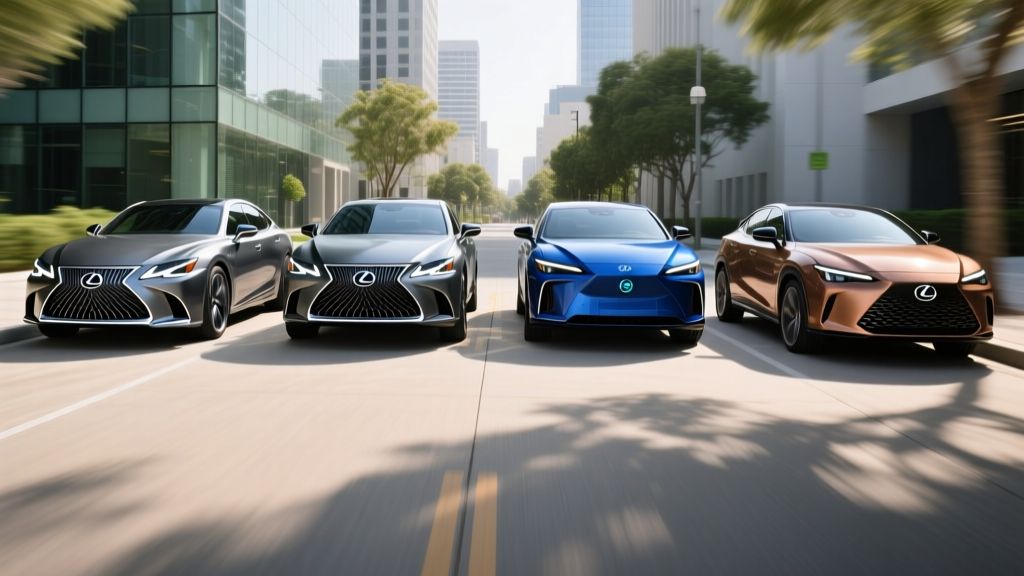
The 2026 Lexus Hybrid Lineup at a Glance
Lexus offers one of the broadest hybrid portfolios in the luxury segment, spanning conventional hybrids (HEVs) that never need plugging in and plug-in hybrids (PHEVs) that deliver genuine electric-only commuting range. For 2026, the lineup includes the NX, RX, TX, UX, and ES in hybrid form, plus the NX 450h+ and RX 500h as performance-oriented electrified options. This guide breaks down exact EPA fuel economy, powertrain specs, pricing, and real-world ownership considerations so you can match the right Lexus hybrid to your driving pattern.
HEV vs PHEV: The Core Difference
Conventional Hybrid (HEV): Uses a small battery (typically 1-2 kWh) charged entirely by the engine and regenerative braking. You never plug it in. It optimizes fuel economy by assisting the gas engine, enabling electric-only driving at very low speeds for brief distances. Think of it as a significantly more efficient gas car.
Plug-in Hybrid (PHEV): Carries a much larger battery (18-22 kWh in the Lexus lineup) that you charge via a wall outlet or Level 2 charger. This enables 20-40 miles of true electric-only driving at highway speeds before the gasoline engine engages. Once the battery depletes, it operates as a conventional hybrid. Ideal for commuters with short one-way trips and access to charging.
Fuel Economy: EPA Ratings and Real-World MPG
Lexus hybrids consistently deliver strong real-world fuel economy, and unlike full EVs, their efficiency tends to improve in city driving where regenerative braking and electric motor assist work hardest. Here is the full 2026 lineup breakdown:
| Model | Powertrain | EPA City | EPA Highway | EPA Combined | Real-World Expectation |
|---|---|---|---|---|---|
| UX 250h | 2.0L I4 HEV | 41 MPG | 38 MPG | 39 MPG | 40-44 MPG city; 35-38 highway |
| ES 300h | 2.5L I4 HEV | 43 MPG | 44 MPG | 44 MPG | 44-48 city; 40-43 highway |
| NX 350h | 2.5L I4 HEV | 41 MPG | 37 MPG | 39 MPG | 39-43 city; 34-37 highway |
| RX 350h | 2.5L I4 HEV | 37 MPG | 34 MPG | 36 MPG | 36-40 city; 32-34 highway |
| TX 500h | 2.4L Turbo HEV | 27 MPG | 28 MPG | 27 MPG | 26-29 city; 26-28 highway |
| NX 450h+ (PHEV) | 2.5L I4 PHEV | 84 MPGe | — | 84 MPGe (combined) | 36 mi EV range; 36 MPG hybrid mode |
| RX 450h+ (PHEV) | 2.5L I4 PHEV | 83 MPGe | — | 83 MPGe (combined) | 37 mi EV range; 35 MPG hybrid mode |
Real-world note: Lexus HEVs routinely exceed their EPA city ratings in stop-and-go traffic because the electric motor handles low-speed propulsion while the engine shuts off at stops. On sustained highway runs above 75 mph, expect to see numbers 2-4 MPG below the EPA highway figure due to aerodynamic drag. Cold weather (below 30°F) typically reduces fuel economy by 5-10% as the engine runs longer to heat the cabin and bring the catalytic converter to operating temperature.
Powertrain Specs: What's Under the Hood
| Model | Engine | Combined HP | Drivetrain | 0-60 mph | Towing |
|---|---|---|---|---|---|
| UX 250h | 2.0L I4 + 2 motors | 181 hp | AWD | 7.0 sec | Not rated |
| ES 300h | 2.5L I4 + 1 motor | 215 hp | FWD | 7.3 sec | Not rated |
| NX 350h | 2.5L I4 + 2 motors | 240 hp | AWD | 6.8 sec | 2,000 lbs |
| RX 350h | 2.5L I4 + 2 motors | 246 hp | AWD | 7.4 sec | 3,500 lbs |
| TX 500h | 2.4L Turbo I4 + 2 motors | 366 hp | AWD | 5.9 sec | 5,000 lbs |
| NX 450h+ | 2.5L I4 + 2 motors (PHEV) | 302 hp | AWD | 6.0 sec | 2,000 lbs |
| RX 450h+ | 2.5L I4 + 2 motors (PHEV) | 302 hp | AWD | 6.5 sec | 3,500 lbs |
The TX 500h uses Lexus's DIRECT4 all-wheel-drive system with a turbocharged engine and rear-mounted electric motor, giving it the most aggressive performance in the hybrid lineup. The PHEV models (NX 450h+ and RX 450h+) share a 302-hp powertrain that delivers brisk acceleration while still offering electric-only commuting capability.
PHEV Deep Dive: Electric-Only Range, Charging, and Battery
For 2026, Lexus offers two plug-in hybrid models. Both use an 18.1 kWh lithium-ion battery pack (usable capacity approximately 14.5 kWh) paired with the proven 2.5-liter four-cylinder hybrid system.
| Spec | NX 450h+ | RX 450h+ |
|---|---|---|
| Battery Capacity | 18.1 kWh (14.5 kWh usable) | 18.1 kWh (14.5 kWh usable) |
| EPA Electric-Only Range | 37 miles | 37 miles |
| Real-World EV Range | 30-35 mi (highway/cold) | 30-35 mi (highway/cold) |
| Total Combined Range | ~510 miles | ~520 miles |
| Level 1 Charging (120V) | ~12 hours (0-100%) | ~12 hours (0-100%) |
| Level 2 Charging (240V, 32A) | ~4 hours (0-100%) | ~4 hours (0-100%) |
| DC Fast Charging | Not supported | Not supported |
| Charge Port | J1772 | J1772 |
| Onboard Charger | 3.3 kW | 3.3 kW |
Charging Reality Check
Neither Lexus PHEV supports DC fast charging. The 3.3 kW onboard charger means a full charge from empty takes roughly 4 hours on a Level 2 home charger. For daily commuting, this is sufficient — plug in overnight and wake up to a full 37 miles of electric range. However, on road trips you will not be able to quickly top up the battery at public fast-charging stations. The battery will deplete within 30-35 miles of driving, after which the vehicle operates as a conventional hybrid at approximately 35-36 MPG combined.
kWh vs kW refresher: The battery stores 18.1 kWh of energy (like a fuel tank size). The onboard charger accepts 3.3 kW of power (like the flow rate of a gas pump). A higher kW rating means faster charging; a higher kWh rating means more stored energy and greater electric range.
Pricing and Tax Credit Eligibility
Here is the 2026 MSRP breakdown across the Lexus hybrid lineup, including destination charges:
| Model | Base Trim MSRP | Mid Trim MSRP | Top Trim MSRP |
|---|---|---|---|
| UX 250h | $38,350 | $41,500 (Premium) | $45,200 (F SPORT) |
| ES 300h | $45,150 | $49,800 (Luxury) | $53,400 (Ultra Luxury) |
| NX 350h | $43,400 | $47,600 (Premium) | $52,100 (F SPORT) |
| RX 350h | $52,800 | $57,200 (Premium+) | $61,500 (Luxury) |
| TX 500h | $63,200 | $67,500 (Premium+) | $72,000 (Luxury) |
| NX 450h+ (PHEV) | $52,900 | $56,500 (Premium) | $60,200 (F SPORT) |
| RX 450h+ (PHEV) | $62,500 | $66,800 (Premium+) | $70,900 (Luxury) |
Federal Tax Credit Status
Under current IRS §30D rules, the federal clean vehicle credit of up to $7,500 is available only for vehicles that meet battery component and critical-mineral sourcing requirements, MSRP caps ($80,000 for SUVs, $55,000 for sedans), and buyer income limits ($300,000 joint / $150,000 single). As of 2026:
- NX 450h+ (PHEV): MSRP starts at $52,900 — falls under the $80,000 SUV cap. Eligibility for the full $7,500 depends on battery sourcing compliance, which has not been confirmed for the 2026 model year. Check the IRS qualified vehicles list before purchasing.
- RX 450h+ (PHEV): MSRP starts at $62,500 — under the SUV cap. Same sourcing uncertainty applies.
- ES 300h (HEV sedan): At $45,150 base, it clears the $55,000 sedan cap. However, conventional hybrids receive at most $2,500 under the credit structure (which prioritizes larger batteries), and sourcing requirements further limit qualification.
- Conventional HEVs (UX, NX 350h, RX 350h, TX 500h): Small battery capacity (1-2 kWh) makes it extremely unlikely these qualify for meaningful federal credits. Some may qualify for a reduced credit — verify on irs.gov.
Point-of-sale transfer: If eligible, you can transfer the credit to the dealer at purchase for an immediate price reduction rather than waiting to claim it on your tax return. Confirm eligibility with your dealer and cross-reference the IRS qualified vehicle list.
Battery Reliability, Warranty, and Replacement Cost
Lexus Hybrid Battery Warranty
All 2026 Lexus hybrids and PHEVs carry a 10-year / 150,000-mile hybrid battery warranty (whichever comes first). This covers defects and capacity loss below a defined threshold. California-emissions states (CARB states) may have extended coverage requirements. The powertrain warranty is 6 years / 70,000 miles.
Lexus (and parent company Toyota) has the longest track record in hybrid technology, dating back to the 2004 RX 400h. Real-world data from taxi fleets and high-mileage owners consistently shows Lexus hybrid batteries lasting 150,000-250,000 miles before significant degradation. The nickel-metal-hydride (NiMH) packs in most HEV models are less energy-dense than lithium-ion but exceptionally durable. The PHEV models use lithium-ion chemistry for greater energy density and electric range, with slightly more sensitivity to long-term degradation — though the 18.1 kWh pack is conservatively tuned with a substantial buffer to protect longevity.
Battery Replacement Cost
If a hybrid battery does fail outside warranty, replacement costs vary by model:
- HEV models (UX, NX, RX, ES, TX): $3,000–$5,000 for a new OEM battery pack. Refurbished units are available from $1,500–$2,500.
- PHEV models (NX 450h+, RX 450h+): $6,000–$9,000 for the larger 18.1 kWh lithium-ion pack.
According to NHTSA reliability data and long-term owner surveys, Lexus hybrid battery failure rates within the warranty period remain below 2%. This is a key reason Lexus hybrids command strong resale values.
Who Should Choose a Lexus Hybrid vs a Full EV or Gas Car
Lexus HEV (NX 350h, RX 350h, ES 300h, UX 250h)
Pros:
- No charging infrastructure needed — just fill up with gas
- 36-44 MPG combined cuts fuel costs 35-50% vs gas-only competitors
- Proven 20-year hybrid reliability record
- No range anxiety on road trips
- Lower purchase price than PHEV or full EV equivalents
Cons:
- No electric-only driving range of significance
- Minimal or no federal tax credit
- Still burning gasoline — higher per-mile fuel cost than EV charging
Lexus PHEV (NX 450h+, RX 450h+)
Pros:
- 37 miles electric-only covers most daily commutes
- 500+ mile total range eliminates road-trip anxiety
- Potential $7,500 federal tax credit (verify sourcing)
- 302 hp provides strong acceleration
- Operates as efficient hybrid once battery depletes
Cons:
- Requires home or workplace charging to realize EV benefits
- No DC fast charging — 4-hour Level 2 charge time
- $8,000-$10,000 price premium over HEV equivalent
- Heavier due to larger battery — slightly lower hybrid-mode MPG
Decision Framework: Which Is Right for You?
Choose a Lexus HEV if: You don't have reliable access to home or workplace charging, you drive more than 40 miles daily, you want maximum simplicity, or you're budget-conscious and want a luxury vehicle under $50,000.
Choose a Lexus PHEV if: Your one-way commute is under 35 miles, you can charge at home overnight, you want to drive mostly electric on weekdays but take gas-powered road trips on weekends, and you can verify federal tax credit eligibility to offset the price premium.
Choose a full BEV (like the Lexus RZ 450e) if: You have reliable home charging, your daily driving is under 200 miles, you want zero tailpipe emissions, and you're comfortable planning road trips around DC fast-charging infrastructure.
Frequently Asked Questions
How many MPG does the Lexus RX 350h hybrid get?
The 2026 Lexus RX 350h is EPA-rated at 37 MPG city, 34 MPG highway, and 36 MPG combined. In real-world city driving with frequent stops, owners commonly report 38-41 MPG thanks to regenerative braking. Sustained highway driving at 75+ mph typically yields 31-34 MPG.
How far can the Lexus NX 450h+ go on electric only?
The EPA rates the NX 450h+ at 37 miles of electric-only range. In real-world conditions — particularly highway speeds above 65 mph or temperatures below 40°F — expect 30-34 miles. Once the battery depletes, the NX 450h+ operates as a conventional hybrid at approximately 36 MPG combined.
Do Lexus conventional hybrids need to be plugged in?
No. Lexus HEVs (UX 250h, NX 350h, RX 350h, ES 300h, TX 500h) charge their small batteries entirely through the gasoline engine and regenerative braking. You never plug them in. Only the PHEV models (NX 450h+, RX 450h+) require plugging in to access their electric-only range.
Is the Lexus hybrid battery reliable and what does replacement cost?
Lexus hybrid batteries are among the most reliable in the industry, with failure rates under 2% within the 10-year/150,000-mile warranty period. Many units last 200,000+ miles. If replacement is needed out of warranty, HEV batteries cost $3,000-$5,000 and PHEV batteries cost $6,000-$9,000 for OEM units.
Does any Lexus hybrid qualify for the federal tax credit?
The PHEV models (NX 450h+ and RX 450h+) have the best chance of qualifying for up to $7,500 under IRS §30D, provided they meet battery sourcing requirements and the buyer meets income limits. Conventional HEVs have small batteries and are unlikely to qualify for meaningful credits. Always verify current eligibility on the IRS qualified vehicles page before purchasing, as sourcing compliance can change by model year.
How does Lexus hybrid fuel economy compare to a gas-only luxury SUV?
The RX 350h at 36 MPG combined uses roughly 40% less fuel than a comparable gas-only luxury midsize SUV averaging 22 MPG combined. Over 15,000 miles per year at $3.50/gallon, that translates to approximately $1,050 in annual fuel savings. According to fueleconomy.gov, the RX 350h's annual fuel cost is roughly $1,550 compared to $2,600 for a gas-only competitor in the same class.
Can I charge a Lexus PHEV at a public DC fast charger?
No. The NX 450h+ and RX 450h+ do not have DC fast-charging capability. They charge exclusively via AC power at up to 3.3 kW through a J1772 connector — meaning Level 1 (120V household outlet) or Level 2 (240V home or public charger). A full Level 2 charge takes approximately 4 hours. This is a deliberate engineering choice: PHEV batteries are small enough that overnight home charging is sufficient, and omitting DC hardware saves weight and cost.