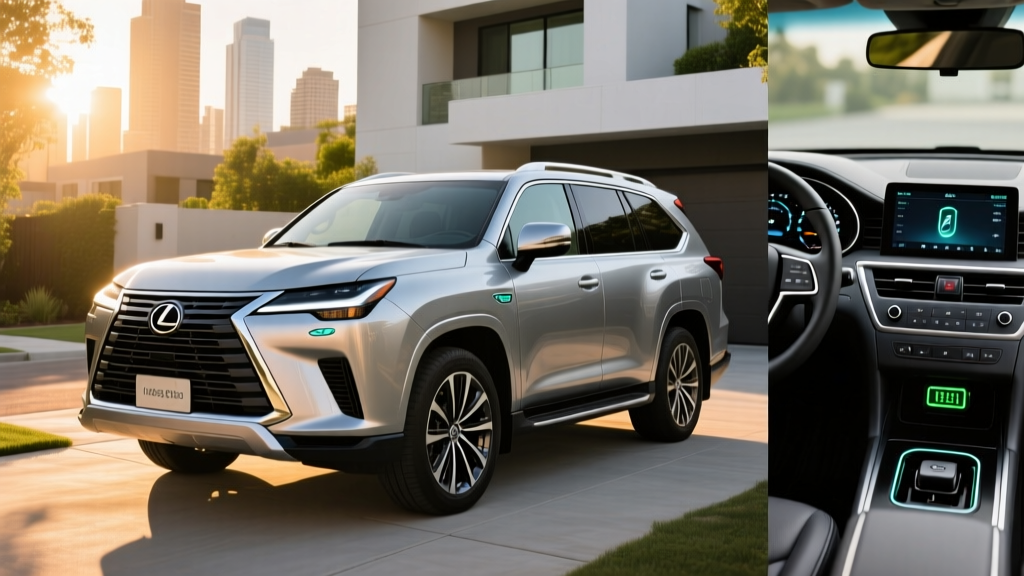
The 2026 Lexus GX 550 is one of the most capable luxury body-on-frame SUVs on the market, but its thirst for premium gasoline has buyers searching for a more efficient variant. That search leads to one inevitable question: is there a Lexus GX 550 hybrid, and if so, what kind of fuel economy does it deliver? As of the 2026 model year, the Lexus GX lineup relies on the twin-turbocharged i-FORCE MAX V6 — a powertrain that shares hybrid architecture with its Toyota siblings but operates as a performance-first system rather than a fuel-economy play. Let's break down exactly what's under the hood, what the EPA says, and whether a hybrid GX is in your future.
The 2026 Lexus GX 550 Powertrain: Hybrid Tech Without the Hybrid Badge
The 2026 Lexus GX 550 is powered by the i-FORCE MAX twin-turbo 3.4-liter V6 paired with a 10-speed automatic transmission. This engine integrates an electric motor between the engine and transmission — a configuration Toyota and Lexus call a "parallel hybrid" architecture in the broader powertrain family. However, in the GX 550, this system is tuned for maximum torque output rather than fuel savings.
| Specification | 2026 Lexus GX 550 |
|---|---|
| Engine | 3.4L Twin-Turbo V6 (i-FORCE MAX) |
| Combined Output | 409 hp / 479 lb-ft torque |
| Transmission | 10-speed automatic |
| Drivetrain | Full-time 4WD |
| 0–60 mph | ~6.5 seconds |
| Towing Capacity | Up to 8,000 lbs |
| Hybrid System | No (mild-hybrid assist only) |
| Electric-Only Driving | Not available |
The electric motor in the i-FORCE MAX serves primarily to fill torque gaps at low RPM and smooth out the twin-turbo spool-up. It does not provide electric-only propulsion, regenerative braking on the scale of a full hybrid, or meaningful MPG gains over a conventional turbo V6. This is an important distinction for buyers expecting Prius-style efficiency from a "hybrid" badge.
EPA Fuel Economy: What the Numbers Actually Say
According to fueleconomy.gov, the 2026 Lexus GX 550 carries the following EPA estimates:
| Driving Cycle | EPA Estimate |
|---|---|
| City | 15 MPG |
| Highway | 21 MPG |
| Combined | 17 MPG |
These numbers are consistent with other body-on-frame luxury SUVs in this class — the Land Rover Defender 110 and Mercedes-Benz G-Class return similar figures. The GX 550's boxy aerodynamics, 5,000+ lb curb weight, and full-time four-wheel drive all work against highway efficiency.
Real-World MPG vs. EPA Sticker
In real-world mixed driving, owners report averaging between 16–19 MPG combined, depending heavily on driving style and terrain. City-heavy commutes with frequent stops can push the figure closer to 14 MPG, while steady-state highway cruising at 65–70 mph may yield 20–22 MPG. Cold weather, roof racks, and aggressive acceleration all compress these numbers downward. Unlike full hybrids (HEVs) that recapture energy during braking, the GX 550's mild-hybrid assist provides negligible regenerative benefit — so stop-and-go traffic does not boost efficiency the way it does in a Toyota Highlander Hybrid or Lexus RX 500h.
Is There a Lexus GX Hybrid or PHEV Coming?
As of early 2026, Lexus has not announced a dedicated hybrid (HEV) or plug-in hybrid (PHEV) variant of the GX. However, the GX's platform sibling — the Toyota Land Cruiser — is sold in international markets with hybrid and diesel powertrains, and Lexus has been expanding its electrified lineup aggressively. Industry analysts expect a GX 550h or GX PHEV variant could arrive by the 2027–2028 model year, likely using a version of the hybrid MAX system found in the Lexus RX 500h or Toyota Grand Highlander Hybrid MAX.
If a PHEV variant arrives, expect:
- A larger battery pack (likely 18–25 kWh usable)
- 25–35 miles of electric-only range
- Level 2 AC charging capability (no DC fast charging, typical for PHEVs in this class)
- Combined MPGe rating in the 50–60 range when the battery is charged
Until then, the GX 550 remains a conventional turbocharged gasoline vehicle with mild-hybrid torque assist.
HEV vs. PHEV vs. EV: Which Powertrain Fits Your Lifestyle?
Buyers cross-shopping the Lexus GX often weigh it against electrified alternatives. Here's a decision framework based on real ownership patterns:
| Factor | Conventional Hybrid (HEV) | Plug-In Hybrid (PHEV) | Battery Electric (BEV) |
|---|---|---|---|
| Plug in required? | No | Yes (for EV range) | Yes (always) |
| Electric-only range | 0 miles | 20–50 miles typical | 200–400+ miles |
| Home charging needed | No | Recommended (Level 2) | Essential (Level 2) |
| Best for | No garage/outlet access | Short commutes + road trips | Home charging + daily driving |
| Fuel cost per mile | ~$0.12–$0.15 | ~$0.04 (EV) / $0.12 (gas) | ~$0.03–$0.05 |
| Maintenance | Standard + hybrid battery | Standard + hybrid battery | Minimal (no oil, fewer fluids) |
Choose the current GX 550 (gasoline) if: You need maximum towing capacity (8,000 lbs), serious off-road capability, and don't have reliable home charging access. The GX's body-on-frame construction and full-time 4WD are its core value proposition.
Wait for a potential GX hybrid/PHEV if: You want the GX's capability but drive 15,000+ miles per year and want to reduce fuel spend. A PHEV variant would let you commute electrically on weekdays while retaining gas range for weekend towing and trail runs.
Consider a full EV (Rivian R1S, Tesla Model X, or upcoming electric Lexus) if: You have Level 2 home charging, rarely tow over 5,000 lbs, and prioritize low running costs and instant torque over body-on-frame ruggedness.
Pricing, Tax Credits, and Total Cost of Ownership
The 2026 Lexus GX 550 starts at approximately $64,500 MSRP for the Premium trim, climbing to over $85,000 for the Ultra Luxury grade with options. Because the GX 550 is not classified as a hybrid or plug-in hybrid by the EPA, it does not qualify for the federal §30D Clean Vehicle Credit (up to $7,500). That credit requires a vehicle with a battery capacity of at least 7 kWh that can be recharged from an external source — criteria the GX 550 does not meet.
Battery & Powertrain Warranty
Even though the GX 550 is not a full hybrid, its i-FORCE MAX powertrain includes hybrid-adjacent components. Lexus covers the GX 550 with:
- Basic Warranty: 4 years / 50,000 miles
- Powertrain Warranty: 6 years / 70,000 miles
- Hybrid Battery Components (if applicable to future HEV/PHEV): Lexus typically provides 10 years / 150,000 miles on dedicated hybrid batteries
The mild-hybrid motor and associated electronics in the current GX 550 fall under the standard powertrain warranty. Should Lexus introduce a full hybrid GX variant, expect the industry-standard 10-year hybrid battery coverage to apply.
Five-Year Fuel Cost Estimate
At 17 MPG combined, 15,000 miles/year, and $4.20/gallon premium fuel, the GX 550 costs approximately $3,706 per year in fuel — or $18,530 over five years. For comparison, a plug-in hybrid SUV averaging 55 MPGe (when charged regularly) could cut that fuel spend to under $8,000 over the same period, assuming home Level 2 charging at $0.14/kWh.
Reliability and Long-Term Ownership Outlook
Lexus consistently ranks at or near the top of J.D. Power and Consumer Reports reliability surveys, and the GX nameplate has a decades-long reputation for durability — many first-generation GX 470 examples have exceeded 300,000 miles with basic maintenance. The i-FORCE MAX V6 is a newer engine (introduced for the 2022 model year in the Tundra), and early data suggests solid reliability, though long-term 100,000+ mile data is still accumulating.
Key reliability considerations for the current GX 550:
- Turbocharged engine complexity: Twin turbos add components that can require service beyond 100,000 miles
- 10-speed automatic: Proven in Toyota/Lexus applications, generally reliable
- Mild-hybrid motor: Low-stress component, minimal failure reports
- Body-on-frame durability: Excellent — the GX's ladder frame is built for decades of use
If a future GX hybrid variant uses a dedicated hybrid battery (likely NiMH or small Li-ion), replacement costs typically range from $2,500–$4,500 at a Lexus dealer, though most hybrid batteries last well beyond the 10-year/150,000-mile warranty period based on historical Lexus data.
Pros and Cons: The 2026 Lexus GX 550 at a Glance
Pros
- 409 hp and 479 lb-ft of torque deliver confident acceleration and passing power
- 8,000-lb towing capacity leads the luxury SUV segment
- Body-on-frame construction with locking differentials for genuine off-road use
- Lexus reliability reputation and strong resale value
- Premium interior with excellent build quality
- Third-row seating (standard on most trims)
Cons
- 17 MPG combined is poor by modern standards — no hybrid option available
- Requires premium (91+ octane) fuel, increasing operating cost
- No federal tax credit eligibility (not a qualifying hybrid/PHEV/EV)
- Boxy design creates wind noise at highway speeds
- Over $80,000 when optioned to Ultra Luxury
- No electric-only driving capability of any kind
Frequently Asked Questions
How many MPG does the 2026 Lexus GX 550 get?
The EPA rates the 2026 Lexus GX 550 at 15 MPG city, 21 MPG highway, and 17 MPG combined. Real-world averages typically fall between 16–19 MPG depending on driving conditions. This is a conventional gasoline vehicle — there is no full hybrid or plug-in hybrid GX variant available for 2026.
Is the Lexus GX 550 a hybrid?
No. The 2026 Lexus GX 550 uses the i-FORCE MAX twin-turbo V6, which includes a small electric motor for torque assist, but it is not a hybrid in the conventional (HEV) or plug-in (PHEV) sense. It cannot drive on electric power alone and does not require plugging in. Lexus has not announced a dedicated GX hybrid for the 2026 model year.
Will there be a Lexus GX hybrid or PHEV in the future?
Lexus has not officially confirmed a GX hybrid or PHEV, but industry analysts expect one could arrive by 2027–2028 given the brand's electrification strategy and the availability of hybrid powertrains in the related Toyota Land Cruiser lineup globally.
Does the Lexus GX 550 qualify for any federal tax credit?
No. The GX 550 does not qualify for the IRS §30D Clean Vehicle Credit because it is not a plug-in hybrid or battery electric vehicle. The credit requires a vehicle that can be recharged from an external power source with a battery of at least 7 kWh. Check IRS.gov for current eligibility rules.
What is the Lexus GX 550 battery warranty?
The 2026 GX 550 carries a 6-year/70,000-mile powertrain warranty that covers the engine, transmission, and mild-hybrid assist components. If a future full-hybrid GX variant is released, expect Lexus's standard 10-year/150,000-mile hybrid battery warranty to apply.
Hybrid vs. PHEV vs. EV — which should I choose instead of the GX 550?
If fuel economy is your priority and you don't need body-on-frame towing, consider the Lexus RX 500h (HEV, ~36 MPG combined), the Jeep Wrangler 4xe (PHEV, ~22 miles electric-only), or the Rivian R1S (BEV, 352 miles EPA range). Each sacrifices some of the GX's off-road and towing capability for dramatically lower operating costs.
Is the GX 550 reliable long-term?
Lexus ranks among the most reliable luxury brands, and the GX platform has a proven track record spanning two decades. The twin-turbo V6 is newer technology, but early reliability data is positive. Expect the GX 550 to reach 200,000+ miles with proper maintenance, consistent with Lexus's historical durability.