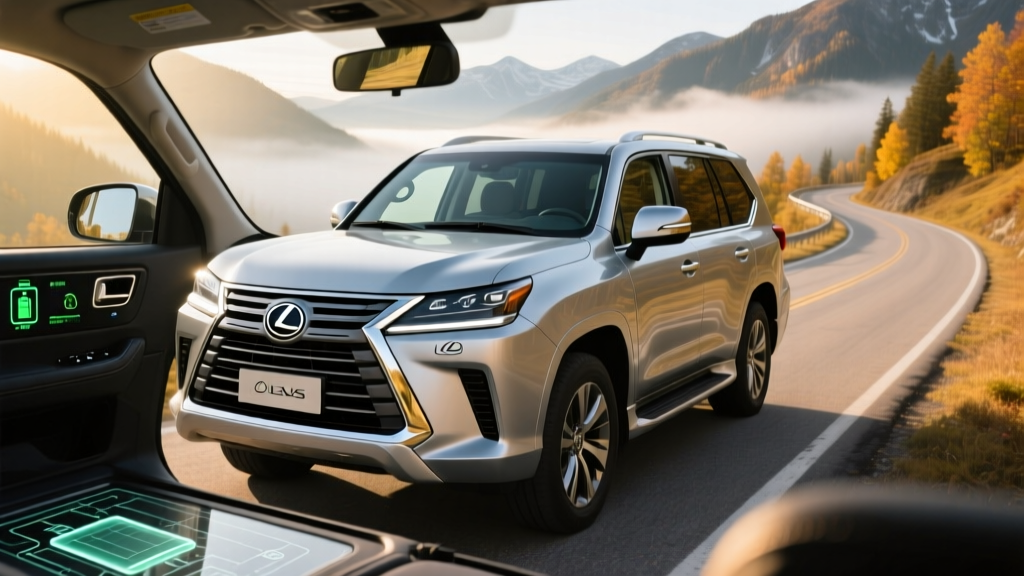
The Lexus GX has long been the body-on-frame choice for buyers who want Land Cruiser-grade capability with a luxury badge. For 2026, the Lexus GX hybrid — officially the GX 550h — pairs a twin-turbo V6 with an electric motor in Toyota's i-FORCE MAX powertrain. It's a conventional hybrid (HEV), not a plug-in, meaning there's no cord to deal with and no electric-only range to manage. But does the efficiency gain justify the premium over the gas-only GX 550?
This guide breaks down the 2026 Lexus GX Hybrid's real-world MPG, powertrain output, battery longevity, warranty coverage, pricing, and where it fits in the broader hybrid-vs-PHEV-vs-EV decision.
HEV vs PHEV: What the 2026 Lexus GX 550h Actually Is
Before diving into numbers, it's essential to distinguish what the GX 550h is — and isn't.
Conventional Hybrid (HEV) — Lexus GX 550h
- No plug-in charging required — the battery charges via regenerative braking and the engine
- No electric-only driving range (the motor assists the engine but can't propel the SUV alone at meaningful speeds)
- Small traction battery (~1.5–2 kWh) sealed into the powertrain
- Efficiency gains come from engine load reduction, stop/start elimination, and regen
Plug-In Hybrid (PHEV) — Not Offered on the GX
- Larger battery (typically 15–25 kWh) charged via a plug
- 20–40 miles of electric-only range before the engine kicks in
- Eligible for partial federal tax credits under IRS §30D if battery sourcing and MSRP caps are met
- Requires home or workplace charging access to realize full benefit
Lexus does not offer a PHEV variant of the GX for 2026. If you want plug-in capability in a body-on-frame luxury SUV, you're looking at competitors like the Jeep Wrangler 4xe or the BMW X5 xDrive50e — both of which sacrifice some off-road geometry or cargo space for their larger battery packs. The GX 550h keeps things simpler: fill up with gas and drive.
2026 Lexus GX 550h Powertrain and Performance Specs
| Specification | 2026 Lexus GX 550h |
|---|---|
| Engine | 3.4L twin-turbo V6 + electric motor (i-FORCE MAX) |
| Combined Horsepower | 326 HP |
| Combined Torque | 465 lb-ft |
| Transmission | 10-speed automatic |
| Drivetrain | Full-time 4WD |
| 0–60 mph | ~6.5 seconds (est.) |
| Towing Capacity | 6,000 lbs |
| Hybrid Battery | ~1.5 kWh NiMH (sealed, self-charging) |
| Base MSRP | $72,450 (Premium trim) |
The i-FORCE MAX system is shared with the Toyota Land Cruiser and Tundra Hybrid. The electric motor sits between the engine and transmission, providing torque fill at low RPMs and smoothing out the twin-turbo V6's power delivery. The result is strong off-the-line acceleration and confident highway merging without the lag you'd feel in a turbo-only setup.
Fuel Economy: EPA MPG and Real-World Expectations
| Driving Cycle | EPA Estimate | Real-World Expectation |
|---|---|---|
| City | 22 MPG | 21–24 MPG (hybrids often beat EPA in stop-and-go) |
| Highway | 21 MPG | 19–21 MPG (aerodynamic drag hurts at 75+ mph) |
| Combined | 21 MPG | 20–22 MPG |
Source: fueleconomy.gov
These numbers may look modest until you consider what the GX 550h replaces: the previous-generation GX 460's 4.6L V8 returned just 15 MPG combined. That's a roughly 40% efficiency improvement in a vehicle that's larger, more powerful, and more capable.
For context, the non-hybrid 2026 GX 550 (same twin-turbo V6 without the electric motor) earns an EPA-estimated 17 MPG combined. The hybrid surcharge pays for itself in fuel savings within roughly 4–5 years for a driver covering 15,000 miles annually at $3.50/gallon.
Real-World MPG Note: Hybrid efficiency shines in city driving, where regenerative braking recaptures energy the gas-only model wastes as heat. On long highway stretches at 80 mph with roof racks or a trailer, expect the GX 550h's advantage over the gas model to narrow. Cold weather (below 30°F) reduces battery assist efficiency by roughly 5–8%, bringing combined real-world MPG closer to 19.
Battery Warranty, Lifespan, and Replacement Cost
Lexus Hybrid Battery Warranty
- Coverage: 10 years / 150,000 miles (whichever comes first)
- What's covered: Defects and capacity loss below a defined threshold
- Transferable: Yes, to subsequent owners — a strong resale-value signal
Lexus and Toyota have built the most extensive real-world hybrid battery longevity data of any automaker. The Prius, now in its 25th year, demonstrates that NiMH hybrid batteries routinely last 150,000–200,000 miles before meaningful degradation. The GX 550h's battery is small (~1.5 kWh), meaning it undergoes shallower charge-discharge cycles than a PHEV or BEV battery, which reduces stress and extends calendar life.
Replacement cost if out of warranty: A Lexus hybrid battery pack replacement typically runs $3,000–$5,000 including labor, based on current RX and LX hybrid service pricing. Independent hybrid battery specialists offer refurbished units for $1,500–$2,500. Given the 10-year/150,000-mile warranty and the shallow-cycle chemistry, most original owners will never face this expense.
Pricing, Trims, and Tax Credit Eligibility
The 2026 Lexus GX 550h starts at approximately $72,450 for the Premium trim, climbing to $82,000+ for the Overtrail and Luxury variants with off-road and premium packages.
Federal Tax Credit: Not Eligible
The Lexus GX 550h is a conventional hybrid (HEV), not a plug-in hybrid or battery-electric vehicle. Under current IRS §30D rules, the federal clean vehicle credit applies only to PHEVs and BEVs that meet battery sourcing, critical mineral, MSRP cap ($80,000 for SUVs), and buyer income requirements.
The GX 550h does not qualify for the §30D credit. Some states offer separate hybrid incentives — check your state's energy office or DMV for current programs.
The hybrid premium over the gas-only GX 550 is roughly $3,000–$4,000 depending on trim. With no federal credit to offset that, the purchase decision rests on fuel savings, driving refinement, and long-term ownership value.
Who Should Choose the GX 550h vs a PHEV or Full EV?
Choose the GX 550h If:
- You want body-on-frame capability (6,000-lb tow, serious off-road geometry) with better fuel economy
- You lack reliable home or workplace charging access
- You tow frequently — PHEVs and EVs lose significant range under trailer load
- You plan to own the vehicle 8–12+ years (Lexus reliability + hybrid simplicity)
- You don't want to manage charging routines or range planning
Look at a PHEV or EV Instead If:
- You have home Level 2 charging and a short commute (a PHEV like the BMW X5 xDrive50e gives 30+ electric miles)
- Daily driving is under 40 miles round-trip — a PHEV or EV eliminates nearly all fuel use
- You want federal tax credits ($3,750–$7,500) to offset a higher purchase price
- Off-road capability and towing aren't priorities
The GX 550h occupies a narrow but defensible niche: it's the most fuel-efficient body-on-frame luxury SUV you can buy without plugging in. If your lifestyle demands that platform — trailers, dirt roads, three-row family hauling in remote areas — the hybrid is the clear pick over the gas-only GX. If your daily routine is a 20-mile commute with a garage charger, a PHEV or BEV will deliver far greater energy-cost savings.
Frequently Asked Questions
How many MPG does the 2026 Lexus GX Hybrid get?
The EPA rates the GX 550h at 22 city / 21 highway / 21 combined MPG. Real-world testing shows hybrids often exceed their EPA city estimate in stop-and-go traffic thanks to regenerative braking, while highway MPG can dip to 19 at sustained speeds above 75 mph.
Does the Lexus GX Hybrid have electric-only range?
No. The GX 550h is a conventional hybrid (HEV), not a plug-in. The electric motor assists the gasoline engine but cannot propel the vehicle on electric power alone at normal driving speeds. You never plug it in — it charges itself through regenerative braking and engine operation.
Is the GX 550h reliable, and what does a battery replacement cost?
Lexus consistently ranks at or near the top of J.D. Power and Consumer Reports reliability studies. The hybrid system adds proven Toyota components used across millions of vehicles. The hybrid battery is warranted for 10 years / 150,000 miles, and out-of-warranty replacement runs $3,000–$5,000 at a dealer or $1,500–$2,500 through an independent specialist.
Does the 2026 Lexus GX Hybrid qualify for a federal tax credit?
No. Federal clean vehicle credits under IRS §30D apply only to plug-in hybrids (PHEVs) and battery-electric vehicles (BEVs). The GX 550h is a self-charging conventional hybrid and is not eligible. Check your state for any local hybrid incentives.
How does the GX 550h compare to the gas-only GX 550?
The gas-only GX 550 makes 349 HP (23 more than the hybrid) but earns just 17 MPG combined vs the hybrid's 21 MPG. The hybrid provides smoother low-speed torque delivery and eliminates turbo lag. The trade-off is roughly $3,000–$4,000 more upfront and slightly less peak horsepower — a worthwhile exchange for most buyers in this segment.
Hybrid vs PHEV vs EV — which powertrain fits my lifestyle?
If you charge at home and commute under 40 miles, a PHEV or EV eliminates most fuel costs. If you tow, drive off-road, or lack charging access, a conventional hybrid like the GX 550h delivers efficiency gains without lifestyle compromise. The GX 550h is purpose-built for buyers who need body-on-frame capability and want to reduce — but not eliminate — their fuel consumption.