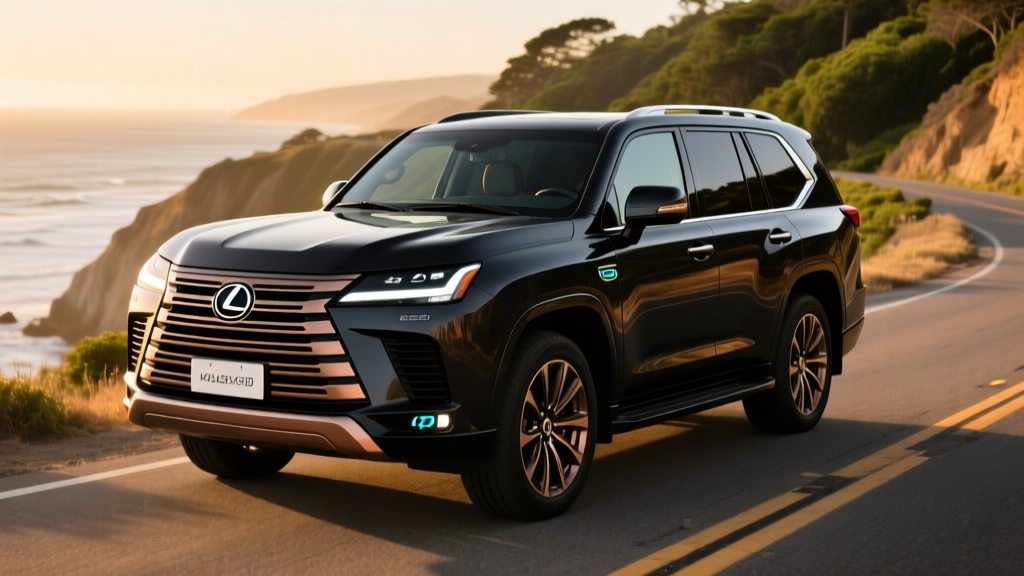
The Lexus GX has long been the body-on-frame SUV buyers turn to when they want Land Cruiser-grade capability wrapped in a quieter, more refined cabin. For 2026, the big question is whether the Lexus GX 550 Hybrid variant — built around Toyota's i-FORCE MAX twin-turbo hybrid powertrain — delivers meaningful fuel-economy gains over the standard GX 550 without sacrificing the towing and off-road chops the nameplate is known for.
This guide breaks down the 2026 Lexus GX 550 Hybrid's powertrain, EPA fuel economy, real-world efficiency expectations, pricing, warranty coverage, and where it fits in the broader hybrid-versus-PHEV-versus-EV decision. If you're researching whether this is the right electrified three-row SUV for your driveway, the data below should make that call a lot easier.
HEV vs PHEV: What the Lexus GX 550 Hybrid Actually Is
Before getting into the numbers, it's essential to clarify what the Lexus GX 550 Hybrid is — and what it isn't.
Conventional Hybrid (HEV)
The GX 550 Hybrid is a conventional hybrid (HEV). It pairs a gasoline engine with a small electric motor and a compact battery pack that recharges through regenerative braking and the engine itself. You never plug it in. You fuel it at a gas station like any other vehicle, and the hybrid system works in the background to reduce fuel consumption, particularly in stop-and-go driving.
Plug-In Hybrid (PHEV)
A plug-in hybrid (PHEV) like the Toyota RAV4 Prime or Jeep Wrangler 4xe carries a much larger battery (typically 15–25 kWh) that you charge from a wall outlet or Level 2 charger. PHEVs deliver 25–50 miles of electric-only driving before the gasoline engine kicks in. The GX 550 Hybrid does not offer this capability.
Full EV (BEV)
A battery-electric vehicle has no gasoline engine at all. If you're considering a fully electric three-row SUV, competitors like the Kia EV9 or Rivian R1S operate in a different category entirely — with zero tailpipe emissions, home charging requirements, and eligibility for the full §30D federal tax credit (subject to income, MSRP, and battery-sourcing rules).
Lexus currently does not offer a PHEV version of the GX. If plug-in capability is a must-have for your large SUV, you'll need to look at competitors or wait for potential future variants.
Powertrain: i-FORCE MAX Twin-Turbo V6 Hybrid Specs
The 2026 Lexus GX 550 Hybrid uses Toyota's i-FORCE MAX powertrain, which sandwiches an electric motor between the twin-turbocharged 3.4-liter V6 engine and the 10-speed automatic transmission. This is the same architecture found in the Toyota Tundra i-FORCE MAX and Sequoia, tuned here for the GX's luxury-SUV mission.
| Specification | Detail |
|---|---|
| Engine | 3.4L Twin-Turbo V6 (V35A-FTS) |
| Electric Motor | Integrated between engine and transmission |
| Combined Horsepower | ~463 hp (estimated, final 2026 specs pending) |
| Combined Torque | ~583 lb-ft (estimated) |
| Transmission | 10-speed automatic |
| Drivetrain | Full-time 4WD with low range |
| Hybrid Battery | ~1.5 kWh nickel-metal hydride (NiMH), self-charging |
| Towing Capacity | Up to ~8,000 lbs (estimated) |
| 0–60 mph | ~6.0 seconds (estimated) |
The electric motor fills in torque at low RPMs before the turbos fully spool, which gives the GX 550 Hybrid noticeably stronger off-the-line acceleration than a conventional turbo V6 alone. The small battery pack is there to buffer energy — not to provide meaningful electric-only range. Expect maybe a quarter-mile of EV creep at very low speeds in parking lots, but functionally, this is a gas-powered SUV with hybrid assist.
Fuel Economy: EPA MPG and Real-World Expectations
This is the metric most hybrid shoppers care about first. The standard (non-hybrid) Lexus GX 550 with the twin-turbo V6 returns roughly 15 city / 21 highway / 17 combined MPG per EPA estimates on fueleconomy.gov. The i-FORCE MAX hybrid variant is designed to improve on those figures, particularly in city driving where regenerative braking and electric-motor assist do the most work.
| Driving Cycle | Standard GX 550 (EPA) | GX 550 Hybrid (Est.) |
|---|---|---|
| City | 15 MPG | ~19–22 MPG |
| Highway | 21 MPG | ~21–24 MPG |
| Combined | 17 MPG | ~20–23 MPG |
Note: Final 2026 EPA figures for the GX 550 Hybrid were not yet published at the time of writing. Estimates above are based on the i-FORCE MAX hybrid system's performance in the Toyota Sequoia (21 city / 24 hwy / 22 combined) and Tundra (19–20 city / 22–24 hwy). Check fueleconomy.gov for the official numbers once released.
Real-World MPG vs. EPA Sticker
Conventional hybrids typically exceed their EPA city rating in real-world stop-and-go driving because regenerative braking captures energy that a gas-only vehicle wastes as heat. On the highway, where the engine does most of the work and aero drag dominates, real-world MPG often lands slightly below the EPA highway number.
For the GX 550 Hybrid, expect:
- City / suburban driving: Real-world MPG may match or slightly exceed the EPA city estimate — the hybrid system shines here.
- Highway cruising at 75+ mph: Expect roughly 1–3 MPG below the EPA highway number. The GX's boxy shape and body-on-frame weight work against it.
- Towing: Fuel economy drops dramatically when towing — expect 10–13 MPG with a loaded trailer, hybrid or not.
- Cold weather: Hybrids lose some efficiency in winter because the engine runs more frequently to provide cabin heat and because battery chemistry is less efficient at low temperatures. Budget a 10–15% reduction in MPG during sustained sub-freezing driving.
Pricing, Trims, and Tax Credit Eligibility
The 2026 Lexus GX 550 lineup starts in the mid-$60,000 range for the base Premium trim with the standard twin-turbo V6. The i-FORCE MAX hybrid powertrain is expected to be available on higher trims (likely Overtrail and Luxury), adding a premium of roughly $2,000–$4,000 over the equivalent non-hybrid trim.
| Trim | Standard V6 MSRP (Est.) | Hybrid i-FORCE MAX MSRP (Est.) |
|---|---|---|
| Premium | ~$64,000 | N/A (hybrid not expected on base) |
| Premium+ | ~$69,000 | ~$71,000–$73,000 |
| Overtrail | ~$73,000 | ~$75,000–$77,000 |
| Luxury | ~$81,000 | ~$83,000–$85,000 |
Pricing is estimated based on the outgoing model year. Confirm final MSRP with your Lexus dealer.
Does the Lexus GX 550 Hybrid Qualify for a Federal Tax Credit?
No. Under IRS §30D rules, the federal clean vehicle credit of up to $7,500 is available only for plug-in electric vehicles — battery-electric vehicles (BEVs) and plug-in hybrids (PHEVs) that meet battery capacity, critical-mineral sourcing, MSRP caps, and buyer income limits. A conventional hybrid (HEV) like the GX 550 Hybrid does not qualify for the §30D credit because it has no plug-in capability.
Some states and utilities offer smaller rebates for conventional hybrids, but these vary widely by jurisdiction and are often modest ($250–$1,000). Check your state's energy office or utility provider for current programs. For the full rules on plug-in vehicle credits, see IRS.gov's clean vehicle tax credits page.
Battery Warranty, Reliability, and Replacement Cost
Hybrid battery longevity is consistently the top concern for first-time hybrid buyers. Here's what the data actually shows.
Lexus Hybrid Battery Warranty
Lexus covers the hybrid battery in the GX 550 Hybrid with a 10-year / 150,000-mile warranty (whichever comes first). This covers defects and capacity loss below a defined threshold. Lexus's hybrid systems have been in production since 2004 (RX 400h), and real-world failure data from millions of Toyota/Lexus hybrids on the road shows that NiMH hybrid batteries routinely last 150,000–200,000+ miles before significant degradation.
Is the GX 550 Hybrid Reliable?
The i-FORCE MAX powertrain is shared with the Toyota Tundra and Sequoia, which have accumulated substantial real-world mileage since the 2022 model year. Early reports have been generally positive, though some Tundra owners noted minor issues with the hybrid system's transition between electric and gas power at low speeds — something Toyota has addressed through software updates. The GX, being a later application of the same system, benefits from those refinements.
Lexus as a brand consistently ranks at or near the top of J.D. Power and Consumer Reports reliability surveys. The body-on-frame GX platform (shared with the Land Cruiser 300 Series) is proven in global markets.
Hybrid Battery Replacement Cost
If the hybrid battery does fail outside warranty, replacement cost for a Lexus/Toyota NiMH hybrid battery pack typically ranges from $2,000 to $4,000 including labor. This is far less than a full EV traction battery replacement ($8,000–$20,000+), because the hybrid battery is small (~1.5 kWh) and uses mature NiMH chemistry. Third-party refurbishment options are also available for $1,000–$2,000.
Who Should Choose the GX 550 Hybrid vs. a Full EV or Gas SUV
Decision Framework: Is the GX 550 Hybrid Right for You?
Choose the Lexus GX 550 Hybrid if:
- You want a body-on-frame, three-row luxury SUV with genuine off-road and towing capability (8,000 lbs).
- You drive in a lot of stop-and-go traffic and want to reduce fuel consumption without changing your fueling habits.
- You don't have access to home charging and aren't ready to rely on public charging infrastructure.
- You want Lexus reliability and resale value with a modest efficiency bump over the standard V6.
Choose the standard GX 550 (non-hybrid) if:
- You want the lowest purchase price and plan to keep the vehicle for a shorter ownership cycle.
- Most of your driving is highway, where the hybrid advantage is smallest.
Choose a full EV (e.g., Rivian R1S, Kia EV9) if:
- You have reliable home Level 2 charging and want the lowest per-mile "fuel" cost (electricity at $0.12/kWh ≈ $0.04/mile vs. gas at $3.50/gal ≈ $0.21/mile for 17 MPG).
- You want to qualify for the up-to-$7,500 federal tax credit under §30D (eligibility varies — check IRS rules).
- You don't regularly tow heavy trailers (EV range drops significantly when towing).
Choose a PHEV (e.g., Volvo XC90 Recharge) if:
- You want 30–40 miles of electric-only commuting with a gas engine for road trips.
- You have home charging and want to drive most weekdays on electricity while keeping gas flexibility.
Pros
- Significant city MPG improvement over the standard twin-turbo V6
- Instant electric-motor torque fills in turbo lag for strong acceleration
- No plug-in charging required — fuel like a normal gas vehicle
- 10-year / 150,000-mile hybrid battery warranty
- Full-time 4WD, low range, and ~8,000-lb towing retained
- Lexus reliability and strong resale value
Cons
- No electric-only driving range — this is not a PHEV
- No federal tax credit eligibility (§30D requires plug-in capability)
- Highway MPG improvement over the standard V6 is modest
- Hybrid system adds cost and complexity (though proven in Tundra/Sequoia)
- Fuel economy still trails unibody crossovers and all EVs on a per-mile cost basis
- Boxy, heavy platform limits maximum efficiency potential
Frequently Asked Questions
How many MPG does the Lexus GX 550 Hybrid get?
The standard Lexus GX 550 is EPA-rated at approximately 15 city / 21 highway / 17 combined MPG. The i-FORCE MAX hybrid variant is expected to deliver roughly 19–22 city / 21–24 highway / 20–23 combined MPG, based on the same powertrain's performance in the Toyota Sequoia. Final 2026 EPA figures should be confirmed on fueleconomy.gov.
Can the Lexus GX 550 Hybrid drive on electric power only?
Only for very short distances at extremely low speeds (parking lot creeping). The hybrid battery is approximately 1.5 kWh — far too small for meaningful electric-only range. This is a conventional hybrid, not a plug-in hybrid. If you want 30+ miles of EV driving, you need a PHEV or a full BEV.
Does the Lexus GX 550 Hybrid qualify for the $7,500 federal tax credit?
No. The IRS §30D Clean Vehicle Credit applies only to plug-in electric vehicles (BEVs and PHEVs) that meet battery sourcing, MSRP, and buyer income requirements. A conventional hybrid like the GX 550 Hybrid does not qualify. See IRS.gov for current rules.
Is the hybrid battery reliable, and what does replacement cost?
Lexus covers the hybrid battery for 10 years / 150,000 miles. Toyota/Lexus NiMH hybrid batteries have a strong track record of lasting 150,000–200,000+ miles. Out-of-warranty replacement typically costs $2,000–$4,000 — far less than an EV battery replacement.
Do I need to plug in the Lexus GX 550 Hybrid?
No. The GX 550 Hybrid is a conventional (self-charging) hybrid. The battery recharges through regenerative braking and the gasoline engine. You fuel it exclusively at a gas station.
How does the GX 550 Hybrid compare to the Toyota Sequoia hybrid?
Both use the i-FORCE MAX twin-turbo V6 hybrid system. The Sequoia is larger, more family-hauler-oriented, and starts around $62,000. The GX is more compact, more off-road-capable (with available locking differentials and disconnecting stabilizer bar), and positioned as a luxury vehicle. Fuel economy is similar between the two, with the Sequoia slightly higher due to tuning.
Hybrid vs PHEV vs EV — which is right for a large SUV buyer?
If you can't charge at home, a conventional hybrid (HEV) like the GX 550 Hybrid is the pragmatic choice — no infrastructure needed. If you have home charging and want to commute on electricity with gas backup, a PHEV gives you the best of both worlds (but no body-on-frame PHEV SUVs match the GX's off-road capability). If you have home charging, don't tow heavy, and want the lowest running costs, a full EV like the Rivian R1S offers the most savings over time.