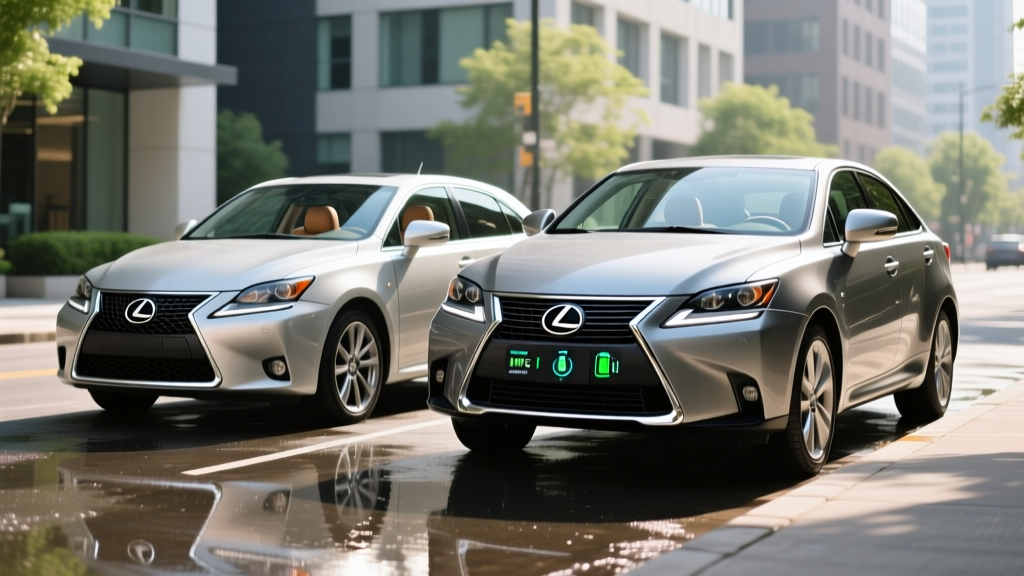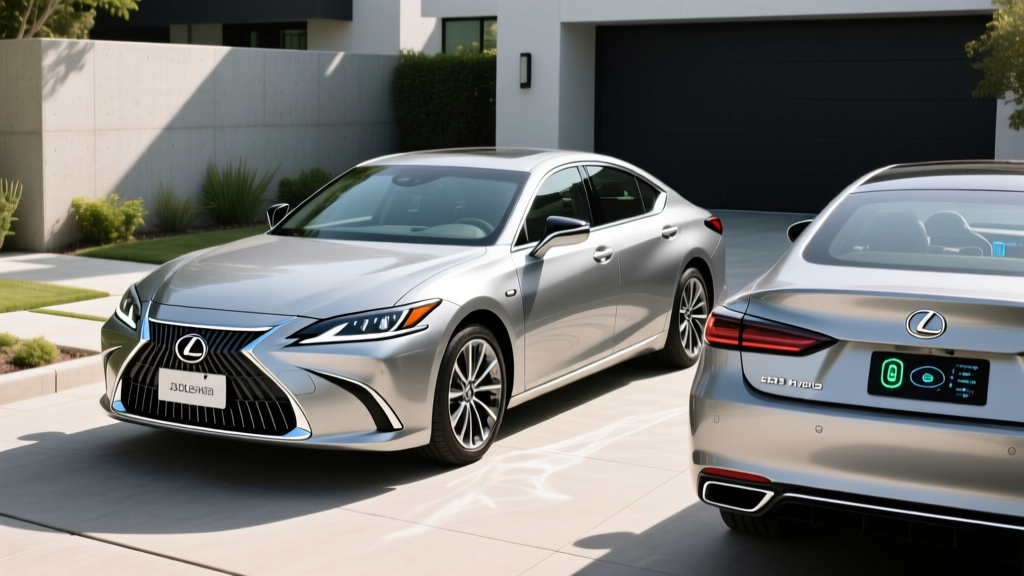
The Lexus ES350 Hybrid occupies a specific niche in the luxury midsize sedan segment: it pairs traditional Lexus refinement with a gasoline-electric hybrid powertrain that prioritizes fuel economy over plug-in complexity. For 2026, the ES350 Hybrid continues to attract buyers who want premium comfort and strong MPG without ever needing to plug in. This guide covers the exact EPA fuel economy figures, real-world efficiency expectations, powertrain specifications, battery longevity data, and whether any tax credits apply — giving you the numbers you need to make an informed purchase decision.
What the Lexus ES350 Hybrid Actually Is: HEV vs PHEV
Before examining specs, it is essential to establish what the Lexus ES350 Hybrid is — and what it is not. The ES350 Hybrid is a conventional hybrid electric vehicle (HEV). It charges its battery exclusively through regenerative braking and the gasoline engine. You never plug it in.
HEV vs PHEV: Key Differences
| Feature | HEV (Lexus ES350 Hybrid) | PHEV (Plug-In Hybrid) |
|---|---|---|
| Plug-in charging | No — self-charging | Yes — plug in for electric-only miles |
| Electric-only range | ~1 mile at low speed | 20–45 miles typical |
| Battery size | ~1.6 kWh (small) | 13–25 kWh (large) |
| Federal tax credit (§30D) | Not eligible | Up to $7,500 if criteria met |
| Best for | No home charging access; simplicity | Home charging + short daily commute |
Lexus does not currently offer the ES sedan as a plug-in hybrid. If you are searching for a Lexus PHEV, the closest options in the lineup are the NX 450h+ and RX 450h+ SUVs. The ES350 Hybrid remains strictly an HEV, which is a deliberate choice: it eliminates charging infrastructure requirements while still delivering substantial fuel savings over the gas-only ES350.
Fuel Economy: EPA Ratings and Real-World MPG
The headline number for the 2026 Lexus ES350 Hybrid is its EPA-estimated fuel economy. According to fueleconomy.gov, the ratings break down as follows:
| Driving Cycle | EPA Estimate |
|---|---|
| City | 43 MPG |
| Highway | 44 MPG |
| Combined | 44 MPG |
Real-World MPG vs EPA Sticker
Toyota and Lexus hybrids historically perform well against — and sometimes exceed — their EPA estimates in city driving. The hybrid system's regenerative braking recaptures energy during stop-and-go traffic, which is precisely the scenario where conventional gasoline engines are least efficient. In real-world ownership, many ES350 Hybrid drivers report 42–47 MPG combined depending on driving style, climate, and route composition.
Highway-only driving at sustained speeds above 70 mph tends to produce results closer to the low 40s, as the electric motor assists less at constant velocity and aerodynamic drag dominates. In cold weather (below 35°F), expect a temporary 3–5 MPG reduction as the engine runs more frequently to heat the cabin and warm the hybrid battery to optimal operating temperature. Unlike full EVs, which can lose 20–30% of range in winter, the ES350 Hybrid's fuel economy penalty in cold conditions is modest.
Annual Fuel Cost Estimate
At 15,000 miles per year and $3.50 per gallon of premium fuel (the ES350 Hybrid recommends premium unleaded), annual fuel cost runs approximately $1,193. Compare that to the gas-only ES350 at roughly 26 MPG combined, which would cost about $2,019 per year — a savings of over $800 annually with the hybrid.
Powertrain Specifications and Performance
The 2026 Lexus ES350 Hybrid uses Toyota's fourth-generation hybrid system, pairing a 2.5-liter inline-four Atkinson-cycle gasoline engine with a permanent-magnet electric motor through an electronically controlled continuously variable transmission (eCVT).
| Specification | Value |
|---|---|
| Engine | 2.5L inline-4 Atkinson cycle |
| Engine horsepower | 176 hp |
| Electric motor output | 134 hp |
| Combined system horsepower | 215 hp |
| Combined system torque | 163 lb-ft (engine) + 199 lb-ft (motor) |
| Transmission | eCVT |
| Drivetrain | Front-wheel drive |
| 0–60 mph | ~8.1 seconds |
| Hybrid battery capacity | ~1.6 kWh (nickel-metal hydride) |
| Fuel tank | 13.2 gallons |
| Total driving range | ~580 miles |
The 215 combined horsepower figure is adequate for confident highway merging and passing but not sporty. The eCVT delivers seamless, shift-free acceleration that suits the ES sedan's luxury-oriented character. This is a powertrain designed for smoothness and efficiency, not track performance. If acceleration priority is high, the gas-only ES350 with its 302-hp V6 is notably quicker (0–60 in approximately 6.6 seconds), though at a significant fuel-economy penalty.
Battery Warranty, Lifespan, and Replacement Cost
Hybrid battery longevity is consistently the top concern among first-time hybrid buyers. Here is what the data shows for the Lexus ES350 Hybrid:
Lexus Hybrid Battery Warranty
- Coverage period: 10 years or 150,000 miles (whichever comes first)
- What is covered: Hybrid battery pack, hybrid control module, and related hybrid system components
- Capacity threshold: Warranty applies if the battery fails to hold sufficient charge to operate the hybrid system properly
- Transferable: Yes, warranty transfers to subsequent owners at no cost
Real-World Hybrid Battery Longevity
Lexus and Toyota hybrid batteries have demonstrated exceptional longevity in real-world use. The nickel-metal hydride (NiMH) battery pack in the ES350 Hybrid is conservative in its charge-discharge cycling — the system never fully depletes or fully charges the battery, keeping it in a narrow state-of-charge window that dramatically extends cell life. Data from Toyota/Lexus hybrids in fleet and taxi service routinely shows hybrid batteries lasting 200,000 to 300,000+ miles without replacement.
For context, a study of Toyota Prius hybrids (which use a similar hybrid architecture) found battery failure rates below 1.5% within the warranty period. The ES350 Hybrid benefits from the same engineering philosophy and manufacturing quality.
Battery Replacement Cost If Needed
If the hybrid battery does require replacement after the warranty period, a new OEM Lexus ES350 Hybrid battery pack typically costs between $2,500 and $4,000 including parts and labor at a dealership. Independent hybrid specialists may offer refurbished battery packs for $1,500–$2,500. Given that most ES350 Hybrid owners will sell or trade the vehicle long before 200,000 miles, the probability of personally funding an out-of-warranty battery replacement is low.
Pricing, Trims, and Tax Credit Eligibility
The 2026 Lexus ES350 Hybrid is available in several trims. Pricing starts in the mid-$40,000 range:
| Trim | MSRP (approx.) |
|---|---|
| ES 350h Base | $44,590 |
| ES 350h Premium | $47,290 |
| ES 350h Luxury | $50,890 |
| ES 350h F SPORT Design | $48,590 |
Note: Prices include destination charge and are approximate based on manufacturer data. Verify exact pricing with your local Lexus dealer.
Federal Tax Credit: Does the ES350 Hybrid Qualify?
No. The Lexus ES350 Hybrid does not qualify for the federal IRS §30D Clean Vehicle Credit. This credit — up to $7,500 — applies only to plug-in electric vehicles (BEVs and PHEVs) that meet battery capacity, critical-mineral sourcing, MSRP cap, and buyer income requirements. Because the ES350 Hybrid is a conventional HEV with no plug-in capability, it is categorically excluded from §30D.
Some states offer separate incentives for conventional hybrids, though these are increasingly rare as state programs shift focus to zero-emission vehicles. Check your state's energy or environmental agency website for current hybrid-specific rebates. As of 2026, no major state incentives specifically target HEV purchases.
Who Should Choose the Lexus ES350 Hybrid?
Pros
- 44 MPG combined EPA — exceptional for a luxury midsize sedan
- No plug-in charging required — works with any lifestyle
- 10-year/150,000-mile hybrid battery warranty
- Proven Toyota/Lexus hybrid reliability with low failure rates
- Smooth, quiet eCVT powertrain well-suited to luxury sedan character
- ~580 miles total range between fill-ups
- Strong resale value typical of Lexus products
Cons
- No electric-only driving range (unlike PHEVs)
- No federal tax credit eligibility
- 215 hp is adequate but not quick — 8.1-second 0–60 time
- Requires premium unleaded fuel
- FWD only — no all-wheel-drive option on the hybrid
- Infotainment system learning curve for some users
Decision Framework: Hybrid vs PHEV vs Full EV
Choose the Lexus ES350 Hybrid (HEV) if: You want maximum fuel efficiency without changing your refueling habits. You lack access to home or workplace charging. You want luxury sedan comfort with low operating costs and proven reliability. You drive a mix of city and highway miles.
Choose a PHEV (like the Lexus RX 450h+ or BMW 330e) if: You have reliable home Level 2 charging and a daily commute under 30 miles. You want electric-only driving for most trips but gasoline backup for road trips. You may qualify for the $7,500 federal tax credit on qualifying PHEV models.
Choose a full EV (like the Tesla Model S, BMW i5, or Mercedes EQE) if: You have home charging and want zero tailpipe emissions. Your daily driving is under 250 miles. You want the lowest per-mile fuel cost and minimal maintenance. You qualify for federal and state EV incentives.
Frequently Asked Questions
How many MPG does the Lexus ES350 Hybrid get?
The 2026 Lexus ES350 Hybrid is EPA-rated at 43 MPG city, 44 MPG highway, and 44 MPG combined. Real-world results typically fall between 42 and 47 MPG combined, with city-heavy driving often exceeding the EPA estimate thanks to regenerative braking.
How far can the Lexus ES350 Hybrid go on electric only?
Effectively about 1 mile at very low speeds (under 25 mph) on flat terrain. The ES350 Hybrid is a conventional HEV, not a plug-in hybrid — its small ~1.6 kWh battery is not designed for meaningful electric-only driving. The electric motor assists the gasoline engine continuously but does not power the car independently for any significant distance.
Is the Lexus ES350 Hybrid reliable?
Yes. Lexus consistently ranks at or near the top of J.D. Power and Consumer Reports reliability surveys. The Toyota/Lexus hybrid system is one of the most proven electrified powertrains in production, with millions of units on the road globally. The hybrid battery carries a 10-year/150,000-mile warranty, and real-world failure rates within the warranty period are extremely low (estimated below 1.5%).
What does a Lexus hybrid battery replacement cost?
An OEM replacement hybrid battery for the ES350 Hybrid costs approximately $2,500–$4,000 at a Lexus dealership, including parts and labor. Refurbished options from independent hybrid specialists may cost $1,500–$2,500. However, most hybrid batteries last 200,000+ miles, making out-of-pocket replacement uncommon for typical owners.
Does the Lexus ES350 Hybrid qualify for any tax credit?
No. The federal IRS §30D Clean Vehicle Credit applies only to plug-in electric vehicles (BEVs and PHEVs). The ES350 Hybrid is a conventional HEV and is not eligible for the federal credit. Some states may offer minor hybrid incentives, but these are increasingly rare. Check your state's environmental or energy agency for current programs.
Does the ES350 Hybrid require premium fuel?
Yes. Lexus recommends premium unleaded (91 octane or higher) for the ES350 Hybrid. Using lower-octane fuel may reduce performance and efficiency, and could potentially affect warranty coverage if engine damage results.
Is there an all-wheel-drive Lexus ES Hybrid?
As of the 2026 model year, the ES350 Hybrid is offered exclusively with front-wheel drive. The gas-only ES350 is also FWD. If all-wheel drive is a priority in a Lexus sedan, the larger LS lineup or Lexus SUV hybrids (such as the RX 350h, which offers AWD) may be more suitable.
The Bottom Line on the Lexus ES350 Hybrid
The 2026 Lexus ES350 Hybrid delivers exactly what its target buyer wants: 44 MPG combined in a quiet, comfortable luxury sedan with no behavioral changes required. You fuel it like any other car, maintain it on standard Lexus service intervals, and let the hybrid system quietly save you over $800 per year in fuel costs versus the V6 gas model. The 10-year/150,000-mile hybrid battery warranty and Toyota/Lexus track record on hybrid longevity address the primary ownership concern. The trade-offs — no EV tax credit, no electric-only range, and modest acceleration — are acceptable compromises for buyers who prioritize simplicity and fuel efficiency in a premium package.