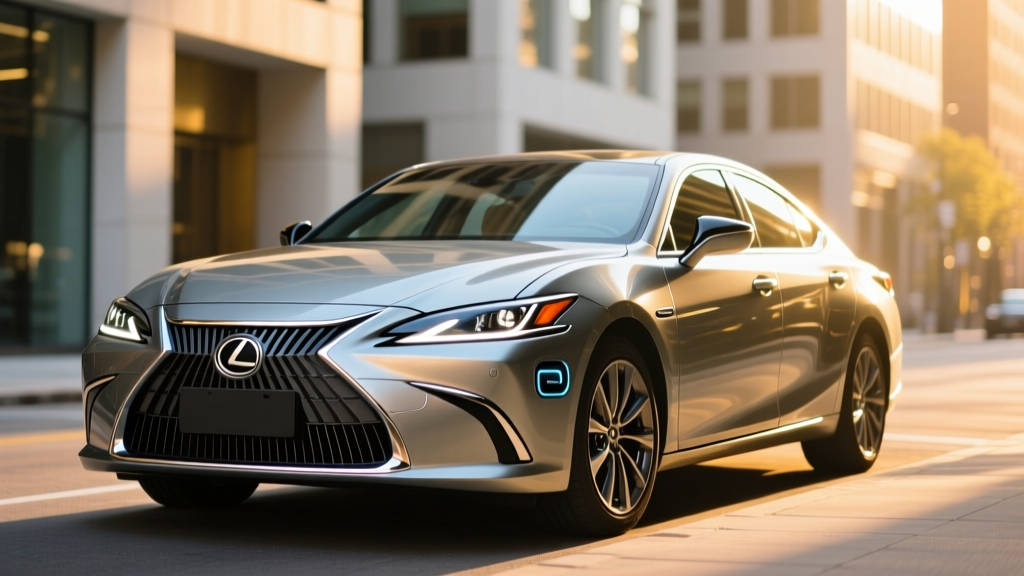
If you've been searching for an ES 350 hybrid, you've likely discovered that Lexus doesn't actually badge a hybrid version of its ES sedan with the "350" designation. The hybrid model in the lineup is the Lexus ES 300h, while the ES 350 carries a conventional V6 gasoline powertrain. This naming quirk trips up plenty of shoppers, so let's clear the air and dig into what the ES 300h actually delivers for the 2026 model year — and whether it's the right electrified sedan for your driveway.
Understanding the ES Lineup: ES 350 vs. ES 300h
Lexus offers the seventh-generation ES sedan in two distinct powertrain flavors for 2026:
ES 350 (Gasoline)
- 3.5L V6, 302 hp
- 8-speed automatic
- EPA: 22 city / 32 hwy / 26 combined MPG
- No hybrid battery, no electric motor
ES 300h (Hybrid / HEV)
- 2.5L 4-cyl + electric motor, 215 hp combined
- eCVT transmission
- EPA: 43 city / 44 hwy / 44 combined MPG
- Self-charging — never needs to be plugged in
The ES 300h is a conventional hybrid (HEV), not a plug-in hybrid (PHEV). That means it generates all its electricity internally through regenerative braking and the gasoline engine. There is no plug, no electric-only driving range to manage, and no home charger to install. You simply fill it with gas and drive — the hybrid system handles the rest.
EPA Fuel Economy and Real-World MPG
| Trim | City MPG | Highway MPG | Combined MPG |
|---|---|---|---|
| ES 300h (all trims) | 43 | 44 | 44 |
| ES 350 (gas V6) | 22 | 32 | 26 |
Source: fueleconomy.gov (EPA)
Hybrids frequently outperform their EPA city estimates in stop-and-go traffic because the electric motor does the heavy lifting at low speeds. In real-world mixed driving, owners consistently report 40–46 MPG combined depending on climate, terrain, and driving style. Highway-heavy commutes at 75+ mph tend to pull the figure toward the low 40s, while city-dominant driving with frequent stops can push it into the mid-to-high 40s.
Powertrain and Performance Specs
| Specification | ES 300h |
|---|---|
| Engine | 2.5L inline-4 (A25A-FXS Dynamic Force) |
| Electric Motor | Permanent-magnet synchronous (front axle) |
| Combined System Output | 215 hp |
| Transmission | eCVT (electronically controlled) |
| 0–60 mph | ~7.7 seconds |
| Drivetrain | Front-wheel drive |
| Hybrid Battery | ~1.6 kWh nickel-metal hydride (NiMH) |
| Curb Weight | ~3,700 lbs |
The ES 300h's 215 combined horsepower is modest by luxury-sedan standards, but the electric motor's instant torque gives it responsive off-the-line acceleration. The eCVT keeps the engine in its most efficient rev range, which is the tradeoff — you won't get the sporty, stepped-shift feel of the ES 350's 8-speed automatic. For a comfort-oriented luxury cruiser, the powertrain is well-matched to the car's mission.
Hybrid vs. Plug-In Hybrid vs. Full EV: Which Fits You?
The ES 300h occupies one specific spot on the electrification spectrum. Here's how the three options compare for a luxury sedan buyer:
| Factor | HEV (ES 300h) | PHEV (e.g., BMW 550e xDrive) | Full BEV (e.g., BMW i5, Mercedes EQE) |
|---|---|---|---|
| Needs a plug? | No | Yes (for EV range) | Yes (always) |
| Electric-only range | 0 miles | ~30–40 miles | 250–350 miles |
| Home charger needed? | No | Recommended (Level 2) | Essential (Level 2) |
| Federal tax credit (§30D) | Not eligible | Up to $7,500 (if sourcing/income rules met) | Up to $7,500 (if sourcing/income rules met) |
| Maintenance complexity | Low (gas + hybrid) | Higher (gas + plug-in system) | Lowest (no engine) |
| Best for | No home charging access; wants efficiency without behavior change | Short commute + home charging + road-trip flexibility | Home charging + daily driving under 300 mi |
Choose the ES 300h (HEV) if you don't have access to home or workplace charging, you want dramatically better fuel economy than a gas sedan, and you don't want to change any habits. Fill up and go.
Choose a PHEV if you can install a Level 2 charger at home, your daily commute is under 40 miles (covering most trips on electricity), and you still want a gas engine for longer road trips.
Choose a full EV if you have reliable home charging, your daily needs fall within ~250 miles, and you want to eliminate gasoline entirely while minimizing maintenance.
Pricing, Trims, and Tax Credit Eligibility
| Trim | 2026 MSRP (est.) |
|---|---|
| ES 300h Base | $45,890 |
| ES 300h Luxury | $48,390 |
| ES 300h F SPORT Design | $49,890 |
| ES 300h Ultra Luxury | $53,390 |
Pricing is estimated based on 2025 carryover; confirm with your local Lexus dealer for exact 2026 figures.
The ES 300h is a conventional hybrid (HEV), not a plug-in vehicle. Under IRS §30D rules, only plug-in electric vehicles (PHEVs and BEVs) with a battery capacity of at least 7 kWh qualify for the federal tax credit. The ES 300h's ~1.6 kWh NiMH battery does not meet this threshold.
- IRS §30D New Clean Vehicle Credit: Not applicable (no plug)
- IRS §25D (previously owned clean vehicle): Not applicable
- State-level hybrid incentives: Vary by jurisdiction — check your state's energy office or DMV for any current hybrid rebates or HOV lane access programs
Battery Warranty, Lifespan, and Replacement Cost
- Coverage: 10 years / 150,000 miles (whichever comes first)
- What's covered: Hybrid battery pack and hybrid system components (inverter, electric motor, control modules)
- Capacity threshold: Lexus replaces or reconditions if the battery falls below a defined performance level during the warranty period
Toyota and Lexus have decades of hybrid data behind them. The ES 300h's nickel-metal hydride battery is smaller and less stressed than a PHEV or BEV pack, and real-world longevity data from the broader Lexus/Toyota hybrid fleet shows these batteries routinely lasting 150,000–200,000+ miles before needing attention. Unlike the large lithium-ion packs in full EVs, the ES 300h's hybrid battery operates in a narrow state-of-charge window, which significantly reduces degradation.
If you do face an out-of-warranty replacement, a new OEM hybrid battery for the ES 300h typically runs $2,500–$4,000 including labor — a fraction of the $10,000–$20,000+ that full EV battery replacements can cost. Third-party reconditioned batteries are available for less. This is one of the most affordable electrified-vehicle battery replacement scenarios in the market.
Reliability, Safety, and Ownership Costs
Lexus consistently ranks at or near the top of J.D. Power and Consumer Reports reliability studies, and the ES 300h benefits from a powertrain shared across millions of Toyota/Lexus hybrids. The hybrid system adds fewer moving parts than you might expect — there's no traditional starter motor, no alternator, and the eCVT has no belts, bands, or clutch packs to wear out. Brake pad life is also extended significantly thanks to regenerative braking handling most deceleration.
The ES 300h carries strong safety credentials. Check current ratings from IIHS and NHTSA for the latest crash-test results. The Lexus Safety System+ 3.0 suite includes adaptive cruise control, lane-trace assist, pre-collision with pedestrian detection, and road-sign assist — all standard.
| Cost Factor | ES 300h (est.) | ES 350 Gas (est.) |
|---|---|---|
| MSRP (base) | $45,890 | $43,490 |
| Fuel (5 yr, 15k mi/yr, $3.40/gal) | ~$5,800 | ~$9,800 |
| Maintenance (5 yr) | ~$2,800 | ~$3,200 |
| Insurance (5 yr avg.) | ~$9,500 | ~$9,200 |
| Estimated 5-yr depreciation | ~$18,000 | ~$17,500 |
| Total 5-yr cost (est.) | ~$81,990 | ~$83,190 |
The ES 300h's fuel savings of roughly $4,000 over five years more than offset its higher starting MSRP compared to the gas ES 350. The break-even point typically arrives within 2–3 years of average driving.
Pros
- 44 MPG combined — best-in-class for a midsize luxury sedan
- No plug, no charger, no behavior change required
- 10-year/150,000-mile hybrid battery warranty
- Exceptional Lexus reliability record
- Quiet, refined ride with strong sound isolation
- Low battery replacement cost if needed ($2,500–$4,000)
Cons
- Not eligible for any federal tax credit
- 215 hp is adequate, not sporty — 0-60 in ~7.7 sec
- eCVT drone under hard acceleration
- No all-wheel-drive option (FWD only)
- Infotainment system still lags German rivals in responsiveness
- Modest trunk space vs. competitors (16.7 cu ft)
Who Should Buy the ES 300h — and Who Shouldn't
Choose the ES 300h if:
- You want luxury-sedan comfort with 44 MPG and zero lifestyle changes
- You live in an apartment or lack home/workplace charging access
- You drive 12,000–20,000 miles per year and want to minimize fuel costs
- You prioritize long-term reliability and low maintenance costs
- You plan to keep the car 8+ years (the hybrid system pays dividends over time)
Look elsewhere if:
- You want electric-only commuting — consider a PHEV like the BMW 550e or a full EV like the Hyundai Ioniq 6
- You want sporty acceleration — the ES 350 V6 or a German turbo-6 sedan will be more engaging
- You need all-wheel drive — the ES 300h is FWD only; look at the Lexus RX 350h or a PHEV SUV
- You want a federal tax credit — only PHEVs and BEVs qualify under current IRS §30D rules
Frequently Asked Questions
Is there a Lexus ES 350 hybrid?
No. Lexus designates the hybrid ES sedan as the ES 300h. The ES 350 is the gasoline-only V6 model. If you're searching for an "ES 350 hybrid," the ES 300h is the car you're actually looking for.
How many MPG does the ES 300h get?
The EPA rates the 2026 ES 300h at 43 city / 44 highway / 44 combined MPG. In real-world driving, owners typically see 40–46 MPG combined, with city-heavy driving often exceeding the EPA estimate thanks to regenerative braking.
Does the ES 300h need to be plugged in?
No. The ES 300h is a conventional hybrid (HEV). Its small battery recharges through regenerative braking and the gasoline engine. There is no plug and no electric-only driving mode.
How far can the ES 300h drive on electric only?
Essentially zero miles in sustained electric-only mode. At very low speeds (parking lots, creeping traffic), the electric motor may propel the car briefly, but the engine engages almost immediately under any meaningful load. If electric-only range matters to you, you need a PHEV or a full EV.
Does the ES 300h qualify for a federal tax credit?
No. The IRS §30D New Clean Vehicle Credit requires a plug-in vehicle with at least 7 kWh of battery capacity. The ES 300h's ~1.6 kWh NiMH battery does not qualify. Check your state's energy office for any local hybrid incentives.
How long will the ES 300h hybrid battery last?
Lexus covers the hybrid battery for 10 years or 150,000 miles. Based on long-term data from Toyota/Lexus hybrids, these batteries commonly last 150,000–200,000+ miles. Out-of-warranty replacement costs approximately $2,500–$4,000.
Is the ES 300h more expensive to maintain than the gas ES 350?
Generally, no. The hybrid system eliminates the starter motor and alternator, and regenerative braking extends brake pad life significantly. Routine maintenance (oil changes, filters, tires) is similar between both models. Over five years, the ES 300h typically costs less to operate thanks to fuel savings.