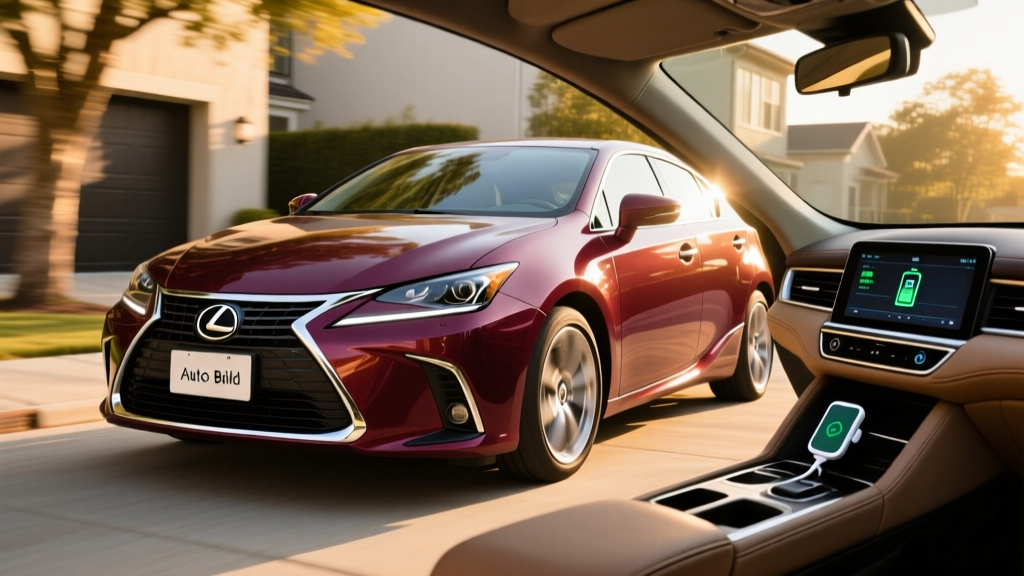
The Lexus CT 200h Hybrid in 2026: A Used-HEV Benchmark
The Lexus CT 200h hybrid was discontinued after the 2017 model year in the United States, but it remains one of the most searched luxury hybrid hatchbacks on the used market. Built on the proven Toyota Prius powertrain architecture and wrapped in a premium Lexus package, the CT 200h carved out a niche as the entry point to luxury hybrid ownership. In 2026, with new EV and hybrid prices climbing and federal tax credit rules tightening, a well-maintained used CT 200h is drawing renewed interest from cost-conscious buyers who want hybrid efficiency without plug-in complexity.
This guide covers everything a prospective buyer or current owner needs: exact EPA fuel economy, real-world MPG data, battery longevity, replacement costs, powertrain specs, and how the CT 200h stacks up against modern alternatives — both plug-in hybrids and full EVs.
Powertrain and Performance Specs
The CT 200h uses Toyota's Hybrid Synergy Drive — the same series-parallel system found in the third-generation Prius (2010–2015), retuned for a more premium driving feel. Here is the exact hardware breakdown:
| Specification | Value |
|---|---|
| Gasoline Engine | 1.8L 4-cylinder Atkinson-cycle (2ZR-FXE) |
| Engine Horsepower | 98 hp @ 5,200 rpm |
| Engine Torque | 105 lb-ft @ 4,000 rpm |
| Electric Motor | Permanent-magnet synchronous, 60 kW (80 hp) |
| Combined Net Horsepower | 134 hp |
| Transmission | Electronically controlled CVT (eCVT) |
| Drivetrain | Front-wheel drive |
| Hybrid Battery | 1.3 kWh (nominal), Nickel-Metal Hydride (NiMH) |
| 0–60 mph | ~9.8 seconds (EPA/manufacturer estimate) |
| Curb Weight | ~3,130 lbs |
The 1.3 kWh NiMH battery is small by modern standards — it exists to buffer energy, not to provide meaningful electric-only range. In practice, the CT 200h can creep on electric power alone at very low speeds (roughly 1 mile or less, under 25 mph), but it is not designed for sustained EV mode driving. The engine and motor work in concert, seamlessly switching and blending power sources depending on load, speed, and battery state of charge.
Fuel Economy: EPA Ratings and Real-World MPG
Fuel efficiency is the primary reason buyers choose the CT 200h. Here are the official EPA figures, which remained consistent across most model years:
| Driving Condition | EPA MPG |
|---|---|
| City | 43 MPG |
| Highway | 40 MPG |
| Combined | 42 MPG |
Source: U.S. EPA fueleconomy.gov
Real-World MPG: What Owners Actually Report
Conventional hybrids like the CT 200h tend to perform close to — and sometimes better than — their EPA ratings in mixed city driving, where regenerative braking is most active. Real-world data from owner communities and fuel-tracking platforms tells a nuanced story:
- City / stop-and-go driving: Many owners report 42–46 MPG, occasionally exceeding the EPA city rating. The Atkinson-cycle engine shuts off frequently at low speeds, and regen recovers energy at every stop.
- Highway (65–75 mph): Expect 37–41 MPG. The CT 200h's aerodynamics and relatively small engine mean it works harder at sustained high speeds, where the hybrid system provides less benefit.
- Combined real-world average: Owner-reported averages cluster around 39–43 MPG, closely tracking the EPA combined figure.
- Cold weather penalty: In sub-freezing temperatures, expect a 5–10% MPG reduction (roughly 36–40 MPG combined). The engine runs more often to provide cabin heat and maintain battery temperature.
With a 10.6-gallon fuel tank, real-world total range falls between 380 and 450 miles depending on driving conditions — adequate for most commutes and road trips with infrequent fuel stops.
Battery Lifespan, Warranty, and Replacement Cost
Battery longevity is the single most common concern among used hybrid buyers. The CT 200h uses a Nickel-Metal Hydride (NiMH) battery pack — a mature, well-understood chemistry that Toyota/Lexus has deployed across millions of Prius-family vehicles since 1997.
How Long Do CT 200h Batteries Actually Last?
NiMH batteries in Toyota/Lexus hybrids have an extensive track record. Data from owner forums, repair databases, and hybrid specialists indicate:
- Typical lifespan: 12–15 years or 150,000–200,000+ miles before significant degradation or failure.
- Degradation pattern: NiMH packs lose capacity gradually. You may notice slightly reduced fuel economy (1–3 MPG drop) and more frequent engine cycling before outright failure.
- Failure mode: Individual cells within the pack weaken unevenly. Often, a single bad cell module triggers a hybrid system warning.
Battery Replacement Cost Breakdown
| Option | Estimated Cost | Notes |
|---|---|---|
| New OEM battery (Lexus dealer) | $3,000–$4,000 | Full new pack, typically includes 1-year warranty |
| Refurbished/remanufactured pack | $1,500–$2,500 | Replaced weak cells; 1–3 year warranty typical |
| Individual cell module replacement | $500–$1,200 | Requires hybrid specialist; fixes specific weak cells |
| Used battery from salvage | $800–$1,500 | Risky — unknown remaining life |
For a used CT 200h valued between $10,000 and $16,000 in 2026, a full OEM replacement is a significant percentage of the vehicle's worth. Most owners opt for refurbished packs or cell-level repair from independent hybrid specialists, which can extend the vehicle's life cost-effectively.
HEV vs. PHEV vs. Full EV: Which Fits Your Situation?
The CT 200h occupies a specific position in the electrification spectrum. Here is how it compares to the alternatives available to buyers in 2026:
| Factor | HEV (e.g., CT 200h) | PHEV (e.g., Prius Prime) | BEV (e.g., Chevy Bolt EV) |
|---|---|---|---|
| Plug-in required? | No | Yes (for EV range) | Yes |
| Electric-only range | ~1 mi (low speed only) | 25–44 mi (model dependent) | 200–350+ mi |
| Total range | 380–450 mi | 400–600+ mi | 200–350+ mi |
| Home charging needed? | No | Recommended (Level 1 or 2) | Essential (Level 2 ideal) |
| Used price range (2026) | $10,000–$16,000 | $22,000–$35,000 | $15,000–$30,000 |
| Federal tax credit (used) | Not eligible | Up to $4,000 (§25E) | Up to $4,000 (§25E) |
| Maintenance complexity | Low (proven Toyota hybrid) | Moderate (dual systems) | Low (fewer moving parts) |
Choose the CT 200h (HEV) If:
- You cannot install a home charger (apartment, street parking, no garage).
- Your budget is under $16,000 and you want luxury-badge hybrid efficiency.
- You drive a mix of city and highway and want consistent 40+ MPG without behavioral changes.
- You want minimal ownership complexity — no charging cables, no range planning, no charging-network apps.
Consider a PHEV or BEV Instead If:
- You have home charging access and a short commute (a PHEV can cover daily driving on electricity alone).
- You want to qualify for the federal used clean vehicle credit (§25E) — up to $4,000 on qualifying used PHEVs and BEVs (not available on conventional HEVs like the CT 200h).
- You want modern safety tech and infotainment — the CT 200h's last model year (2017) lacks Apple CarPlay, Android Auto, and advanced ADAS features standard on newer electrified vehicles.
Tax Credits and Incentives
Because the Lexus CT 200h is a conventional hybrid (HEV), it does not qualify for any federal plug-in vehicle tax credit — neither the new-vehicle §30D credit nor the used-vehicle §25E credit. These credits are reserved for plug-in vehicles with battery capacities above specific thresholds.
When the CT 200h was new, it did not qualify for the federal hybrid tax credit either (that credit applied to early-generation hybrids like the original Prius and expired for Toyota/Lexus vehicles in 2010 due to the manufacturer sales cap).
Some states and municipalities offer incentives for hybrid vehicles, but these vary widely by jurisdiction and change frequently. Check your state's energy office or department of environmental quality for current programs. A qualified tax professional can advise on any applicable local benefits.
Reliability, Safety, and Ownership Costs
The CT 200h benefits enormously from its Toyota Prius underpinnings. The 2ZR-FXE engine and Hybrid Synergy Drive are among the most proven powertrains in automotive history, with millions of units on the road globally.
Reliability Highlights
- Engine: The Atkinson-cycle 1.8L is under-stressed and known to exceed 250,000 miles with basic maintenance. No turbocharger, no direct injection complexity on early models.
- eCVT transmission: Toyota's planetary-gear eCVT has no belts, no clutches, and no traditional friction components. Failure is rare when transmission fluid is changed at recommended intervals.
- Brakes: Regenerative braking reduces wear on the friction brakes significantly. Many owners report original brake pads lasting 80,000–100,000+ miles.
- Common issues: Some owners report 12V auxiliary battery drain if the vehicle sits unused for extended periods. The brake actuator assembly has been a known failure point on some model years (check for recalls and service campaigns).
Safety Ratings
The CT 200h earned a Top Safety Pick designation from the Insurance Institute for Highway Safety (IIHS) in several model years, with Good ratings in moderate overlap front, side, and roof strength tests. However, it predates modern small-overlap and pedestrian-impact testing protocols. By 2026 standards, its safety technology is dated — no automatic emergency braking, no lane-keeping assist, no adaptive cruise control on most trims.
Estimated Annual Ownership Costs
- Fuel: At 42 MPG combined and $3.20/gallon (2026 national average), driving 12,000 miles/year costs roughly $914 annually.
- Insurance: Varies by state and driver profile; expect $1,200–$1,800/year for a used luxury hatchback.
- Maintenance: Toyota/Lexus hybrid maintenance is low. Budget $400–$600/year for oil changes, fluid top-offs, tire rotations, and cabin filters.
- Depreciation: The CT 200h has already absorbed most of its depreciation. Values have stabilized, and strong hybrid demand in 2026 has supported used prices.
Pros and Cons of the Lexus CT 200h in 2026
Pros
- Proven 42 MPG combined — real-world figures often match or exceed EPA
- Extremely reliable Toyota/Lexus hybrid powertrain
- No plug-in charging required — ideal for apartment dwellers
- Low maintenance costs (long brake life, simple eCVT)
- Premium materials and quiet cabin for the price point
- Affordable used entry to luxury hybrid ownership
Cons
- Slow acceleration (9.8s 0–60) — noticeable in highway merging
- Dated infotainment — no Apple CarPlay or Android Auto
- Limited modern ADAS (no AEB, no lane-keeping)
- Tight rear seat and modest cargo space (14.3 cu ft)
- NiMH battery replacement could cost $1,500–$4,000
- No federal tax credit eligibility
- Discontinued since 2017 — no new examples available
Frequently Asked Questions
How many MPG does the Lexus CT 200h hybrid get?
The EPA rates the CT 200h at 43 MPG city, 40 MPG highway, and 42 MPG combined. Real-world driving typically yields 39–43 MPG combined, with city driving sometimes exceeding the EPA city rating and highway driving at 75 mph dipping to 37–39 MPG.
Is the Lexus CT 200h a plug-in hybrid?
No. The CT 200h is a conventional hybrid (HEV). It never plugs in. Its battery charges solely through regenerative braking and the gasoline engine. If you want plug-in capability, look at the Toyota Prius Prime, Lexus NX 450h+, or another PHEV.
How long does the CT 200h hybrid battery last?
Based on extensive real-world data from the Toyota/Lexus NiMH hybrid platform, the CT 200h battery typically lasts 12–15 years or 150,000–200,000+ miles. Many original batteries are still in service. When failure does occur, refurbished replacements cost $1,500–$2,500 and individual cell repairs can cost as little as $500–$1,200.
Does the Lexus CT 200h qualify for any tax credit?
No. As a conventional hybrid (HEV), the CT 200h does not qualify for the federal §30D new-vehicle credit or the §25E used-vehicle credit. Those credits apply only to plug-in vehicles (PHEVs and BEVs). Check your state for any local hybrid incentives.
Is the CT 200h still a good buy in 2026?
If you want an affordable, reliable, fuel-efficient luxury hatchback and cannot charge at home, the CT 200h remains a strong choice. Its main drawbacks are outdated safety tech, slow acceleration, and lack of modern infotainment. If you have home charging access and a higher budget, a newer PHEV or used BEV will offer better technology, more power, and potential tax credit eligibility.
What is the Lexus CT 200h battery replacement cost?
A new OEM hybrid battery from a Lexus dealer runs $3,000–$4,000. Refurbished packs cost $1,500–$2,500, and individual cell module replacement at a hybrid specialist costs $500–$1,200. Most used-CT 200h owners choose the refurbished or cell-repair route for the best value.