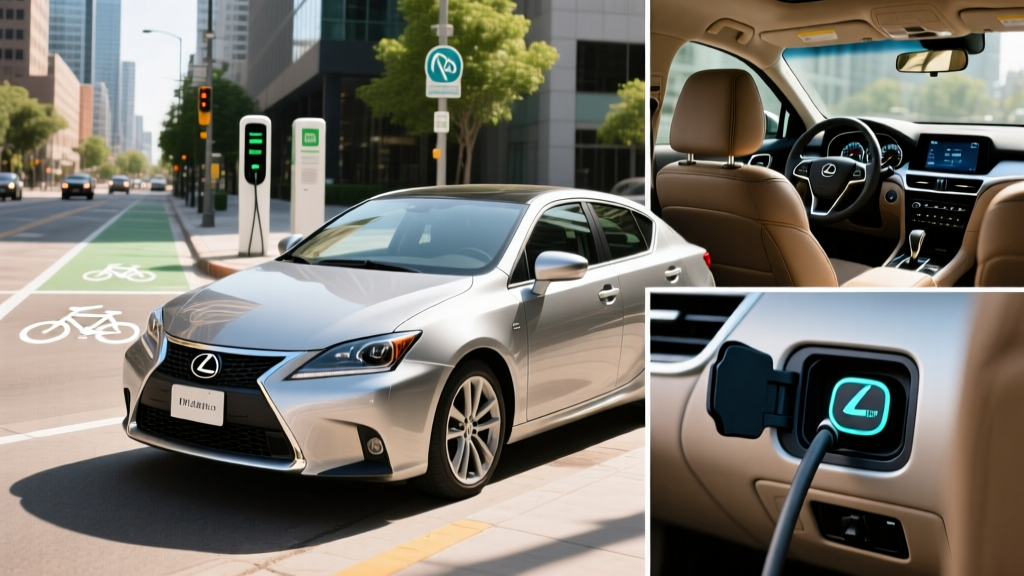
The 2014 Lexus CT 200h occupies an unusual space in the used-car market: a luxury-branded conventional hybrid hatchback that sips fuel like a Prius but wears a spindle grille and leather seats. More than a decade after its debut, buyers still search for the Lexus CT hybrid 2014 model year specifically — it was the first refresh year that brought updated styling and improved infotainment to Toyota's premium compact hybrid.
But with modern EVs and PHEVs now dominating the electrified conversation, does a 2014 conventional hybrid still earn a spot in your driveway? This guide covers every spec that matters: real-world MPG, battery longevity, replacement costs, and how this HEV stacks up against the alternatives available in 2026.
HEV vs PHEV vs EV: Where the CT 200h Fits
Before examining specs, it's critical to understand what the CT 200h is — and what it isn't. This is a conventional hybrid (HEV), not a plug-in hybrid (PHEV) or a battery-electric vehicle (BEV).
| Feature | HEV (CT 200h) | PHEV (e.g., Prius Prime) | BEV (e.g., Model 3) |
|---|---|---|---|
| Plugs in? | No | Yes | Yes |
| Electric-only range | ~1 mile at low speed | 25–45 miles | 250–360 miles |
| Gas engine | Yes (primary + regen) | Yes (backup) | None |
| Fuel needed | Yes, always | Yes, for longer trips | No |
| Home charging required | No | Recommended | Essential |
| Federal tax credit (new) | $0 | Up to $7,500 (§30D) | Up to $7,500 (§30D) |
The CT 200h charges its own small nickel-metal hydride (NiMH) battery through regenerative braking and the gas engine. You never plug it in. That simplicity is its biggest selling point for apartment dwellers or anyone without garage charging access — but it also means zero electric-only commuting capability.
Fuel Economy: EPA Numbers and Real-World MPG
The 2014 CT 200h shares its powertrain with the third-generation Toyota Prius, and the EPA fuel economy figures reflect that lineage. According to fueleconomy.gov, the official ratings are:
| Driving Cycle | EPA Rating | Real-World Expectation |
|---|---|---|
| City | 51 MPG | 46–52 MPG (hybrids excel in stop-and-go) |
| Highway | 48 MPG | 42–47 MPG (aero drag and higher speeds reduce regen benefit) |
| Combined | 50 MPG | 44–50 MPG depending on driving mix |
Real-world note: Like all Toyota Hybrid Synergy Drive vehicles, the CT 200h tends to beat its EPA city rating in actual stop-and-go traffic, where regenerative braking recaptures the most energy. Highway-heavy commutes will pull the combined figure closer to 44–46 MPG. In cold weather (below 35°F), expect a 5–10% MPG reduction as the engine runs more frequently to maintain cabin heat and battery temperature.
With a 10.6-gallon fuel tank, total range sits between 470 and 530 miles per fill-up — competitive with many modern PHEVs in combined gas-electric range, though without any plug-in miles.
Powertrain and Performance Specs
| Specification | 2014 Lexus CT 200h |
|---|---|
| Engine | 1.8L inline-4 Atkinson cycle |
| Engine output | 98 hp / 105 lb-ft torque |
| Electric motor | Permanent-magnet AC synchronous |
| Motor output | 80 hp / 153 lb-ft torque |
| Net combined horsepower | 134 hp |
| Transmission | eCVT (planetary gearset, not a belt CVT) |
| 0–60 mph | 9.8 seconds |
| Drivetrain | Front-wheel drive |
| Hybrid battery | 1.3 kWh NiMH (nominal) |
| Curb weight | ~3,130 lbs |
| Cargo volume | 14.3 cu ft (rear seats up) / 37.4 cu ft (folded) |
The 134 net horsepower figure sounds modest — and it is. The CT 200h is not quick. A 9.8-second 0–60 time puts it firmly in the "adequate for commuting" category. Where the electric motor shines is low-speed torque delivery: the 153 lb-ft from the motor makes city driving feel more responsive than the horsepower number suggests.
The eCVT uses a planetary gearset rather than a traditional belt-and-pulley continuously variable transmission. This design has proven exceptionally durable — there are no belts to wear, and the system has fewer moving parts than a conventional automatic.
Hybrid Battery Lifespan, Warranty, and Replacement Cost
This is the number-one concern for any used-hybrid buyer, and it's where the CT 200h has a strong track record. The 1.3 kWh NiMH battery pack is small, lightly stressed, and benefits from Toyota's conservative state-of-charge management — the system never fully charges or fully depletes the pack, which dramatically slows degradation.
Original battery warranty: 8 years / 100,000 miles (10 years / 150,000 miles in CARB states including CA, NY, MA, and others that follow California emissions standards).
For a 2014 model in 2026: The original factory warranty has expired for virtually all examples. You are buying this vehicle as-is unless a dealer offers a separate certified-pre-owned (CPO) warranty.
How long do CT 200h batteries actually last? Real-world data from owner forums and fleet use (including taxi service) shows the NiMH pack commonly reaches 180,000–250,000 miles before any significant capacity loss triggers a check-hybrid-system warning. Many exceed 200,000 miles on the original pack. The key failure mode is individual cell imbalance rather than total pack death.
Replacement costs in 2026:
- Refurbished/remanufactured pack: $1,200–$2,200 installed (most common choice for a used CT 200h)
- New OEM Toyota/Lexus pack: $3,000–$4,200 installed
- Individual cell replacement (specialist shops): $600–$1,200
The NiMH chemistry, while less energy-dense than modern lithium-ion, has one advantage for used buyers: it degrades more gracefully and is simpler to refurbish. A reconditioned pack from a reputable supplier typically carries its own 1–3 year warranty.
Pricing and Tax Credit Reality for 2026 Buyers
The 2014 Lexus CT 200h originally carried an MSRP starting around $32,050 (base) to approximately $40,000 (fully loaded with Premium, Navigation, and F Sport packages). In the 2026 used market, pricing has settled considerably:
- High-mileage (130k+ miles), fair condition: $8,000–$11,000
- Average mileage (80k–120k), good condition: $11,000–$15,000
- Low-mileage (under 70k), excellent/CPO: $15,000–$19,000
Tax credit eligibility: The CT 200h does not qualify for any federal tax credit. As a conventional hybrid (HEV), it was never eligible for the §30D new qualified plug-in electric vehicle credit, and the IRS used-EV credit (up to $4,000 under §25E) applies only to battery-electric and plug-in hybrid vehicles — not conventional hybrids. No state-level hybrid incentives remain for this model either. The purchase price you negotiate is the price you pay.
Reliability, Safety, and Ownership Costs
The CT 200h's Toyota-sourced powertrain is one of the most proven hybrid systems ever built. The 1.8L 2ZR-FXE engine and Hybrid Synergy Drive components have accumulated billions of real-world miles across the Prius family. The main reliability considerations are non-powertrain:
- Water pump: The electric water pump on the 1.8L has a known failure pattern around 100,000–140,000 miles. Replacement runs $400–$700.
- Brake actuator: The regenerative brake actuator can develop issues above 120,000 miles. Listen for unusual pump cycling sounds at startup. Replacement is $800–$1,500.
- 12V auxiliary battery: Located in the rear cargo area, this standard lead-accent battery typically needs replacement every 4–5 years. A weak 12V battery can cause hybrid system errors even when the traction battery is healthy.
- EGR valve and intake: Carbon buildup in the EGR system is common above 120,000 miles. A cleaning service ($200–$400) can prevent rough-idle issues.
Safety ratings: The 2014 CT 200h earned an IIHS Top Safety Pick designation with "Good" ratings in moderate overlap front, side, roof strength, and head restraint tests. It was not tested in the newer small-overlap or updated side-impact protocols. NHTSA gave it 4 out of 5 stars overall. By 2026 standards, it lacks automatic emergency braking, lane-keeping assist, and adaptive cruise control — features now standard on most new vehicles.
Insurance: Expect moderate premiums. The CT 200h is not a high-theft or high-repair-cost vehicle, but Lexus parts pricing is slightly above Toyota levels. Average annual insurance runs $1,200–$1,800 depending on your profile and state.
Who Should Buy the 2014 CT 200h — and Who Shouldn't
Pros
- 50 MPG combined EPA — still excellent by any standard
- No plug-in required — ideal for apartment/curbside parkers
- Lexus build quality, quiet cabin, premium materials
- Proven Toyota hybrid reliability with massive parts availability
- Low annual fuel cost (~$900–$1,100/yr at 12,000 miles)
- Hatchback versatility with fold-flat rear seats
Cons
- Slow: 9.8-second 0–60 is noticeable in merging situations
- Dated infotainment — no Apple CarPlay/Android Auto (2014 model)
- No modern ADAS (no AEB, no lane-keeping, no adaptive cruise)
- Firm ride on F Sport models with low-profile tires
- Tight rear-seat legroom (32.5 inches)
- No tax credits available — pure out-of-pocket purchase
Choose the 2014 CT 200h if: You want a reliable, fuel-efficient daily driver without needing any home charging infrastructure. You prioritize low running costs and Lexus-quality interiors over performance and cutting-edge tech. Your budget is $10,000–$16,000 and you want minimal ownership surprises.
Look elsewhere if: You want electric-only commuting (consider a used Prius Prime PHEV or a Chevy Volt). You need modern safety features like automatic emergency braking (look at a 2019+ Corolla Hybrid or 2020+ Prius). You have home charging access and want to eliminate gas entirely (a used Nissan Leaf or Chevy Bolt EV offers 150+ miles of range for similar money).
2014 CT 200h vs. Modern Alternatives
| Vehicle | Type | Combined MPG / Range | Used Price (2026) | Key Trade-off |
|---|---|---|---|---|
| 2014 Lexus CT 200h | HEV | 50 MPG | $11k–$16k | Luxury badge, no plug needed, but slow and dated tech |
| 2017 Toyota Prius Prime | PHEV | 25 mi EV + 54 MPG | $14k–$19k | Plug-in capability, but requires charging access |
| 2017 Chevy Bolt EV | BEV | 238 mi EPA range | $11k–$15k | Zero gas, but needs home Level 2 charger |
| 2020 Toyota Corolla Hybrid | HEV | 52 MPG | $17k–$22k | Newer safety tech, but sedan only, higher price |
The CT 200h's closest competitor in its own era was the Prius V (wagon) and later the Prius Prime. Against modern options, its main advantage remains the Lexus badge and interior quality at a price point where most competitors feel more utilitarian. If you can charge at home, a used Bolt EV or Prius Prime will deliver lower per-mile costs. If you can't charge at home, the CT 200h is still one of the most efficient vehicles you can buy without a plug.
Frequently Asked Questions
How many MPG does the 2014 Lexus CT 200h hybrid get?
The EPA rates the 2014 CT 200h at 51 city / 48 highway / 50 combined MPG. In real-world driving, most owners report 44–50 MPG combined, with city-heavy driving yielding the best results thanks to regenerative braking. Highway-only driving at 75+ mph drops the figure closer to 42–45 MPG.
Does the Lexus CT 200h need to be plugged in?
No. The CT 200h is a conventional hybrid (HEV), not a plug-in hybrid. It charges its small NiMH battery entirely through regenerative braking and the gasoline engine. You fuel it like any other car — just less often.
Is the 2014 CT 200h hybrid battery expensive to replace?
A refurbished NiMH pack costs $1,200–$2,200 installed, while a new OEM pack runs $3,000–$4,200. However, these batteries commonly last 180,000–250,000 miles. Many CT 200h owners never need a replacement. Individual cell repair is also an option for $600–$1,200 at specialist shops.
Does the 2014 Lexus CT 200h qualify for any tax credit?
No. As a conventional hybrid, the CT 200h does not qualify for the federal §30D plug-in vehicle credit or the §25E used-EV credit. There are no remaining state hybrid incentives for this model. The purchase is entirely out-of-pocket.
Is the CT 200h reliable for high-mileage use?
Yes. The Toyota-sourced 1.8L hybrid powertrain is among the most reliable ever produced. The main wear items to budget for are the electric water pump (~$500), brake actuator (~$1,000), and EGR system cleaning (~$300). The eCVT planetary gearset is essentially maintenance-free. With basic care, 200,000+ miles is a reasonable expectation.
Can I add Apple CarPlay or Android Auto to the 2014 CT 200h?
Not natively. The 2014 infotainment system predates both platforms. Aftermarket solutions exist — third-party interface modules ($300–$600 plus installation) can add CarPlay/Android Auto to the factory screen, or you can replace the head unit entirely with an aftermarket option. Neither approach is as seamless as factory-integrated systems in newer vehicles.
Hybrid vs PHEV vs EV — which should I choose?
If you lack reliable home or workplace charging, a conventional hybrid like the CT 200h remains the most practical electrified option — no infrastructure required, instant fuel savings. If you can charge at home and your daily commute is under 30 miles, a PHEV gives you electric-only weekday driving with gas backup for road trips. If you have Level 2 home charging and want to eliminate gas entirely, a used BEV (Bolt EV, Leaf, Model 3) offers the lowest per-mile cost and zero tailpipe emissions.