The Lexus 450 Hybrid Family: HEV vs PHEV Explained
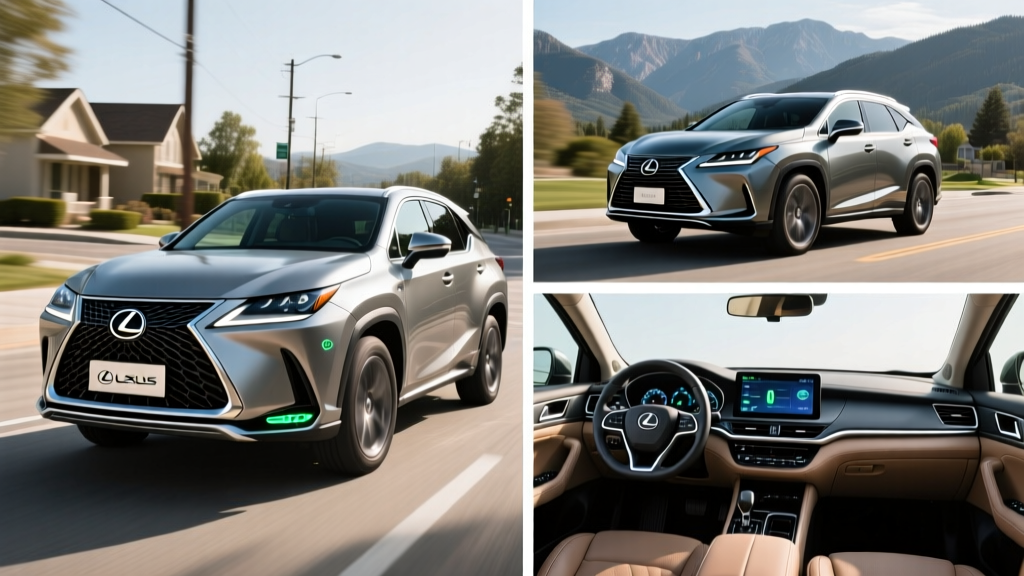
When shoppers search for a "Lexus 450 hybrid," they're actually looking at two very different powertrains across Lexus's SUV lineup. The 450h badge denotes Lexus's plug-in hybrid (PHEV) models — the NX 450h+ and RX 450h+ — while the newer TX 450h+ extends that architecture to a three-row family hauler. The "+" matters: it signals a larger battery you can plug in and drive on electricity alone, unlike conventional Lexus hybrids (like the RX 350h) that generate all their electricity onboard.
HEV vs PHEV: What's the Difference?
| Feature | Conventional Hybrid (HEV) — e.g., RX 350h | Plug-In Hybrid (PHEV) — e.g., NX 450h+, RX 450h+, TX 450h+ |
|---|---|---|
| Plug-in charging | No — never plug in | Yes — Level 1 or Level 2 |
| Electric-only range | None (motor assists engine) | 33–37 miles EPA |
| Battery size | ~1.1–1.9 kWh | 18.1 kWh usable |
| Gas-only driving | Always blended | Full hybrid mode once battery depletes |
| Federal tax credit | No | Up to $3,750 (subject to §30D rules) |
If you can charge at home and your commute falls under 35 miles round-trip, the 450h+ PHEV models let you drive almost entirely on electricity on weekdays while keeping unlimited gas range for road trips. If you lack charging access, a conventional 350h Lexus hybrid is simpler — but you won't find the "450" badge without the plug.
Lexus 450h+ Models: Side-by-Side Spec Table
| Spec | NX 450h+ (AWD) | RX 450h+ (AWD) | TX 450h+ (AWD) |
|---|---|---|---|
| Vehicle class | Compact SUV | Midsize SUV (2-row) | Midsize SUV (3-row) |
| Powertrain | 2.5L I4 + 2 motors | 2.5L I4 + 2 motors | 2.4L turbo I4 hybrid + motors |
| Combined horsepower | 304 hp | 304 hp | 373 hp |
| 0–60 mph | 6.0 sec | 6.2 sec | 5.9 sec |
| Battery (usable) | 18.1 kWh lithium-ion | 18.1 kWh lithium-ion | 18.1 kWh lithium-ion |
| EPA electric range | 37 miles | 35 miles | 33 miles |
| Total combined range | ~550 miles | ~520 miles | ~500 miles |
| EPA combined MPGe (EV mode) | 84 MPGe | 83 MPGe | 77 MPGe |
| EPA combined MPG (hybrid mode) | 36 MPG | 35 MPG | 29 MPG |
| EPA city / highway MPG (hybrid) | 38 / 33 | 37 / 34 | 28 / 30 |
| Max AC charge rate | 3.3 kW (Level 2) | 3.3 kW (Level 2) | 3.3 kW (Level 2) |
| DC fast charge capable | No | No | No |
| Charge time 0–100% (Level 2, 240V) | ~5.5 hours | ~5.5 hours | ~5.5 hours |
| Base MSRP (2025/2026) | $59,915 | $71,415 | $74,515 |
| Federal tax credit (§30D) | Up to $3,750 | Up to $3,750 | Up to $3,750 |
Sources: EPA fueleconomy.gov, Lexus NX 450h+ official page, Lexus RX 450h+ official page.
Fuel Economy: Real-World MPG vs EPA Stickers
The EPA numbers tell one story, but real-world ownership often tells a better one — especially in city driving where hybrids excel.
| Model | EPA City MPG (hybrid mode) | EPA Highway MPG | EPA Combined | Real-World Expectation |
|---|---|---|---|---|
| NX 450h+ | 38 | 33 | 36 | 38–42 city / 30–33 highway |
| RX 450h+ | 37 | 34 | 35 | 36–40 city / 31–34 highway |
| TX 450h+ | 28 | 30 | 29 | 27–31 city / 28–30 highway |
Like most Toyota/Lexus hybrids, the NX and RX 450h+ tend to exceed their EPA city estimates in real-world stop-and-go driving, where regenerative braking recaptures energy constantly. Highway driving is where you'll see numbers dip below sticker, particularly above 75 mph or in headwinds.
The TX 450h+, being a heavier three-row vehicle with a turbocharged engine, delivers lower fuel economy overall. Its 29 MPG combined is still strong for a 5,000-lb three-row SUV — a gas-only competitor in this class typically returns 20–23 MPG combined — but buyers expecting NX-level efficiency should adjust expectations.
The PHEV advantage: If you charge nightly and commute under 35 miles, your effective "MPG" is essentially infinite on weekdays because you're burning zero gasoline. Many NX 450h+ owners report visiting gas stations once every 6–8 weeks.
Electric-Only Range and Charging: What to Expect
PHEV Electric Range Reality Check
EPA sticker: 33–37 miles electric-only (depending on model)
Real-world expectation: 28–35 miles in mild weather; 22–28 miles in freezing temperatures or at sustained highway speeds above 70 mph.
Heater use in winter is the biggest range killer in PHEVs. The 450h+ models use a resistive heater (not a heat pump), so expect a 20–30% electric range reduction in sub-30°F weather.
All three Lexus 450h+ models share the same 18.1 kWh usable battery and 3.3 kW onboard charger. That 3.3 kW rate is a meaningful limitation: it means no DC fast charging and a relatively slow Level 2 top-up. On a 240-volt Level 2 circuit at 3.3 kW, a full charge takes roughly 5.5 hours. On a standard 120-volt household outlet (Level 1, ~1.4 kW), expect about 12 hours for a full charge — feasible for overnight, but tight if you need a midday top-up.
For most PHEV owners, Level 1 overnight charging on a standard outlet is sufficient. You're replenishing 18 kWh over 10–12 hours, which covers the full battery. A Level 2 home charger is a luxury, not a necessity, for this vehicle class.
Battery Warranty, Reliability, and Replacement Cost
Lexus Hybrid Battery Warranty
Coverage: 10 years / 150,000 miles (whichever comes first) on the hybrid battery and all hybrid-system components.
Capacity threshold: Lexus does not publish a specific State of Health (SoH) percentage trigger for warranty replacement, but dealers typically replace batteries that fall below ~70% capacity or show cell-imbalance faults.
Transferability: The hybrid battery warranty is fully transferable to subsequent owners — a strong resale-value signal.
Lexus's hybrid reliability track record is among the best in the industry. The Toyota Hybrid Synergy Drive architecture underpinning these PHEVs has been in continuous production since the 2004 Prius, with billions of real-world miles logged. The 18.1 kWh battery in the 450h+ is relatively small and conservatively managed — Lexus buffers the top and bottom of the pack to avoid deep cycling, which is the primary degradation driver for lithium-ion cells.
Replacement cost if out of warranty: A Lexus PHEV battery replacement currently runs approximately $8,000–$12,000 including parts and labor at a dealership. However, given the 10-year/150,000-mile warranty and Toyota's historical battery longevity (many first-generation Prius batteries exceeded 200,000 miles with minimal degradation), this is a low-probability expense for most owners.
The conventional hybrid components (inverter, motor-generators, planetary gearset) carry the same 10-year/150,000-mile coverage. Lexus also provides a 4-year/50,000-mile basic warranty and 6-year/70,000-mile powertrain warranty on non-hybrid components.
Pricing and Federal Tax Credit Eligibility
The Lexus 450h+ lineup occupies the premium end of the PHEV market. Here's what the pricing looks like and whether federal incentives apply.
- §30D Federal PHEV Credit: Up to $3,750 for qualifying buyers (the credit is reduced from $7,500 because battery critical-mineral and component sourcing requirements are partially unmet for these models)
- MSRP cap: SUVs must have an MSRP at or below $80,000 — all three 450h+ models qualify at base, but heavily optioned RX and TX builds may exceed the cap
- Buyer income cap: Modified AGI must not exceed $150,000 (single), $225,000 (head of household), or $300,000 (joint filing)
- Point-of-sale transfer: As of 2024, you can transfer the credit to the dealer at purchase for an immediate price reduction — you don't need to wait until tax filing
- State incentives: Vary widely — check your state's energy office or IRS §30D guidance for current rules
| Model | Base MSRP | Est. Price After $3,750 Credit | MSRP Cap Safe? |
|---|---|---|---|
| NX 450h+ Premium | $59,915 | ~$56,165 | Yes — well under $80K |
| RX 450h+ Premium | $71,415 | ~$67,665 | Yes — base qualifies |
| RX 450h+ Luxury | $78,515 | ~$74,765 | Borderline — options may push over $80K |
| TX 450h+ Premium | $74,515 | ~$70,765 | Yes — base qualifies |
| TX 450h+ Luxury | $80,315 | Ineligible (exceeds $80K cap) | No — over MSRP limit |
Key caveat: Tax credit eligibility depends on your personal tax situation, the vehicle's battery sourcing compliance at time of purchase, and current IRS rules. Always verify with a tax professional and check the fueleconomy.gov tax credit database before committing to a purchase.
Who Should Buy a Lexus 450h+ — and Who Shouldn't
Choose the Lexus 450h+ PHEV If:
- You have home charging access (even a standard 120V outlet works overnight)
- Your daily round-trip commute is under 35 miles
- You take regular road trips and don't want to plan around charging stations
- You want premium refinement and Lexus reliability with reduced fuel costs
- You're not ready for a full EV but want meaningful electric driving
Choose a Full BEV (e.g., Tesla Model Y, BMW iX) Instead If:
- You have reliable home Level 2 charging and rarely drive more than 250 miles in a day
- You want zero maintenance on an internal combustion engine
- You qualify for the full $7,500 federal EV credit on a competing model
- Your total cost of ownership analysis favors BEV over 5+ years
Choose a Conventional Hybrid (e.g., RX 350h) Instead If:
- You cannot charge at home or at work
- You want lower upfront cost (the 350h saves $7,000–$10,000 vs the 450h+)
- Your driving is mostly highway, where PHEV electric range offers little benefit
- You prefer not to manage plug-in routines
Pros
- 33–37 miles of electric-only range covers most commutes
- Excellent Lexus build quality and dealer network
- 10-year/150,000-mile hybrid battery warranty
- No range anxiety — gas engine for unlimited road trips
- Strong resale value; hybrid battery warranty transfers to new owners
- Real-world city MPG often exceeds EPA estimates
Cons
- 3.3 kW charger is slow; no DC fast charging
- Premium pricing — $60K to $80K+ depending on model and trim
- Electric range drops significantly in freezing weather
- Tax credit limited to $3,750 (not the full $7,500)
- Resistive heater (no heat pump) reduces winter EV efficiency
- TX 450h+ Luxury trim exceeds $80K MSRP cap — no federal credit
Frequently Asked Questions
How many MPG does the Lexus 450 hybrid get?
In hybrid mode (after the battery is depleted), the NX 450h+ achieves 36 MPG combined (38 city / 33 highway), the RX 450h+ gets 35 combined (37/34), and the TX 450h+ returns 29 combined (28/30). While operating in electric mode, efficiency is rated at 77–84 MPGe depending on the model. Real-world city driving often yields 2–4 MPG above the EPA city estimate thanks to regenerative braking.
How far can the Lexus 450h+ go on electric only?
The EPA rates the NX 450h+ at 37 miles electric-only, the RX 450h+ at 35 miles, and the TX 450h+ at 33 miles. In practice, expect 28–35 miles in mild conditions and 22–28 miles in cold weather or sustained highway driving above 70 mph. Once the battery depletes, the gas engine engages seamlessly and you drive as a conventional hybrid with no range limitation.
Does the Lexus 450h+ qualify for a tax credit?
Yes, but the amount is up to $3,750 under the IRS §30D clean vehicle credit — not the full $7,500 available for some fully electric vehicles. Eligibility depends on your income (AGI caps of $150K single / $300K joint), the vehicle's MSRP (must be at or below $80,000 for SUVs), and battery sourcing compliance. The credit can be transferred to the dealer at point of sale for an immediate price reduction. Always verify current eligibility on IRS.gov before purchasing.
Is the Lexus 450h+ reliable, and what does a battery replacement cost?
Lexus's hybrid powertrain is among the most proven in the industry, with over two decades of continuous refinement. The hybrid battery carries a 10-year/150,000-mile warranty. Out-of-pocket replacement (if needed after warranty expiration) costs approximately $8,000–$12,000 at a dealership. Given Toyota/Lexus's track record of hybrid batteries lasting 200,000+ miles with moderate degradation, most original owners will never face this cost.
Do I need to install a Level 2 charger at home for the Lexus 450h+?
No. The 450h+'s 3.3 kW onboard charger means a standard 120-volt household outlet (Level 1) can fully recharge the 18.1 kWh battery in about 12 hours — sufficient for overnight replenishment. A Level 2 (240V) installation reduces charge time to roughly 5.5 hours and is convenient but not essential. The vehicle does not support DC fast charging.
Hybrid vs PHEV vs EV — which Lexus is right for me?
If you can charge at home and commute under 35 miles daily, the 450h+ PHEV gives you electric driving on weekdays with gas flexibility for road trips. If you can't charge, a conventional Lexus hybrid (RX 350h, NX 350h) delivers strong MPG without any plug-in routine. If you have home Level 2 charging, rarely exceed 250 miles in a day, and want the lowest operating cost, a full BEV like the Tesla Model Y or BMW iX may offer better long-term economics — but at the cost of road-trip charging planning.