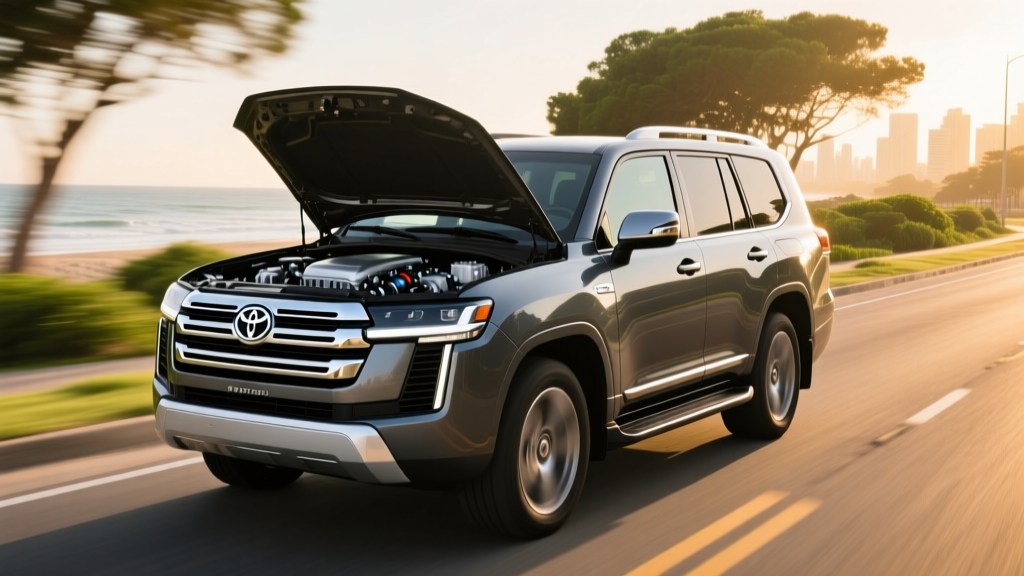
The 2026 Toyota Land Cruiser returns to its rugged roots with a turbocharged hybrid powertrain that prioritizes torque over outright efficiency. But for a body-on-frame SUV that can tow 6,000 pounds and crawl over boulders, the Land Cruiser hybrid MPG story is more nuanced than the EPA sticker suggests. This guide breaks down every efficiency figure, powertrain spec, and ownership cost you need to evaluate whether Toyota's hybrid off-roader fits your garage.
Land Cruiser Hybrid MPG: EPA Numbers and Real-World Results
The 2026 Toyota Land Cruiser uses the i-FORCE MAX hybrid powertrain across all trims — there is no non-hybrid option. The EPA rates it identically regardless of whether you choose the base 1958, the mid-grade Land Cruiser, or the off-road-focused Land Cruiser Off-Road trim.
| Metric | EPA Estimate |
|---|---|
| City MPG | 22 mpg |
| Highway MPG | 25 mpg |
| Combined MPG | 23 mpg |
| Fuel Tank Capacity | 18.5 gallons |
| Total Driving Range | ~425 miles |
Real-World MPG vs. EPA Sticker
The i-FORCE MAX hybrid system uses a small electric motor sandwiched between the engine and transmission to assist during acceleration and low-speed crawling — not to drive the vehicle on electric power alone. In real-world driving:
- City driving: Expect 21–24 mpg. The hybrid assist helps in stop-and-go traffic, but the Land Cruiser's 5,000+ lb curb weight limits gains.
- Highway cruising (70–80 mph): Expect 22–24 mpg. The turbo four-cylinder runs efficiently at steady speed, and aerodynamic drag is the primary enemy.
- Off-road / towing: Expect 14–18 mpg under load. Towing near the 6,000-lb max will push consumption well below EPA estimates.
- Cold weather: Expect a 1–2 mpg reduction in winter. The engine runs richer during warm-up, and the hybrid battery is less efficient below freezing.
Unlike Toyota's conventional hybrids (Prius, Camry Hybrid), the Land Cruiser's hybrid system is designed for torque fill, not maximum efficiency. Owners who drive primarily in the city may slightly beat the EPA combined figure, while highway-heavy drivers and those who tow will fall below it.
i-FORCE MAX Hybrid Powertrain: Specs and How It Works
The 2026 Land Cruiser pairs a 2.4-liter turbocharged inline-four engine with a 48-horsepower electric motor integrated into the 8-speed automatic transmission housing. This is Toyota's i-FORCE MAX system, and it is a conventional hybrid (HEV) — not a plug-in hybrid.
| Specification | Value |
|---|---|
| Engine | 2.4L turbocharged inline-4 |
| Engine Output | 278 hp / 317 lb-ft torque |
| Electric Motor | 48 hp / 184 lb-ft (integrated in transmission) |
| Combined System Output | 326 hp / 465 lb-ft torque |
| Transmission | 8-speed automatic (Direct Shift-8AT) |
| Drivetrain | Full-time 4WD with locking center differential |
| Hybrid Battery | ~1.87 kWh nickel-metal hydride (NiMH) |
| 0–60 mph | ~6.4 seconds (est.) |
| Max Towing Capacity | 6,000 lbs |
The hybrid battery is small — roughly 1.87 kWh — because the system's purpose is torque supplementation, not electric-only driving. The motor provides instant low-end torque to smooth out turbo lag and reduce strain on the engine during acceleration. You cannot plug this vehicle in; the battery recharges through regenerative braking and engine-driven generation.
HEV vs. PHEV vs. EV: Where Does the Land Cruiser Fit?
Understanding the Land Cruiser's Hybrid Type
The Land Cruiser is a conventional hybrid (HEV), meaning it generates its own electricity and never requires plug-in charging. Here's how it compares to the alternatives:
| Feature | HEV (Land Cruiser) | PHEV (e.g., Jeep Wrangler 4xe) | BEV (e.g., Rivian R1S) |
|---|---|---|---|
| Plug-in Required? | No | Yes (Level 1 or 2) | Yes (Level 2 or DC fast) |
| Electric-Only Range | None | 20–35 miles typical | 250–400+ miles |
| Gas Engine | Yes (primary) | Yes (backup + primary) | None |
| Fuel Economy (combined) | 23 mpg | 20 mpg gas / 45–50 MPGe electric | 2.0–2.5 kWh/mi |
| Total Range | ~425 miles | ~350–400 miles | 250–400 miles (electric only) |
| Towing Capability | 6,000 lbs | 3,500 lbs | 7,700 lbs |
| Federal Tax Credit | None | Up to $3,750–$7,500* | Up to $7,500* |
*Tax credit eligibility depends on MSRP caps, buyer income limits, and battery-sourcing requirements under IRS §30D. Verify current rules at irs.gov.
The Land Cruiser's HEV system is the simplest electrified option: no charging infrastructure needed, no range planning, no battery anxiety. But it also means zero electric-only driving and no federal tax credit eligibility.
2026 Land Cruiser Pricing and Tax Credit Eligibility
The 2026 Toyota Land Cruiser is offered in three trims, all with the i-FORCE MAX hybrid powertrain and full-time 4WD as standard.
| Trim | Starting MSRP (est.) |
|---|---|
| 1958 | $57,345 |
| Land Cruiser | $62,395 |
| Land Cruiser Off-Road | $63,195 |
Does the Land Cruiser Qualify for a Federal Tax Credit?
No. The Land Cruiser is a conventional hybrid (HEV), and the federal §30D New Clean Vehicle Credit applies only to plug-in electric vehicles (PHEVs and BEVs) with a minimum battery capacity of 7 kWh. The Land Cruiser's ~1.87 kWh NiMH battery does not meet this threshold. There is no federal tax credit for conventional hybrids as of the 2026 tax year.
Federal §30D Credit Requirements (Why the Land Cruiser Doesn't Qualify)
- Vehicle must be a plug-in EV (PHEV or BEV) — Land Cruiser is HEV ✗
- Battery capacity must be at least 7 kWh — Land Cruiser has ~1.87 kWh ✗
- MSRP cap: $80,000 for SUVs — Land Cruiser qualifies ✓
- Buyer income cap: $300,000 joint / $150,000 single — varies by buyer
- Battery components and critical minerals must meet sourcing thresholds — N/A
Some states offer separate incentives for hybrids, but these are typically modest ($500–$1,500) and vary widely. Check your state's energy office or AFDC state incentive database for details.
Hybrid Battery Warranty, Reliability, and Replacement Cost
Toyota Hybrid Battery Warranty Coverage
| Hybrid Battery Warranty | 10 years / 150,000 miles (whichever comes first) |
| Powertrain Warranty | 5 years / 60,000 miles |
| Basic Vehicle Warranty | 3 years / 36,000 miles |
| Hybrid System Components | 8 years / 100,000 miles |
Toyota has built a strong track record with hybrid reliability since the Prius launched in 1997. The i-FORCE MAX system in the Land Cruiser uses a nickel-metal hydride (NiMH) battery — a proven chemistry that Toyota has deployed across millions of hybrids. NiMH is less energy-dense than lithium-ion but is extremely durable and tolerant of heat, making it well-suited to an off-road SUV that sees high ambient temperatures and heavy loads.
How Long Will the Hybrid Battery Last?
Based on Toyota's hybrid history (Highlander Hybrid, Sequoia i-FORCE MAX, Tundra i-FORCE MAX), the hybrid battery in the Land Cruiser should last well beyond the 10-year/150,000-mile warranty period under normal use. Toyota's hybrid batteries are designed with a large buffer — you never use the full capacity — which significantly extends cycle life. Degradation is typically minimal: expect 5–10% capacity loss over 150,000 miles, which has negligible impact on fuel economy since the battery's role is torque assist, not range.
Hybrid Battery Replacement Cost
If the hybrid battery does fail outside warranty, replacement cost for the i-FORCE MAX system is estimated at $3,000–$5,000 for the battery pack itself, plus $500–$1,000 in labor. This is significantly less than a full EV battery replacement ($10,000–$25,000) because the pack is small. Third-party refurbishment shops may offer lower-cost options as the platform ages.
For context, NHTSA has not issued any recalls related to the i-FORCE MAX hybrid battery system as of early 2026.
Who Should Buy the Land Cruiser Hybrid (and Who Shouldn't)
Pros
- 465 lb-ft of torque for confident towing and off-road crawling
- No plug-in charging required — works like a normal gas car
- Strong reliability history from Toyota's hybrid systems
- 10-year/150,000-mile hybrid battery warranty
- Body-on-frame durability with modern tech and safety features
- Reasonable 23 mpg combined for a 5,000+ lb off-road SUV
Cons
- No electric-only driving — always burns fuel
- No federal tax credit eligibility
- Starting price above $57,000; well-equipped models exceed $65,000
- Only 425 miles of total range — smaller tank than some competitors
- Third-row seat is cramped (best for children only)
- MPG drops significantly when towing or off-roading
Choose the Land Cruiser Hybrid If:
- You want a rugged, body-on-frame SUV with real off-road capability and 6,000-lb towing
- You don't have access to home charging and don't want to plan charging stops
- You value Toyota's hybrid reliability and long warranty coverage
- You prioritize low-end torque and turbo-lag elimination over maximum fuel savings
Look Elsewhere If:
- You want electric-only commuting — consider a PHEV like the Toyota RAV4 Prime or Jeep Wrangler 4xe
- You need a federal tax credit to offset purchase cost — only PHEVs and BEVs qualify
- You drive 20,000+ miles/year mostly in the city — a full EV will save significantly more on fuel
- You need a spacious third row — the Land Cruiser's is tight; consider the Sequoia or Grand Highlander Hybrid
Land Cruiser Hybrid vs. Key Competitors
| Spec | Toyota Land Cruiser | Toyota Sequoia | Jeep Wrangler 4xe (PHEV) |
|---|---|---|---|
| Powertrain Type | HEV (i-FORCE MAX) | HEV (i-FORCE MAX) | PHEV |
| Combined MPG | 23 mpg | 22 mpg | 20 mpg (gas) / 49 MPGe |
| Electric-Only Range | None | None | ~22 miles |
| Combined HP / Torque | 326 hp / 465 lb-ft | 437 hp / 583 lb-ft | 375 hp / 470 lb-ft |
| Max Towing | 6,000 lbs | 9,520 lbs | 3,500 lbs |
| Starting MSRP | ~$57,345 | ~$63,495 | ~$53,795 |
| Federal Tax Credit | None | None | Up to $3,750* |
| Third Row | Yes (tight) | Yes (spacious) | No (2-row) |
*Wrangler 4xe credit eligibility depends on current §30D battery-sourcing rules; verify at irs.gov.
The Sequoia offers far more power, towing, and interior space but sacrifices 1 mpg and costs more. The Wrangler 4xe provides electric-only commuting but is significantly smaller, less refined, and has lower towing capacity. The Land Cruiser occupies a niche: serious off-road hardware in a mid-size package with hybrid efficiency gains and Toyota reliability.
Frequently Asked Questions
How many MPG does the 2026 Land Cruiser hybrid get?
The EPA rates the 2026 Toyota Land Cruiser at 22 mpg city, 25 mpg highway, and 23 mpg combined. Real-world results typically fall between 20–25 mpg depending on driving conditions. Towing and off-road use will reduce fuel economy to the mid-teens.
Does the Land Cruiser hybrid need to be plugged in?
No. The Land Cruiser is a conventional hybrid (HEV), not a plug-in hybrid (PHEV). Its small hybrid battery recharges through regenerative braking and the gas engine. You fuel it like any other gasoline vehicle.
Can the Land Cruiser drive on electric power only?
No. The i-FORCE MAX system's electric motor assists the gas engine but cannot propel the vehicle on its own. There is no EV mode and no electric-only range. The motor's role is to provide instant torque during acceleration and reduce turbo lag.
Is the Land Cruiser hybrid reliable?
Toyota's hybrid systems have an excellent reliability track record spanning over 25 years. The i-FORCE MAX uses a proven NiMH battery chemistry and is covered by a 10-year/150,000-mile hybrid battery warranty. Long-term data from the Tundra and Sequoia (which share this powertrain) shows strong durability.
What does it cost to replace the Land Cruiser hybrid battery?
Out-of-warranty replacement for the i-FORCE MAX hybrid battery is estimated at $3,000–$5,000 for parts plus $500–$1,000 in labor. However, Toyota's hybrid batteries are designed to last well beyond the 150,000-mile warranty period, and most owners will never need a replacement.
Does the Land Cruiser hybrid qualify for a tax credit?
No. The federal §30D New Clean Vehicle Credit requires a plug-in vehicle with at least 7 kWh of battery capacity. The Land Cruiser's ~1.87 kWh NiMH battery does not qualify. Check your state's incentive database for any local hybrid rebates.
How does Land Cruiser hybrid MPG compare to the old V8 Land Cruiser?
The previous-generation Land Cruiser (5.7L V8, discontinued after 2021) was rated at 13 mpg city / 17 mpg highway / 14 mpg combined by the EPA. The 2026 i-FORCE MAX hybrid achieves 23 mpg combined — a 64% improvement in fuel economy, alongside significantly more torque (465 lb-ft vs. 401 lb-ft).
Is the Land Cruiser hybrid good for towing?
Yes. The Land Cruiser is rated to tow up to 6,000 pounds, and the i-FORCE MAX hybrid system's 465 lb-ft of combined torque provides strong low-end pulling power. Expect fuel economy to drop to approximately 14–18 mpg while towing near the maximum capacity.
Sources: EPA fuel economy data via fueleconomy.gov, Toyota Motor Corporation official specifications, IRS §30D credit rules at irs.gov, and AFDC state incentive database.