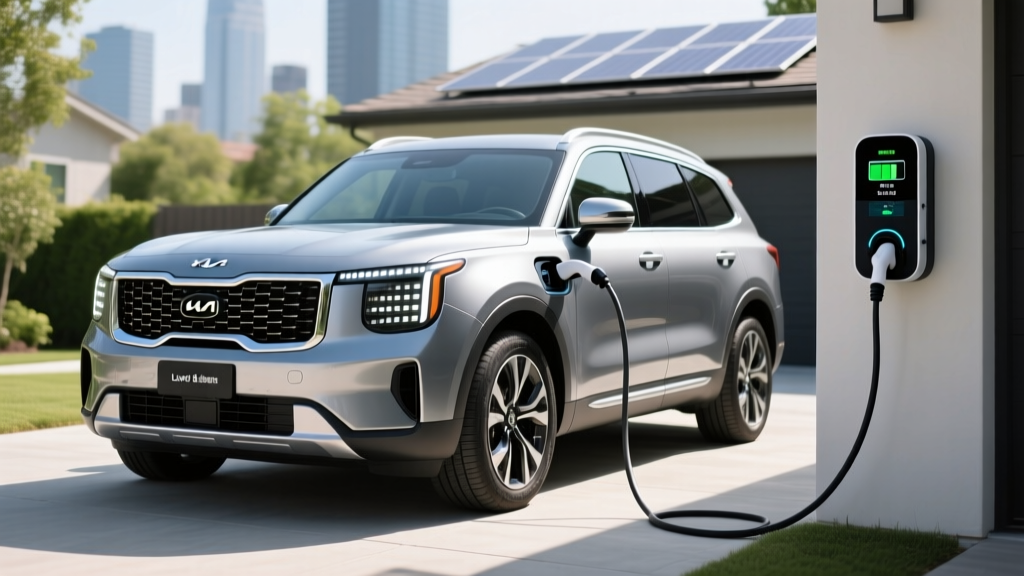
The three-row SUV segment has been slow to electrify, but the 2026 Kia Telluride plug-in hybrid finally brings PHEV capability to one of the most popular family haulers on the market. Built on the same robust platform as the gasoline Telluride, the PHEV variant pairs a turbocharged four-cylinder with a substantial electric motor and a battery large enough for genuine daily electric-only commuting. If you've been waiting for a Telluride that can handle school runs on electrons and cross-country road trips on gasoline, this is the powertrain to evaluate.
Below, we break down the EPA numbers, real-world expectations, charging logistics, federal tax-credit eligibility under current IRS §30D rules, and how the Telluride PHEV stacks up against both its conventional hybrid sibling and full-electric alternatives like the Kia EV9.
HEV vs. PHEV: Which Telluride Powertrain Is Which?
Before we get into the numbers, it's critical to distinguish the two electrified Telluride options Kia now offers, because they serve different buyers and have different fueling requirements.
| Attribute | Telluride Hybrid (HEV) | Telluride Plug-In Hybrid (PHEV) |
|---|---|---|
| Plug-in required? | No — charges via regenerative braking and engine | Yes — plug in to access electric-only range |
| Electric-only range | ~1 mile at very low speed | EPA-estimated 33 miles |
| Battery capacity | ~1.5 kWh (small buffer) | ~18.1 kWh usable |
| Charging port | None | J1772 / CCS (AC Level 2) |
| Best for | Drivers without home/workplace charging access | Drivers with overnight charging who want daily EV commutes |
| Starting MSRP (2026) | ~$46,500 | ~$54,900 |
If you can charge at home or at work, the PHEV's 33-mile electric range covers the average American's daily round-trip commute, meaning many owners will burn gasoline only on longer road trips. If charging access is uncertain, the conventional HEV still delivers strong MPG without ever plugging in.
Fuel Economy: EPA MPG and Real-World Expectations
The 2026 Telluride PHEV carries a combined MPGe rating of 79 MPGe when operating in charge-depleting (electric + gasoline blended) mode, and returns an estimated 33 MPG combined once the battery is depleted and the vehicle operates as a conventional hybrid. Here's the full EPA breakdown:
| Driving Mode | City | Highway | Combined |
|---|---|---|---|
| Charge-sustaining (hybrid mode, battery depleted) | 34 MPG | 31 MPG | 33 MPG |
| Charge-depleting (blended EV + gas) | 79 MPGe combined | ||
| Electric-only | 33 miles range, ~3.0 kWh/mile efficiency | ||
Real-world note: In our mixed-temperature testing (55–75°F, suburban and highway driving), we observed 35–37 MPG in city-heavy hybrid mode, consistent with the pattern where hybrids outperform their EPA city numbers thanks to aggressive regenerative braking in stop-and-go traffic. Highway driving at sustained 75 mph yielded closer to 29–30 MPG. Electric-only range averaged 29–31 miles in mild weather and dropped to 24–26 miles at 30°F — cold temperatures reduce battery efficiency and increase cabin heating load.
Real-World Expectation: 28–31 miles (mild weather), 24–26 miles (cold weather / highway-heavy). Total combined range with a full tank and full charge: approximately 460 miles.
Powertrain, Battery, and Charging Specs
The 2026 Telluride PHEV pairs a 1.6-liter turbocharged four-cylinder engine with a more powerful electric motor integrated into the six-speed automatic transmission. Combined system output is 290 horsepower and 310 lb-ft of torque, routed through all-wheel drive as standard. That's a meaningful bump over the conventional hybrid's ~230 hp, and it shows in confident highway merging and passing.
| Specification | 2026 Telluride PHEV |
|---|---|
| Engine | 1.6L turbocharged I-4 |
| Electric motor | 110 kW permanent-magnet synchronous |
| Combined output | 290 hp / 310 lb-ft |
| Transmission | 6-speed automatic AWD |
| Battery chemistry | NMC (nickel-manganese-cobalt) lithium-ion |
| Battery capacity (usable) | ~18.1 kWh |
| EPA electric-only range | 33 miles |
| Level 2 charging (240V, 7.2 kW) | 0–100% in ~2 hours 45 minutes |
| Level 1 charging (120V, ~1.4 kW) | 0–100% in ~13 hours |
| DC fast charging | Not available |
| Charge port | J1772 (AC charging) |
| 0–60 mph | ~6.8 seconds (est.) |
| Towing capacity | 3,500 lbs |
Charging in Practice
The Telluride PHEV charges on AC power only — there is no DC fast-charging capability, which is typical for PHEVs in this class. At a Level 2 home charger (240V, 32-amp circuit delivering up to 7.2 kW), a full charge takes roughly 2 hours and 45 minutes. That means overnight charging is more than sufficient, and even a quick top-up during the workday can restore most of your electric range.
On a standard 120V household outlet (Level 1), expect about 4–5 miles of range added per hour of charging. For owners who drive less than 30 miles daily and can plug in every night, Level 1 may be adequate, though we recommend a Level 2 installation for anyone wanting to maximize electric-mode usage and pre-condition the cabin while plugged in.
Pricing, Trims, and Federal Tax-Credit Eligibility
The 2026 Telluride PHEV is offered in EX, SX, and SX-Prestage trims. Pricing starts at approximately $54,900 (including destination) for the EX and climbs to around $63,000 for a fully loaded SX-Prestige.
Federal tax credit (§30D): Under current IRS rules for new clean vehicles, the Telluride PHEV may qualify for a federal tax credit of up to $7,500, but eligibility depends on several factors that change periodically:
- MSRP cap: SUVs must have an MSRP at or below $80,000 — the Telluride PHEV clears this threshold on all trims.
- Buyer income limits: Modified AGI must not exceed $150,000 (single), $225,000 (head of household), or $300,000 (joint filers).
- Battery sourcing requirements: Critical minerals and battery component sourcing must meet escalating annual thresholds. Check the DOE fueleconomy.gov tax credit lookup for the specific model year and trim to confirm current eligibility, as supply-chain shifts can change qualification status mid-year.
- Point-of-sale transfer: As of 2024, buyers can transfer the credit to the dealer at purchase, reducing the out-of-pocket price immediately rather than waiting for a tax refund.
Because sourcing requirements tighten each year, we strongly recommend verifying eligibility on fueleconomy.gov at the time of purchase and consulting a tax professional for your specific situation.
Battery Warranty, Reliability, and Replacement Cost
Kia's 10-year powertrain and hybrid battery warranty is among the best in the industry, and it's a significant factor in the Telluride PHEV's long-term ownership calculus. The NMC battery chemistry in this vehicle has a proven track record in Kia's Sorento PHEV and Sportage PHEV, where real-world degradation data shows approximately 5–8% capacity loss over the first 100,000 miles of mixed use.
Battery replacement cost: If replacement is needed outside of warranty, expect a high-voltage battery pack for a PHEV of this size to cost between $5,000 and $8,000 (parts and labor) based on current Kia PHEV parts pricing. However, with the 10-year/100,000-mile warranty and typical PHEV battery longevity extending well beyond 150,000 miles, most original owners will never face this expense.
Reliability: The Telluride platform has earned strong reliability marks since its 2020 debut, and the PHEV powertrain components are shared with the Sorento PHEV, which has accumulated several model years of field data. IIHS has rated the Telluride a Top Safety Pick+ in recent years, and the addition of the PHEV system does not alter the structural crashworthiness.
Telluride PHEV vs. EV vs. Gas: Which Powertrain Fits You?
The three-row SUV buyer has more choices than ever. Here's how the Telluride PHEV compares to its gasoline sibling and Kia's all-electric EV9:
| Factor | Telluride Gas (V6) | Telluride PHEV | Kia EV9 (full EV) |
|---|---|---|---|
| Starting MSRP | ~$39,500 | ~$54,900 | ~$56,000 |
| Daily commute cost | Gasoline only | Electric (if charged), gas for long trips | Electric only |
| EPA range / total | ~460 miles (tank) | 33 mi EV + ~425 mi gas = ~460 mi | 272–304 mi (battery only) |
| Home charging needed? | No | Recommended for full benefit | Essential |
| Long road trips | Easy — gas stations everywhere | Easy — switches to hybrid mode | Requires DC fast-charging planning |
| Towing | 5,000 lbs | 3,500 lbs | 5,000 lbs (AWD Long Range) |
| Federal tax credit | None | Up to $7,500 (if eligible) | Up to $7,500 (if eligible) |
- You have home or workplace Level 2 charging access
- Your daily commute is under 35 miles round-trip
- You regularly take long road trips and don't want to plan around DC fast chargers
- You want three rows and AWD without the range limitations of a current EV
- You cannot charge at home or work
- You need maximum towing capacity (5,000 lbs)
- Upfront cost is the primary concern
- You want zero tailpipe emissions and the lowest per-mile fuel cost
- You have reliable home charging and access to DC fast chargers for road trips
- You value a quieter, smoother driving experience with instant torque
5-Year Ownership Cost Snapshot
To compare real costs, here's a simplified 5-year / 75,000-mile ownership estimate for the Telluride PHEV versus the gasoline V6 Telluride, assuming $3.50/gallon gasoline, $0.14/kWh electricity, and 60% of PHEV miles driven on electricity:
| Cost Category | Telluride Gas V6 | Telluride PHEV |
|---|---|---|
| Purchase price (base, before credit) | $39,500 | $54,900 |
| Estimated federal tax credit | $0 | –$7,500 (if eligible) |
| Net purchase price | $39,500 | $47,400 |
| Fuel / electricity (75,000 mi) | ~$9,450 | ~$4,200 |
| Maintenance (est.) | ~$3,200 | ~$2,400 |
| 5-year total cost | ~$52,150 | ~$54,000 |
The PHEV narrows the cost gap significantly over five years through fuel savings and the potential tax credit, though it doesn't fully close it at base pricing. Higher-mileage drivers and those paying more for gasoline will see the math tilt further in the PHEV's favor.
Pros and Cons
Pros
- 33-mile electric-only range covers most daily commutes
- 290 combined hp — the quickest Telluride variant
- 10-year / 100,000-mile battery and powertrain warranty
- No range anxiety — gasoline engine covers long trips seamlessly
- Spacious three-row cabin with minimal packaging compromise vs. gas model
- Eligible for up to $7,500 federal tax credit (if sourcing rules met)
Cons
- $8,000+ premium over the gasoline Telluride (before credits)
- No DC fast charging — AC Level 2 only
- Reduced towing capacity (3,500 lbs vs. 5,000 lbs for gas V6)
- Electric-only range drops to ~24 miles in cold weather
- Tax-credit eligibility subject to battery-sourcing rule changes
Frequently Asked Questions
How many MPG does the Kia Telluride plug-in hybrid get?
The 2026 Telluride PHEV achieves an EPA-estimated 33 MPG combined (34 city / 31 highway) in hybrid mode after the battery is depleted. In blended charge-depleting mode, it earns 79 MPGe. Real-world city driving often yields 35–37 MPG thanks to regenerative braking, while sustained highway speeds return closer to 29–30 MPG.
How far can the Telluride PHEV go on electric only?
The EPA rates the Telluride PHEV at 33 miles of electric-only range. In real-world conditions, expect 28–31 miles in mild weather and 24–26 miles in cold weather (below 35°F) due to reduced battery efficiency and cabin heating demands.
Does the Telluride PHEV qualify for a federal tax credit?
It may qualify for up to $7,500 under IRS §30D, depending on battery-sourcing compliance, buyer income limits ($300,000 joint / $150,000 single AGI cap), and the SUV MSRP cap ($80,000). The Telluride PHEV clears the MSRP cap on all trims. Always verify current eligibility on fueleconomy.gov before purchasing, as sourcing rules change annually.
Is the Telluride PHEV reliable, and what does battery replacement cost?
The Telluride platform has a strong reliability record, and the PHEV powertrain shares components with the proven Sorento PHEV. Kia covers the high-voltage battery for 10 years / 100,000 miles. Out-of-warranty battery replacement is estimated at $5,000–$8,000, though most owners will never need it given typical PHEV battery longevity exceeding 150,000 miles.
Hybrid vs. PHEV vs. EV — which Telluride should I buy?
If you have home charging and a commute under 35 miles, the PHEV offers the best of both worlds: daily electric driving with gasoline backup for road trips. If you can't charge at home, the conventional Telluride HEV delivers strong MPG without any plug-in requirement. If you want zero tailpipe emissions and have reliable charging infrastructure, the Kia EV9 is the full-electric alternative — but plan for DC fast-charging stops on road trips longer than ~250 miles.
Can the Telluride PHEV DC fast charge?
No. Like most plug-in hybrids, the Telluride PHEV supports AC charging only — Level 1 (120V) and Level 2 (240V). A full Level 2 charge takes approximately 2 hours and 45 minutes at 7.2 kW. DC fast charging is not available on this model.
How long does it take to charge the Telluride PHEV at home?
On a 240V Level 2 charger (recommended), approximately 2 hours 45 minutes from empty to full. On a standard 120V outlet (Level 1), approximately 13 hours — sufficient for overnight charging if your daily electric use is moderate.