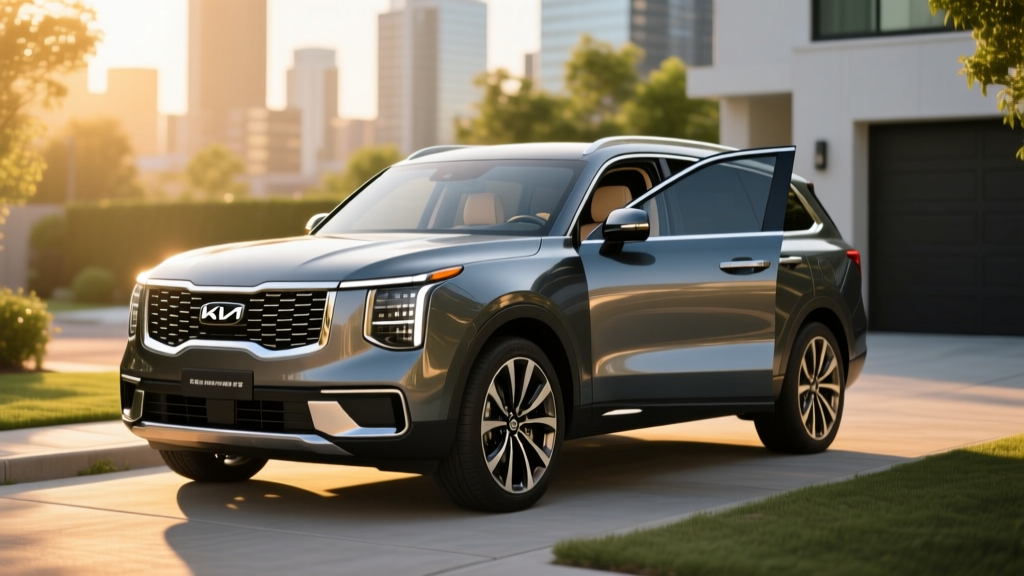
The three-row SUV segment has been dominated by the Kia Telluride since its debut, but the addition of a hybrid powertrain changes the ownership equation significantly. If you've been searching for the Kia Telluride Hybrid SX Prestige — the top-tier trim of Kia's electrified family hauler — you're likely weighing whether the hybrid premium pays for itself at the pump, how real-world MPG stacks up against EPA estimates, and whether this HEV makes more sense than a plug-in hybrid or full battery-electric vehicle for your family's needs.
This guide breaks down every number that matters: EPA and real-world fuel economy, the hybrid powertrain's combined output, battery warranty terms, pricing across trims, and federal tax credit eligibility under current IRS rules.
HEV vs PHEV: What the Telluride Hybrid Actually Is
Before examining the spec sheet, it's essential to understand what you're buying. The Telluride Hybrid is a conventional hybrid electric vehicle (HEV) — not a plug-in hybrid (PHEV). That distinction carries real-world implications:
Conventional Hybrid (HEV) — Telluride Hybrid
- No plug, no charging cable required
- Small battery (~1.5–2.0 kWh) charged entirely by regenerative braking and the gasoline engine
- Electric motor assists the engine but cannot propel the vehicle alone for meaningful distances
- No electric-only range to speak of — the motor provides torque fill and low-speed assist
- Lower upfront cost vs PHEV; no home charging infrastructure needed
Plug-In Hybrid (PHEV) — Not Offered on Telluride (Yet)
- Larger battery (typically 12–20+ kWh) with a charging port (Level 1/Level 2)
- 25–40+ miles of electric-only driving before the gas engine engages
- Higher upfront cost; requires home or workplace charging to realize full value
- May qualify for the federal §30D tax credit if battery-sourcing and MSRP rules are met
If you don't have access to home or workplace charging, the HEV configuration of the Telluride Hybrid is the pragmatic choice. You get meaningful fuel-economy gains without any behavioral change — just fill up and drive.
Powertrain Specs: Engine, Motor, and Combined Output
The Telluride Hybrid pairs a turbocharged 1.6-liter four-cylinder engine with an electric motor integrated into the transmission housing. Here's the full powertrain breakdown:
| Specification | Detail |
|---|---|
| Engine | 1.6L Turbocharged GDI 4-cylinder |
| Engine Output | 180 hp / 195 lb-ft torque |
| Electric Motor | 47.7 kW (~64 hp) permanent-magnet synchronous |
| Combined System Output | 240 hp / 271 lb-ft torque (est.) |
| Transmission | 6-speed automatic (torque-converter type) |
| Drivetrain | FWD standard; AWD available (SX Prestige typically AWD) |
| Battery Type | Lithium-ion polymer (~1.5 kWh, HEV) |
| Towing Capacity | Up to 5,000 lbs (with towing package) |
| 0–60 mph | ~7.8 seconds (est., AWD) |
The 240 combined horsepower is a meaningful bump over the standard Telluride's 291-hp V6 in terms of low-end responsiveness — the electric motor delivers instant torque from a stop, which makes the hybrid feel quicker in city driving than the numbers suggest. The trade-off is that highway passing power at speed is adequate rather than thrilling, which is typical of turbo-four hybrid setups.
Fuel Economy: EPA Ratings and Real-World MPG
This is the primary reason buyers choose the Telluride Hybrid over the gas V6 model. Here's how the numbers break down according to fueleconomy.gov (EPA estimates):
| Configuration | City MPG | Highway MPG | Combined MPG |
|---|---|---|---|
| Telluride Hybrid (FWD) | 34 | 31 | 33 |
| Telluride Hybrid (AWD) | 33 | 30 | 32 |
| Telluride Gas V6 (AWD, baseline) | 18 | 24 | 20 |
Real-World MPG vs EPA: What to Expect
EPA Combined: 32–33 MPG (AWD/FWD)
Real-World Expectation: Hybrids typically exceed EPA city estimates in stop-and-go driving, where regenerative braking recaptures the most energy. Expect 33–36 MPG in city/suburban driving and 27–30 MPG on sustained highway trips at 70+ mph. In cold weather (below 30°F), plan for a 5–10% reduction as the engine runs more frequently to provide cabin heat and maintain battery temperature.
Over 15,000 annual miles, the AWD hybrid saves roughly 300 gallons of fuel per year compared to the gas V6 AWD — approximately $900–$1,100 in annual savings at $3.20/gallon.
The hybrid's city-heavy efficiency advantage is the inverse of most gas vehicles. If your commute involves frequent stops, school drop-offs, and suburban errands, you'll consistently beat the combined EPA figure. Long interstate road trips will see the gap narrow, but you'll still outpace the V6 by 10+ MPG.
SX Prestige Trim: Pricing and What You Get
The SX Prestige sits at the top of the Telluride Hybrid lineup, loaded with features that rival luxury three-row SUVs at twice the price. Here's the pricing structure for the 2026 model year:
| Trim | MSRP (FWD) | MSRP (AWD) | Key Additions Over Lower Trims |
|---|---|---|---|
| EX | ~$42,000 | ~$44,000 | Base hybrid trim, cloth/leatherette, 12.3" infotainment |
| SX | ~$47,000 | ~$49,000 | Leather, premium audio, Highway Driving Assist 2 |
| SX Prestige | ~$51,000 | ~$53,000 | Nappa leather, ventilated 2nd-row seats, head-up display, dual 12.3" screens, Highway Driving Assist 2 with lane-change assist |
Destination charges add approximately $1,395. The SX Prestige AWD lands near $54,400 out the door before any incentives — a significant investment, but one that compares favorably to similarly equipped luxury alternatives like the BMW X7 or Mercedes GLS, which start above $80,000.
Federal Tax Credit Eligibility
Because the Telluride Hybrid is a conventional HEV (not a PHEV or BEV), it does not qualify for the federal §30D Clean Vehicle Credit of up to $7,500. That credit, governed by IRS rules, applies only to plug-in vehicles with battery capacities of at least 7 kWh that meet critical-mineral and battery-component sourcing requirements.
- §30D credit: Not eligible — HEV battery is far below the 7 kWh threshold
- State incentives: Some states offer rebates for conventional hybrids — check your state's energy or environmental agency website
- Used hybrid credit (§25E): If purchasing a qualifying used Telluride Hybrid, the up-to-$4,000 used clean vehicle credit may apply, subject to income caps and sale-price limits — consult a tax professional
The absence of a federal tax credit is the primary financial disadvantage versus PHEV competitors. However, the lower purchase price of the HEV (no large battery premium) and zero charging-infrastructure cost partially offset this gap.
Battery Warranty, Reliability, and Replacement Cost
Hybrid battery longevity remains the top concern for first-time hybrid buyers. Here's what Kia provides:
Kia Hybrid Battery Warranty
- Coverage: 10 years / 100,000 miles (whichever comes first)
- What's covered: Hybrid battery pack, hybrid control unit, and related hybrid-system components
- Transferability: Kia's hybrid warranty is transferable to subsequent owners, which supports resale value
- Capacity threshold: Warranty typically covers defects and significant capacity loss that impairs hybrid function (not gradual, minor degradation)
Kia's 10-year/100,000-mile hybrid battery warranty is among the strongest in the segment and directly addresses the most common buyer objection. For context, Toyota covers its hybrid batteries for 10 years/150,000 miles, while Honda offers 8 years/100,000 miles.
Reliability Outlook
The Telluride has earned strong reliability marks since its introduction. The hybrid system adds complexity (electric motor, inverter, battery pack) but also reduces wear on certain components — regenerative braking extends brake pad life, and the electric motor's low-end torque reduces strain on the transmission during acceleration. According to IIHS, the Telluride has consistently earned Top Safety Pick ratings, and the hybrid variant shares the same structural platform.
Battery Replacement Cost
If a hybrid battery replacement is needed outside warranty — rare but possible at high mileage — expect a cost in the range of $2,000–$3,500 for the battery pack itself, plus labor. This is substantially less than a full EV battery replacement ($8,000–$20,000+) because HEV battery packs are small (~1.5 kWh). Third-party remanufactured batteries may reduce this cost further.
Who Should Choose the Telluride Hybrid vs a PHEV or Full EV?
The decision between an HEV, PHEV, and BEV comes down to your charging access, driving patterns, and budget. Here's a practical decision framework:
Choose the Telluride Hybrid (HEV) If:
- You lack reliable home or workplace charging access
- Your driving is a mix of city and highway with no single pattern dominating
- You want better fuel economy without any behavioral change (no plugging in)
- You tow occasionally (hybrid maintains towing capability)
- You want the lowest-complexity path to improved MPG
Consider a PHEV (e.g., Hyundai Santa Fe PHEV, Toyota RAV4 Prime) If:
- You have Level 2 home charging and most daily trips are under 30 miles
- You want electric-only commuting with gas-engine flexibility for road trips
- You can benefit from the §30D federal tax credit (up to $7,500, subject to eligibility)
- You're willing to pay a higher upfront premium for the larger battery and charging hardware
Consider a Full EV (e.g., Kia EV9, Rivian R1S) If:
- You have reliable Level 2 home charging and access to DC fast charging for road trips
- You want zero tailpipe emissions and the lowest per-mile energy cost
- You're ready to plan charging stops on long road trips
- The full $7,500 federal credit (if eligible) meaningfully reduces the purchase price
For families who take frequent road trips, live in apartments without charging access, or simply want to eliminate one variable from their ownership experience, the Telluride Hybrid HEV is the lowest-friction upgrade from a gas V6. The fuel savings are real and immediate, and there's no learning curve.
Pros and Cons at a Glance
Pros
- 32–33 MPG combined — a 60% improvement over the gas V6 AWD
- No plug-in required; zero behavioral change from a gas car
- 10-year/100,000-mile hybrid battery warranty
- SX Prestige trim rivals luxury SUVs in features and materials
- 5,000-lb towing capacity maintained
- Instant electric torque improves city drivability
- Three-row seating for up to 8 passengers
Cons
- No federal §30D tax credit eligibility (HEV)
- Highway MPG drops to ~27–30 real-world at 70+ mph
- SX Prestige AWD pushes past $53,000 MSRP
- No PHEV variant currently offered in the Telluride lineup
- Turbo-four lacks the smoothness of the V6 at high RPM
- Cold-weather fuel economy penalty of 5–10%
Frequently Asked Questions
How many MPG does the Kia Telluride Hybrid get?
The 2026 Telluride Hybrid achieves an EPA-estimated 34 city / 31 highway / 33 combined MPG in FWD configuration, and 33 city / 30 highway / 32 combined in AWD. Real-world city driving often exceeds the EPA city figure, while sustained highway driving at 75+ mph typically yields 27–30 MPG.
Does the Telluride Hybrid need to be plugged in?
No. The Telluride Hybrid is a conventional hybrid (HEV). Its small lithium-ion battery is charged entirely through regenerative braking and the gasoline engine. There is no charging port and no electric-only driving range of consequence.
Is there a Telluride plug-in hybrid (PHEV)?
As of the 2026 model year, Kia does not offer a Telluride PHEV. The brand's plug-in hybrid three-row options are limited. Buyers seeking a PHEV three-row SUV may look at the Hyundai Santa Fe PHEV or the Toyota Grand Highlander Hybrid (HEV, not PHEV). Kia's larger EV offering is the EV9, a fully electric three-row SUV.
Is the Kia Telluride Hybrid reliable?
The Telluride platform has demonstrated strong reliability since its introduction, and Kia's 10-year/100,000-mile hybrid battery warranty provides long-term peace of mind. The hybrid system adds components (motor, inverter) but also reduces wear on brakes and transmission. Third-party reliability surveys from Consumer Reports and J.D. Power have generally rated the Telluride favorably.
What does the Telluride Hybrid battery replacement cost?
Out-of-warranty hybrid battery replacement is estimated at $2,000–$3,500 including labor. However, the 10-year/100,000-mile warranty covers defects and significant failures, and most hybrid batteries last well beyond the warranty period. HEV batteries are small (~1.5 kWh), making replacement far less expensive than an EV battery swap.
Does the Telluride Hybrid qualify for a tax credit?
The Telluride Hybrid does not qualify for the federal §30D Clean Vehicle Credit, which requires a plug-in vehicle with at least 7 kWh of battery capacity. Some states may offer hybrid-specific rebates — check your state's energy office. The used-vehicle credit (§25E, up to $4,000) may apply if purchasing a qualifying pre-owned Telluride Hybrid, subject to income and price caps.
How does the Telluride Hybrid compare to the Kia EV9?
The EV9 is Kia's all-electric three-row SUV with an EPA-estimated range of 230–304 miles depending on trim and battery size, starting around $55,000. The Telluride Hybrid offers greater range flexibility (500+ miles on a tank), no charging dependency, and a lower entry price, but cannot match the EV9's per-mile energy cost or zero-emission driving. The choice depends on charging access and willingness to plan road-trip charging stops.
The Kia Telluride Hybrid SX Prestige occupies a specific and valuable niche: a premium three-row SUV that delivers substantial fuel savings without requiring any infrastructure investment or behavioral change. For families who want the Telluride's proven space, safety, and feature set with a meaningful MPG upgrade — and who aren't ready or able to commit to plug-in charging — it's one of the most compelling hybrid options in the segment.