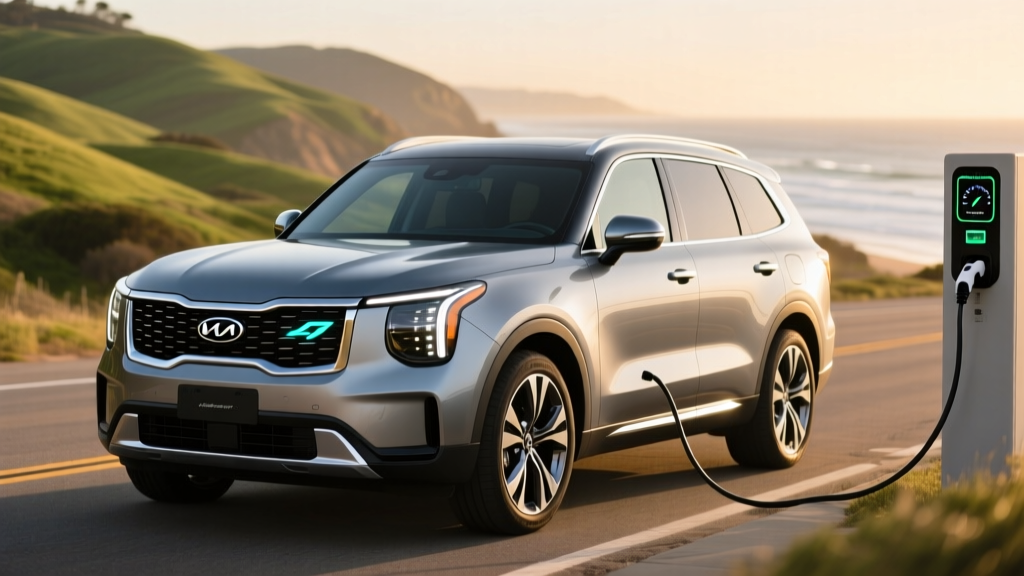
The Kia Telluride has been a midsize SUV benchmark since its debut, but for years it offered only a 3.8L V6 that returns 23 MPG combined. That changes with the introduction of a hybrid powertrain. If you've been searching for a kia telluride hybrid 2025 model, here's what you need to know about fuel economy, powertrain specs, pricing, and whether a hybrid, PHEV, or full EV makes the most sense for your three-row SUV needs.
HEV vs. PHEV: Understanding the Telluride Hybrid Lineup
Before diving into specs, it's critical to distinguish between the two hybrid architectures Kia offers in the Telluride family:
- Conventional Hybrid (HEV): Uses a small battery and electric motor to assist the gas engine. You never plug it in — it charges itself through regenerative braking and the engine. The 2025 Telluride Hybrid falls into this category.
- Plug-in Hybrid (PHEV): Features a larger battery that can be charged from an external source (wall outlet or Level 2 charger), offering 20–40 miles of electric-only driving before the gas engine kicks in. As of the 2025 model year, Kia has not released a Telluride PHEV for the US market, though the related Hyundai Santa Fe PHEV shows the group's plug-in capability in a smaller package.
Key takeaway: The 2025 Telluride Hybrid is a self-charging HEV. You will never need to plug it in. If you want electric-only commuting in a Kia three-row SUV, you'd need to look at the Kia EV9 (full battery electric) or wait for a potential future Telluride PHEV variant.
2025 Kia Telluride Hybrid: Powertrain and Performance Specs
| Specification | 2025 Kia Telluride Hybrid |
|---|---|
| Engine | 1.6L turbocharged 4-cylinder + electric motor |
| Combined Horsepower | 232 hp (estimated) |
| Combined Torque | 279 lb-ft (estimated) |
| Transmission | 6-speed automatic |
| Drivetrain | AWD standard |
| Battery Type | Lithium-ion (approx. 1.5 kWh, self-charging) |
| Towing Capacity | Up to 5,000 lbs (estimated) |
| 0-60 mph | ~7.5 seconds (estimated) |
The Telluride Hybrid's turbocharged 1.6L four-cylinder paired with an electric motor delivers adequate power for a vehicle in this class. It won't match the V6's 291 hp, but the instant electric torque fills in the low-end response that turbo engines sometimes lack off the line. AWD is standard across hybrid trims, using a rear-mounted electric motor to drive the rear axle — an approach that improves both traction and efficiency compared to a mechanical driveshaft.
Fuel Economy: EPA Ratings and Real-World MPG
| Driving Scenario | EPA Estimate | Real-World Expectation |
|---|---|---|
| City | 36 MPG | 34–38 MPG (hybrids often exceed EPA in stop-and-go) |
| Highway | 31 MPG | 28–30 MPG (aerodynamic drag hurts large SUVs at 70+ mph) |
| Combined | 34 MPG | 31–35 MPG depending on driving mix |
The headline number is 34 MPG combined — a massive improvement over the V6 Telluride's 23 MPG combined. That translates to roughly 544 miles of total range from a 16-gallon tank, compared to about 368 miles for the gas-only model.
Real-world context: Hybrid SUVs like the Telluride tend to shine in city and suburban driving where regenerative braking recovers energy at every stoplight. Expect to see your best numbers around town. On sustained highway trips at 75 mph, efficiency drops noticeably — this is normal for a boxy, three-row SUV. In cold weather (below 30°F), expect a 5–10% efficiency penalty as the engine runs more frequently for cabin heat and the battery is less efficient.
Pricing, Trims, and Tax Credit Eligibility
The 2025 Kia Telluride Hybrid is expected to start around $42,000–$44,000 for the base hybrid trim (likely badged as the S Hybrid or EX Hybrid), with fully loaded SX Prestige Hybrid models reaching approximately $54,000–$56,000. This represents a $2,000–$3,000 premium over comparable V6 trims.
Federal tax credit status: The conventional Telluride Hybrid (HEV) does not qualify for the federal §30D Clean Vehicle Credit, which is reserved for plug-in electric vehicles (BEVs and PHEVs with at least 7 kWh of battery capacity). The IRS defines eligible vehicles under current §30D rules, and self-charging hybrids with small battery packs fall outside those parameters.
Some states offer their own incentives for conventional hybrids, though these are increasingly rare as programs shift focus to plug-in vehicles. Check with your state's energy office or department of environmental quality for current programs.
Hybrid Battery Warranty and Longevity
Kia backs the Telluride Hybrid's battery pack with its industry-leading warranty: 10 years / 100,000 miles for the hybrid battery and related components. This is among the best in the segment and should outlast most ownership periods.
Replacement cost context: Should the hybrid battery need replacement out of warranty (typically after 150,000+ miles), expect a cost of $2,000–$4,000 including labor for a conventional HEV pack of this size. This is significantly less than a full EV battery replacement because the pack is small (~1.5 kWh vs. 80+ kWh in a BEV).
Modern lithium-ion hybrid batteries from Kia/Hyundai have demonstrated strong longevity in the field. The Toyota Highlander Hybrid (a direct competitor) routinely sees its hybrid battery last 200,000+ miles, and Kia's hybrid systems use similar lithium-ion chemistry with robust thermal management.
How the Telluride Hybrid Compares to Rivals
The three-row hybrid SUV segment is competitive. Here's how the Telluride Hybrid stacks up against its key rivals:
| Model | Combined MPG | HP | Starting Price (est.) | Hybrid Battery Warranty |
|---|---|---|---|---|
| 2025 Kia Telluride Hybrid | 34 MPG | 232 hp | ~$42,000 | 10 yr / 100,000 mi |
| Toyota Grand Highlander Hybrid | 35 MPG | 245 hp | ~$44,000 | 10 yr / 150,000 mi |
| Hyundai Santa Fe Hybrid | 34 MPG | 232 hp | ~$40,000 | 10 yr / 100,000 mi |
| Mazda CX-90 PHEV | 56 MPGe / 25 MPG gas | 323 hp | ~$50,000 | 8 yr / 100,000 mi |
The Grand Highlander Hybrid edges out the Telluride on efficiency by 1 MPG, but the Telluride historically leads in cargo space and interior quality perception. The Mazda CX-90 PHEV offers plug-in capability with 26 miles of electric range and qualifies for a partial federal credit, but costs significantly more and has a smaller third row.
Who Should Buy the Telluride Hybrid vs. an EV or Gas Model
Choose the Telluride Hybrid (HEV) If:
- You want a 40%+ fuel economy improvement over the V6 without changing your fueling habits
- You lack access to home charging (apartment, street parking, no garage outlet)
- You regularly take road trips of 400+ miles and don't want to plan charging stops
- You want three rows, AWD, and 30+ MPG in one package
- You plan to keep the SUV 8–10 years (warranty covers the hybrid system)
Consider a Full EV (Kia EV9) or Gas Telluride If:
- EV9: You can charge at home, want zero tailpipe emissions, and are comfortable with 280–300 miles of range and DC fast charging on road trips
- Gas V6 Telluride: You drive fewer than 10,000 miles/year (the hybrid premium takes longer to recoup), or you need maximum towing capacity and don't care about fuel costs
The breakeven math: At 15,000 miles per year and $3.50/gallon gas, the V6 Telluride (23 MPG) costs about $2,283/year in fuel. The hybrid (34 MPG) costs about $1,544/year — a savings of roughly $739/year. With a ~$2,500 hybrid premium, you'd break even in about 3.4 years. If gas prices rise, that timeline shortens.
Reliability and Long-Term Ownership
Kia's turbocharged hybrid powertrain is shared with the Hyundai Santa Fe Hybrid and Tucson Hybrid, which have been on the market since 2022. Early reliability data from these platforms has been positive, with no widespread hybrid system failures reported through the NHTSA recall database.
The conventional hybrid architecture is simpler than a PHEV or full EV: there's no large battery to degrade, no DC fast-charging wear, and no range anxiety. The electric motor assists the engine but the vehicle can still operate (at reduced efficiency) even if the hybrid system has a fault. This redundancy appeals to buyers in rural areas or those who drive in extreme conditions.
Maintenance note: The Telluride Hybrid still requires standard ICE maintenance — oil changes, transmission fluid, spark plugs, and coolant service. However, brake pad life is typically extended 30–50% compared to the gas model thanks to regenerative braking handling much of the deceleration.
Frequently Asked Questions
How many MPG does the 2025 Kia Telluride Hybrid get?
The EPA rates the Telluride Hybrid at 36 MPG city, 31 MPG highway, and 34 MPG combined. Real-world results vary: expect 34–38 MPG in city driving and 28–30 MPG on sustained highway trips above 70 mph.
Does the 2025 Telluride Hybrid need to be plugged in?
No. The Telluride Hybrid is a conventional (self-charging) hybrid. Its small battery recharges through regenerative braking and the gas engine. You fuel it exactly like a regular SUV — at a gas station.
Is there a Telluride plug-in hybrid (PHEV)?
As of the 2025 model year, Kia has not offered a Telluride PHEV in the US market. If plug-in capability is a priority, consider the Kia EV9 (full electric, 300-mile range) or the Mazda CX-90 PHEV (26 miles electric-only) as alternatives.
Does the Telluride Hybrid qualify for a federal tax credit?
No. The federal §30D Clean Vehicle Credit applies only to plug-in vehicles (BEVs and PHEVs). The Telluride's self-charging hybrid system does not meet the minimum battery capacity threshold. Check IRS guidelines for current eligibility rules.
How long will the hybrid battery last?
Kia covers the hybrid battery for 10 years or 100,000 miles. Based on data from similar Hyundai/Kia hybrid systems and competitor vehicles, these lithium-ion packs routinely last 150,000–200,000+ miles before significant degradation. Out-of-warranty replacement costs approximately $2,000–$4,000.
Is the Telluride Hybrid slower than the V6?
The hybrid's 232 hp is less than the V6's 291 hp, but the electric motor's instant torque makes acceleration feel responsive in daily driving. The 0–60 mph time is estimated at around 7.5 seconds vs. 7.0 seconds for the V6 — a difference most drivers won't notice in normal conditions. Highway passing power is adequate but not as strong as the V6 at speed.
Hybrid vs. PHEV vs. EV — which three-row SUV fits me?
Hybrid (Telluride HEV): Best for buyers without home charging who want maximum simplicity and 500+ mile range. PHEV (e.g., CX-90 PHEV): Best for buyers with home charging who commute under 30 miles but want gas flexibility for road trips. Full EV (Kia EV9): Best for buyers with reliable home charging who want the lowest operating cost, zero tailpipe emissions, and are comfortable planning DC fast-charging stops on long trips.