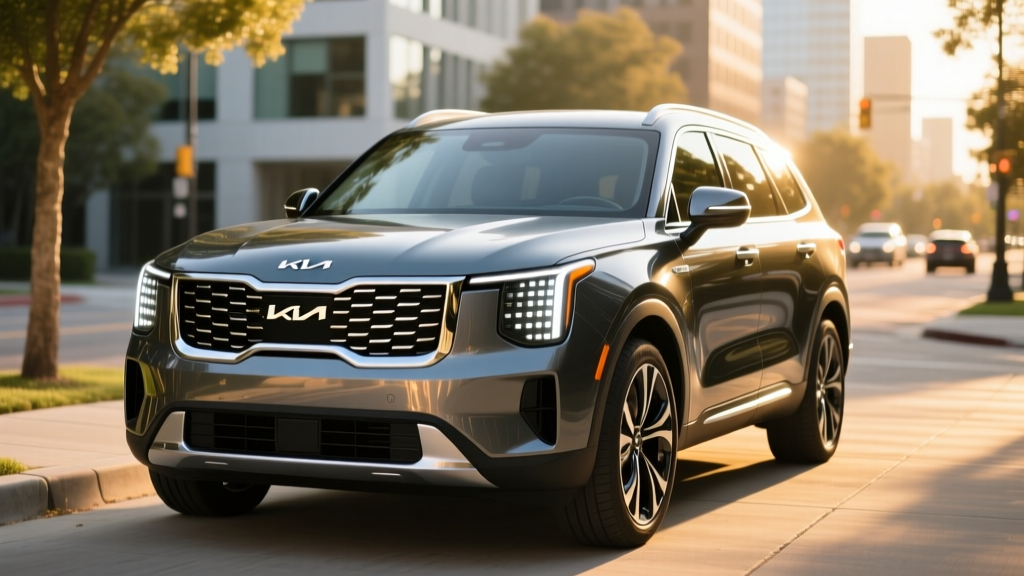
The three-row midsize SUV segment has been dominated by the Kia Telluride since its debut, but one glaring omission remains: a hybrid powertrain. For the 2027 model year, that finally changes. Kia has confirmed that a Telluride Hybrid is in development, arriving alongside the next-generation Telluride's mid-cycle refresh. Here is every confirmed detail, every credible projection, and the ownership math you need before deciding whether to wait.
Telluride Hybrid vs. Telluride PHEV: What Kia Has Confirmed
Before dissecting specs, it is critical to understand the distinction between the two hybrid flavors Kia is expected to offer:
HEV — Conventional Hybrid
- No plug required. Regenerative braking and the engine charge the small battery.
- Estimated 1.5–2.0 kWh battery pack
- Electric motor assists the gas engine; cannot drive on electricity alone at highway speeds
- Target: 27–30 MPG combined (EPA est.)
- No federal tax credit eligibility
PHEV — Plug-In Hybrid
- Plugs in to charge. Larger battery enables pure electric driving for daily commutes.
- Estimated 18–25 kWh battery pack
- 30–35 miles of electric-only range (EPA est.) before the gas engine engages
- Total range: 400+ miles combining electric and gas
- May qualify for partial federal tax credit under IRS §30D rules, depending on battery sourcing
Kia's current PHEV lineup — the Sorento PHEV and Sportage PHEV — uses a 1.6-liter turbo four-cylinder paired with a 72 kW electric motor and an 18 kWh battery. The Telluride, being significantly heavier, will likely receive an uprated version of this system or an adaptation of the Hyundai Motor Group's newer hybrid architecture.
Projected Powertrain Specs and Performance
| Attribute | HEV (Est.) | PHEV (Est.) | Current Gas Telluride |
|---|---|---|---|
| Engine | 2.5L turbo I-4 | 1.6L turbo I-4 | 3.8L V6 |
| Combined HP | ~290 hp | ~290–320 hp | 291 hp |
| Combined Torque | ~310 lb-ft | ~330 lb-ft | 262 lb-ft |
| Battery Capacity | ~1.5 kWh | ~20 kWh | N/A |
| Electric-Only Range | N/A | 30–35 mi | N/A |
| EPA MPG Combined | 27–30 | ~32 (charge-sustaining) | 21–23 |
| 0–60 mph | ~7.0 sec | ~6.8 sec | 7.1 sec |
| Towing Capacity | ~5,000 lb | ~4,000–5,000 lb | 5,000 lb |
| Drivetrain | AWD standard | AWD standard | FWD/AWD |
| Transmission | 6-speed auto | 6-speed auto | 8-speed auto |
These projections draw from Hyundai Motor Group's existing hybrid architecture shared across the Sorento, Sportage, and Tucson platforms, adapted for the Telluride's larger N3 platform. The turbocharged engine choice matters: Hyundai's 2.5T produces 281 hp and 311 lb-ft in the Santa Fe Hybrid, and Kia will likely tune it similarly for the heavier Telluride.
Fuel Economy: EPA Estimates vs. Real-World Expectations
| Metric | HEV (Est.) | PHEV (Est.) | Gas V6 AWD |
|---|---|---|---|
| City MPG | 30–33 | 34–37 (gas mode) | 18 |
| Highway MPG | 25–27 | 28–30 (gas mode) | 24 |
| Combined MPG | 27–30 | 32–34 (gas mode) | 21 |
| MPGe (PHEV, electric) | N/A | 75–85 MPGe | N/A |
| Total Range | ~500 mi | ~440 mi | ~440 mi |
Real-world reality check: Hybrids almost always exceed their EPA city rating in stop-and-go traffic because regenerative braking recaptures energy that a conventional vehicle wastes as heat. Expect the Telluride HEV to deliver 31–35 MPG in urban driving. Highway mileage, however, tends to fall 1–3 MPG below the EPA sticker at sustained 70–80 mph speeds, where the electric motor provides less benefit and aerodynamic drag dominates.
For the PHEV, the combined range figure depends heavily on your charging habits. If you plug in nightly and commute under 30 miles, you may use almost zero gasoline during the workweek. On a road trip with no charging stops, the PHEV operates as a conventional hybrid with slightly lower MPG than the HEV variant due to the added battery weight.
PHEV Charging: What You Need to Know
If you opt for the Telluride PHEV, here is what charging looks like in practice:
| Level | Power | 0–100% Time | Notes |
|---|---|---|---|
| Level 1 (120V outlet) | ~1.4 kW | ~14–16 hours | Emergency only; too slow for daily use |
| Level 2 (240V) | ~7.2 kW | ~2.5–3 hours | Home or workplace; ideal for overnight |
| DC Fast Charge | N/A | N/A | PHEVs rarely support DC fast charging |
A critical distinction: kW (kilowatts) measures the rate of power delivery — how fast energy flows into the battery. kWh (kilowatt-hours) measures total energy stored — the size of the "tank." The Telluride PHEV's ~20 kWh battery charged at 7.2 kW takes roughly 20 ÷ 7.2 ≈ 2.8 hours from empty. Most PHEV owners plug in at night and wake up to a full charge every morning.
Do not expect DC fast-charging capability on the PHEV. Hyundai Motor Group reserves DC charging for its full BEV lineup (Ioniq 5, EV6, EV9). The Sorento PHEV and Sportage PHEV both charge exclusively via Level 1 and Level 2 AC, and the Telluride PHEV will follow suit.
Pricing, Trim Levels, and Tax Credit Eligibility
Based on the current Telluride lineup and the premium Kia charges for hybrid powertrains across its range (the Sorento Hybrid commands a ~$2,500 premium over the gas version), here is our projected pricing:
- Telluride HEV LX AWD: ~$43,000–$45,000 MSRP
- Telluride HEV EX AWD: ~$47,000–$49,000 MSRP
- Telluride HEV SX Prestige AWD: ~$54,000–$56,000 MSRP
- Telluride PHEV EX AWD: ~$52,000–$54,000 MSRP
- Telluride PHEV SX Prestige AWD: ~$58,000–$60,000 MSRP
The conventional Telluride HEV does not qualify for the federal EV tax credit — it is a hybrid, not a plug-in vehicle.
The Telluride PHEV may qualify for up to $7,500 under IRS §30D, but eligibility depends on three factors that frequently change:
- MSRP cap: SUVs must have an MSRP at or below $80,000 (the Telluride PHEV should clear this)
- Buyer income cap: Modified AGI must not exceed $150,000 (single) / $300,000 (joint)
- Battery sourcing: Critical minerals and battery components must meet phased-in domestic/F.T.A.-partner sourcing requirements that tighten annually through 2030
As of the 2026 tax year, several Hyundai/Kia PHEVs have qualified for a partial credit ($3,750) due to battery-component sourcing limitations. Always verify current eligibility at fueleconomy.gov before purchasing, and consult a tax professional for your specific situation. The credit can now be transferred to the dealer as a point-of-sale discount.
Reliability, Battery Warranty, and Long-Term Costs
Is the Telluride Hybrid reliable? Kia's hybrid powertrains have a strong track record. The 1.6T hybrid system in the Sorento and Sportage PHEV has proven durable, with few widespread complaints on NHTSA's database. The 2.5T engine is newer to hybrid duty but shares architecture with the proven Theta III family.
Battery replacement cost: If the hybrid battery fails outside warranty (rare before 150,000+ miles based on industry data), replacement for a ~20 kWh PHEV pack currently runs $4,000–$7,000 including labor at a Kia dealership. The smaller HEV battery pack would cost roughly $2,000–$3,500. These costs have been trending downward as battery cell prices decline.
Maintenance savings: Hybrids actually reduce certain maintenance costs. Regenerative braking extends brake pad life significantly — many hybrid owners report 80,000+ miles on original pads. The engine runs fewer hours than in a gas-only vehicle, which can extend oil change intervals (though you should still follow Kia's recommended schedule).
Who Should Choose the Telluride Hybrid vs. a Full EV or Gas Model?
✅ Choose the Telluride HEV If:
- You want better MPG with zero lifestyle change — no plugs, no charging apps
- You frequently tow (5,000 lb capacity expected)
- Your daily driving mixes city and highway with no predictable charging access
- You want a ~$6,000–$8,000 fuel savings over 5 years vs. the V6 without paying the PHEV premium
✅ Choose the Telluride PHEV If:
- Your daily commute is under 30 miles and you can charge at home (Level 2, 240V)
- You want to drive on electricity most weekdays but need gas flexibility for road trips
- You qualify for the federal tax credit, which can offset the ~$5,000 PHEV premium
- You want the lowest possible running costs without range anxiety
❌ Choose a Full EV (Kia EV9) Instead If:
- You have reliable home Level 2 charging and rarely tow more than 3,000 lb
- You want the lowest cost per mile — electricity at $0.13/kWh costs roughly $0.04/mile vs. $0.14/mile for a 28 MPG hybrid at $3.80/gallon
- You want near-zero maintenance (no oil changes, no spark plugs, minimal brake wear)
- You qualify for the full $7,500 federal tax credit on the EV9
How the 2027 Telluride Hybrid Compares to Rivals
The three-row hybrid SUV segment is heating up. Here is where the Telluride Hybrid is expected to land:
| Model | Combined MPG | Combined HP | Starting MSRP | PHEV Available? |
|---|---|---|---|---|
| Toyota Grand Highlander Hybrid | 35–36 | 245–362 | $46,020 | Yes (PHEV) |
| Mazda CX-90 PHEV | 25 (56 MPGe) | 323 | $51,400 | PHEV only |
| Kia Sorento Hybrid | 34–35 | 261 | $39,090 | Yes (PHEV) |
| Telluride HEV (proj.) | 27–30 | ~290 | ~$43,000 | Yes (PHEV) |
| Hyundai Palisade Hybrid | 27–29 | ~290 | ~$43,500 | TBA |
The Telluride Hybrid is not projected to lead in MPG — Toyota's hybrid system is the efficiency benchmark. Where the Telluride wins is interior space (best-in-class third row), towing capacity, and overall refinement. If maximum fuel economy is your priority, the Grand Highlander Hybrid is the segment leader. If you want the best overall three-row SUV that also happens to be a hybrid, the Telluride remains the one to beat.
Release Timeline: When Can You Buy It?
Kia has confirmed the next-generation Telluride is in development, with the hybrid variants expected to debut alongside the refreshed model. Based on Kia's typical product cadence and industry reporting:
- Official reveal: Late 2026 (likely at the LA Auto Show in November or early 2027)
- On-sale date: Spring 2027 as a 2027 model year
- HEV arrives first: The conventional hybrid typically launches before the PHEV, which may follow 3–6 months later
All specifications in this article are projections based on Hyundai Motor Group's published hybrid architecture, current Sorento/Sportage hybrid data, and industry analysis. Final EPA ratings, MSRP, and feature availability will be confirmed by Kia at launch. We will update this guide when official numbers are released.
Frequently Asked Questions
How many MPG does the 2027 Telluride Hybrid get?
The Telluride HEV is projected to achieve 27–30 MPG combined (30–33 city / 25–27 highway). The PHEV variant should deliver 32–34 MPG combined in gas-only mode plus 30–35 miles of electric-only range with a 75–85 MPGe rating when running on electricity. These are estimates; final EPA numbers will be published at fueleconomy.gov closer to launch.
How far can the Telluride PHEV go on electric only?
We project 30–35 miles of EPA-rated electric-only range, sufficient for most daily commutes. Real-world range will vary: expect 25–30 miles in cold weather (below 40°F) when cabin heating draws additional power, and up to 35–38 miles in mild conditions with light-footed driving.
Does the Telluride Hybrid need to be plugged in?
The conventional HEV does not need to be plugged in — it charges its small battery through regenerative braking and the gas engine. The PHEV variant does benefit from plugging in to maximize its electric-only range, but it will still operate as a normal hybrid if you never plug it in.
Is the hybrid battery reliable and what does replacement cost?
Kia covers the hybrid battery for 10 years/100,000 miles. Industry data shows modern lithium-ion hybrid batteries rarely fail before 150,000+ miles. If replacement is needed out of warranty, expect $2,000–$3,500 for the HEV pack and $4,000–$7,000 for the PHEV pack, including labor.
Does the Telluride Hybrid qualify for any tax credit?
The conventional HEV does not qualify for any federal tax credit. The PHEV may qualify for up to $7,500 under IRS §30D, subject to buyer income limits ($300K joint / $150K single), the $80,000 SUV MSRP cap, and battery-sourcing requirements that tighten each year. Check current eligibility at fueleconomy.gov and consult a tax professional.
Should I wait for the Telluride Hybrid or buy a Kia EV9?
If you have home Level 2 charging, rarely tow heavy loads, and want the lowest cost per mile, the EV9 (300+ mile range, ~$0.04/mile) is the better long-term choice. If you need 5,000-lb towing, frequently drive in areas with limited charging infrastructure, or simply prefer the familiarity of a gas tank as backup, the Telluride Hybrid is the smarter fit.