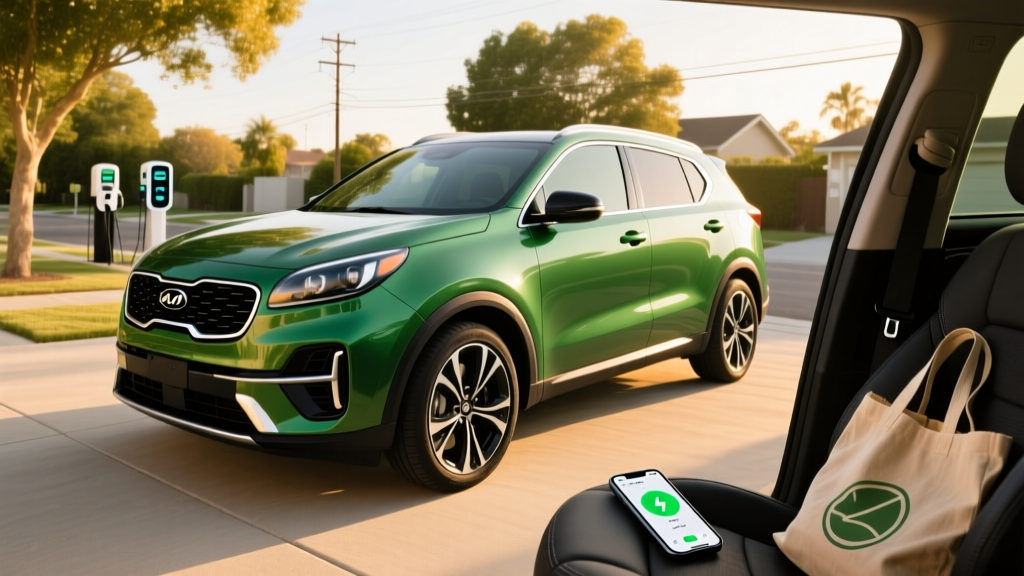
The Kia Sportage has been a compact SUV staple for years, but the current-generation hybrid models are where the lineup genuinely shines for efficiency-minded buyers. The Kia Sportage X-Line Hybrid occupies a specific niche: it delivers the rugged, outdoorsy styling of the X-Line trim package paired with a conventional hybrid (HEV) powertrain that requires no plug, no charging anxiety, and no lifestyle change from a gas car. For 2026, the Sportage Hybrid continues with its turbocharged 1.6-liter powertrain, all-wheel drive, and an EPA rating that makes it one of the most efficient compact SUVs you can buy without plugging in.
This guide breaks down everything a buyer needs to know — from exact MPG figures and real-world fuel economy to how the HEV compares against the Sportage Plug-In Hybrid (PHEV) and whether a full battery-electric vehicle (BEV) might be a better fit. We'll also cover the battery warranty, reliability outlook, and tax-credit eligibility so you can make a spec-driven decision.
HEV vs. PHEV: Which Sportage Hybrid Are You Actually Looking At?
Before diving into numbers, it's essential to understand that Kia sells two distinct hybrid Sportage models. Confusing them is one of the most common mistakes shoppers make on the lot.
| Feature | Sportage Hybrid (HEV) | Sportage Plug-In Hybrid (PHEV) |
|---|---|---|
| Plug-in charging required? | No — self-charging via engine + regen | Yes — plug in to access electric-only range |
| Battery capacity | ~1.49 kWh (small buffer) | 13.8 kWh usable (NMC lithium-ion) |
| Electric-only range | None (EV assist only at low speeds) | EPA-est. 34 miles |
| Combined horsepower | 232 hp | 268 hp |
| EPA combined MPG / MPGe | 38 MPG combined | 84 MPGe (electric) / 35 MPG (gas-only) |
| Drivetrain | AWD standard | AWD standard |
| Starting MSRP (2026) | ~$32,590 | ~$40,490 |
| Federal tax credit (§30D) | Not eligible | Eligible — up to $7,500 (rules apply) |
The X-Line Hybrid discussed in this article is the HEV. It does not plug in. It charges its small battery through regenerative braking and the gasoline engine. If you want the plug-in version with 34 miles of electric-only commuting, you're looking at the Sportage PHEV — a different vehicle at a different price point.
Fuel Economy: EPA Ratings and Real-World MPG
The 2026 Kia Sportage X-Line Hybrid carries the following EPA-estimated fuel economy ratings, per fueleconomy.gov:
| Driving Cycle | EPA Estimate | Real-World Expectation |
|---|---|---|
| City | 38 MPG | 39–43 MPG (hybrids often exceed EPA in stop-and-go) |
| Highway | 38 MPG | 34–37 MPG (aerodynamic drag reduces hybrid advantage) |
| Combined | 38 MPG | 36–40 MPG depending on driving mix |
Hybrid powertrains are at their best in city driving, where the electric motor handles low-speed propulsion and regenerative braking recaptures energy at every stop. On the highway, the gasoline engine does most of the work, and the Sportage Hybrid's boxy SUV profile creates aerodynamic drag that slightly reduces efficiency.
Real-world note: In mixed suburban-and-highway driving, owners typically report 36–40 MPG combined. In heavy city traffic with frequent stops, it's common to see 40+ MPG on the trip computer. Cold weather (below 30°F) will reduce fuel economy by roughly 5–10% due to increased engine runtime for cabin heating and reduced battery efficiency.
Powertrain and Performance Specs
The Sportage X-Line Hybrid uses Kia's turbocharged hybrid setup, which pairs a 1.6-liter turbocharged four-cylinder engine with an electric motor integrated into the six-speed automatic transmission. Here's the full breakdown:
| Specification | 2026 Sportage X-Line Hybrid |
|---|---|
| Engine | 1.6L turbocharged 4-cylinder |
| Engine output | 178 hp / 195 lb-ft torque |
| Electric motor | 47.7 kW (~64 hp) |
| Combined system output | 232 hp / 258 lb-ft torque |
| Transmission | 6-speed automatic (no CVT) |
| Drivetrain | AWD (standard on X-Line) |
| 0–60 mph | ~7.1 seconds |
| Battery type | Lithium-ion polymer, ~1.49 kWh |
| Towing capacity | 2,000 lbs (with tow package) |
| Cargo volume | 39.6 cu ft (rear seats up) / 73.7 cu ft (folded) |
Unlike many competitors that use continuously variable transmissions (CVTs), Kia sticks with a traditional six-speed automatic. The result is more natural-feeling acceleration without the "rubber band" drone common in Toyota and Honda hybrids. The 232 combined horsepower puts the Sportage Hybrid ahead of the Toyota RAV4 Hybrid (219 hp) and on par with the Honda CR-V Hybrid (204 hp) in terms of real-world passing confidence.
Pricing, Trims, and Tax Credit Eligibility
The 2026 Kia Sportage X-Line Hybrid starts at approximately $32,590 MSRP (including destination). The X-Line sits in the middle of the Hybrid range, above the base LX Hybrid and below the X-Line Prestige and top SX-Prestige trims.
Federal tax credit: The Sportage HEV (conventional hybrid) does not qualify for the federal §30D Clean Vehicle Credit. That credit applies only to plug-in electric vehicles — BEVs and PHEVs. If the $7,500 credit is a priority for your purchase decision, you'd need to consider the Sportage Plug-In Hybrid or a full EV and meet the IRS income, MSRP, and battery-sourcing requirements.
Some states offer separate rebates or tax incentives for conventional hybrids, but these vary significantly by jurisdiction. Check your state energy office or department of revenue for current programs.
Battery Warranty, Reliability, and Replacement Cost
Hybrid battery longevity is consistently the top concern for first-time hybrid buyers. Here's what Kia provides:
| Warranty Coverage | Term |
|---|---|
| Hybrid battery | 10 years / 100,000 miles |
| Hybrid system components (motor, inverter) | 10 years / 100,000 miles |
| Powertrain (engine, transmission) | 10 years / 100,000 miles |
| Bumper-to-bumper | 5 years / 60,000 miles |
| Battery capacity retention guarantee | Kia warrants the hybrid battery will maintain sufficient capacity to operate the hybrid system; specific SoH threshold defined in warranty booklet |
Replacement cost if out of warranty: A hybrid battery replacement for the Sportage HEV typically runs between $2,000 and $3,500 including labor. This is significantly less than a full EV battery replacement because the HEV battery pack is small (~1.49 kWh). For context, the battery in the Sportage HEV is roughly 1/50th the size of a typical EV battery.
Reliability outlook: Kia's 1.6T hybrid powertrain has been in production since the 2023 model year refresh. The conventional hybrid system is mechanically simpler than a PHEV or BEV — there's no high-voltage charging system, no large battery thermal management system, and the electric motor assists rather than solely propels the vehicle. Independent reliability data from sources like Consumer Reports has rated the Sportage Hybrid as average to above-average for the compact hybrid SUV segment.
Sportage X-Line Hybrid vs. Sportage PHEV vs. Full EV: Which Fits You?
Choosing between a conventional hybrid, a plug-in hybrid, and a full battery-electric vehicle comes down to your daily driving pattern, home charging access, and budget. Here's a practical decision framework:
Choose the Sportage X-Line Hybrid (HEV) if:
- You have no access to home or workplace charging (apartment, street parking, no garage)
- Your commute is long (40+ miles each way) and mostly highway
- You want maximum simplicity — fill up with gas and drive
- Your budget is under $35,000 and you want AWD
- You take frequent road trips to areas with sparse charging infrastructure
Choose the Sportage PHEV if:
- You can install a Level 2 charger at home or have reliable workplace charging
- Your daily commute is under 34 miles round-trip (you'll rarely use gas on weekdays)
- You want the §30D federal tax credit (up to $7,500, subject to income and sourcing rules)
- You want 268 hp and stronger acceleration
- You still want gas-engine flexibility for long road trips
Choose a full EV (e.g., Kia EV6, Hyundai Ioniq 5) if:
- You have reliable home Level 2 charging
- Your daily driving is under 250 miles and you can plan road-trip charging stops
- You want the lowest per-mile fuel cost (~$0.04–0.06/mile on home electricity vs. ~$0.14/mile at 38 MPG with $3.50/gal gas)
- You want near-zero routine maintenance (no oil changes, no transmission fluid)
- You want to maximize the federal tax credit and eliminate tailpipe emissions
The math on fuel savings: At 38 MPG combined and $3.50/gallon, the Sportage Hybrid costs roughly $0.092 per mile in fuel. A comparable gas-only Sportage AWD (about 26 MPG combined) costs $0.135 per mile. Over 15,000 miles per year, the hybrid saves approximately $645 annually in fuel. Over a 10-year ownership period, that's roughly $6,450 in fuel savings — enough to offset a meaningful portion of the hybrid's price premium over the gas model.
X-Line Trim: What You Get for the Money
The X-Line trim is Kia's adventure-oriented appearance package. On the Hybrid, it includes:
- Unique front and rear bumpers with satin-chrome skid plate accents
- 18-inch alloy wheels with all-terrain tires
- Roof rails with crossbar mounting points
- Gloss black exterior trim and mirror caps
- LED projector headlights with LED daytime running lights
- SynTex (synthetic leather) seating surfaces
- 12.3-inch dual panoramic displays (instrument cluster + infotainment)
- Wireless Apple CarPlay and Android Auto
- Heated front seats and heated steering wheel
- Highway Driving Assist (HDA) — Kia's Level 2 adaptive cruise + lane centering system
The X-Line Hybrid sits at a compelling price point: it's roughly $2,000 above the base LX Hybrid but adds significant content. The step up to the X-Line Prestige Hybrid (~$36,590) adds a panoramic sunroof, ventilated front seats, a Harman Kardon premium audio system, and a surround-view monitor.
Frequently Asked Questions
How many MPG does the Kia Sportage X-Line Hybrid get?
The EPA rates the 2026 Sportage Hybrid AWD at 38 MPG city, 38 MPG highway, and 38 MPG combined. In real-world driving, expect 36–40 MPG combined, with city driving often yielding 40+ MPG thanks to regenerative braking and electric motor assist at low speeds.
Does the Sportage X-Line Hybrid need to be plugged in?
No. The Sportage Hybrid is a conventional HEV (hybrid electric vehicle). Its small battery recharges through regenerative braking and the gasoline engine. You fuel it like any other car — with gasoline at any station. If you want a plug-in model with electric-only range, look at the Sportage PHEV instead.
How far can the Sportage PHEV go on electric only?
The Sportage Plug-In Hybrid (a different model from the X-Line Hybrid) has an EPA-estimated 34 miles of electric-only range. Once the battery depletes, it operates as a conventional hybrid at 35 MPG combined. The PHEV starts at approximately $40,490.
Is the Kia Sportage Hybrid reliable, and what does battery replacement cost?
Kia covers the hybrid battery and system components with a 10-year/100,000-mile warranty. Out-of-warranty hybrid battery replacement runs approximately $2,000–$3,500. The HEV system is mechanically straightforward, and the 1.6T hybrid powertrain has been in production since 2023 with no widespread failure patterns reported.
Does the Sportage X-Line Hybrid qualify for any tax credit?
The conventional Sportage Hybrid (HEV) does not qualify for the federal §30D Clean Vehicle Credit, which is reserved for plug-in vehicles (PHEVs and BEVs). The Sportage PHEV may qualify for up to $7,500 depending on your income, the vehicle's MSRP, and battery component/critical mineral sourcing requirements as defined by the IRS. Some states offer hybrid-specific incentives — check your state's energy office.
How does the Sportage Hybrid compare to the RAV4 Hybrid?
The Toyota RAV4 Hybrid offers 41 MPG combined (3 MPG more) with 219 hp. The Sportage Hybrid provides 232 hp (13 hp more), a more traditional 6-speed automatic transmission (no CVT drone), and a slightly more modern interior with standard dual 12.3-inch screens. Both come standard with AWD and carry similar 10-year/100,000-mile hybrid battery warranties (Toyota's is 10 years/150,000 miles). The Sportage Hybrid is often priced $1,000–$2,000 below an equivalently equipped RAV4 Hybrid.
What is the total driving range on a full tank?
With a 13.7-gallon fuel tank and 38 MPG combined, the Sportage X-Line Hybrid delivers approximately 520 miles of total range on a single fill-up. Highway-heavy driving may reduce this to around 470 miles; city-heavy driving can push it above 540 miles.
The 2026 Kia Sportage X-Line Hybrid is a strong choice for buyers who want compact-SUV practicality, standard AWD, and hybrid efficiency without changing their refueling habits. It won't match a PHEV's electric-only commuting or a BEV's per-mile cost, but for drivers without charging access or those who regularly exceed 200 miles between stops, it's one of the most capable and well-equipped options in the segment.