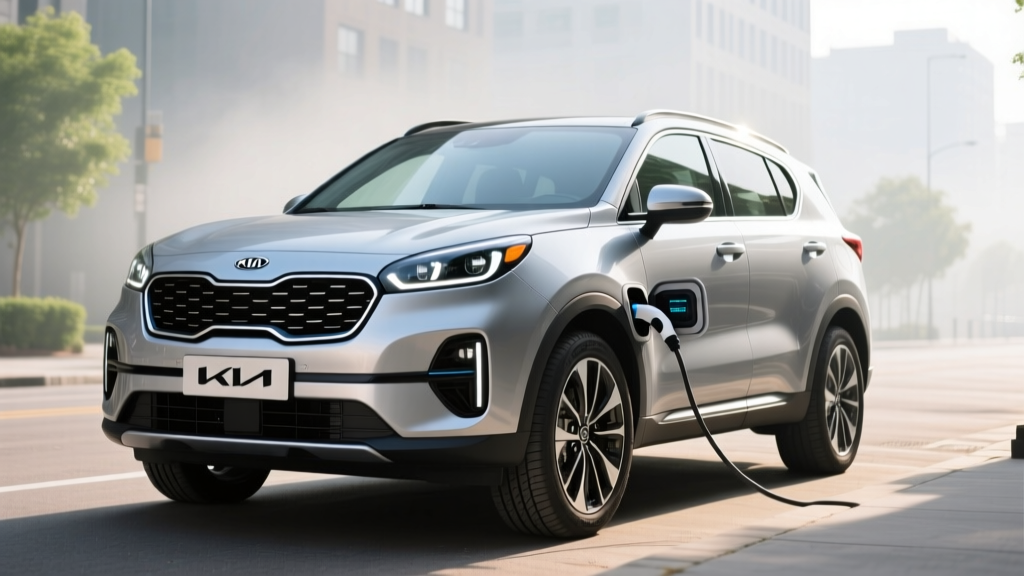
The compact hybrid SUV segment is crowded, but the 2026 Kia Sportage EX Hybrid makes a compelling case for itself by pairing strong fuel economy with legitimate cargo space and a well-equipped cabin. If you have been searching for a Kia Sportage EX hybrid and want to know what daily ownership actually looks like — not just the brochure numbers — this guide covers the real-world MPG, powertrain behavior, battery longevity, and whether the HEV or the PHEV variant is the smarter buy for your situation.
Before we get into the numbers, one critical distinction: the Sportage comes in three powertrain flavors — a conventional gas model, a hybrid (HEV), and a plug-in hybrid (PHEV). The EX Hybrid is the HEV. It charges itself through regenerative braking and the gasoline engine. You never plug it in. The PHEV is a separate, more expensive model with a larger battery and an electric-only driving mode. We will compare both below.
How Many MPG Does the Kia Sportage EX Hybrid Get?
The EPA rates the 2026 Sportage Hybrid at 38 MPG city / 38 MPG highway / 38 MPG combined for the FWD configuration. AWD trims drop slightly to 36 MPG combined. These numbers are competitive with the Toyota RAV4 Hybrid (39-41 MPG combined) and the Honda CR-V Hybrid (40 MPG combined AWD), though the Sportage offers more standard horsepower than either rival.
| Drivetrain | City MPG | Highway MPG | Combined MPG |
|---|---|---|---|
| FWD | 38 | 38 | 38 |
| AWD | 36 | 36 | 36 |
Source: EPA fueleconomy.gov
Powertrain: Engine, Motor, and Combined Horsepower
The Sportage Hybrid uses a 1.6-liter turbocharged four-cylinder gasoline engine paired with a 47.7 kW (64 hp) electric motor integrated into the six-speed automatic transmission. Combined system output is 232 horsepower and 258 lb-ft of torque. That torque figure is available almost immediately thanks to the electric motor, which gives the Sportage Hybrid a responsive feel from a stoplight that many naturally aspirated hybrid competitors cannot match.
| Component | Specification |
|---|---|
| Gasoline Engine | 1.6L turbocharged 4-cylinder, 178 hp / 195 lb-ft |
| Electric Motor | 47.7 kW (64 hp) permanent-magnet synchronous |
| Combined System Output | 232 hp / 258 lb-ft |
| Transmission | 6-speed automatic (torque converter) |
| Traction Battery | ~1.5 kWh lithium-ion (HEV, not plug-in) |
| Drivetrain Options | FWD or AWD |
| 0-60 mph (est.) | ~7.2 seconds |
Unlike some hybrids that use a continuously variable transmission (CVT) or planetary gearset, Kia retained a conventional six-speed automatic. The trade-off: slightly less seamless power blending than a Toyota Hybrid Synergy Drive system, but a more natural, stepped acceleration feel that many drivers prefer. The electric motor fills in torque during gear shifts, minimizing the "rubber band" sensation common in CVT hybrids.
Sportage HEV vs. Sportage PHEV: Which One Fits You?
Kia also offers the Sportage as a plug-in hybrid (PHEV). Here is how the two electrified variants compare side by side:
| Attribute | Sportage Hybrid (HEV) | Sportage Plug-In Hybrid (PHEV) |
|---|---|---|
| Plug-in Charging | No — self-charging | Yes — Level 1 (120V) or Level 2 (240V) |
| Traction Battery Size | ~1.5 kWh | 13.8 kWh usable |
| Electric-Only Range | N/A (EV assist only) | EPA 34 miles |
| Combined System HP | 232 hp | 261 hp |
| Fuel Economy (gas only) | 38 MPG combined | 35 MPG combined (hybrid mode after battery depleted) |
| MPGe (electric + gas) | N/A | 84 MPGe combined |
| Total Range | ~510 miles | ~430 miles (34 EV + ~396 gas) |
| Level 2 Charge Time (0-100%) | N/A | ~3.5 hours at 7.2 kW |
| DC Fast Charge | N/A | No DC fast charging |
| Starting MSRP (2026) | ~$32,090 | ~$40,090 |
The PHEV's 34-mile electric-only range is enough to cover most daily commutes without using a drop of gasoline — provided you can charge at home overnight. On a standard 120V outlet (Level 1), a full charge takes roughly 11 hours. A 240V Level 2 home charger cuts that to about 3.5 hours. Note that the PHEV does not support DC fast charging, which is typical for compact PHEVs in this class.
Pricing, Trims, and Tax Credit Eligibility
The 2026 Kia Sportage EX Hybrid starts at an MSRP of approximately $32,090 (FWD), with AWD adding roughly $1,500. Higher trims — SX and SX-Prestige — push pricing into the $36,000-$39,000 range.
If you opt for the Sportage PHEV instead, it may qualify for up to $7,500 in federal tax credit under §30D, but eligibility depends on several conditions:
- Buyer income cap: Modified AGI must not exceed $150,000 (single) / $300,000 (joint filing)
- MSRP cap: SUVs/vans capped at $80,000 — the Sportage PHEV clears this easily
- Battery sourcing: Critical minerals and battery components must meet phased-in domestic/FtA-country thresholds per IRS rules
- Point-of-sale transfer: As of 2024+, you can transfer the credit to the dealer at purchase for an immediate price reduction, rather than waiting to claim it on your tax return
Because battery sourcing rules tighten annually, always verify PHEV eligibility at the time of purchase. A tax professional can confirm whether your specific situation qualifies.
Battery Warranty, Lifespan, and Replacement Cost
Hybrid batteries in this size class (~1.5 kWh for the HEV, 13.8 kWh for the PHEV) use lithium-ion chemistry with conservative state-of-charge windows managed by the vehicle's battery management system (BMS). The BMS never lets the battery fully charge or fully deplete, which dramatically slows degradation. Based on industry data from similar Hyundai/Kia hybrid platforms, expect less than 10% capacity loss over 10 years and 100,000+ miles of typical use.
If the battery does need replacement outside of warranty, current estimates for a Sportage Hybrid traction battery range from $2,500 to $4,000 (parts and labor), depending on the service provider. The PHEV's larger 13.8 kWh pack would cost significantly more — typically $6,000 to $9,000. However, widespread hybrid battery failures within the warranty period are rare. Most owners will sell or trade the vehicle long before a replacement is needed.
Who Should Choose the Sportage Hybrid vs. a Full EV or Gas Car?
✓ Choose the Sportage HEV If:
- You cannot install a home charger (apartment, no garage)
- You want 38+ MPG without changing any habits
- You take frequent long road trips and don't want to plan charging stops
- Your budget is under $35,000
- You want AWD capability with minimal fuel penalty
✓ Choose the Sportage PHEV If:
- You can charge at home (Level 1 or Level 2)
- Your daily commute is under 34 miles round-trip
- You want near-zero fuel use on weekdays but gas flexibility for weekends
- You qualify for the §30D tax credit (effectively lowering the price to ~$32,500)
- You want 261 hp and stronger electric acceleration
✓ Choose a Full BEV Instead If:
- You have reliable home Level 2 charging
- You want zero tailpipe emissions and lowest per-mile "fuel" cost
- You're eligible for the full $7,500 federal credit on a BEV
- You rarely drive more than 250 miles in a single day
- Maintenance minimization matters (no oil changes, fewer moving parts)
Pros, Cons, and the Bottom Line
Pros
- 38 MPG combined — competitive in class
- 232 hp / 258 lb-ft — punchy for a hybrid SUV
- 10-year / 100,000-mile battery warranty
- Spacious cargo area (~39.5 cu ft behind rear seats)
- No plug-in charging needed — zero lifestyle change
- Conventional 6-speed auto feels natural to drive
Cons
- 1-2 MPG behind RAV4 Hybrid and CR-V Hybrid
- HEV does not qualify for federal tax credit
- AWD fuel economy drops to 36 MPG combined
- Small ~1.5 kWh battery limits EV assist at highway speed
- Base price higher than non-hybrid Sportage LX (~$28,590)
- No DC fast charging on PHEV variant
The 2026 Kia Sportage EX Hybrid is not the highest-MPG option in its class, but it delivers the best combination of power and efficiency at its price point. If 232 horsepower matters to you alongside 38 MPG, the Sportage Hybrid is the clear pick. If pure fuel economy is the only metric, the RAV4 Hybrid edges it out by a small margin. And if you can charge at home, the PHEV variant transforms the value equation entirely — especially with a potential $7,500 federal credit.
Frequently Asked Questions
Does the Kia Sportage Hybrid need to be plugged in?
No. The Sportage Hybrid (HEV) is a self-charging hybrid. It recovers energy through regenerative braking and the gasoline engine. You fuel it like a conventional car and never plug it in. Only the Sportage PHEV requires plugging in to access its 34-mile electric-only range.
How far can the Sportage PHEV go on electric power alone?
The EPA rates the 2026 Sportage PHEV at 34 miles of electric-only range. In mild weather (55-75°F) on flat terrain at city speeds, some owners report 36-38 miles. In cold weather or at highway speeds, expect 26-30 miles before the gasoline engine engages.
Is the Kia Sportage Hybrid reliable?
Kia's 1.6L turbo hybrid powertrain has been in production since the 2022 model year across the Sportage and Tucson platforms. Early reliability data from owner surveys and IIHS safety ratings show no systemic powertrain issues. The 10-year/100,000-mile battery warranty provides additional protection. Long-term (10+ year) data specific to this generation is still accumulating.
What does it cost to replace the hybrid battery?
Out-of-warranty replacement for the Sportage HEV's ~1.5 kWh traction battery is estimated at $2,500-$4,000 including labor. The PHEV's 13.8 kWh battery would cost $6,000-$9,000. However, these batteries rarely fail within the 10-year warranty period, and Kia's warranty coverage is among the best in the industry.
Does the Sportage Hybrid qualify for any tax credit?
The HEV (conventional hybrid) does not qualify for the federal §30D clean vehicle credit. The PHEV may qualify for up to $7,500, subject to buyer income limits, battery sourcing requirements, and MSRP caps. Some states offer additional rebates for PHEVs — check your state's energy office or fueleconomy.gov tax center for details.
How does the Sportage Hybrid compare to the RAV4 Hybrid?
The Toyota RAV4 Hybrid achieves 39-41 MPG combined (depending on trim) versus the Sportage's 38 MPG. The RAV4 uses a CVT and produces 219 hp, while the Sportage Hybrid makes 232 hp with a 6-speed automatic. The Sportage offers slightly more cargo volume (39.5 vs. 37.6 cu ft) and a longer warranty (10yr/100k vs. Toyota's 10yr/150k battery but 3yr/36k bumper-to-bumper). If MPG is the top priority, the RAV4 wins narrowly. If power, interior space, and warranty breadth matter more, the Sportage is the stronger choice.