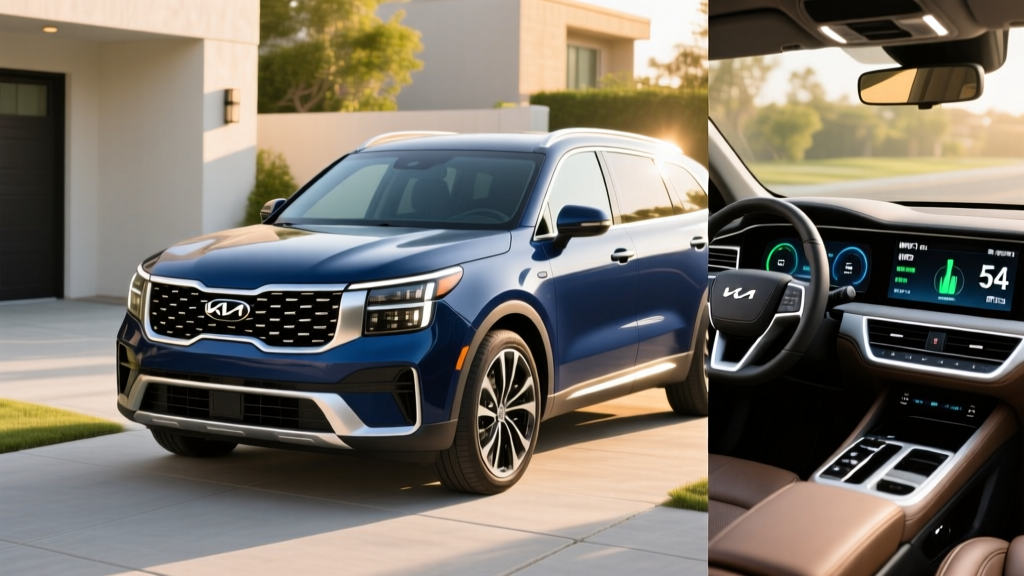
The Kia Sorento occupies a rare niche: a three-row midsize SUV that offers both a conventional hybrid (HEV) and a plug-in hybrid (PHEV) in the same body. For buyers searching for Kia Sorento hybrid MPG figures, the answer depends heavily on which powertrain you choose, how you drive, and whether you have access to home charging. This guide breaks down the exact EPA numbers, real-world expectations, powertrain specs, and ownership costs for both the 2026 Sorento Hybrid and Sorento Plug-In Hybrid.
HEV vs PHEV: Which Sorento Hybrid Are We Talking About?
Kia sells two distinct electrified Sorento variants, and confusing them is the most common buyer mistake. Here's the fundamental difference:
Conventional Hybrid (HEV): Uses a small battery (1.49 kWh) that recharges through regenerative braking and the gas engine. You never plug it in. It improves fuel economy across all driving conditions, especially in stop-and-go city traffic.
Plug-In Hybrid (PHEV): Carries a much larger battery (13.8 kWh) that you can charge from a wall outlet or Level 2 charger. It delivers roughly 32 miles of pure electric driving before the gas engine kicks in, functioning as a regular hybrid afterward.
If you can't charge at home or work, the HEV is the smarter pick. If you have a garage outlet and a short commute, the PHEV can run weeks without visiting a gas station.
Kia Sorento Hybrid MPG: EPA Ratings and Real-World Numbers
The 2026 Sorento HEV pairs a 1.6-liter turbocharged four-cylinder with a 47.7 kW electric motor and a 6-speed automatic transmission. Combined output is 232 horsepower and 262 lb-ft of torque, routed through all four wheels via standard AWD.
| Metric | City | Highway | Combined |
|---|---|---|---|
| EPA Estimate | 34 MPG | 35 MPG | 35 MPG |
| Real-World Expectation | 35–38 MPG | 30–33 MPG | 32–36 MPG |
Source: EPA Fuel Economy
Why real-world city MPG often beats the EPA sticker: Hybrids recapture energy during braking and low-speed driving, so urban stop-and-go traffic actually helps. On sustained highway runs at 75+ mph, the engine works harder and the electric motor contributes less, dropping efficiency. Expect roughly 30–33 MPG on long road trips. In cold weather (below 30°F), fuel economy can dip 5–10% as the engine runs more frequently for cabin heat.
Sorento Plug-In Hybrid: Electric-Only Range and MPGe
The PHEV model replaces the HEV's small battery with a 13.8 kWh lithium-ion pack (NMC chemistry) and a more powerful 72 kW electric motor. Combined system output rises to 261 horsepower and 271 lb-ft of torque.
| Metric | Value |
|---|---|
| Electric-Only Range | 32 miles |
| Total Combined Range (EV + Gas) | ~420 miles |
| MPGe (Electric Mode) | 79 MPGe |
| MPG (Hybrid Mode, Battery Depleted) | 33 MPG Combined |
MPGe explained: Miles Per Gallon Equivalent converts electricity consumption into the energy equivalent of a gallon of gasoline. At 79 MPGe, the Sorento PHEV uses roughly 43 kWh per 100 miles in electric mode — roughly $0.04–$0.06 per mile on average US electricity rates versus $0.14–$0.17 per mile on gas at $3.50/gallon.
In practice, owners with a 20–25 mile round-trip commute and nightly home charging report using the gas engine only a handful of times per month. Once the battery depletes, the PHEV operates as a conventional hybrid at 33 MPG combined — still better than most gas-only midsize SUVs.
Charging the PHEV: Times, Connectors, and What to Expect
| Level | Power (kW) | 0–100% Time | Connector |
|---|---|---|---|
| Level 1 (120V household outlet) | ~1.4 kW | ~10–11 hours | J1772 |
| Level 2 (240V home/public) | ~3.3 kW | ~3.5 hours | J1772 |
| DC Fast Charging | Not supported — the Sorento PHEV has no DC fast-charge port | ||
The onboard charger maxes out at 3.3 kW, which is typical for PHEVs but means you won't benefit from installing a 48-amp Level 2 circuit — a 16-amp, 240V circuit is sufficient. Most owners plug in overnight using the included Level 1 cord on a standard 120V outlet, which fully replenishes the 13.8 kWh battery by morning.
Practical tip: The Sorento PHEV's charge port is on the driver's side front fender. If your garage outlet is on the passenger side, you'll need a 25-foot J1772 extension cord rated for EV use or to reposition your parking spot. Measure before you buy.
Pricing, Trims, and Tax Credit Eligibility
| Model / Trim | MSRP (incl. destination) | Federal Tax Credit |
|---|---|---|
| Sorento HEV LX | ~$39,090 | None |
| Sorento HEV EX | ~$43,390 | None |
| Sorento HEV SX Prestige | ~$47,890 | None |
| Sorento PHEV EX | ~$51,090 | Up to $7,500* |
| Sorento PHEV SX Prestige | ~$55,490 | Up to $7,500* |
*Federal tax credit eligibility under IRS §30D depends on multiple requirements that change frequently:
- MSRP cap: SUVs must have an MSRP at or below $80,000 (all Sorento trims qualify).
- Buyer income cap: Modified AGI must not exceed $150,000 (single), $225,000 (head of household), or $300,000 (joint).
- Battery sourcing: Critical minerals and battery components must meet phased-in domestic/free-trade sourcing thresholds. Kia's PHEV battery sourcing has varied by model year — confirm current-year compliance with your dealer or tax professional.
- Point-of-sale transfer: As of 2024+, eligible buyers can transfer the credit to the dealer at purchase, reducing the purchase price upfront rather than waiting for a tax return credit.
Key distinction: The conventional HEV Sorento does not qualify for the federal §30D clean vehicle credit — only plug-in vehicles with a battery capacity of at least 7 kWh are eligible. Some states offer separate rebates for conventional hybrids; check your state energy office for current programs.
Powertrain and Performance Specs
| Spec | HEV | PHEV |
|---|---|---|
| Engine | 1.6L Turbo I4 | 1.6L Turbo I4 |
| Electric Motor | 47.7 kW | 72 kW |
| Combined Horsepower | 232 HP | 261 HP |
| Combined Torque | 262 lb-ft | 271 lb-ft |
| Transmission | 6-Speed Auto | 6-Speed Auto |
| Drivetrain | AWD (standard) | AWD (standard) |
| 0–60 MPH (est.) | ~7.6 sec | ~7.0 sec |
| Towing Capacity | 2,000 lbs | 2,000 lbs |
| Seating | 6 or 7 passengers | 6 passengers |
Both powertrains use Kia's turbo-hybrid architecture, which pairs the electric motor between the engine and transmission rather than using a dedicated hybrid transmission (e-CVT). This gives the Sorento a more natural shift feel compared to Toyota's CVT-based hybrids, though it sacrifices a small amount of low-speed efficiency. The PHEV's larger motor provides noticeably stronger off-the-line acceleration in electric mode.
Battery Warranty, Lifespan, and Replacement Cost
Kia Hybrid Battery Warranty
HEV: 10 years / 100,000 miles (whichever comes first) — covers battery capacity loss below a manufacturer-defined threshold and defects.
PHEV: 10 years / 100,000 miles — same coverage terms. Federal law (EPA emissions warranty) additionally mandates at least 8 years / 80,000 miles of coverage on PHEV battery packs.
How long do Sorento hybrid batteries actually last? Kia's NMC hybrid cells are designed for the vehicle's lifetime. Based on data from Hyundai/Kia's hybrid lineup (which shares this powertrain architecture), most packs retain 85–90% capacity after 100,000 miles. Complete failures within the warranty period are uncommon but covered.
Out-of-warranty replacement cost: If the battery does need replacement after the warranty expires, expect $2,500–$4,500 for the HEV pack and $5,000–$8,000 for the larger PHEV pack, including parts and labor at a Kia dealership. Independent hybrid shops may offer refurbished packs at 30–40% less. Given that most Sorento hybrids are still well within their warranty window (the hybrid launched for the 2021 model year), this cost is largely theoretical for current buyers.
Reliability and Safety
The Sorento Hybrid shares its N3 platform with the Hyundai Santa Fe Hybrid. The 1.6T hybrid powertrain has been in production since 2020 across multiple Kia/Hyundai models, giving it a maturing reliability track record. Common early-model-year complaints (2021–2022) centered on infotainment software glitches and minor transmission hesitation — both largely addressed in subsequent model-year updates.
The IIHS has historically rated the Sorento well in crash tests, and standard driver-assistance features include forward collision-avoidance assist, lane-keeping assist, blind-spot monitoring, and rear cross-traffic alert. Note: these are SAE Level 1–2 driver-assist features, not autonomous driving — the driver must remain fully engaged at all times.
Hybrid vs PHEV vs Full EV: Which Sorento Fits You?
Decision Framework
Choose the HEV if:
- You don't have access to home or workplace charging
- You want maximum simplicity — no plugs, no cords, no apps
- Your budget is under $48,000
- You drive mostly city miles and want 35+ MPG without behavior changes
Choose the PHEV if:
- You have a garage or driveway with a 120V or 240V outlet
- Your daily commute is under 35 miles round-trip
- You want EV-like daily driving with gas flexibility for road trips
- You qualify for the §30D tax credit (effectively reducing the price gap vs the HEV by up to $7,500)
Consider a full EV (e.g., Kia EV9) if:
- You have reliable Level 2 home charging
- You rarely drive more than 250 miles in a single day
- You want zero tailpipe emissions and minimal maintenance
- You're ready to plan around DC fast-charging stops on road trips
Pros and Cons at a Glance
Pros
- Three-row seating in a hybrid (rare in this segment)
- Standard AWD on both HEV and PHEV
- Strong 10yr/100k-mile battery warranty
- PHEV offers 32 mi EV range — enough for most commutes
- Natural 6-speed auto feel (no CVT drone)
- 261 HP PHEV is genuinely quick off the line
Cons
- PHEV has no DC fast charging
- 3.3 kW onboard charger is slow for public Level 2
- Third row is tight for adults on long trips
- HEV does not qualify for federal tax credit
- Cargo space reduced vs gas Sorento (battery placement)
- PHEV price premium is steep without the tax credit
Frequently Asked Questions
How many MPG does the Kia Sorento Hybrid get?
The 2026 Sorento HEV is EPA-rated at 34 city / 35 highway / 35 combined MPG. In real-world city driving, many owners report 35–38 MPG thanks to regenerative braking. Highway cruising at 75+ mph typically yields 30–33 MPG.
How far can the Sorento PHEV go on electric only?
The EPA rates the Sorento Plug-In Hybrid at 32 miles of electric-only range. In mild weather (50–80°F) at city speeds, you may see 34–35 miles. In cold weather or at highway speeds, expect 25–28 miles before the gas engine engages.
Does the Kia Sorento Hybrid qualify for a tax credit?
The conventional HEV does not qualify for any federal tax credit. The PHEV may qualify for up to $7,500 under IRS §30D, subject to buyer income limits, MSRP caps (the Sorento is under the $80,000 SUV cap), and battery sourcing requirements. Verify current-year eligibility at IRS.gov or with a tax professional before purchasing.
Is the Sorento Hybrid reliable? What does a battery replacement cost?
The 1.6T hybrid powertrain has been in use across Kia/Hyundai models since 2020 with generally solid reliability. The hybrid battery is covered by a 10-year/100,000-mile warranty. Out-of-warranty replacement costs are estimated at $2,500–$4,500 (HEV) or $5,000–$8,000 (PHEV), though most vehicles will never need this within normal ownership.
Do I need to plug in the Sorento Hybrid?
No. The conventional HEV charges its own battery through regenerative braking and the gas engine — you never plug it in. Only the PHEV model requires (or benefits from) plugging in. If you skip charging the PHEV, it simply operates as a regular hybrid at ~33 MPG combined.
Can the Sorento PHEV DC fast charge?
No. The Sorento PHEV only supports Level 1 (120V) and Level 2 (240V) AC charging via a J1772 connector. The onboard charger is limited to 3.3 kW. This is standard for most PHEVs — the battery is small enough that overnight Level 1 charging is usually sufficient.