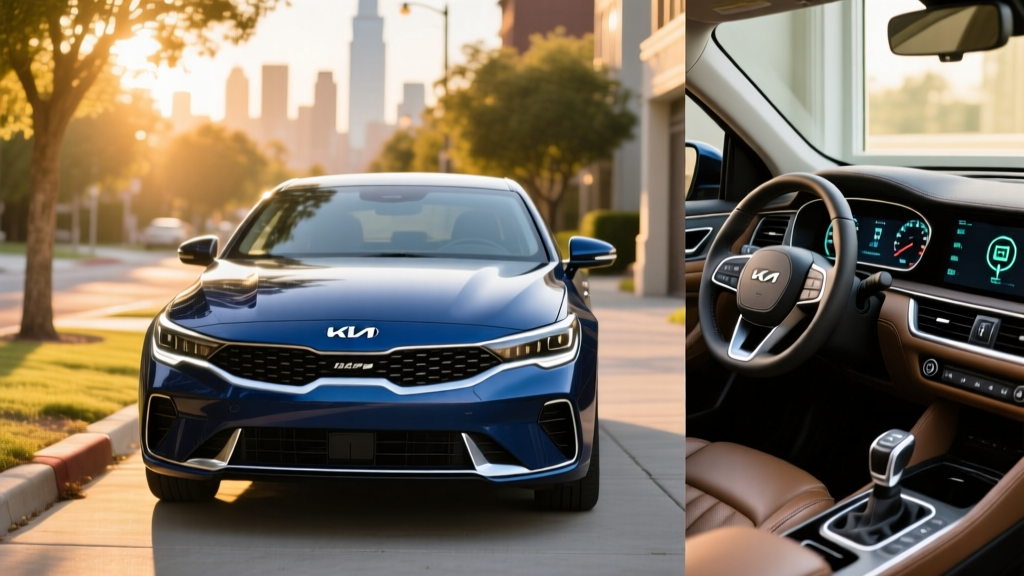
The Kia Optima Hybrid at a Glance
The Kia Optima Hybrid occupies a specific niche in the midsize sedan segment: a conventional hybrid electric vehicle (HEV) that requires no plug, no behavior change, and delivers measurable fuel savings over its gas-only sibling. Kia produced the Optima Hybrid through the 2020 model year before replacing it with the Kia K5, which currently offers no hybrid variant in the US market. That makes the Optima Hybrid a primarily used-market proposition in 2026 — and a compelling one for buyers who want hybrid efficiency without the complexity or cost of a plug-in hybrid or full battery-electric vehicle.
This guide covers the final-generation Optima Hybrid (2017–2020) with exact EPA figures, real-world fuel economy expectations, battery longevity data, and a clear decision framework for whether this HEV fits your needs versus a PHEV or BEV.
HEV vs PHEV vs EV: Understanding What the Optima Hybrid Is
Before diving into specs, it's essential to distinguish what the Optima Hybrid is — and what it isn't. Kia offered two electrified Optima variants during the 2017–2020 generation:
| Attribute | Optima Hybrid (HEV) | Optima Plug-In Hybrid (PHEV) |
|---|---|---|
| Requires plug-in charging? | No — self-charging via regenerative braking and engine | Yes — 9.8 kWh battery, plug to unlock full EV range |
| Battery capacity | 1.62 kWh (lithium-ion polymer) | 9.8 kWh (lithium-ion polymer) |
| Electric-only range | Not applicable (motor assists engine only) | 29 miles (EPA) |
| Combined horsepower | 192 hp | 202 hp |
| EPA combined fuel economy | 41 MPG (EX trim) / 40 MPG (S trim) | 40 MPG combined (gas) / 103 MPGe (electric+gas) |
| DC fast charging | No | No — Level 1/Level 2 only |
| Federal tax credit (§30D) | Not eligible | Was eligible (credit expired for Kia after hitting cap) |
Key distinction: The conventional Optima Hybrid (HEV) never needs to be plugged in. Its small 1.62 kWh battery charges through regenerative braking and the gasoline engine. The Optima PHEV has a larger battery you charge via a wall outlet or Level 2 station to access 29 miles of pure electric driving before the gas engine engages. Both are discontinued as of 2026.
EPA Fuel Economy and Real-World MPG
Fuel economy is the primary reason buyers choose the Optima Hybrid. Here are the official EPA figures from fueleconomy.gov for the final model years:
| Trim / Year | City MPG | Highway MPG | Combined MPG |
|---|---|---|---|
| 2020 Optima Hybrid EX | 41 | 42 | 41 |
| 2020 Optima Hybrid S | 40 | 39 | 40 |
| 2019 Optima Hybrid EX | 40 | 40 | 40 |
| 2017 Optima Hybrid Premium | 39 | 46 | 42 |
Real-World MPG: What Owners Actually Report
Hybrids frequently outperform their EPA estimates in city driving because regenerative braking recovers energy that a conventional car wastes as heat at every stoplight. The Optima Hybrid is no exception. Owner-reported data on Fuelly and hybrid forums clusters around:
- City driving (stop-and-go): 42–46 MPG — the electric motor handles low-speed propulsion, and regen captures braking energy
- Highway cruising (65–75 mph): 36–40 MPG — the engine does most of the work at sustained speeds, reducing hybrid advantage
- Combined mixed driving: 38–44 MPG depending on route composition
- Cold weather penalty: Expect 3–6 MPG reduction in winter months below freezing, as the engine runs more often to provide cabin heat and the battery's chemical efficiency drops
If your commute is predominantly urban with frequent stops, the Optima Hybrid will likely exceed its EPA sticker. Highway-dominant commutes will fall slightly below it — a pattern common to all parallel hybrids.
Powertrain and Performance Specs
| Specification | Value |
|---|---|
| Gasoline engine | 2.0L inline-4, 154 hp @ 6,000 rpm |
| Electric motor | 38 kW (51 hp), integrated into transmission |
| Combined system output | 192 hp @ 6,000 rpm / 271 lb-ft torque |
| Transmission | 6-speed automatic (torque converter, no CVT) |
| 0–60 mph | ~8.3 seconds (independent testing) |
| Hybrid battery | 1.62 kWh lithium-ion polymer, located behind rear seat |
| Drivetrain | Front-wheel drive |
| Curb weight | ~3,600 lbs |
One notable engineering choice: Kia uses a conventional 6-speed automatic transmission with the electric motor sandwiched between the engine and gearbox (via a clutch), rather than the planetary-gear CVT arrangement Toyota and Ford use. The result is more natural-feeling acceleration with defined gear shifts — a trade-off that sacrifices a fraction of an MPG for better driving feel. The 271 lb-ft of combined torque is available low in the rev range, giving the Optima Hybrid respectable off-the-line response despite the ~3,600-lb curb weight.
Battery Warranty, Longevity, and Replacement Cost
How Long Does the Optima Hybrid Battery Last?
Kia's lithium-ion polymer pack is significantly more durable than the nickel-metal hydride batteries in early-generation hybrids. Real-world longevity data from owner forums and repair databases shows:
- Typical lifespan: 150,000–200,000+ miles before significant degradation, based on Hyundai/Kia hybrid fleet data
- Degradation pattern: The 1.62 kWh pack is small and shallow-cycled (rarely fully charged or fully depleted), which dramatically extends cell life. Most owners never notice capacity loss because the system manages a large buffer
- Failure mode: Individual cell imbalance is more common than wholesale pack failure. Some owners report a "check hybrid system" warning around 120,000–160,000 miles, often resolvable with a module rebalance rather than full replacement
Battery Replacement Cost
If the pack does fail outside warranty, here's what to budget:
- OEM replacement (Kia dealer): $2,500–$3,800 including parts and labor
- Refurbished/remanufactured pack: $1,500–$2,500 from independent hybrid specialists
- Individual module repair: $500–$1,200 if only specific cells have degraded
Because the Optima Hybrid's battery is small (1.62 kWh vs. 60–100 kWh in a full EV), replacement costs are a fraction of what BEV owners face. This is a meaningful ownership advantage for budget-conscious buyers.
Used Market Pricing and Tax Credit Eligibility
The Kia Optima Hybrid is no longer sold new. As of early 2026, used-market pricing for the 2017–2020 generation typically falls in these ranges:
| Model Year | Typical Price Range (Used) | Mileage Range |
|---|---|---|
| 2020 Optima Hybrid EX | $16,000–$21,000 | 35,000–60,000 mi |
| 2019 Optima Hybrid EX | $14,000–$18,000 | 50,000–80,000 mi |
| 2017–2018 Optima Hybrid | $11,000–$15,000 | 70,000–110,000 mi |
Does the Optima Hybrid Qualify for a Federal Tax Credit?
No. The conventional Optima Hybrid (HEV) does not qualify for the federal §30D Clean Vehicle Credit. That credit requires a plug-in vehicle with a battery capacity of at least 7 kWh — the Optima HEV's 1.62 kWh pack falls well short.
The Optima Plug-In Hybrid (PHEV) was eligible for a federal credit of approximately $4,543 when new, but Hyundai/Kia hit the manufacturer credit phase-out cap years ago. As of 2026, neither the used HEV nor the used PHEV variant qualifies for any federal tax incentive. Some states offer modest used-EV rebates for PHEVs — check your state energy office for current programs.
Pros and Cons of the Optima Hybrid
✓ Pros
- 41 MPG EPA combined — excellent for a midsize sedan
- No plug required — works with existing gas-station infrastructure
- Conventional 6-speed automatic avoids CVT drone
- 10-year/100,000-mile hybrid battery warranty
- Low battery replacement cost vs. BEVs ($2,500–$3,800 OEM)
- Spacious cabin with 15.9 cu-ft trunk (only slightly reduced by battery)
- Strong used-market value — well-equipped examples under $18K
✗ Cons
- Discontinued — no new 2026 model available
- No electric-only driving capability (unlike the PHEV variant)
- 0–60 in ~8.3 seconds — adequate but not quick
- Highway MPG drops to 36–40 real-world at sustained 75 mph
- No federal tax credit eligibility
- Cold-weather fuel economy penalty of 3–6 MPG
- Infotainment on 2017–2018 models feels dated vs. 2026 standards
Who Should Buy the Optima Hybrid — and Who Shouldn't
Decision Framework
Choose the Optima Hybrid (HEV) if:
- You lack access to home or workplace charging (apartment, street parking, no garage outlet)
- Your commute is city-heavy with frequent stops — where hybrid efficiency peaks
- You want a midsize sedan under $20K with sub-$1,500/year fuel costs
- You're not ready to manage charging logistics or EV range planning
Choose the Optima PHEV instead if:
- You have Level 2 charging access at home and a commute under 29 miles — you could drive months without using gas
- You want electric-only commuting but need a gas engine for road trips
Choose a full BEV (e.g., Hyundai Ioniq 6, Tesla Model 3) if:
- You have reliable home Level 2 charging
- You want to eliminate oil changes, transmission fluid, and spark plugs entirely
- Your daily driving is under 250 miles and you qualify for the §30D credit (up to $7,500 for new EVs meeting IRS sourcing requirements)
The Optima Hybrid's strongest value proposition is simplicity. You fuel it like any gas car, it returns 40+ MPG in the conditions where most people drive, and maintenance costs stay low because the hybrid system adds minimal complexity — no plug, no charging app, no range calculation. For the used-car buyer prioritizing fuel economy over technology novelty, it remains one of the best midsize hybrid sedans available.
Frequently Asked Questions
How many MPG does the Kia Optima Hybrid get?
The 2020 Optima Hybrid EX is EPA-rated at 41 MPG city, 42 MPG highway, and 41 MPG combined. Real-world owners report 38–44 MPG combined depending on driving mix. City-dominant commutes often exceed the EPA estimate thanks to regenerative braking.
Does the Optima Hybrid need to be plugged in?
No. The conventional Optima Hybrid (HEV) is a self-charging system. Its 1.62 kWh battery charges through regenerative braking and the gasoline engine. You never plug it in. The Optima Plug-In Hybrid (PHEV) is a different model that does require plug-in charging to access its 29-mile electric-only range.
How far can the Optima PHEV go on electric only?
The Optima Plug-In Hybrid delivers an EPA-rated 29 miles of all-electric range from its 9.8 kWh battery. After that, the 2.0L engine engages and the car operates as a conventional hybrid rated at 40 MPG combined. Total range exceeds 550 miles with a full tank and full charge.
Is the Kia Optima Hybrid reliable?
Yes. The Optima Hybrid's powertrain — the 2.0L Nu engine paired with Kia's 6-speed hybrid automatic — has proven durable. The lithium-ion polymer battery pack carries a 10-year/100,000-mile warranty and typically lasts 150,000–200,000+ miles based on fleet data. Common non-hybrid issues (brake wear, suspension components) are standard midsize-sedan maintenance items.
What does it cost to replace the Optima Hybrid battery?
An OEM replacement through a Kia dealer runs $2,500–$3,800 including labor. Refurbished packs from independent hybrid specialists cost $1,500–$2,500. Because the pack is only 1.62 kWh, costs are far lower than full EV battery replacements, which can exceed $10,000.
Does the Optima Hybrid qualify for any tax credit in 2026?
No. The conventional HEV does not qualify for the federal §30D Clean Vehicle Credit, which requires a plug-in vehicle with at least 7 kWh of battery capacity. The used Optima PHEV also does not qualify, as the federal used-EV credit (§25E) requires the vehicle to be purchased from a dealer for under $25,000 and meet battery sourcing requirements — most Optima PHEVs fall outside these parameters. Check IRS.gov for current rules.
How does the Optima Hybrid compare to the Toyota Camry Hybrid?
The Toyota Camry Hybrid (52 MPG combined LE trim) outperforms the Optima Hybrid by roughly 11 MPG on the EPA cycle. However, the Camry Hybrid commands a $3,000–$5,000 premium on the used market. The Optima Hybrid offers better value per dollar if you're budget-constrained, while the Camry Hybrid is the efficiency leader if MPG is your top priority.