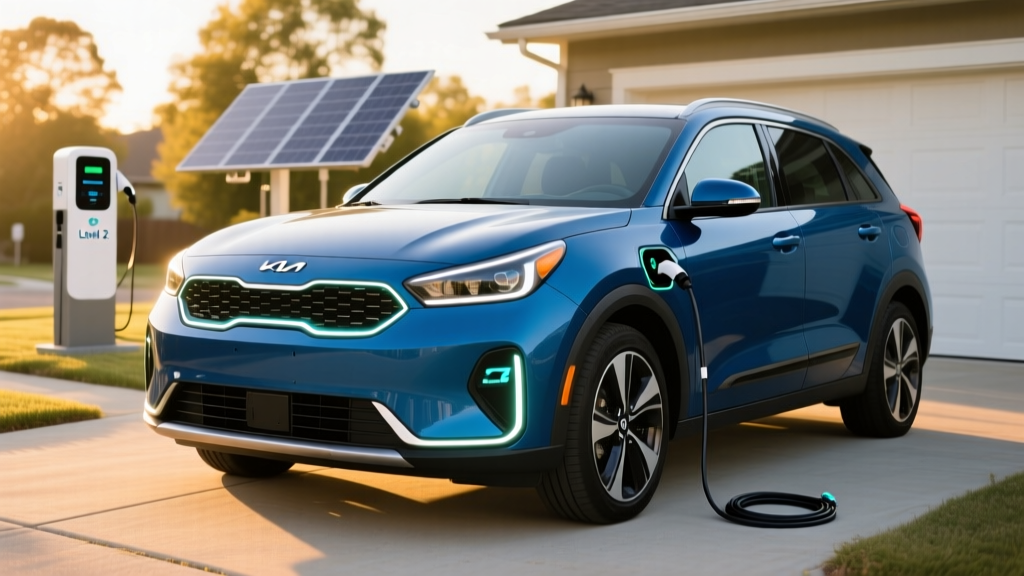
The Kia Niro Plug-In Hybrid occupies a narrow but valuable lane: it's one of the few remaining PHEV crossovers that pairs genuine electric-only commuting range with a sub-$40,000 starting price. For 2026, the Niro PHEV carries over the second-generation architecture introduced for the 2023 model year, with a 1.6-liter turbocharged four-cylinder paired to a more powerful electric motor and an 11.1 kWh lithium-ion polymer battery pack. The result is an EPA-rated 33 miles of electric-only driving and a combined 139 horsepower — enough to make this a legitimate daily-driver EV for short commutes and a capable hybrid for road trips.
But spec sheets only tell part of the story. This guide breaks down the real-world efficiency you can expect, whether the Niro PHEV qualifies for federal tax credits under current IRS §30D rules, how the battery warranty stacks up, and — critically — whether you'd be better served by the conventional Niro Hybrid, a full battery-electric vehicle, or a different PHEV entirely.
HEV vs PHEV: Understanding the Two Niro Variants
Kia sells the Niro in three electrified flavors for 2026: a conventional hybrid (HEV), a plug-in hybrid (PHEV), and a fully electric (EV) model. The naming can confuse first-time electrified-car shoppers, so let's be precise about what distinguishes them.
| Feature | Niro Hybrid (HEV) | Niro Plug-In Hybrid (PHEV) | Niro EV |
|---|---|---|---|
| Plug-in charging | No — self-charging via regen | Yes — 11.1 kWh battery, J1772 port | Yes — 64.8 kWh battery, CCS/NACS port |
| Electric-only range | ~1 mile (low-speed creep) | 33 miles (EPA) | 239 miles (EPA) |
| Combined MPG / MPGe | 53 MPG combined | 48 MPGe (electric) / 48 MPG (hybrid) | 113 MPGe combined |
| Combined horsepower | 139 hp | 180 hp | 201 hp |
| Starting MSRP (2026) | ~$28,500 | ~$35,000 | ~$40,000 |
| Federal tax credit (§30D) | Not eligible | Up to $7,500 (see eligibility below) | Up to $7,500 (see eligibility below) |
The conventional Niro Hybrid never plugs in. Its small battery recharges through regenerative braking and the gasoline engine. The Niro PHEV, by contrast, has a substantially larger battery that you charge via a standard J1772 connector — at home on a 120V outlet, a 240V Level 2 charger, or at public charging stations. Once the electric range depletes, the PHEV seamlessly operates as a conventional hybrid, so you're never stranded.
EPA Fuel Economy and Electric Range: The Official Numbers
According to fueleconomy.gov, the 2026 Kia Niro Plug-In Hybrid posts the following EPA estimates:
| Metric | EPA Rating |
|---|---|
| Electric-only range | 33 miles |
| Combined MPGe (electric mode) | 108 MPGe |
| Combined MPG (hybrid mode, gas only) | 48 MPG |
| City MPG (hybrid mode) | 49 MPG |
| Highway MPG (hybrid mode) | 47 MPG |
| Total combined range (electric + gas) | ~440 miles |
| Fuel tank capacity | 11.1 gallons |
The 33-mile electric-only range is the headline figure for commuters. If your round-trip commute is 30 miles or less and you charge at home nightly, you could go weeks without the gasoline engine engaging at all. The 48 MPG combined rating in hybrid mode means that even on longer road trips where you exceed the battery range, fuel costs stay low.
Real-World MPG and Electric Range: What to Actually Expect
EPA numbers are laboratory estimates. Real-world results depend on driving style, terrain, temperature, and whether you're running climate control. Here's what owner data and independent testing suggest for the Niro PHEV:
Electric-only range in practice: Expect 28–35 miles in mild weather (55–75°F) with moderate acceleration and no heavy HVAC load. In cold weather (below 32°F), battery chemistry and cabin heating demands can reduce electric-only range by 20–30%, dropping usable electric miles to roughly 22–28. Highway-speed driving (70+ mph) also shortens electric range because the motor works harder against aerodynamic drag.
Hybrid-mode MPG in practice: Hybrids tend to match or slightly exceed their EPA city ratings because regenerative braking recovers more energy in stop-and-go traffic. Many Niro PHEV owners report 50–55 MPG in city driving once the battery is depleted. Highway cruising at 75 mph typically yields 42–46 MPG — slightly below the EPA highway figure, which is typical for all vehicles at sustained high speed.
Combined real-world efficiency: If you charge daily and drive 30–40 miles per day, your effective fuel consumption may approach zero gasoline for daily use, with the 11.1-gallon tank providing 440+ miles of range on road trips where you never need to stop for fuel and electrons simultaneously.
Powertrain Specs: Engine, Motor, and Combined Output
| Specification | Detail |
|---|---|
| Engine | 1.6L turbocharged 4-cylinder (GDI) |
| Engine output | 104 hp / 195 lb-ft torque |
| Electric motor | Permanent-magnet synchronous (PMSM) |
| Motor output | 83 hp / 195 lb-ft torque |
| Combined system output | 180 hp / 195 lb-ft torque |
| Transmission | 6-speed dual-clutch automatic (DCT) |
| Drivetrain | Front-wheel drive |
| Battery (usable) | 11.1 kWh, lithium-ion polymer |
| 0–60 mph | ~7.2 seconds |
The 180 combined horsepower is a meaningful upgrade over the conventional Niro Hybrid's 139 hp. The electric motor's instant torque (available from 0 RPM) makes the PHEV feel notably quicker off the line, even though the 0–60 time of approximately 7.2 seconds is brisk rather than sporty. The 6-speed dual-clutch transmission is a differentiator — most competing PHEVs and hybrids use continuously variable transmissions (CVTs), which can produce a rubber-band drone under hard acceleration. The DCT shifts like a conventional automatic, which most drivers find more natural.
Charging the Niro PHEV: Speeds, Connectors, and Home Setup
The Niro PHEV charges exclusively through AC power — it does not support DC fast charging. This is standard for most plug-in hybrids, whose smaller batteries don't justify the added cost and weight of DC fast-charge hardware.
| Charging Level | Power | Time (0–100%) | Connector |
|---|---|---|---|
| Level 1 (120V household outlet) | ~1.4 kW | ~8–9 hours | J1772 |
| Level 2 (240V home/public charger) | ~3.3 kW (onboard charger limit) | ~2.5–3 hours | J1772 |
| DC Fast Charge | Not supported | N/A | N/A |
The Niro PHEV's onboard charger is rated at 3.3 kW. Even if you connect to a 7.2 kW or 11.5 kW Level 2 station, the car will only accept 3.3 kW. This means a full charge from empty takes roughly 2.5 to 3 hours on Level 2 — perfectly adequate for overnight charging but not ideal for mid-day top-ups on road trips.
Home charging practicality: Most Niro PHEV owners find Level 1 charging (a standard 120V outlet) sufficient if they drive less than 35 miles daily and park for 8+ hours overnight. At 1.4 kW, eight hours adds roughly 11–12 miles of electric range. If your daily drive exceeds 30 miles, a Level 2 home charger is worth the investment. Expect to pay $500–$1,200 for a quality Level 2 EVSE (Electric Vehicle Supply Equipment) unit and $500–$2,000 for professional electrical installation depending on your panel capacity and wiring run. A licensed electrician should evaluate whether your home's electrical panel can support a dedicated 240V circuit.
Pricing, Trims, and Federal Tax Credit Eligibility
The 2026 Kia Niro Plug-In Hybrid is offered in three trims:
| Trim | MSRP (approx.) | Key Features |
|---|---|---|
| LX | $35,000 | 8-inch display, wireless CarPlay/Android Auto, heated front seats, Smart Cruise Control |
| EX | $37,500 | 10.25-inch dual displays, navigation, power liftgate, Highway Driving Assist |
| SX Touring | $40,500 | Harman Kardon audio, sunroof, ventilated front seats, leather, LED projection headlights |
Federal tax credit (§30D): The Niro PHEV may qualify for up to $7,500 under the IRS Clean Vehicle Credit, but eligibility is not automatic. Under current 2026 rules, several conditions must be met:
- MSRP cap: The vehicle's MSRP must not exceed $80,000 for SUVs/crossovers (the Niro PHEV clears this easily).
- Buyer income cap: Modified adjusted gross income must not exceed $150,000 (single), $225,000 (head of household), or $300,000 (joint).
- Battery component sourcing: A percentage of battery components must be manufactured or assembled in North America, and critical minerals must meet sourcing thresholds. These thresholds increase annually. Verify current-year compliance on the IRS Clean Vehicle Credits page.
- Point-of-sale transfer: As of 2024, eligible buyers can transfer the credit to the dealer at purchase, reducing the out-of-pocket price immediately rather than waiting for a tax refund.
The credit amount may be $3,750 or $7,500 depending on whether the vehicle meets the battery-component requirement, the critical-minerals requirement, or both. Kia's North American assembly (West Point, Georgia) helps with some requirements, but critical-mineral sourcing rules are stringent and change yearly. Always confirm eligibility with your tax professional and cross-reference the IRS's official eligible-vehicle list before purchasing.
Battery Warranty, Reliability, and Replacement Cost
| Warranty Item | Coverage |
|---|---|
| High-voltage battery | 10 years / 100,000 miles |
| Hybrid system components (motor, inverter, etc.) | 10 years / 100,000 miles |
| Basic vehicle warranty | 5 years / 60,000 miles |
| Powertrain warranty | 10 years / 100,000 miles |
| Capacity retention threshold | Typically 70% of original capacity (verify with dealer) |
Kia's 10-year/100,000-mile hybrid battery warranty is among the longest in the industry and a major confidence signal for PHEV buyers worried about long-term battery health. The lithium-ion polymer chemistry used in the Niro PHEV is proven technology — Kia and Hyundai have deployed it across millions of hybrid and PHEV vehicles since the mid-2010s.
Real-world degradation: PHEV batteries are smaller and cycle more frequently than full EV batteries, but Kia's thermal management system and conservative buffer (the car never lets you use 100% of the 11.1 kWh) help limit degradation. Owners typically see 5–10% range loss over the first 5 years, with the battery remaining well above the 70% warranty threshold at 100,000 miles.
Out-of-warranty replacement cost: If the high-voltage battery fails after the warranty expires, expect a replacement cost between $3,500 and $5,500 including parts and labor. This is significantly less than a full EV battery replacement because the PHEV pack is far smaller (11.1 kWh vs. 60–100 kWh in a BEV). Independent hybrid-battery specialists can sometimes refurbish or replace individual cells for $1,500–$2,500.
Reliability track record: Kia's hybrid powertrain has proven durable. The Niro specifically has earned strong marks from owner surveys. The 1.6L turbo engine is shared across multiple Hyundai/Kia models with millions of miles of field data. The DCT transmission has been refined through multiple generations and is no longer the early-2010s concern it once was.
Niro PHEV vs. Full EV vs. Gas Car: Which Should You Choose?
Choose the Niro PHEV if:
- Your daily round-trip commute is 20–35 miles and you can charge at home overnight.
- You take road trips of 200+ miles several times per year and don't want to plan around DC fast-charging infrastructure.
- You want electric-mode commuting savings without committing to a full EV's higher purchase price.
- You live in an apartment or area where reliable public DC fast charging is sparse, but you can install or access Level 2 charging at home or work.
Choose a full EV (like the Niro EV or Hyundai Ioniq 5) if:
- You have reliable home Level 2 charging and rarely drive more than 200 miles in a single day.
- You want zero gasoline purchases, zero oil changes, and the lowest per-mile fuel cost.
- Your state offers additional EV-only incentives beyond the federal credit.
Choose the conventional Niro Hybrid (HEV) if:
- You cannot charge at home or at work — no garage, no outlet access, no workplace chargers.
- You want the lowest purchase price and don't want to think about plugging in.
- Your daily mileage is high (60+ miles) and you'd rarely use the PHEV's 33-mile electric range anyway.
Choose a gasoline-only crossover if:
- You drive very few miles per year (under 5,000), making the fuel-cost savings of electrification too small to offset a higher purchase price.
Pros and Cons at a Glance
Pros
- 33 miles electric-only covers most daily commutes without gasoline
- 48 MPG combined in hybrid mode keeps road-trip fuel costs low
- 180 hp combined — noticeably quicker than the conventional Niro Hybrid
- 10-year/100,000-mile battery and powertrain warranty
- Potential $7,500 federal tax credit reduces effective price significantly
- 6-speed DCT feels more natural than a CVT
- Comfortable ride quality and practical cargo space (19.4 cu ft behind rear seats)
Cons
- No DC fast charging — long road trips rely entirely on gasoline
- 3.3 kW onboard charger limits Level 2 speed
- Electric-only range drops to ~22–28 miles in cold weather
- FWD only — no AWD option for snow-belt buyers
- SX Touring trim pushes past $40,000, closing the gap with more capable full EVs
- Smaller cargo area than competing PHEV SUVs like the Toyota RAV4 Prime
Frequently Asked Questions
How many MPG does the Kia Niro Plug-In Hybrid get?
The EPA rates the 2026 Niro PHEV at 49 MPG city, 47 MPG highway, and 48 MPG combined when operating in hybrid mode on gasoline. In electric mode, it achieves 108 MPGe. Real-world city driving often yields 50–55 MPG thanks to aggressive regenerative braking, while sustained highway driving at 75 mph typically returns 42–46 MPG.
How far can the Niro PHEV go on electric only?
The EPA rates the Niro PHEV at 33 miles of electric-only range. In mild weather with moderate driving, expect 28–35 real-world miles. In cold weather or at sustained highway speeds, plan for 22–28 miles before the gasoline engine engages.
Does the Niro Plug-In Hybrid qualify for a tax credit?
The Niro PHEV may qualify for up to $7,500 under the federal §30D Clean Vehicle Credit, subject to buyer income limits ($150K single / $300K joint), battery-component sourcing rules, and the $80,000 MSRP cap for SUVs. Eligibility changes as sourcing requirements tighten annually. Confirm current-year status on irs.gov and consult a tax professional before relying on the credit.
Is the Niro PHEV reliable, and what does a battery replacement cost?
Kia's hybrid powertrain has a strong reliability record, and the Niro PHEV is covered by a 10-year/100,000-mile high-voltage battery warranty. Out-of-warranty battery replacement runs approximately $3,500–$5,500 at a dealership, or $1,500–$2,500 through an independent hybrid specialist for cell-level repair. Most owners see only 5–10% battery degradation over the first five years.
Can I charge the Niro PHEV on a regular household outlet?
Yes. The Niro PHEV charges on a standard 120V Level 1 outlet at approximately 1.4 kW, reaching a full charge in 8–9 hours. This is sufficient for owners who drive less than 35 miles daily and park overnight. For faster charging, a 240V Level 2 station fills the battery in about 2.5–3 hours (limited by the car's 3.3 kW onboard charger).
How does the Niro PHEV compare to the Toyota RAV4 Prime?
The RAV4 Prime offers 42 miles of electric range, 302 combined horsepower, and available AWD — but starts around $44,000, roughly $9,000 more than the Niro PHEV LX. The Niro PHEV sacrifices some electric range and power for a significantly lower entry price, better fuel economy in hybrid mode, and a smaller physical footprint that's easier to park in urban environments.