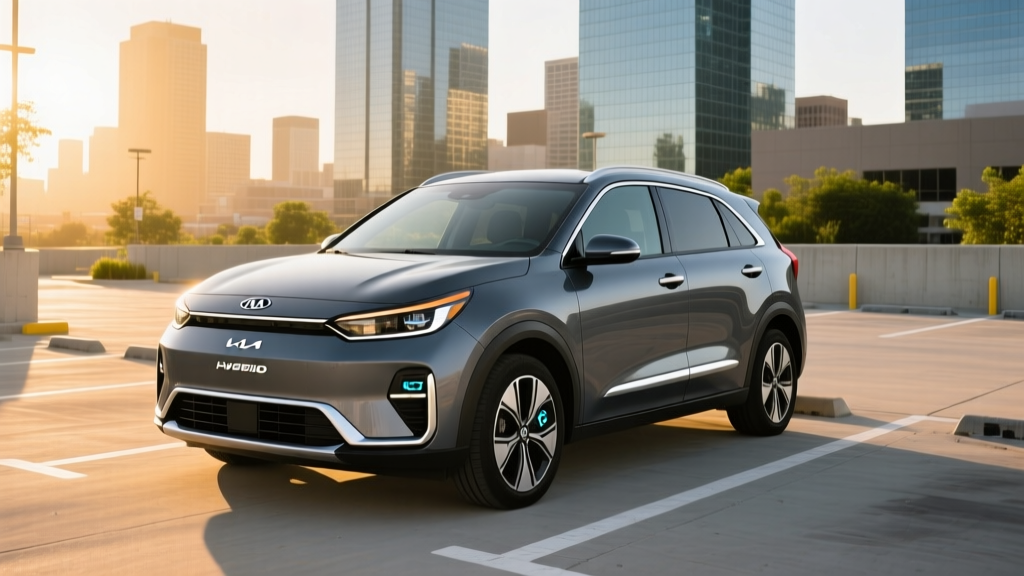
For buyers searching kia niro hybrid τιμή ελλάδα από — loosely translated from Greek as "Kia Niro hybrid price from" — the question of value extends well beyond sticker price. Whether you're cross-shopping from Europe or simply hunting for the most fuel-efficient crossover under $30,000 in the US market, the 2026 Kia Niro Hybrid (HEV) and its plug-in sibling (PHEV) demand a close look. This guide breaks down exactly what US buyers should budget, what real-world MPG looks like, and whether the Niro earns its reputation as a hybrid bargain.
2026 Kia Niro Hybrid: The Quick Numbers
| Specification | Niro HEV | Niro PHEV |
|---|---|---|
| Base MSRP | $28,590 (LX) | $35,390 (EX) |
| EPA Combined MPG / MPGe | 53 MPG combined | 108 MPGe (electric) / 48 MPG (gas) |
| City / Highway MPG | 53 city / 54 highway | 49 city / 47 highway (gas-only mode) |
| Combined Horsepower | 139 hp | 180 hp |
| Battery Capacity | 1.56 kWh (Li-ion) | 11.1 kWh (Li-ion polymer) |
| Electric-Only Range (PHEV) | N/A | 33 miles (EPA) |
| Total Range | ~560 miles | ~440 miles combined (gas + electric) |
| 0–60 mph | ~9.8 sec | ~7.6 sec |
| Drivetrain | FWD, 6-speed DCT | FWD, 6-speed DCT |
| Cargo Volume | 22.8 cu ft (rear seats up) | 19.4 cu ft (battery intrusion) |
| Battery Warranty | 10 yr / 100,000 mi | 10 yr / 100,000 mi |
Sources: fueleconomy.gov, Kia US Specifications.
HEV vs PHEV: Which Niro Are You Actually Buying?
The Niro lineup can confuse first-time hybrid shoppers. Here is the fundamental split:
Niro HEV (Conventional Hybrid)
- No plug required. The 1.56 kWh battery charges through regenerative braking and the gasoline engine.
- Best for: Drivers without reliable home or workplace charging access.
- How it works: The 1.6L GDI 4-cylinder engine and a 32 kW electric motor work in tandem through a 6-speed dual-clutch transmission. The motor assists during acceleration and can propel the car at low speeds for brief distances.
- Real-world MPG: Expect 50–56 MPG combined. Hybrids often exceed EPA city estimates in stop-and-go traffic because regenerative braking recovers more energy. Highway driving at 75+ mph may yield 46–50 MPG.
Niro PHEV (Plug-In Hybrid)
- Plugs in to charge. The 11.1 kWh battery delivers 33 miles of EPA-rated electric-only range.
- Best for: Commuters with home Level 2 charging and daily drives under 35 miles round-trip.
- How it works: A larger 62 kW electric motor paired with the same 1.6L engine. In EV mode, the engine stays dormant until the battery depletes or you demand heavy acceleration.
- Charging: Level 1 (120V) takes ~9 hours; Level 2 (240V, 3.3 kW onboard charger) takes ~3 hours. No DC fast charging — a deliberate trade-off to keep weight and cost down.
Real-World Fuel Economy: What the EPA Sticker Doesn't Tell You
| Scenario | Niro HEV (MPG) | Niro PHEV (MPG / MPGe) |
|---|---|---|
| EPA City | 53 | 49 (gas) / 108 MPGe (electric) |
| EPA Highway | 54 | 47 (gas) |
| EPA Combined | 53 | 48 (gas) / 108 MPGe |
| Real-world city (mixed traffic) | 50–56 | 46–51 (gas mode) |
| Real-world highway (70–80 mph) | 46–50 | 43–47 |
| Cold weather (below 32°F) | 42–48 | 40–45 (gas); EV range drops ~20–30%) |
The Niro HEV's near-identical city and highway EPA figures are unusual — most hybrids favor city driving. Kia's 6-speed DCT avoids the efficiency losses common in CVT-equipped competitors, though it introduces slight shift lag under hard acceleration. In practice, owners who drive predominantly in urban environments with frequent stops often report 54–56 MPG on the HEV, while sustained highway trips at 80 mph bring that figure closer to 46.
For the PHEV, the 33-mile electric range is EPA-rated under ideal conditions. Expect 25–28 miles of real-world electric range in cold weather or at highway speeds. Once the battery depletes, the PHEV operates as a heavier conventional hybrid — hence the slightly lower 48 MPG combined versus the HEV's 53.
Powertrain Deep Dive: 139 hp vs 180 hp
Both Niros share a 1.6-liter naturally aspirated GDI 4-cylinder engine producing 104 hp on its own. The difference lies in the electric motor:
- HEV: 32 kW (43 hp) permanent-magnet synchronous motor → 139 hp combined system output.
- PHEV: 62 kW (83 hp) motor → 180 hp combined system output.
Neither Niro is quick by EV standards, but the PHEV's 7.6-second 0–60 time makes highway merging confident, while the HEV's 9.8-second run feels adequate around town but strained on uphill on-ramps. The 6-speed dual-clutch transmission in both models delivers crisper shifts than a CVT but can hesitate at low speeds — a characteristic Kia has improved in successive model years through software calibration.
Pricing, Trims, and Tax Credit Reality
Here is what US buyers should budget for the 2026 model year:
- Niro HEV LX: $28,590 MSRP
- Niro HEV EX: $31,290
- Niro HEV EX Touring: $33,590
- Niro HEV SX Touring: $36,290
- Niro PHEV EX: $35,390
- Niro PHEV X-Line: $37,590
- Niro PHEV SX Touring: $39,790
Federal Tax Credit Eligibility (IRS §30D — 2026 Rules)
Niro HEV: Conventional hybrids do not qualify for the federal §30D new clean vehicle credit. That credit applies only to plug-in vehicles (BEVs and PHEVs).
Niro PHEV: The PHEV may qualify for a partial or full credit (up to $7,500), but eligibility depends on several conditions that shift frequently:
- Buyer AGI must not exceed $150,000 (single) / $300,000 (joint)
- Vehicle MSRP must be under $55,000 (SUVs/vans) — the Niro PHEV qualifies at all trims
- Battery components and critical minerals must meet North American sourcing thresholds that tighten annually
- Credit can be transferred to the dealer as a point-of-sale discount
As of early 2026, the Niro PHEV's Korean-built battery sourcing has placed it on the partial-credit side of the eligibility ledger. Verify current status at IRS.gov or confirm with your dealer before purchase.
For buyers comparing to the Greek-market search intent behind kia niro hybrid τιμή ελλάδα από: European pricing differs significantly due to VAT structures, local incentives, and trim configurations. Greek Niro Hybrid pricing typically starts around €29,000–€31,000 depending on the model year and dealer, but US MSRP figures above reflect the American market with its own incentive landscape.
Battery Longevity, Warranty, and Replacement Costs
Hybrid Battery Warranty
Coverage: 10 years / 100,000 miles (whichever comes first) on the high-voltage hybrid battery for both HEV and PHEV models. This exceeds the federal minimum mandate of 8 years / 80,000 miles and applies to the original owner and subsequent owners in most states.
What it covers: Battery capacity falling below a defined threshold (typically ~70% state of health), cell failure, and related power electronics.
Powertrain warranty: 10 years / 100,000 miles on the engine, transmission, and hybrid motor.
Basic warranty: 5 years / 60,000 miles bumper-to-bumper.
Replacement cost if out of warranty: A Niro HEV battery pack replacement runs approximately $2,500–$4,000 including labor. The PHEV's larger 11.1 kWh pack is costlier — roughly $5,000–$8,000. However, real-world data from Kia's hybrid lineup suggests most packs retain 85–90% capacity after 150,000 miles under normal use. The Niro's liquid-cooled battery thermal management system significantly reduces degradation compared to air-cooled competitors.
Practical tip: Avoid routinely charging the PHEV to 100% and leaving it sitting in hot climates. Charging to 80–90% for daily use and reserving 100% for long-trip days extends long-term battery health. The HEV's small 1.56 kWh buffer is managed entirely by the car's software and requires no owner intervention.
Who Should Buy the Niro Hybrid — and Who Should Look Elsewhere?
Pros
- Class-leading 53 MPG combined (HEV) under $29K
- 10-year / 100K-mile battery and powertrain warranty
- Comfortable ride quality; car-like handling for a crossover
- PHEV offers 33 miles EV range for short-commute households
- Strong standard safety suite (forward collision, lane keep, blind spot)
- Dual-clutch transmission feels more natural than CVT drones
Cons
- HEV 0–60 in 9.8 sec — slowest in the compact hybrid crossover segment
- No AWD option on any Niro trim (competitors like the RAV4 Hybrid offer it)
- PHEV cargo space reduced to 19.4 cu ft due to battery placement
- No DC fast charging on the PHEV — limits road-trip utility
- HEV does not qualify for any federal tax credit
- Rear seat headroom tight for passengers over 6'2"
Choose the Niro HEV if:
- You want maximum MPG with zero plug-in infrastructure.
- Your budget is firm under $30,000 and you want a crossover form factor.
- Your daily driving is mostly urban and suburban — under 50 miles per day.
- You don't need AWD and live in a moderate climate.
Choose the Niro PHEV if:
- You can install a Level 2 home charger and your round-trip commute is under 35 miles.
- You want to drive on electricity daily but still need gas flexibility for road trips.
- The potential $3,750–$7,500 federal credit (check current IRS eligibility) narrows the price gap with the HEV.
- You value the extra 41 hp for highway passing confidence.
Choose a full EV (like the Kia EV6 or Hyundai Ioniq 5) if:
- You have reliable home charging and your daily driving rarely exceeds 200 miles.
- You want to eliminate gasoline costs entirely and reduce maintenance (no oil changes, no transmission fluid).
- You qualify for the full $7,500 federal credit on a qualifying BEV.
Choose a conventional gas car if:
- You drive fewer than 8,000 miles per year — the hybrid premium won't pay back in fuel savings.
- You need AWD and can't wait for the Niro's FWD-only limitation.
Frequently Asked Questions
How many MPG does the Kia Niro Hybrid get?
The 2026 Kia Niro HEV is EPA-rated at 53 MPG city, 54 highway, and 53 combined. Real-world results typically range from 46–56 MPG depending on driving style, temperature, and route mix. The PHEV achieves 48 MPG combined in gas-only mode and 108 MPGe when operating on its electric battery.
How far can the Niro PHEV go on electric only?
The EPA rates the Niro PHEV at 33 miles of electric-only range. In real-world driving, expect 28–33 miles in mild weather and 22–28 miles in cold conditions or at sustained highway speeds. Once depleted, the gasoline engine engages seamlessly and the car operates as a conventional hybrid.
Does the Kia Niro Hybrid qualify for a tax credit?
The Niro HEV (conventional hybrid) does not qualify for the federal §30D clean vehicle credit — that credit is reserved for plug-in vehicles. The Niro PHEV may qualify for up to $7,500 depending on current battery-sourcing rules, buyer income, and MSRP caps. Check IRS.gov for the latest eligibility list before purchasing. Some states offer additional rebates for PHEVs — check your state energy office.
Is the Kia Niro Hybrid reliable, and what does battery replacement cost?
The Niro hybrid powertrain has demonstrated strong reliability across its production run since 2017, with the battery and powertrain covered by Kia's 10-year/100,000-mile warranty. Out-of-warranty HEV battery replacement costs approximately $2,500–$4,000; PHEV battery replacement runs $5,000–$8,000. Most owners never need a replacement within typical ownership periods.
Does the Niro Hybrid need to be plugged in?
No. The Niro HEV is a conventional hybrid — it charges its small battery through regenerative braking and the gasoline engine. You never plug it in. Only the Niro PHEV requires (and benefits from) plug-in charging to access its 33-mile electric range.
Can the Niro PHEV DC fast charge?
No. The Niro PHEV is limited to Level 2 AC charging at 3.3 kW, which fully replenishes the 11.1 kWh battery in approximately 3 hours. This is common for compact PHEVs — DC fast charging hardware adds cost and weight that most PHEV buyers don't need given their overnight home-charging patterns.
How does the Niro Hybrid compare to the Toyota RAV4 Hybrid?
The RAV4 Hybrid offers AWD and more cargo space but starts at a higher MSRP (~$32,000) and returns 39 MPG combined — 14 MPG less than the Niro HEV. If you need AWD and maximum utility, the RAV4 wins. If MPG and budget are priorities, the Niro is the more efficient and affordable choice.
For buyers navigating the Kia Niro Hybrid's value proposition — whether searching from the US or parsing international pricing with queries like kia niro hybrid τιμή ελλάδα από — the bottom line is clear: at $28,590 and 53 MPG combined, the HEV is one of the most cost-efficient crossovers on the market. The PHEV adds meaningful electric commuting capability for those with charging access, provided the tax credit math works in your favor. Test-drive both, run your commute numbers, and let your daily miles decide.