The 2026 Kia Motors Hybrid Lineup at a Glance
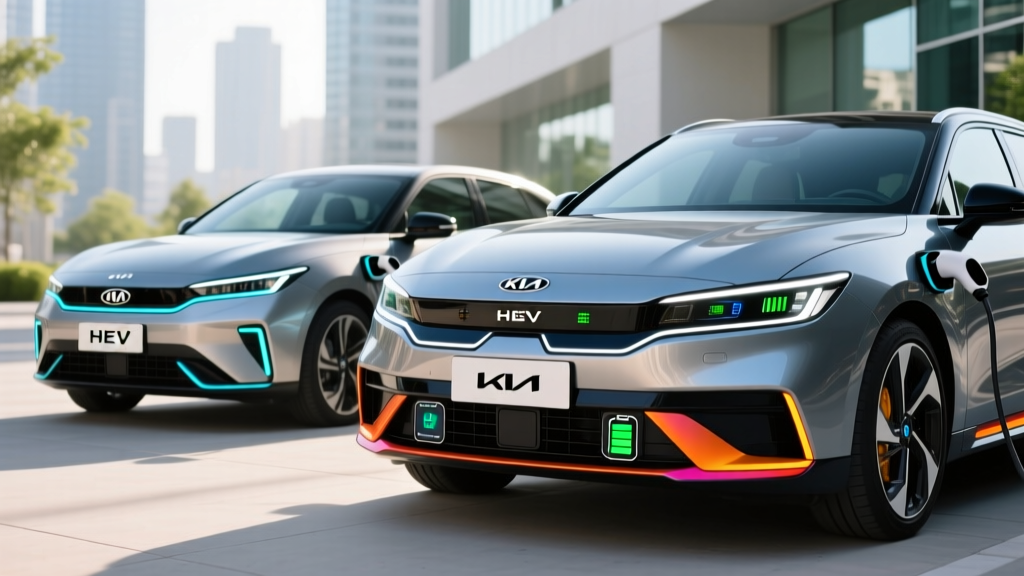
Kia's electrified portfolio has expanded well beyond the original Niro. For 2026, the brand fields conventional hybrids (HEVs) and plug-in hybrids (PHEVs) across four nameplates: Niro, Sportage, Sorento, and Carnival. Each targets a different buyer — from the commuter who wants 50+ MPG without plugging in, to the family hauler who needs 30+ miles of electric-only school-run range before the gas engine fires up.
This guide breaks down every current Kia motors hybrid option with exact EPA figures, battery specs, powertrain output, pricing, and tax-credit eligibility so you can match the right powertrain to your driving pattern.
HEV vs PHEV — What's the Difference?
Conventional Hybrid (HEV): A small battery (typically 1–2 kWh) recharges through regenerative braking and the gas engine. You never plug it in. The electric motor assists the engine to cut fuel consumption, especially in city driving. Think of it as a more efficient gas car.
Plug-In Hybrid (PHEV): A larger battery (11–18 kWh) that you plug in to recharge. It delivers 25–35+ miles of pure electric driving before the gas engine takes over, functioning as a regular hybrid afterward. Ideal if most trips are short and you have home charging access.
2026 Kia Hybrid & PHEV Spec Comparison
| Model | Type | Powertrain | Combined HP | Battery (kWh) | EV Range (mi) | EPA Combined MPG/MPGe | Base MSRP |
|---|---|---|---|---|---|---|---|
| Niro HEV | HEV | 1.6L I4 + 1x motor | 139 hp | 1.56 kWh | N/A | 53 combined | $28,490 |
| Niro PHEV | PHEV | 1.6L I4 + 1x motor | 180 hp | 11.1 kWh (NMC) | 33 mi | 105 MPGe / 48 MPG | $35,590 |
| Sportage HEV | HEV | 1.6L Turbo I4 + 1x motor | 232 hp | 1.49 kWh | N/A | 43 combined (FWD) | $30,490 |
| Sportage PHEV | PHEV | 1.6L Turbo I4 + 1x motor | 261 hp | 13.7 kWh (NMC) | 34 mi | 84 MPGe / 35 MPG | $40,490 |
| Sorento HEV | HEV | 1.6L Turbo I4 + 1x motor | 232 hp | 1.49 kWh | N/A | 35 combined | $38,690 |
| Sorento PHEV | PHEV | 1.6L Turbo I4 + 1x motor | 261 hp | 13.7 kWh (NMC) | 32 mi | 79 MPGe / 33 MPG | $51,890 |
| Carnival HEV | HEV | 1.6L Turbo I4 + 1x motor | 242 hp | 1.49 kWh | N/A | 34 combined | $41,900 |
Sources: EPA fueleconomy.gov, Kia Motors America. All figures reflect 2026 model-year EPA estimates where published; MSRP excludes destination.
Fuel Economy Deep Dive: Real-World MPG vs EPA Stickers
| Model | City MPG | Highway MPG | Combined MPG | Real-World Expectation |
|---|---|---|---|---|
| Niro HEV | 53 | 54 | 53 | 48–55 (hybrids often beat EPA in city due to regen braking) |
| Niro PHEV (gas-only) | 48 | 49 | 48 | 43–50 once battery depletes |
| Sportage HEV (FWD) | 42 | 44 | 43 | 38–44; AWD drops ~2–3 MPG |
| Sportage PHEV (gas-only) | 36 | 35 | 35 | 30–36; highway-heavy driving reduces hybrid efficiency |
| Sorento HEV | 36 | 35 | 35 | 30–36; heavier curb weight limits city gains |
| Sorento PHEV (gas-only) | 33 | 34 | 33 | 28–34; towing further reduces figures |
| Carnival HEV | 34 | 33 | 34 | 28–35; minivan aero penalty on highway |
Conventional hybrids shine in stop-and-go traffic where regenerative braking recovers energy that a gas-only car wastes as heat. The Niro HEV's 53 MPG city figure is realistic — many owners report matching or slightly exceeding it in urban commuting. Highway-only driving at 75+ MPH reduces efficiency for all hybrids because the electric motor contributes less at sustained high speeds.
For PHEVs, the MPGe figure (which combines electric and gas operation) is only meaningful if you regularly recharge. If you never plug in a Sportage PHEV, you're carrying 300+ lbs of battery dead weight and getting 35 MPG — the HEV version would be cheaper and nearly as efficient.
PHEV Electric-Only Range and Charging Details
Kia's PHEV lineup uses NMC (nickel-manganese-cobalt) lithium-ion battery packs sized between 11.1 and 13.7 kWh usable. Here's what that delivers in practice:
- Niro PHEV: 33 miles EPA electric-only range. Sufficient for most round-trip commutes under 30 miles.
- Sportage PHEV: 34 miles EPA electric-only range. The larger pack offsets the heavier crossover body.
- Sorento PHEV: 32 miles EPA electric-only range. Three-row weight takes a slight toll.
Cold-weather reality check: Expect a 20–30% reduction in electric-only range when temperatures drop below freezing. A Sportage PHEV rated at 34 miles may deliver only 24–27 miles in January Midwest conditions before the 1.6L turbo engine engages. Cabin heating draws significant energy from the pack.
Charging Times and Connectors
None of Kia's current PHEVs support DC fast charging — a deliberate engineering choice shared with most PHEVs in this price class. Charging is limited to:
- Level 1 (120V household outlet): ~1.4 kW — fully charges the 13.7 kWh Sportage/Sorento pack in roughly 10–11 hours. Fine for overnight top-ups if your daily EV-range use is under 30 miles.
- Level 2 (240V, J1772 connector): ~3.3 kW onboard charger — full charge in approximately 3.5–4.5 hours depending on pack size. Kia includes a dual-voltage (120V/240V) portable cord with PHEVs, but a dedicated Level 2 home unit (e.g., ChargePoint Home Flex) provides faster, more reliable daily charging.
All Kia PHEVs use the standard J1772 connector for AC charging. There is no NACS or CCS port on these vehicles — DC fast-charging capability is reserved for Kia's full battery-electric models (EV6, EV9).
Powertrain Architecture and Performance
Kia uses a single hybrid architecture across its lineup: a 1.6-liter four-cylinder engine paired with an electric motor positioned between the engine and a 6-speed automatic transmission. This is a conventional parallel-hybrid layout — not a series-hybrid or e-CVT system like Toyota's.
The turbocharged variants (Sportage, Sorento, Carnival) produce substantially more combined output than the naturally aspirated Niro:
- Niro HEV: 104 hp engine + 43 hp motor = 139 hp combined. 0–60 in ~9.5 seconds. Adequate for city merging, leisurely on-ramps.
- Niro PHEV: 104 hp engine + 83 hp motor = 180 hp combined. 0–60 in ~7.5 seconds. The larger motor makes a noticeable difference in passing power.
- Sportage/Sorento HEV: 178 hp turbo engine + 64 hp motor = 232 hp combined. 0–60 in ~7.1 seconds. Genuinely quick for a family crossover.
- Sportage/Sorento PHEV: 178 hp turbo engine + 97 hp motor = 261 hp combined. 0–60 in ~6.7 seconds. The strongest acceleration in Kia's hybrid stable.
- Carnival HEV: 178 hp turbo + 74 hp motor = 242 hp combined. 0–60 in ~7.8 seconds. Respectable for a minivan over 4,700 lbs.
All models route power through a 6-speed automatic (no CVT) and offer available AWD on the Sportage and Sorento. The Niro remains FWD-only. The Carnival HEV is FWD-only as well, which is standard for the minivan segment.
Pricing, Tax Credits, and Ownership Economics
MSRP and Trim Pricing
Entry points for the 2026 Kia motors hybrid lineup (base trim, excluding destination charge):
- Niro HEV LX: $28,490
- Niro PHEV EX: $35,590
- Sportage HEV LX: $30,490
- Sportage PHEV X-Line: $40,490
- Sorento HEV LX: $38,690
- Sorento PHEV SX: $51,890
- Carnival HEV LXS: $41,900
Federal Tax Credit Eligibility (§30D)
Key 2026 §30D Rules for PHEVs:
- Only PHEVs qualify — conventional HEVs do not receive a federal tax credit.
- The vehicle must have a battery capacity of at least 7 kWh (all Kia PHEVs meet this).
- MSRP cap: SUVs/PHEVs must be under $80,000; sedans under $55,000. All current Kia PHEVs fall within limits.
- Buyer income cap: AGI must not exceed $150,000 (single), $225,000 (head of household), or $300,000 (joint).
- Battery sourcing and critical minerals: A percentage of battery components must be manufactured or assembled in North America, and critical minerals must be sourced from the US or FTA partners. These thresholds increase annually — verify current-year compliance on IRS.gov §30D guidance before purchase.
- Point-of-sale transfer: As of 2024+, eligible buyers can transfer the credit to the dealer at purchase, reducing the out-of-pocket price directly rather than waiting for a tax refund.
The maximum credit is $7,500, but partial credits ($3,750) apply if only one of the two sourcing requirements is met. Always confirm eligibility with a tax professional before relying on credit projections.
Conventional hybrids like the Niro HEV and Sportage HEV receive no federal purchase incentive, though some states (California, Colorado, New York among them) may offer rebates or HOV-lane access for PHEVs. Check your state's energy office for current programs.
Battery Warranty, Reliability, and Replacement Cost
Kia Hybrid & PHEV Battery Warranty:
- Hybrid/EV battery: 10 years / 100,000 miles (whichever comes first) in all 50 states.
- Capacity retention threshold: Kia covers the battery if it falls below approximately 70% of original capacity during the warranty period.
- Hybrid system components (inverter, motor, controller): 10 years / 100,000 miles.
- Standard powertrain warranty: 10 years / 100,000 miles.
Kia's hybrid battery track record has been solid since the Niro's 2017 introduction. The relatively small packs (1.5–13.7 kWh) experience shallow cycling in HEVs and moderate-depth cycling in PHEVs, both of which are less stressful on NMC cells than the deep cycles in a full BEV.
Out-of-warranty replacement cost: If a hybrid battery fails after the warranty period, expect $2,000–$3,500 for a Niro HEV pack and $4,500–$7,000 for a Sportage/Sorento PHEV pack, including labor. These are estimated ranges based on current dealer pricing and may vary by region. Third-party refurbishment options are emerging and may reduce cost by 30–40%.
For context, most hybrid batteries outlast the vehicle itself. Data from fleet operators and long-term owners suggests NMC packs in shallow-cycle hybrid applications retain 85–90%+ capacity at 150,000 miles under normal use. Avoid frequent DC fast charging (not applicable to Kia PHEVs anyway) and prolonged storage at 100% or 0% state of charge to maximize longevity.
Hybrid vs PHEV vs Full EV — Which Kia Fits You?
Choose a Kia HEV (Niro, Sportage, Sorento, Carnival) if:
- You cannot charge at home or at work (apartment, street parking).
- Your daily driving is a mix of city and highway with no predictable short-trip pattern.
- You want maximum fuel savings with zero behavior change — just fill up less often.
- Budget matters and you want to avoid the $5,000–$8,000 PHEV price premium.
Choose a Kia PHEV (Niro, Sportage, Sorento) if:
- You have access to a 120V or 240V outlet at home or work.
- Most daily trips fall under 30 miles (the electric-only sweet spot).
- You regularly take longer road trips and don't want range anxiety or DC charging dependency.
- You qualify for the §30D federal tax credit, narrowing the price gap with the HEV.
Choose a full Kia BEV (EV6, EV9) if:
- You have reliable Level 2 home charging and access to DC fast chargers for road trips.
- You want to eliminate gasoline entirely and minimize maintenance (no oil changes, no engine).
- Your daily range needs are under 250 miles, or you're willing to plan charging stops on longer trips.
- You want the maximum available federal tax credit and lowest per-mile fuel cost.
Pros and Cons of the Kia Hybrid Lineup
Pros
- Class-leading warranty at 10 years / 100,000 miles on hybrid battery and powertrain
- Niro HEV achieves 53 MPG combined — among the most efficient crossovers sold
- PHEV models offer 32–34 miles EV range, covering most daily commutes without gas
- 6-speed automatic (no CVT drone) delivers natural acceleration feel
- Turbo hybrid powertrains in Sportage/Sorento produce 232–261 hp — genuinely quick
- PHEVs eligible for up to $7,500 federal credit (income/sourcing-dependent)
- Standard J1772 charging on PHEVs — compatible with all public Level 2 stations
Cons
- No DC fast charging on any PHEV — limits quick top-ups on road trips
- AWD unavailable on Niro and Carnival HEV
- PHEV price premium of $5,000–$8,000 over equivalent HEV takes years to recoup at current fuel prices
- Real-world EV range drops 20–30% in freezing temperatures
- Sorento and Carnival hybrids return only 33–35 MPG combined — modest gains over some turbo gas competitors
- Cargo space reduced in PHEV models due to larger battery placement
Frequently Asked Questions
How many MPG does the Kia Niro hybrid get?
The 2026 Kia Niro HEV is EPA-rated at 53 city / 54 highway / 53 combined MPG. In real-world city driving with frequent stops, many owners match or slightly exceed the 53 MPG combined figure thanks to regenerative braking. Sustained highway driving above 75 MPH may reduce efficiency to the high 40s.
How far can a Kia PHEV go on electric only?
Kia's 2026 PHEVs deliver 32–34 miles of EPA-rated electric-only range depending on the model: Niro PHEV (33 mi), Sportage PHEV (34 mi), and Sorento PHEV (32 mi). In freezing weather, expect 20–30% less — roughly 22–27 miles — due to battery chemistry limitations and cabin heating demand.
Do Kia hybrids need to be plugged in?
No. Conventional Kia hybrids (HEV) never need plugging in — the battery recharges through regenerative braking and the gas engine. Only Kia plug-in hybrids (PHEV) benefit from being plugged in. If you never plug in a PHEV, it functions as a regular hybrid but at a higher purchase price and with added battery weight.
Is the Kia hybrid battery reliable and what does replacement cost?
Kia's hybrid batteries carry a 10-year / 100,000-mile warranty with a ~70% capacity retention threshold. Out-of-warranty replacement costs range from roughly $2,000–$3,500 for a Niro HEV pack to $4,500–$7,000 for a Sportage or Sorento PHEV pack. Real-world data suggests most hybrid packs retain 85%+ capacity well past 150,000 miles under normal use.
Does any Kia hybrid qualify for a federal tax credit?
Only Kia PHEVs (Niro PHEV, Sportage PHEV, Sorento PHEV) are eligible for the federal §30D clean vehicle credit — up to $7,500 depending on battery sourcing compliance, buyer income limits, and MSRP caps. Conventional Kia HEVs do not qualify for any federal purchase incentive. Always verify current-year rules at IRS.gov and consult a tax professional before purchasing.
How long does it take to charge a Kia PHEV at home?
On a standard 120V outlet (Level 1), a Kia PHEV with a 13.7 kWh battery takes approximately 10–11 hours from empty to full. On a 240V Level 2 charger, the same pack charges in about 3.5–4.5 hours via the 3.3 kW onboard charger. No Kia PHEV supports DC fast charging.
Should I buy the Kia Sportage HEV or PHEV?
If you can charge at home and your daily driving is under 34 miles, the Sportage PHEV lets you commute entirely on electricity while keeping gas-engine flexibility for road trips. The $10,000 price gap narrows significantly if you qualify for the $7,500 federal credit. If you lack home charging or drive long distances daily, the Sportage HEV at 43 MPG combined is the more practical and affordable choice.