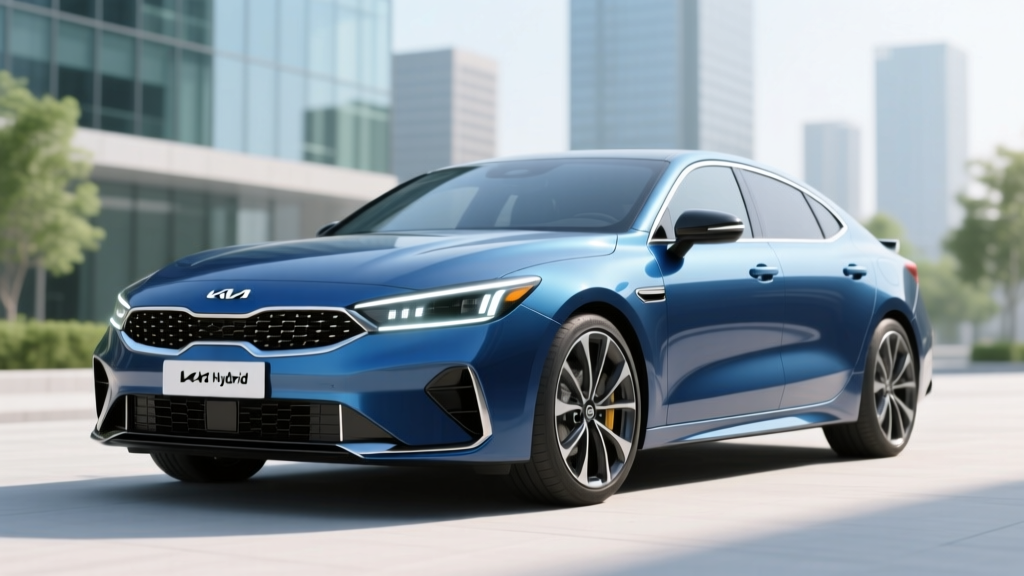
The midsize sedan segment has thinned considerably, but the Kia K5 Hybrid remains one of the few compelling choices for buyers who want serious fuel economy without plugging in. For 2026, the K5 Hybrid continues with a proven 1.6-liter turbocharged hybrid powertrain that delivers an EPA-estimated 52 MPG combined — putting it squarely in competition with the Toyota Camry Hybrid and Honda Accord Hybrid. This guide breaks down every number that matters: real-world fuel economy, powertrain specs, battery longevity, warranty coverage, pricing, and whether this conventional hybrid (HEV) is the right bridge for your driving habits.
2026 Kia K5 Hybrid: Powertrain and Performance Specs
The K5 Hybrid pairs a 1.6-liter turbocharged four-cylinder gasoline engine with an electric motor integrated into a 6-speed automatic transmission. Unlike some hybrids that use a continuously variable transmission (CVT), Kia's setup uses a traditional stepped gearbox, which gives it a more natural, connected driving feel — a notable differentiator in the segment.
| Specification | Value |
|---|---|
| Engine | 1.6L Turbocharged 4-Cylinder |
| Electric Motor | 44 kW (59 hp) permanent-magnet synchronous |
| Combined System Output | 192 hp / 258 lb-ft torque |
| Transmission | 6-Speed Automatic (no CVT) |
| Drivetrain | Front-Wheel Drive |
| Hybrid Battery | ~1.5 kWh lithium-ion (self-charging HEV) |
| 0-60 mph | ~7.5 seconds (est.) |
| Curb Weight | ~3,430 lbs |
| Plug-In Required? | No — regenerative braking recharges battery |
The 192 combined horsepower is competitive for the class. The K5 Hybrid isn't a sport sedan, but the turbo engine provides solid mid-range punch for highway merging, and the electric motor fills in torque at low RPMs where the turbo is still spooling. Expect confident acceleration around town and adequate passing power at speed.
EPA Fuel Economy and Real-World MPG
Fuel economy is the headline number for any hybrid buyer, and the K5 Hybrid delivers. According to fueleconomy.gov, the EPA rates the 2026 K5 Hybrid as follows:
| Driving Cycle | EPA MPG |
|---|---|
| City | 53 MPG |
| Highway | 50 MPG |
| Combined | 52 MPG |
Real-World MPG: What Owners Actually See
Hybrids tend to perform close to — or even exceed — their EPA city estimates in stop-and-go traffic because regenerative braking recaptures energy that a gas car wastes as heat. In real-world driving, expect:
- City / suburban commuting: 48–55 MPG. Short trips with frequent stops maximize regen braking and electric-motor assist.
- Steady highway cruising (65–75 mph): 44–50 MPG. Hybrids lose their advantage at sustained high speeds where the gas engine does most of the work.
- Cold weather (below 30°F): 40–46 MPG. The engine runs longer to heat the cabin and maintain battery temperature, reducing electric-motor contribution.
- Mixed driving (annual average): 47–52 MPG for most owners.
At 52 MPG combined and a national average gas price of ~$3.25/gallon (early 2026), fueling a K5 Hybrid costs roughly $0.063 per mile. Compare that to a non-hybrid midsize sedan averaging 30 MPG combined at ~$0.108 per mile. Over 15,000 miles per year, that's a savings of approximately $685 annually on fuel alone.
HEV vs PHEV vs Full EV: Which Powertrain Fits You?
The K5 is sold as a conventional hybrid (HEV). It does not have a plug-in variant for the 2026 model year, and it does not offer a fully electric version. Understanding the differences between these three powertrain types is essential before you buy:
HEV vs PHEV vs BEV — Quick Comparison
| Feature | HEV (K5 Hybrid) | PHEV (e.g., Toyota Prius Prime) | BEV (e.g., Tesla Model 3) |
|---|---|---|---|
| Plugs in? | No | Yes | Yes |
| Electric-only range | ~1 mi (low-speed creep) | 25–44 mi | 250–400+ mi |
| Total range | 600+ mi | 500–600+ mi | 250–400 mi |
| Home charging needed? | No | Recommended (Level 2) | Essential (Level 2) |
| Gas station visits | Yes (infrequent) | Yes (if beyond EV range) | Never |
| Federal tax credit | Not eligible | Up to $7,500 (§30D) | Up to $7,500 (§30D) |
| Starting price range | $28,000–$35,000 | $33,000–$43,000 | $35,000–$55,000 |
Choose the K5 Hybrid (HEV) If:
- You don't have access to home or workplace charging and can't install a Level 2 charger.
- Your commute is long (50+ miles daily) and you want minimal fuel cost without range planning.
- You want a lower purchase price and zero change to your refueling habits — just fewer gas station stops.
- You live in an apartment or condo where plugging in isn't feasible.
Consider a PHEV or Full EV Instead If:
- You can charge at home (Level 2, 240V) and most of your daily driving is under 30–40 miles.
- You want to maximize electric driving and minimize gas use — a PHEV covers most commutes on electricity alone.
- You want to qualify for the federal §30D tax credit (up to $7,500), which the K5 Hybrid does not qualify for.
Pricing, Trims, and Tax Credit Eligibility
The 2026 Kia K5 Hybrid is offered in two trims. Pricing below includes the destination charge:
| Trim | MSRP (incl. destination) | Key Features |
|---|---|---|
| LXS | $30,490 | 17" alloys, 10.25" touchscreen, wireless CarPlay/Android Auto, SmartSense ADAS suite |
| EX | $34,090 | Leatherette seats, panoramic sunroof, LED headlights, highway driving assist, wireless phone charging |
Federal Tax Credit: Not Eligible
Because the K5 Hybrid is a conventional HEV (not a plug-in), it does not qualify for the IRS §30D Clean Vehicle Credit. That credit — up to $7,500 — is reserved for plug-in electric vehicles (PHEVs and BEVs) that meet battery-sourcing, critical-mineral, MSRP cap, and buyer income requirements outlined at irs.gov.
However, the K5 Hybrid's lower starting price (~$30,490 vs. $33,000+ for comparable PHEVs) partially offsets the lack of a credit. Some states offer modest rebates for high-efficiency hybrids — check your state's energy office or AFDC state incentive database for local programs.
Hybrid Battery Warranty and Longevity
Hybrid battery longevity is consistently the top concern for first-time hybrid buyers. Here's what Kia covers:
Kia Hybrid Battery Warranty
- Hybrid battery: 10 years / 100,000 miles (whichever comes first)
- Hybrid system components (motor, inverter, converter): 10 years / 100,000 miles
- Basic vehicle warranty: 5 years / 60,000 miles
- Powertrain warranty: 10 years / 100,000 miles
Note: In states that follow California Air Resources Board (CARB) emissions standards — including CA, NY, MA, NJ, and others — hybrid battery coverage may extend to 10 years / 150,000 miles. Confirm with your dealer for your state's specific coverage.
Battery Degradation and Replacement Cost
The K5 Hybrid's ~1.5 kWh lithium-ion battery is small and operates within a narrow state-of-charge window (roughly 40–80% SoC), managed by the vehicle's battery management system. This shallow cycling is the key reason hybrid batteries routinely last 150,000–200,000+ miles before meaningful degradation occurs.
If the battery does need replacement outside of warranty, expect:
- Hybrid battery replacement: $2,000–$4,000 (parts + labor at a dealership)
- Aftermarket/remanufactured options: $1,200–$2,500
For context, hybrid battery failures before 150,000 miles are uncommon in Kia's current-generation system. The far more likely maintenance items over the life of the vehicle are the 12V auxiliary battery (every 4–6 years, ~$200), brake pads (which last longer than in gas cars thanks to regenerative braking), and standard fluid changes.
Reliability, Safety, and Ownership Costs
Kia's hybrid powertrain has proven reliable across the K5 and its platform-mate, the Hyundai Sonata Hybrid. The 1.6L turbo-hybrid system has been in production since the 2020 model year with no widespread failure patterns reported. The 6-speed automatic is a conventional design that avoids the reliability concerns some buyers associate with CVTs.
Safety Ratings
The K5 carries strong safety credentials. The NHTSA has awarded the K5 a 5-Star Overall Safety Rating, and the IIHS has tested the K5 extensively. Standard SmartSense features include:
- Forward collision-avoidance assist with pedestrian/cyclist detection
- Blind-spot collision-avoidance assist
- Rear cross-traffic collision-avoidance assist
- Lane keeping assist and lane following assist
- Driver attention warning
- Highway driving assist (EX trim)
Important: All of these are SAE Level 2 driver-assistance features. They do not make the K5 self-driving. You must keep your hands on the wheel and eyes on the road at all times.
Estimated 5-Year Cost of Ownership
| Cost Category | K5 Hybrid (52 MPG) | Gas Midsize Sedan (30 MPG) |
|---|---|---|
| Fuel (at $3.25/gal avg) | $4,688 | $8,125 |
| Maintenance (est.) | $2,800 | $3,200 |
| Insurance (est.) | $7,500 | $7,200 |
| Purchase price (base MSRP) | $30,490 | $28,500 |
| 5-Year Total | $45,478 | $47,025 |
The K5 Hybrid's fuel savings typically offset its ~$2,000 price premium within 3 years. Beyond that, you're saving money every mile. Insurance may run slightly higher due to the hybrid system, but the gap has narrowed significantly as hybrids have become mainstream.
Pros and Cons of the 2026 Kia K5 Hybrid
✓ Pros
- 52 MPG combined — top-tier for the midsize sedan class
- No plug-in required; zero change to refueling habits
- 6-speed automatic (not CVT) for a natural driving feel
- 10-year / 100,000-mile hybrid battery and powertrain warranty
- Strong standard ADAS suite with SmartSense
- Comfortable, well-equipped interior at a competitive price
- 600+ mile total range per tank
✗ Cons
- No federal tax credit eligibility (HEV, not PHEV)
- No all-wheel-drive option (FWD only)
- Highway MPG drops to ~44–47 in real-world sustained cruising
- Only two trim levels (LXS and EX) — limited customization
- Electric-only operation limited to very low speeds (~1 mile)
- Cold-weather fuel economy drops 10–15%
Frequently Asked Questions
How many MPG does the 2026 Kia K5 Hybrid get?
The EPA rates the 2026 K5 Hybrid at 53 MPG city, 50 MPG highway, and 52 MPG combined. In real-world driving, most owners report 47–52 MPG in mixed conditions, with city driving sometimes exceeding the EPA estimate thanks to regenerative braking. Highway-only driving at 70+ mph typically yields 44–48 MPG.
Is the Kia K5 Hybrid a plug-in hybrid (PHEV)?
No. The K5 Hybrid is a conventional hybrid (HEV). It charges its small battery entirely through regenerative braking and the gasoline engine. You never plug it in. Kia does not currently offer a plug-in version of the K5.
Does the K5 Hybrid qualify for any tax credit?
The K5 Hybrid does not qualify for the federal §30D Clean Vehicle Credit, which is limited to plug-in vehicles (PHEVs and BEVs). Some states may offer small incentives for high-efficiency vehicles — check your state's energy office or the AFDC incentive database for local programs.
How long will the K5 Hybrid battery last?
Kia covers the hybrid battery for 10 years / 100,000 miles (10 years / 150,000 miles in CARB states). In practice, modern hybrid batteries routinely last 150,000–200,000+ miles because they operate within a narrow, battery-friendly charge window. If replacement is eventually needed, expect $2,000–$4,000 at a dealership.
Is the K5 Hybrid more reliable than a gas-only K5?
Hybrid systems add complexity (electric motor, inverter, high-voltage battery), but Kia's turbo-hybrid powertrain has been in production since 2020 with strong reliability records. Hybrids also reduce wear on the gas engine (it shuts off at stops and low speeds) and on brake pads (regenerative braking handles much of the deceleration). Overall maintenance costs tend to be comparable to or slightly lower than a gas-only equivalent.
Should I buy the K5 Hybrid or a full EV?
If you have reliable home charging (a garage or driveway with a 240V outlet) and your daily driving is under 250 miles, a full EV like the Tesla Model 3 or Hyundai Ioniq 6 will save you more on fuel and maintenance, and may qualify for up to $7,500 in federal tax credits. If you lack home charging access, drive long distances frequently, or want a lower purchase price with zero lifestyle change, the K5 Hybrid is the pragmatic choice.
What's the total driving range on a full tank?
With a 15.8-gallon fuel tank and 52 MPG combined, the K5 Hybrid delivers an estimated 820+ miles of total range per fill-up. In real-world mixed driving at ~48 MPG, expect approximately 750 miles between stops — one of the longest ranges in the midsize sedan class.