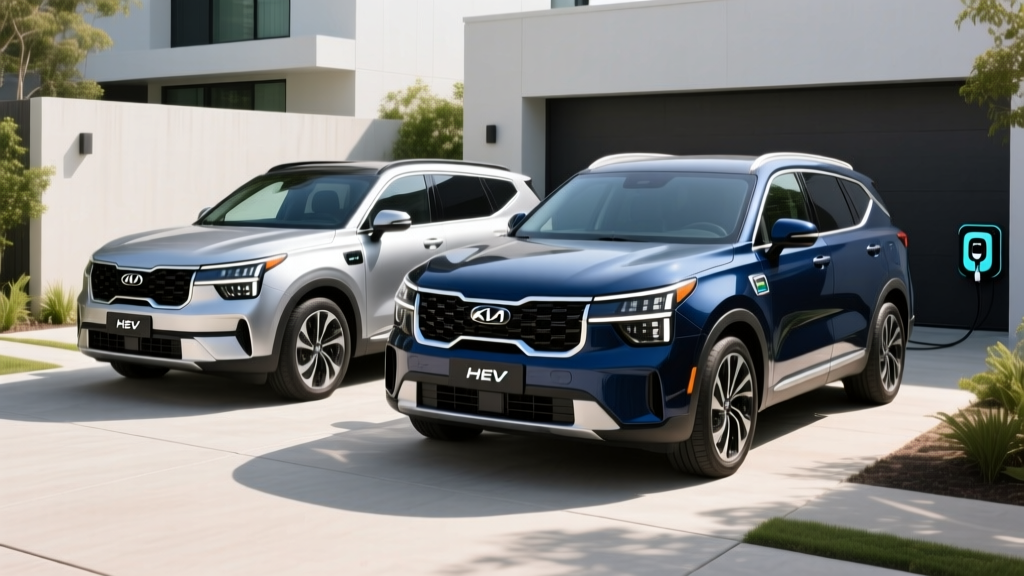
The three-row midsize SUV segment is crowded, but the 2026 Kia Hybrid Sorento occupies a rare position: it offers genuine family hauling with electrified efficiency — in two distinct flavors. Buyers searching for a Kia hybrid Sorento actually face a fork in the road between the conventional hybrid (HEV) and the plug-in hybrid (PHEV). They share a chassis, a turbocharged 1.6-liter engine, and Kia's design language, but their powertrains, fuel economy, and daily driving experiences diverge significantly.
This guide breaks down exact EPA numbers, real-world expectations, powertrain specs, pricing, and tax-credit eligibility so you can choose the right Sorento electrified model — or decide whether a full EV like the Kia EV9 makes more sense for your garage.
HEV vs PHEV: Which Kia Hybrid Sorento Are You Actually Looking At?
Before diving into specs, the distinction matters for your wallet and your routine:
| Feature | Sorento HEV (Hybrid) | Sorento PHEV (Plug-In Hybrid) |
|---|---|---|
| Needs to plug in? | No — regenerative braking + engine charges battery | Yes — plug in for electric-only driving |
| Battery size | ~1.49 kWh (small buffer) | 13.8 kWh usable (lithium-ion polymer) |
| Electric-only range | Less than 1 mile at low speed | EPA-est. 32 miles |
| Combined horsepower | 227 hp | 261 hp |
| Drivetrain | AWD standard | AWD standard |
| Starting MSRP (2026) | ~$38,390 | ~$50,290 |
| Federal tax credit (§30D) | Not eligible | Up to $7,500 (eligibility varies) |
The HEV is a "gas-and-go" experience — you fill up at the pump and the hybrid system seamlessly assists the engine. The PHEV rewards owners who plug in nightly with 30+ miles of silent, zero-tailpipe-emission commuting before the engine ever fires.
Fuel Economy Breakdown: EPA MPG for Every Sorento Hybrid
Here's what the EPA officially rates for the 2026 model year, via fueleconomy.gov:
| Model | City MPG | Highway MPG | Combined MPG | PHEV MPGe (elec+gas) |
|---|---|---|---|---|
| Sorento HEV (AWD) | 34 | 34 | 34 | N/A |
| Sorento PHEV (AWD) | 33 (gas-only) | 34 (gas-only) | 33 (gas-only) | 79 MPGe |
Real-World MPG: What Owners Actually Report
Hybrids typically beat their EPA city estimates in stop-and-go traffic, where regenerative braking recaptures the most energy. In mixed suburban driving, owners of the Sorento HEV commonly report 32–36 MPG combined. Highway-heavy drivers at 75+ mph should expect closer to 29–31 MPG — aerodynamic drag dominates at speed, and the hybrid system has less regen opportunity.
For the PHEV, real-world efficiency depends almost entirely on your charging discipline. If you plug in every night and your commute is under 30 miles round-trip, you may use gasoline only a handful of times per month. Let the battery deplete and you're driving a slightly heavier HEV at 33 MPG combined — still excellent for a three-row AWD SUV.
Powertrain & Performance Specs
| Specification | Sorento HEV | Sorento PHEV |
|---|---|---|
| Engine | 1.6L turbocharged 4-cylinder | 1.6L turbocharged 4-cylinder |
| Engine output | 178 hp / 195 lb-ft | 178 hp / 195 lb-ft |
| Electric motor | 47.7 kW (64 hp) | 72 kW (97 hp) |
| Combined system output | 227 hp / 258 lb-ft | 261 hp / 258 lb-ft |
| Transmission | 6-speed automatic | 6-speed automatic |
| 0–60 mph (est.) | ~7.8 sec | ~7.0 sec |
| Towing capacity | 2,000 lbs | 2,000 lbs |
| Seating | 6 or 7 passengers | 6 passengers (2nd-row captains) |
The PHEV's larger electric motor delivers noticeably stronger low-speed acceleration — useful for merging and school-zone passing. Both models use a conventional 6-speed automatic rather than a CVT, which gives a more natural shift feel that most drivers prefer over the drone of a continuously variable transmission.
PHEV Electric-Only Range, Charging & Battery
Real-world expectation: 28–32 miles in mild weather at moderate speeds. In freezing temperatures with cabin heat running, expect 22–26 miles. Highway driving at 70+ mph will also reduce electric range to roughly 24–27 miles.
The Sorento PHEV's 13.8 kWh battery pack (lithium-ion polymer) stores enough energy for most daily commutes without touching gasoline. Total combined range — electric plus a full 12.4-gallon fuel tank — exceeds 420 miles.
Charging the Sorento PHEV
| Charging Method | Power (kW) | 0–100% Time | Notes |
|---|---|---|---|
| Level 1 (120V household outlet) | ~1.4 kW | ~10.5 hours | Overnight top-up; slow for daily full recharge |
| Level 2 (240V home charger) | ~3.3 kW (onboard limit) | ~3 hours 45 min | Ideal for overnight; full charge by morning |
| DC Fast Charging | Not supported | N/A | No DCFC port on Sorento PHEV |
The Sorento PHEV's onboard charger caps at 3.3 kW, meaning even a 48-amp Level 2 home charger will only deliver 3.3 kW to the battery. This is standard for PHEVs — the smaller battery doesn't need high-speed charging. A standard Level 2 setup (like a ChargePoint Home Flex or Emporia Vue) is more than adequate. Plug in after dinner; wake up to a full battery.
Important: The Sorento PHEV uses a J1772 connector for Level 2 AC charging. No CCS or NACS adapter is needed — those apply to DC fast charging on full EVs.
Pricing, Trims & Tax Credit Eligibility
2026 Kia Sorento HEV Pricing
- S Hybrid: ~$38,390 MSRP
- EX Hybrid: ~$41,590 MSRP
- SX Prestige Hybrid: ~$46,890 MSRP
2026 Kia Sorento PHEV Pricing
- EX PHEV: ~$50,290 MSRP
- SX Prestige PHEV: ~$54,590 MSRP
Destination charges add approximately $1,390 to all trims.
Federal Tax Credit (§30D) — PHEV Only
The Sorento PHEV may qualify for up to $7,500 under IRS §30D, but eligibility depends on multiple criteria that change with supply-chain rules. Per IRS.gov, key requirements include:
- MSRP cap: SUVs must not exceed $80,000 (Sorento PHEV qualifies)
- Buyer income cap: AGI ≤ $150,000 (single) / $300,000 (joint)
- Battery sourcing: Critical minerals and battery components must meet phased-in domestic/free-trade sourcing thresholds (requirements tighten annually through 2030)
- Point-of-sale transfer: Buyers can transfer the credit to the dealer at purchase for an immediate price reduction — or claim it at tax filing
- Final assembly: Vehicle must be assembled in North America
Caution: Battery component and critical-mineral sourcing rules have disqualified several PHEVs from the full $7,500 in recent years — some qualify for only $3,750 or $0 depending on the model year. Always verify current eligibility on fueleconomy.gov's tax credit page before purchasing. Consult a tax professional for your specific situation.
The Sorento HEV (conventional hybrid) does not qualify for the §30D federal clean vehicle credit. Some states and utilities offer separate hybrid incentives — check your local programs.
Battery Warranty, Reliability & Replacement Cost
10 years / 100,000 miles (whichever comes first) — covers battery capacity loss below a defined threshold and defects. This applies to both the HEV and PHEV traction batteries. The standard powertrain warranty also runs 10 years/100,000 miles, with a 5-year/60,000-mile bumper-to-bumper limited warranty.
How Long Will the Hybrid Battery Last?
Modern lithium-ion hybrid batteries are engineered for the life of the vehicle. Kia's hybrid systems use conservative charge/discharge windows (never fully cycling 0–100%) to minimize degradation. Based on industry data from similar Hyundai/Kia hybrid platforms, most owners see less than 10% capacity loss over 100,000 miles.
If a replacement is needed out of warranty, expect:
- HEV battery replacement: ~$2,000–$3,500 (smaller pack, simpler swap)
- PHEV battery replacement: ~$5,000–$8,000 (larger pack, more complex integration)
These are estimates based on current Hyundai/Kia hybrid parts pricing. Third-party refurbishment options may reduce costs as the fleet ages.
Overall Reliability
The Sorento hybrid powertrain shares its core architecture with the Hyundai Tucson Hybrid and Santa Fe Hybrid, which have accumulated years of real-world durability data. The turbocharged 1.6L engine and 6-speed automatic are proven components. Common owner complaints tend to involve infotainment software rather than powertrain issues. NHTSA and IIHS safety ratings should be checked for the latest model-year crash-test results.
Who Should Buy the Sorento Hybrid — And Who Shouldn't?
Choose the Sorento HEV if:
- You can't charge at home (apartment, street parking, no garage outlet)
- You want maximum simplicity — no cables, no charging apps, no behavior change
- Your budget tops out around $45K and you want a well-equipped three-row SUV
- You drive mostly city/suburban routes where hybrid efficiency shines (34 MPG combined)
Choose the Sorento PHEV if:
- You have reliable Level 2 home charging (garage or driveway)
- Your daily commute is under 30 miles round-trip (you'll rarely burn gas)
- You want the extra 34 hp for passing and highway merging
- You qualify for the §30D tax credit, effectively reducing the price gap with the HEV
Consider a Full EV (Kia EV9 or similar) if:
- You want zero tailpipe emissions and zero oil changes
- Your daily driving is under 250 miles and you can charge at home
- You want access to DC fast charging for road trips (10–80% in ~20 minutes on the EV9)
- You're ready to fully transition from gasoline
Pros
- Three-row seating with genuine adult-sized third row
- Standard AWD across all hybrid trims
- 34 MPG combined (HEV) is exceptional for the class
- 10-year/100,000-mile battery and powertrain warranty
- PHEV offers 32 miles electric — covers most commutes gas-free
- Conventional 6-speed auto avoids CVT drone
Cons
- PHEV price premium is steep (~$12K over HEV base)
- PHEV onboard charger limited to 3.3 kW — no faster home charging option
- No DC fast charging on PHEV (road-trip charging is gas-only)
- 2,000-lb towing limit trails V6 and turbo gas Sorento models
- Cargo space reduced slightly vs gas model due to battery placement
- §30D credit eligibility for PHEV is uncertain year-to-year
Frequently Asked Questions
How many MPG does the Kia hybrid Sorento get?
The 2026 Sorento HEV is EPA-rated at 34 MPG city / 34 highway / 34 combined. The PHEV achieves 33 MPG combined when operating on gasoline after battery depletion, plus a 79 MPGe rating when factoring in electric-only driving.
How far can the Sorento PHEV go on electric only?
The EPA rates the Sorento PHEV at 32 miles of electric-only range. In real-world conditions — mild weather, moderate speeds — expect 28–32 miles. Cold weather and highway driving reduce this to roughly 22–27 miles.
Does the Kia Sorento Hybrid need to be plugged in?
The conventional Sorento HEV does not need to plug in. It charges its small battery through regenerative braking and the engine. The Sorento PHEV does need to plug in to access its 32-mile electric range, though it will still function as a regular hybrid if you never plug it in.
Is the Sorento hybrid reliable, and what does battery replacement cost?
Kia's hybrid powertrain has a solid reliability track record, backed by a 10-year/100,000-mile battery warranty. Out-of-warranty replacement costs range from approximately $2,000–$3,500 for the HEV battery to $5,000–$8,000 for the PHEV pack. Most hybrid batteries outlast 150,000+ miles with minimal degradation.
Does the Kia Sorento PHEV qualify for a tax credit?
The Sorento PHEV may qualify for up to $7,500 under the federal §30D clean vehicle credit, subject to buyer income limits, MSRP caps, and battery-sourcing requirements that tighten annually. The conventional HEV does not qualify. Always verify current eligibility on fueleconomy.gov and consult a tax professional.
Hybrid vs PHEV vs EV — which Sorento is right for me?
If you can't charge at home, the HEV is the clear choice — pure efficiency with no behavior change. If you have home charging and a short commute, the PHEV lets you drive electric daily while keeping gas for road trips. If you're ready to eliminate gasoline entirely and your daily range needs are under 250 miles, consider Kia's EV9 instead.
Can the Sorento PHEV DC fast charge?
No. The Sorento PHEV supports only Level 1 (120V) and Level 2 (240V) AC charging via a J1772 connector. DC fast charging is not available — this is typical for plug-in hybrids, whose smaller batteries don't require high-speed charging infrastructure.