Quick Verdict: The Minivan That Sips, Not Gulps
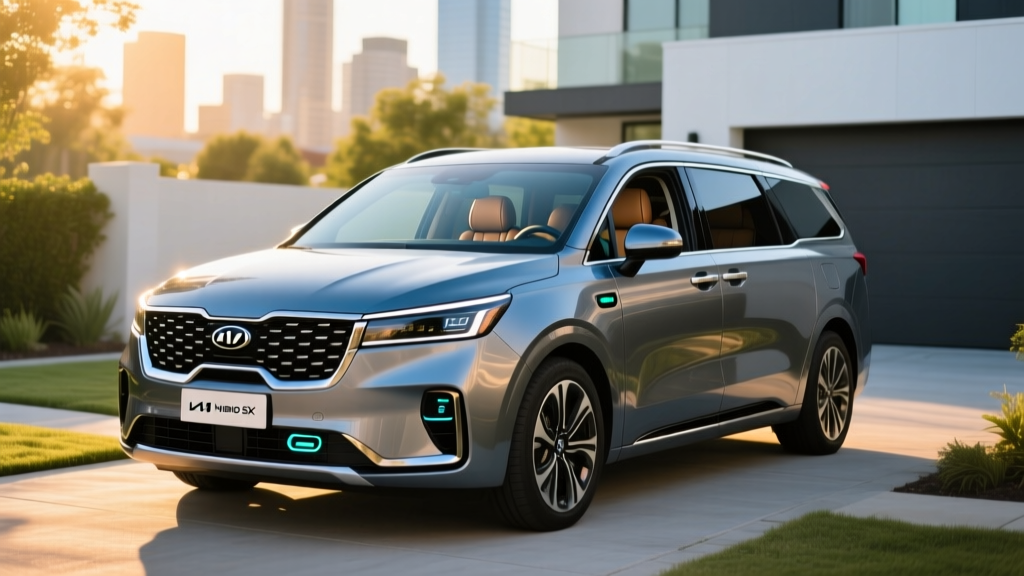
The 2026 Kia Carnival Hybrid SX occupies a specific niche: families who need three-row minivan space but want to cut fuel costs without plugging in. Unlike the plug-in hybrid Pacifica or a full-electric alternative, the Carnival Hybrid is a conventional HEV — it charges its own battery through regenerative braking and the gasoline engine. No plug, no range anxiety, no charging infrastructure required. The SX trim sits near the top of the lineup, adding premium features while maintaining the same 34 MPG combined EPA rating that defines the entire Carnival Hybrid fleet.
For 2026, Kia continues with the proven 1.6-liter turbocharged hybrid powertrain producing 245 combined horsepower. The SX trim brings leather-trimmed seats, a 12.3-inch infotainment display, highway driving assist, and smart power sliding doors. If you're cross-shopping against the Toyota Sienna (also hybrid-only at 36 MPG combined) or the Chrysler Pacifica PHEV (32 electric-only miles), this guide breaks down exactly where the Carnival Hybrid SX fits — and where it falls short.
EPA Fuel Economy and Real-World MPG
The headline number for any hybrid buyer is fuel economy. Here's the EPA-rated breakdown for the 2026 Kia Carnival Hybrid (all trims including SX), sourced from fueleconomy.gov:
| Metric | Value |
|---|---|
| City MPG | 34 |
| Highway MPG | 31 |
| Combined MPG | 33 |
| Gallons per 100 miles | 3.0 |
| Annual fuel cost (est.) | $1,850 |
| Total range (18.5-gal tank) | ~610 miles |
Powertrain: 245 HP From a Turbo Four and Electric Motor
The Carnival Hybrid uses Kia's TMED-II (Transmission-Mounted Electric Drive) system, pairing a 1.6-liter turbocharged GDI four-cylinder engine with a 54 kW (74 hp) electric motor integrated into the 6-speed automatic transmission.
| Component | Specification |
|---|---|
| Engine | 1.6L Turbo GDI 4-cylinder |
| Engine output | 180 hp / 195 lb-ft torque |
| Electric motor | 54 kW (74 hp) / 195 lb-ft torque |
| Combined system output | 245 hp / 271 lb-ft torque |
| Transmission | 6-speed automatic (TMED-II) |
| Drivetrain | Front-wheel drive |
| Hybrid battery | 1.49 kWh lithium-ion (HEV, non-plug-in) |
| 0–60 MPH (est.) | ~7.8 seconds |
| Towing capacity | 3,500 lbs |
This is a conventional hybrid (HEV), not a plug-in hybrid (PHEV). The 1.49 kWh battery is small by design — it buffers regenerative energy and assists acceleration but cannot propel the van on electric power alone for meaningful distances. You will never plug this vehicle in. The gasoline engine and regen braking handle all charging.
HEV (this vehicle): Small battery (~1–2 kWh). Self-charging via engine and regen. No plug. Improves MPG by 30–50% over a gas-only equivalent. Cannot drive on electric-only power beyond very low-speed creep.
PHEV (e.g., Chrysler Pacifica Hybrid): Larger battery (~16 kWh). Plugs into a wall outlet for 30–40 miles of electric-only range. Once the battery depletes, operates as a conventional hybrid. Eligible for federal tax credits; HEVs are not.
Pricing: 2026 Kia Carnival Hybrid SX MSRP
The 2026 Kia Carnival Hybrid SX starts at an MSRP of approximately $47,500, including destination charge. Higher trims (SX Prestige at ~$51,000 and Limited at ~$53,500) add features like a dual-screen panoramic display, premium audio, and second-row VIP lounge seating.
| Trim | MSRP (incl. destination) | Key Additions over Base |
|---|---|---|
| LX | $41,500 | Base hybrid powertrain, 8-passenger seating |
| EX | $44,000 | Power sliding doors, smart liftgate, leatherette |
| SX | $47,500 | Leather seats, 12.3" display, Highway Driving Assist |
| SX Prestige | $51,000 | Dual panoramic display, Bose audio, ventilated 2nd row |
| Limited | $53,500 | Nappa leather, VIP lounge seating, surround-view monitor |
Does the Carnival Hybrid Qualify for a Federal Tax Credit?
No. Under current IRS §30D Clean Vehicle Credit rules, only battery electric vehicles (BEVs) and plug-in hybrids (PHEVs) with sufficient battery capacity qualify for the federal tax credit of up to $7,500. The Carnival Hybrid is a conventional HEV with a 1.49 kWh battery — far below the 7 kWh minimum threshold for PHEVs, and it has no plug-in capability. It does not qualify for any federal purchase incentive.
Some states offer their own rebates for hybrid vehicles, though these are increasingly rare as programs shift toward full EVs. Check your state's energy or environmental agency for current programs. No point-of-sale transfer is available for HEVs.
Battery Warranty, Reliability, and Replacement Cost
Hybrid battery longevity is the number-one concern for HEV buyers, and Kia addresses this with one of the strongest warranties in the segment.
• Hybrid battery: 10 years / 100,000 miles (whichever comes first)
• Hybrid system components (motor, inverter, controller): 10 years / 100,000 miles
• Powertrain (engine, transmission): 10 years / 100,000 miles
• Basic bumper-to-bumper: 5 years / 60,000 miles
Note: In states that follow California Air Resources Board (CARB) emissions standards, hybrid battery coverage may extend to 10 years / 150,000 miles. Confirm with your dealer.
Kia's 1.49 kWh lithium-ion hybrid battery is small and lightly stressed compared to the large packs in BEVs and PHEVs. It rarely cycles through full charge/discharge, which reduces degradation. Industry data from Hyundai-Kia's hybrid fleet (sharing this TMED-II architecture since 2021) shows minimal capacity loss over 100,000+ miles. Battery failures in this generation are uncommon.
Battery Replacement Cost
If the hybrid battery does fail outside warranty, replacement costs typically range from $2,500 to $4,500 including parts and labor at a Kia dealership. Independent hybrid specialists may offer refurbished units for $1,500–$2,500. This is significantly cheaper than a full EV battery replacement ($8,000–$20,000) because the pack is small — roughly 1.5 kWh versus 60–100 kWh in a BEV.
For reliability context, the IIHS has rated the Carnival (non-hybrid and hybrid share the same structure) as a Top Safety Pick when equipped with specific headlights. NHTSA ratings should be confirmed at nhtsa.gov/ratings for the latest 2026 model year scores.
Who Should Choose the Carnival Hybrid SX — and Who Shouldn't
- 33–35 MPG real-world — saves ~$800–$1,100/yr vs. gas-only minivan
- No plug-in required; zero charging infrastructure dependency
- 245 hp provides confident merging and highway passing
- 3,500-lb towing capacity (matches gas V6 competitors)
- 10-year/100,000-mile hybrid battery warranty
- Spacious 8-passenger interior with versatile second-row seating
- SX trim includes Highway Driving Assist (Level 2 ADAS)
- No federal tax credit eligibility (HEV, not PHEV/BEV)
- FWD only — no AWD option (Sienna offers AWD)
- Slightly lower combined MPG than Toyota Sienna (33 vs. 36)
- Electric-only creep limited to very low speeds (not a PHEV)
- SX trim at $47,500 is a significant investment
- No DC fast charging (not applicable — HEV)
- Turbo engine requires premium fuel for maximum performance
- Choose the Carnival Hybrid SX if: You want a premium, tech-loaded minivan with strong fuel economy, you lack home charging access (ruling out PHEVs and BEVs), and you value Kia's 10-year warranty.
- Choose the Toyota Sienna if: Maximum MPG (36 combined) and available AWD are priorities, and you prefer Toyota's hybrid track record.
- Choose the Chrysler Pacifica PHEV if: You have home Level 2 charging, want 32 miles of electric-only school-run driving, and qualify for the $7,500 federal tax credit.
- Choose a full EV (e.g., Kia EV9) if: You have reliable home charging, drive under 250 miles daily, and want zero tailpipe emissions plus federal/state incentives.
Ownership Economics: Carnival Hybrid vs. Gas Minivan
At 33 MPG combined and current national average gas prices (~$3.40/gallon for regular, the Carnival Hybrid recommends regular 87 octane for standard operation), annual fuel cost for 15,000 miles of driving runs approximately $1,550–$1,850. A comparable gas-only minivan averaging 22 MPG would cost roughly $2,300–$2,500 for the same mileage. That's a fuel savings of $600–$800 per year, or about $3,000–$4,000 over five years.
Against the hybrid premium baked into the Carnival Hybrid's price (roughly $3,000–$4,000 over a hypothetical gas equivalent), payback occurs within 4–6 years at average mileage. Higher mileage drivers recoup faster. Insurance premiums for the Carnival Hybrid SX are comparable to other premium minivans in the $47K–$50K range — expect $1,600–$2,200 annually depending on your profile and location.
Frequently Asked Questions
How many MPG does the 2026 Kia Carnival Hybrid SX get?
The EPA rates all 2026 Carnival Hybrid trims at 34 city / 31 highway / 33 combined MPG. In real-world suburban driving, owners typically see 33–35 MPG combined. City-heavy routes can push this to 36+ MPG thanks to regenerative braking, while sustained highway driving above 75 MPH may drop it to 28–30 MPG.
Can the Carnival Hybrid drive on electric power only?
Only at very low speeds (under ~15 MPH) for short distances, such as creeping through a parking lot. The 1.49 kWh battery is too small for meaningful electric-only driving. This is a conventional HEV, not a PHEV — it's designed to assist the gasoline engine, not replace it.
Do I need to plug in the Kia Carnival Hybrid?
No. The Carnival Hybrid is a self-charging conventional hybrid (HEV). The battery charges through regenerative braking and the gasoline engine. There is no plug, no charging port, and no electric-only range to manage.
Is the Carnival Hybrid reliable?
Kia's TMED-II hybrid system has been in production since 2021 across multiple models (Sorento Hybrid, Sportage Hybrid). The 1.49 kWh battery pack is small and lightly stressed, resulting in minimal degradation. Kia backs the hybrid battery and system components with a 10-year/100,000-mile warranty, one of the longest in the industry.
What does it cost to replace the hybrid battery?
Out-of-warranty replacement runs approximately $2,500–$4,500 at a Kia dealership. Refurbished batteries from independent hybrid shops cost $1,500–$2,500. Given the 10-year/100,000-mile warranty and the light-duty nature of the small HEV pack, most owners will never face this expense.
Does the Carnival Hybrid SX qualify for any tax credits?
No federal tax credit is available. The IRS §30D Clean Vehicle Credit requires plug-in capability and a minimum 7 kWh battery. The Carnival Hybrid has a 1.49 kWh battery and no plug. Some states may offer modest hybrid rebates — check your state's environmental or energy agency.
How does the Carnival Hybrid compare to the Toyota Sienna?
The Sienna (hybrid-only) achieves 36 MPG combined versus the Carnival Hybrid's 33 MPG, and offers available AWD. The Carnival Hybrid counters with 245 hp (vs. Sienna's 245 hp), more cargo space behind the third row, Kia's 10-year warranty (vs. Toyota's 10-year/150,000-mile hybrid battery but 3-year/36,000-mile basic), and a more upscale SX Prestige/Limited interior. Fuel savings favor the Sienna; interior flexibility and warranty favor the Carnival.