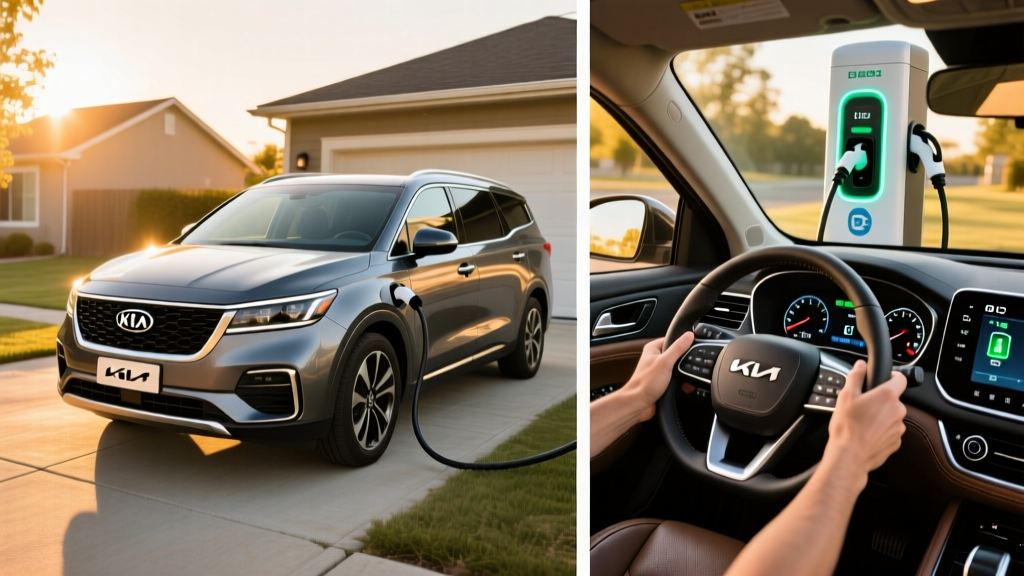
The Kia Carnival Hybrid entered the U.S. market as a 2025 model, replacing the turbocharged V6 with a 1.6-liter turbocharged hybrid powertrain. For families who want minivan practicality without the fuel bill of a traditional gasoline hauler, the Carnival HEV is a compelling option. But what does its fuel economy actually look like on real roads, not just EPA stickers?
As a conventional hybrid (HEV), the Carnival Hybrid requires no plug-in charging. It captures energy through regenerative braking and the gasoline engine to charge a small battery pack, then uses an electric motor to assist acceleration and enable low-speed electric-only driving. This is fundamentally different from a plug-in hybrid (PHEV) — and that distinction matters for buyers evaluating efficiency, cost, and daily usability.
How Many MPG Does the Kia Carnival Hybrid Get?
The EPA rates the 2026 Kia Carnival Hybrid at 34 MPG combined, with 34 MPG city and 31 MPG highway. These figures represent a significant improvement over the outgoing gasoline-only Carnival, which returned 22 MPG combined (19 city / 26 highway).
| Configuration | City MPG | Highway MPG | Combined MPG |
|---|---|---|---|
| 2026 Carnival Hybrid (HEV) | 34 | 31 | 34 |
| 2024 Carnival (3.5L V6 Gas) | 19 | 26 | 22 |
| Toyota Sienna Hybrid (AWD) | 35 | 36 | 35 |
| Honda Odyssey (3.5L V6 Gas) | 19 | 28 | 22 |
Source: EPA Fuel Economy
Real-World MPG vs. EPA Estimates
Hybrid vehicles frequently exceed their EPA city ratings in real-world stop-and-go driving because the electric motor handles low-speed propulsion where gasoline engines are least efficient. On the Carnival Hybrid, owners report achieving 35–38 MPG in city and suburban driving under moderate conditions.
Highway fuel economy tends to land slightly below the EPA sticker at 29–31 MPG at 70–75 mph. This is typical for hybrid minivans — the aerodynamic profile of a large vehicle and the reduced benefit of regenerative braking at sustained speeds narrow the efficiency gap between hybrid and conventional powertrains on long freeway runs.
In cold weather (below 32°F), expect a 5–10% reduction in fuel economy. The engine runs more frequently to heat the cabin and maintain battery temperature, reducing the time spent in electric-only mode.
HEV vs. PHEV: Understanding What the Carnival Hybrid Is (and Isn't)
The Carnival Hybrid is a conventional hybrid electric vehicle (HEV). There is no plug, no electric-only commuter mode, and no eligibility for the federal EV tax credit. If you're searching for a Carnival plug-in hybrid, one does not currently exist in the U.S. market.
| Feature | Conventional Hybrid (HEV) | Plug-In Hybrid (PHEV) |
|---|---|---|
| Plug-in charging | No — charges via engine and regen | Yes — Level 1/Level 2 |
| Electric-only range | ~1 mile at low speed | 20–45 miles typical |
| Battery capacity | 1.0–2.0 kWh | 10–25 kWh |
| Federal tax credit (§30D) | Not eligible | Up to $7,500 (if eligible) |
| Best for | No home charging access, simpler ownership | Home charging + short daily commute |
For buyers who have access to home charging and drive less than 30 miles daily, a PHEV minivan like the Chrysler Pacifica PHEV (32 miles electric-only, 30 MPG combined on gas) offers a different value proposition. But the Carnival HEV appeals to those who want improved fuel economy without changing their fueling habits.
Powertrain: Engine, Motor, and Horsepower
The 2026 Carnival Hybrid pairs a 1.6-liter turbocharged inline-4 gasoline engine with an electric motor integrated into a 6-speed automatic transmission. Kia's Smartstream architecture positions the motor between the engine and transmission for seamless torque blending.
| Specification | 2026 Kia Carnival Hybrid |
|---|---|
| Engine | 1.6L Turbocharged Inline-4 |
| Engine output | 180 hp / 195 lb-ft torque |
| Electric motor output | 64 hp (47 kW) |
| Combined system output | 245 hp / 271 lb-ft torque |
| Transmission | 6-speed automatic |
| Drivetrain | Front-wheel drive (FWD) |
| Hybrid battery | ~1.5 kWh lithium-ion (HEV) |
| Towing capacity | 3,500 lbs |
| 0–60 mph | ~7.8 seconds (est.) |
The combined 245 horsepower provides confident highway merging and passing performance. The turbocharged engine gives the Carnival Hybrid a torque advantage over naturally aspirated hybrid competitors — particularly useful when the minivan is loaded with passengers and cargo.
Pricing, Trims, and Tax Credit Eligibility
The 2026 Kia Carnival Hybrid is available across multiple trims, starting at approximately $40,990 MSRP for the LXS trim and reaching approximately $52,990 for the top SX Prestige trim. Pricing reflects a modest premium over the previous gasoline-only Carnival.
| Trim | MSRP (est.) | Key Features |
|---|---|---|
| LXS | $40,990 | 8-passenger seating, dual 12.3" displays, Smart Power Liftgate |
| EX | $44,490 | Power sliding doors, heated front seats, Highway Driving Assist |
| SX | $48,490 | VIP Lounge seating, navigation, Bose 12-speaker audio |
| SX Prestige | $52,990 | Nappa leather, dual sunroof, 2nd-row heated/ventilated seats |
Federal Tax Credit: Does the Carnival Hybrid Qualify?
No. The Kia Carnival Hybrid is a conventional HEV and does not qualify for the IRS §30D Clean Vehicle Credit. That credit applies exclusively to battery electric vehicles (BEVs) and plug-in hybrids (PHEVs) meeting battery-sourcing, MSRP cap, and buyer income requirements.
Some states offer separate incentives for conventional hybrids, but these are uncommon and vary by jurisdiction. Check your state's energy office or Alternative Fuels Data Center for local programs.
Battery Warranty and Replacement Cost
Kia covers the Carnival Hybrid's battery and hybrid system components under a 10-year / 100,000-mile warranty (for the original owner). This is one of the strongest hybrid warranties in the segment and significantly reduces long-term ownership risk.
Hybrid battery replacement costs for vehicles in this class typically range from $2,000–$4,000 out of warranty. However, hybrid battery failures before 150,000 miles are uncommon with modern lithium-ion packs. The Carnival's small ~1.5 kWh battery undergoes shallow charge/discharge cycles, which is gentler on cell longevity than the deep cycling seen in BEVs and PHEVs.
Reliability and Long-Term Ownership
Kia's 1.6L turbo hybrid powertrain has been deployed across the Hyundai/Kia lineup since 2022 (in the Sorento Hybrid, Tucson Hybrid, and Sportage Hybrid). This gives the Carnival Hybrid a proven component base rather than a first-year risk.
Key reliability considerations:
- Turbocharged engine: Modern turbo engines from Hyundai/Kia have shown good durability, though long-term (200,000+ mile) data on this specific application is still accumulating.
- Hybrid system: The electric motor and power electronics are well-established. Toyota's hybrid dominance set the reliability benchmark, and Kia's system has performed comparably in early field data.
- 6-speed automatic: Unlike the e-CVT planetary gearsets used by Toyota, Kia uses a conventional 6-speed automatic with an integrated motor. This delivers more natural shift feel but adds traditional transmission complexity.
- NHTSA and IIHS: Check NHTSA and IIHS for the latest crash-test ratings, as minivan safety scores are a priority for family buyers.
Carnival Hybrid vs. Toyota Sienna vs. Pacifica PHEV
The minivan segment now offers three distinct powertrain philosophies. Here's how they stack up for different buyers:
Kia Carnival Hybrid (HEV)
Pros:
- 34 MPG combined — strong for a turbo hybrid
- 10-year/100k-mile hybrid warranty
- Turbo torque for loaded highway driving
- Premium interior on upper trims
- No plug-in required
Cons:
- No electric-only commuting range
- No federal tax credit
- Slightly lower highway MPG than Sienna
Toyota Sienna Hybrid (HEV)
Pros:
- 35–36 MPG combined (FWD)
- AWD available (35 MPG combined)
- Proven Toyota hybrid reliability track record
- Best-in-class highway MPG
Cons:
- 245 hp combined — adequate but not punchy
- No turbo — less low-end torque when loaded
- Interior perceived as less premium
- No tax credit
Who Should Choose the Carnival Hybrid?
Choose the Carnival Hybrid if:
- You drive 15,000+ miles per year and want to reduce fuel costs without plug-in infrastructure
- You frequently carry heavy loads and value turbo torque over peak MPG
- You want a 10-year hybrid warranty for long-term peace of mind
- You don't have access to home Level 2 charging
Consider a PHEV (Pacifica Hybrid) if:
- You have home charging and a daily commute under 32 miles
- You want electric-only driving for school runs and errands
- You qualify for the §30D federal tax credit (up to $7,500)
Consider a full BEV if:
- You have reliable home charging and your trips rarely exceed 250 miles
- You want zero tailpipe emissions and the lowest per-mile fuel cost
- You're ready for the EV ownership model (charging planning, route management)
Frequently Asked Questions
How many MPG does the Kia Carnival Hybrid get in real-world driving?
The EPA rates the Carnival Hybrid at 34 MPG combined (34 city / 31 highway). In real-world conditions, city drivers often achieve 35–38 MPG thanks to regenerative braking. Highway fuel economy typically ranges from 29–31 MPG at sustained speeds above 70 mph. Cold weather reduces these figures by 5–10%.
Does the Kia Carnival Hybrid need to be plugged in?
No. The Carnival Hybrid is a conventional HEV. Its small battery charges automatically through the gasoline engine and regenerative braking. You fuel it exactly like a regular gasoline vehicle — there is no plug and no charging cable.
Is there a Kia Carnival plug-in hybrid (PHEV)?
Not in the U.S. market as of the 2026 model year. Kia offers PHEV versions of the Sorento and Sportage SUVs, but the Carnival is available only as a conventional hybrid. The closest PHEV minivan alternative is the Chrysler Pacifica Plug-In Hybrid.
What is the hybrid battery warranty on the Carnival?
Kia provides a 10-year / 100,000-mile warranty on the hybrid battery and related powertrain components for the original owner. This is among the best hybrid warranties available and significantly reduces long-term ownership risk.
Does the Carnival Hybrid qualify for a federal tax credit?
No. The IRS §30D Clean Vehicle Credit applies only to plug-in electric vehicles (BEVs and PHEVs). Conventional hybrids like the Carnival HEV are not eligible. Check your state for any local hybrid incentives through the Alternative Fuels Data Center.
How does the Carnival Hybrid compare to the Toyota Sienna in fuel economy?
The Toyota Sienna Hybrid achieves 35 MPG combined (FWD) or 35 MPG (AWD), edging out the Carnival's 34 MPG combined. However, the Sienna's highway advantage is more pronounced at 36 MPG vs. 31 MPG, making it the more efficient choice for predominantly highway drivers. The Carnival compensates with turbo torque and a more premium interior on upper trims.
What does the hybrid battery replacement cost?
Out-of-warranty hybrid battery replacement for minivan-class vehicles typically costs $2,000–$4,000 including labor. However, Kia's 10-year/100,000-mile warranty covers most owners through the highest-risk period, and modern hybrid batteries rarely fail before 150,000 miles under normal use.