Quick Verdict: The PHEV Jeep Lineup in 2026
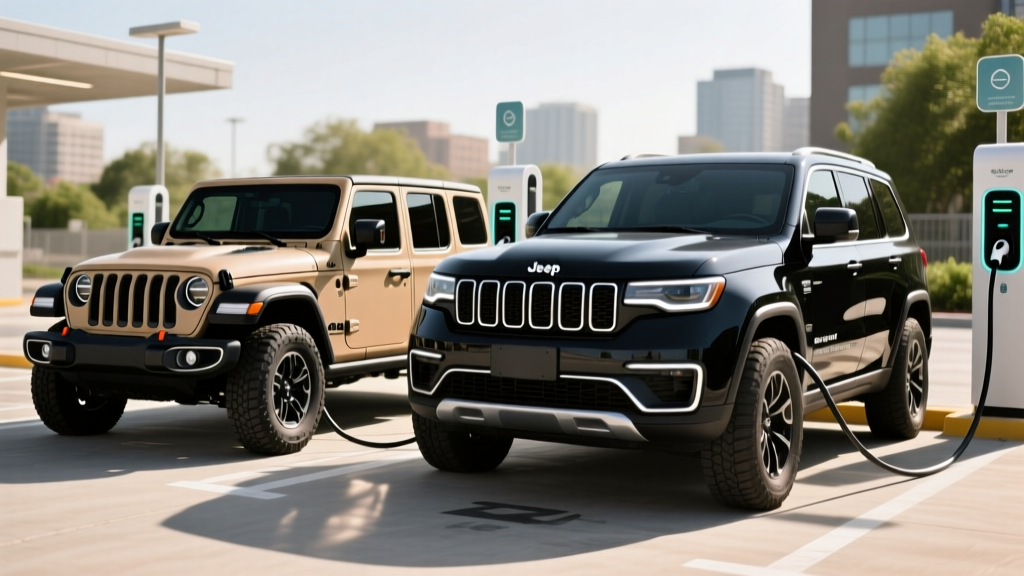
Jeep's 4xe plug-in hybrid badge now spans two core models: the Wrangler 4xe for off-road purists who want electric-only commuting, and the Grand Cherokee 4xe for families needing three-row-adjacent space with a plug-in powertrain. Both pair a 2.0L turbocharged four-cylinder engine with electric motors and a 17.3 kWh battery pack, delivering 21–25 miles of electric-only range before the gas engine engages. If you're searching for a PHEV Jeep, these are your two options — and they serve very different buyers.
This guide breaks down exact EPA figures, real-world efficiency, charging logistics, federal tax credit eligibility under current IRS §30D rules, and whether a 4xe makes more sense than a full EV or a conventional hybrid for your driving pattern.
HEV vs. PHEV: What Jeep Actually Offers
Conventional Hybrid (HEV): Jeep currently does not sell a traditional self-charging hybrid in the U.S. market. The mild-hybrid eTorque system was discontinued after the 2023 model year on the Wrangler and Gladiator. If you see "hybrid Jeep" referenced online, it almost always means the 4xe plug-in models.
Plug-In Hybrid (PHEV — the 4xe): A PHEV has a larger battery than an HEV and can be plugged in to charge. It drives on electricity alone for a limited range (21–25 miles for the 4xe lineup), then seamlessly switches to hybrid operation using the gasoline engine. You can drive it without ever plugging in, but you forfeit the electric-only benefit and the fuel-cost savings.
The distinction matters because some shoppers confuse the old eTorque mild-hybrid system (which cannot plug in and provides no electric-only range) with the 4xe PHEV system. The 4xe is a fundamentally different powertrain with a much larger battery and meaningful electric capability.
Wrangler 4xe vs. Grand Cherokee 4xe: Side-by-Side Specs
| Spec | 2026 Wrangler 4xe | 2026 Grand Cherokee 4xe |
|---|---|---|
| Powertrain | 2.0L turbo I4 + 2 electric motors | 2.0L turbo I4 + 2 electric motors |
| Combined Horsepower | 375 hp | 375 hp |
| Combined Torque | 470 lb-ft | 470 lb-ft |
| Battery (usable) | 17.3 kWh (NMC lithium-ion) | 17.3 kWh (NMC lithium-ion) |
| EPA Electric-Only Range | 21 miles | 25 miles |
| EPA MPGe (electric + gas) | 49 MPGe | 56 MPGe |
| EPA MPG (gas-only hybrid mode) | 20 combined (20 city / 20 hwy) | 23 combined (23 city / 24 hwy) |
| Total Combined Range | ~370 miles | ~440 miles |
| 0–60 mph | ~6.0 sec | |
| Max Level 2 Charge Rate | 7.2 kW | 7.2 kW |
| DC Fast Charging | No | No |
| Level 2 Charge Time (0–100%) | ~2.5 hours | ~2.5 hours |
| Level 1 (120V) Charge Time | ~12 hours | ~12 hours |
| Towing Capacity | 3,500 lbs | 6,000 lbs |
| Base MSRP | $51,790 (Willys 4xe) | $60,490 (Base 4xe) |
| Battery Warranty | 8 yr / 100,000 mi | 8 yr / 100,000 mi |
Sources: EPA fueleconomy.gov, Jeep/Stellantis official specifications.
Electric-Only Range: What 21–25 Miles Actually Means
EPA Electric-Only Range: Wrangler 4xe: 21 miles | Grand Cherokee 4xe: 25 miles
Real-World Expectation: In mild weather (55–75°F) on flat suburban roads at speeds under 45 mph, expect to match or slightly exceed EPA range — up to 23 miles in the Wrangler, 27 in the Grand Cherokee. On the highway at 70+ mph, electric range drops to roughly 15–17 miles due to aerodynamic drag (especially on the boxy Wrangler). In freezing temperatures (below 32°F), expect a 20–30% reduction, bringing the Wrangler down to ~15 miles and the Grand Cherokee to ~18 miles of electric-only driving.
This range is designed to cover a typical commute or school run, not a full day of driving. According to FHWA data, the average American drives roughly 37 miles per day — meaning the 4xe can cover more than half of daily miles on electricity if you charge at home. Once the battery depletes, the vehicle seamlessly transitions to hybrid mode with no driver intervention required.
Pro tip: The 4xe system includes an "e-Save" mode that reserves battery charge for later use — useful if your commute starts on the highway (where gas is more efficient) and ends in city traffic (where electric is ideal).
Fuel Economy: EPA MPG and Real-World Results
| Model | City (gas mode) | Highway (gas mode) | Combined (gas mode) | Combined MPGe (with charge) |
|---|---|---|---|---|
| Wrangler 4xe | 20 | 20 | 20 | 49 MPGe |
| Grand Cherokee 4xe | 23 | 24 | 23 | 56 MPGe |
Real-world note: Once the battery is depleted, the Wrangler 4xe's gas-only fuel economy is unimpressive — 20 MPG combined reflects its heavy curb weight (~5,200 lbs), brick-like aerodynamics, and all-terrain tires. The Grand Cherokee 4xe does better at 23 MPG combined, aided by a more aerodynamic shape. However, if you charge nightly and drive under 25 miles daily, you may use very little gasoline at all. Owners who charge regularly report effective "fuel economy" of 60–80+ MPGe over a tank, depending on how often the engine runs.
Cold weather impact: In sub-freezing temperatures, the gasoline engine may start automatically to provide cabin heat (the 4xe uses engine coolant for heating, not a heat pump). This reduces electric-only range and increases fuel consumption in winter. Expect gas-mode MPG to drop 1–2 MPG in cold weather.
Charging the 4xe: What You Need at Home
Neither 4xe model supports DC fast charging — this is a Level 2 (or Level 1) charging vehicle only. That's typical for PHEVs with smaller batteries, but it's important to understand before you buy.
| Charging Level | Power | Time (0–100%) | Setup |
|---|---|---|---|
| Level 1 (120V household outlet) | ~1.4 kW | ~12 hours | Standard outlet — included cord |
| Level 2 (240V home/public) | 7.2 kW | ~2.5 hours | Requires 240V outlet or hardwired charger |
Home charging reality: Most 4xe owners install a Level 2 charger at home. A 240V / 32-amp circuit delivers the full 7.2 kW, topping up the 17.3 kWh battery in roughly 2.5 hours. Because the battery is small, overnight charging on Level 1 (120V) is feasible if you drive under 20 miles daily — you'll recover roughly 14 miles of electric range in 12 hours. But for consistent full charges, Level 2 is strongly recommended.
Installation cost: A typical Level 2 home installation (240V NEMA 14-50 outlet or hardwired wallbox) runs $500–$1,500 depending on panel proximity and local permitting. If your electrical panel needs an upgrade from 100A to 200A, add $1,500–$3,000. The 4xe does not require a panel upgrade in most homes since 7.2 kW draws only 30 amps.
Federal Tax Credit: Does the 4xe Qualify?
2026 Federal §30D PHEV Tax Credit for Jeep 4xe models:
- Credit amount: $3,750 (partial credit — the 4xe battery meets some but not all critical-mineral and battery-component sourcing thresholds under current IRS rules)
- MSRP cap: SUVs must be under $80,000 MSRP — both 4xe models qualify at base trims, but loaded Grand Cherokee trims may exceed the cap
- Buyer income cap: AGI ≤ $150,000 (single), $225,000 (head of household), $300,000 (married filing jointly)
- Point-of-sale transfer: Yes — you can transfer the credit to the dealer at purchase for an immediate price reduction, per IRS §30D rules
- Battery capacity requirement: ≥ 7 kWh — the 4xe's 17.3 kWh pack qualifies
Important caveat: Tax credit eligibility for PHEVs depends on battery-component and critical-mineral sourcing, which Stellantis has been working to localize. The exact credit amount ($3,750 vs. $7,500) can change as sourcing shifts. Always verify current eligibility on the IRS qualified vehicles list before purchasing. A tax professional can confirm whether your income and filing status qualify.
Reliability, Battery Warranty, and Replacement Cost
Battery Warranty: 8 years / 100,000 miles (whichever comes first), covering defects and capacity loss below 70% of original capacity.
Powertrain Warranty: 5 years / 60,000 miles on the engine, transmission, and electric motors.
Battery Replacement Cost (out of warranty): $7,000–$12,000 for the 17.3 kWh pack, based on current Stellantis parts pricing. Labor adds $500–$1,500.
Reliability context: The 4xe powertrain has been in production since the 2021 model year, giving it a multi-year track record. Early-model (2021–2022) Wrangler 4xe units saw some software-related recalls and battery-cell balancing issues, but Stellantis issued updates. The 2.0L turbo engine is shared across the Stellantis lineup and is generally well-regarded. PHEV batteries experience less degradation than full EV batteries because the system maintains a buffer — you're rarely cycling the pack from 0% to 100%. Most 4xe owners report minimal range loss over 3–5 years of ownership.
Compared to a full EV: The 4xe's smaller battery means a lower replacement cost if failure occurs out of warranty. For comparison, a full EV battery replacement can run $10,000–$20,000+. The 8-year/100,000-mile warranty provides solid coverage through the typical ownership period.
Pros and Cons: The PHEV Jeep Reality
Pros
- 21–25 miles of electric-only range covers most daily commutes
- 375 hp / 470 lb-ft — more torque than the V6 gas Wrangler
- Full off-road capability retained (locking diffs, sway-bar disconnect on Rubicon 4xe)
- No range anxiety — gas engine provides 370–440 total miles
- Qualifies for partial federal tax credit and HOV lane access in some states
- Can be driven without ever plugging in (unlike a full EV)
Cons
- Gas-only MPG is poor (20–23 combined) once battery depletes
- No DC fast charging — impractical to charge on road trips
- Higher base price than gas-only Wrangler/Grand Cherokee (~$10,000+ premium)
- Cold weather triggers engine starts for cabin heat, reducing EV range
- Heavy curb weight increases tire wear and braking distances
- Tax credit amount uncertain due to evolving sourcing rules
Who Should Buy a PHEV Jeep (and Who Shouldn't)
Choose the 4xe PHEV if:
- Your daily commute is under 25 miles and you can charge at home
- You want off-road capability or towing but want to reduce daily fuel use
- You're not ready for a full EV due to road-trip needs or charging-access limitations
- You want HOV lane access (available in California, Colorado, and other states for PHEVs)
Choose a full EV (like the Rivian R1S or Tesla Model X) if:
- You want zero gasoline use and lower per-mile "fuel" cost
- You have reliable home charging and access to DC fast chargers for road trips
- You want lower long-term maintenance (no oil changes, no engine)
Choose a gas-only Wrangler/Grand Cherokee if:
- You cannot charge at home or at work
- Your budget is tight — the 4xe premium is $8,000–$12,000 over equivalent gas trims
- You drive mostly highway miles where the PHEV advantage is minimal
Frequently Asked Questions
How many MPG does the Jeep 4xe get?
In gas-only hybrid mode (battery depleted), the Wrangler 4xe gets 20 MPG combined and the Grand Cherokee 4xe gets 23 MPG combined. When charged and using electric + gas, the combined ratings are 49 MPGe (Wrangler) and 56 MPGe (Grand Cherokee). Real-world efficiency depends heavily on how often you charge — regular charging dramatically reduces gasoline consumption.
How far can the Jeep 4xe go on electric only?
The EPA rates the Wrangler 4xe at 21 miles and the Grand Cherokee 4xe at 25 miles of electric-only range. In real-world conditions, expect 15–23 miles for the Wrangler and 18–27 miles for the Grand Cherokee, depending on temperature, speed, and terrain. Highway driving and cold weather reduce range significantly.
Does the Jeep 4xe qualify for a tax credit?
Yes, the 4xe models currently qualify for a partial federal tax credit under IRS §30D rules — typically $3,750, depending on battery-sourcing compliance at the time of purchase. Buyer income caps and MSRP caps apply. The credit can be transferred to the dealer at point of sale for an immediate price reduction. Always verify current eligibility at IRS.gov before purchasing.
Is the Jeep 4xe reliable, and what does battery replacement cost?
The 4xe powertrain has been in production since 2021 and has a generally acceptable reliability record after early software-related recalls were addressed. The high-voltage battery is warranted for 8 years / 100,000 miles. Out-of-warranty replacement costs $7,000–$12,000 for the battery pack. Because PHEV batteries operate within a narrower state-of-charge window than full EVs, degradation tends to be modest over time.
Can I drive the Jeep 4xe without plugging it in?
Yes. The 4xe operates as a conventional hybrid when the battery is depleted or when you choose not to charge. You'll get 20–23 MPG combined depending on the model — comparable to or slightly worse than the gas-only versions due to the added battery weight. However, you forfeit the fuel savings and electric-only driving that justify the 4xe price premium.
Does the Jeep 4xe support DC fast charging?
No. Neither the Wrangler 4xe nor the Grand Cherokee 4xe supports DC fast charging. The maximum charge rate is 7.2 kW on Level 2 (240V), which fully replenishes the 17.3 kWh battery in approximately 2.5 hours. On a standard 120V outlet (Level 1), a full charge takes roughly 12 hours.