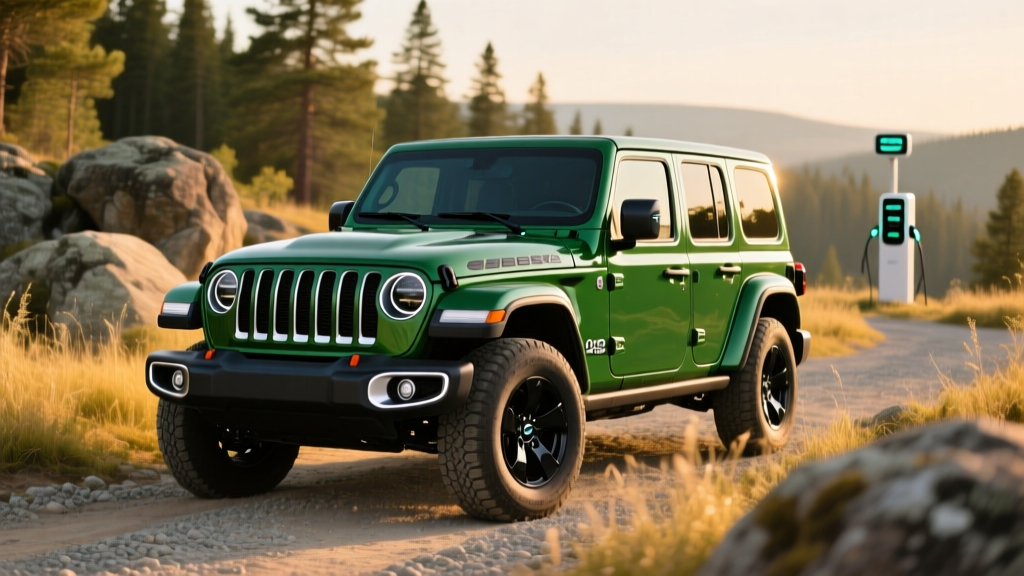
Quick Verdict: The 2026 Jeep Wrangler 4xe remains the only plug-in hybrid convertible off-roader on the market. With 22 miles of EPA-rated electric-only range, 49 MPGe combined, and 375 horsepower, it bridges daily electric commuting and weekend trail capability — but its $51,790 starting price and real-world fuel economy once the battery depletes demand honest scrutiny before you buy.
If you've searched for a Jeep Wrangler plug-in hybrid, you've found the 4xe — Stellantis's PHEV powertrain stuffed into America's most recognizable off-road icon. Unlike a conventional hybrid that you never plug in, the 4xe carries a 17.3 kWh lithium-ion battery (14.0 kWh usable) that you charge from a wall outlet or Level 2 station, giving you a genuine electric-only commute before the turbocharged 2.0L four-cylinder engine fires up.
This guide covers every number that matters: EPA MPG and MPGe, real-world range expectations, charging logistics, powertrain specs, pricing by trim, federal tax credit eligibility under current IRS §30D rules, and battery longevity. Let's get into the data.
HEV vs PHEV: What the Wrangler 4xe Actually Is
Before diving into specs, it's essential to separate conventional hybrids from plug-in hybrids — the Wrangler lineup only offers the latter.
| Feature | Conventional Hybrid (HEV) | Plug-In Hybrid (PHEV) — Wrangler 4xe |
|---|---|---|
| Battery size | ~1–2 kWh | 17.3 kWh gross / 14.0 kWh usable |
| Plug-in charging | No — charges via regen & engine | Yes — Level 1 (120V) and Level 2 (240V) |
| Electric-only range | None (electric assist only) | 22 miles (EPA) |
| EV-only driving | Brief low-speed bursts | Full highway-capable EV mode up to ~75 mph |
| Federal tax credit | None (as of 2026) | Up to $7,500 (§30D, subject to eligibility) |
| Regenerative braking | Yes | Yes, with adjustable max regen |
Bottom line: The Wrangler 4xe is a PHEV. You must plug it in to capture the electric-only range and MPGe benefits. Drive it without ever charging and you're hauling 4,900+ pounds of steel with a 2.0L turbo — fuel economy drops sharply.
Powertrain, Horsepower, and Performance Specs
| Specification | 2026 Jeep Wrangler 4xe |
|---|---|
| Engine | 2.0L turbocharged inline-4 |
| Engine output | 270 hp / 295 lb-ft torque |
| Electric motors | Two: one integrated in the 8-speed transmission (134 hp), one belt-driven starter-generator |
| Combined system output | 375 hp / 470 lb-ft torque |
| Transmission | TorqFlite 8-speed automatic |
| 0–60 mph | ~6.0 seconds |
| Drivetrain | 4WD with Selec-Trac or Rock-Trac transfer case (trim-dependent) |
| Towing capacity | 3,500 lbs |
| Curb weight | ~4,921–5,160 lbs (trim-dependent) |
The 470 lb-ft of combined torque is the real story. Electric torque fills the low-RPM gap that turbo lag leaves in the 2.0L engine, making the 4xe genuinely quick off the line and confident when merging onto highways. For an off-road SUV with solid axles and a removable roof, a 6-second 0–60 time is remarkable.
Fuel Economy: EPA MPG, MPGe, and Real-World Numbers
| Mode | City | Highway | Combined |
|---|---|---|---|
| Charge-sustaining (gas only, battery depleted) | 20 MPG | 20 MPG | 20 MPG |
| Charge-depleting + gas (MPGe) | — | — | 49 MPGe |
EPA electric-only range: 22 miles
Real-world expectation: 16–19 miles at highway speeds or in cold weather (below 40°F). Short, low-speed city commutes in mild weather may yield the full 22 miles or slightly more.
Total combined range (full battery + full 17.2-gallon tank): ~370 miles
Real-world honesty is critical here. The 49 MPGe figure only applies when you start with a full battery and blend electric and gas driving. Once the battery depletes to its hold threshold (roughly 1–2% displayed), the Wrangler 4xe operates as a heavy gas vehicle and returns about 20 MPG combined — sometimes less on the highway, where its boxy aerodynamics and 33-inch tires work against it. EPA data on fueleconomy.gov confirms the 20/20/20 charge-sustaining split.
Owners who charge nightly and commute under 20 miles round-trip may use almost no gasoline during the work week. Owners who never plug in will spend significantly more at the pump than the EPA sticker implies.
Battery, Charging Times, and Infrastructure
| Charging Level | Power | 0–100% Time | Connector |
|---|---|---|---|
| Level 1 (120V household) | ~1.4 kW | ~12 hours | Standard J1772 |
| Level 2 (240V home/public) | Up to 7.2 kW | ~2.5 hours | J1772 |
| DC Fast Charging | Not supported | N/A | N/A |
The 4xe does not support DC fast charging — a common limitation among PHEVs due to smaller battery packs where the cost and weight of DC hardware are harder to justify. For most owners, a Level 2 home charger is the practical solution: plug in when you get home, wake up to a full 22-mile electric range.
The onboard charger maxes out at 7.2 kW. Even if you connect to a 48-amp (11.5 kW) Level 2 station, the 4xe will only draw 7.2 kW. Factor this into your home charging investment — there's no benefit to oversizing the circuit for this vehicle alone.
Home charging setup: A dedicated 240V/40A circuit with a NEMA 14-50 outlet and a quality Level 2 EVSE (like a ChargePoint Home Flex or Grizzl-E Smart) typically costs $500–$1,500 for the equipment plus $500–$2,000 for electrician installation, depending on your panel capacity and run length. If your home has a 100-amp panel already near its load limit, a panel upgrade to 200A could add $1,500–$3,000.
Pricing, Trims, and Federal Tax Credit Eligibility
The 2026 Jeep Wrangler 4xe lineup starts at $51,790 (Sport S, including destination). Key trims include:
- Sport S 4xe: ~$51,790
- Willys 4xe: ~$54,790
- Sahara 4xe: ~$57,790
- Rubicon 4xe: ~$60,790
- High Altitude 4xe: ~$63,790
Federal tax credit (§30D): The Wrangler 4xe may qualify for up to $7,500 under the IRS Clean Vehicle Credit, but eligibility depends on multiple factors that change periodically. As of 2026, the key requirements include:
- MSRP cap: SUVs must have an MSRP at or below $80,000 — the 4xe qualifies across all trims
- Buyer income cap: Modified AGI ≤ $150,000 (single), $225,000 (head of household), $300,000 (joint)
- Battery sourcing: Critical minerals and battery components must meet escalating domestic-sourcing thresholds — Stellantis has adjusted supply chains, but specific eligibility can shift by model year and production batch
- Point-of-sale transfer: As of 2024+, buyers can transfer the credit to the dealer for an immediate price reduction at purchase, rather than waiting to claim it on their tax return
- Assembly: Vehicle must undergo final assembly in North America — the Wrangler is built in Toledo, Ohio ✓
Because battery-sourcing requirements tighten annually and specific VIN eligibility can vary, always verify credit eligibility with your dealer and consult IRS.gov's Clean Vehicle Credit page or a tax professional before purchase. Do not assume the full $7,500 applies to every 4xe on the lot.
Effective price after credit: If you qualify for the full $7,500, the Sport S 4xe drops to roughly $44,290 — competitive with well-equipped gas Wranglers once you factor in fuel savings for electric-commute drivers.
Battery Warranty, Reliability, and Replacement Costs
High-voltage battery warranty: 8 years / 100,000 miles (whichever comes first)
Capacity retention guarantee: Stellantis warrants the 4xe battery against dropping below 70% of original capacity during the warranty period. If degradation exceeds 30%, the battery will be repaired or replaced at no cost.
Powertrain warranty: 5 years / 60,000 miles
Real-world reliability: The Wrangler 4xe has been on sale since the 2021 model year, giving us multi-year ownership data. The high-voltage battery system has proven generally durable, consistent with PHEV batteries across the industry that use conservative charge windows (the 4xe never uses the full 17.3 kWh — the usable buffer is ~14.0 kWh, reducing stress on cells).
Common owner-reported concerns center on the 12V auxiliary battery (a persistent issue across modern vehicles, not unique to the 4xe), occasional software glitches in the Uconnect system, and the added complexity of maintaining both an electric drive system and a turbocharged gas engine. The 2.0L turbo engine has been in the Stellantis lineup since 2018 and is well-understood by Jeep service departments.
Battery replacement cost: If the high-voltage battery needs replacement outside warranty, expect a cost in the range of $8,000–$12,000 (parts and labor), based on current Stellantis PHEV battery pricing. This is comparable to other PHEV battery replacements in the industry. However, given the 8-year/100,000-mile warranty and the conservative state-of-charge management, most owners will never face this expense during typical ownership.
Who Should Buy the Wrangler 4xe — And Who Shouldn't
Choose the Wrangler 4xe if:
- Your daily commute is under 22 miles round-trip and you can charge at home nightly
- You want serious off-road capability (solid axles, locking differentials, sway-bar disconnect on Rubicon) with the option of silent electric trail crawling
- You need a removable roof/doors and a fold-down windshield — no other PHEV offers this
- You tow light loads (≤3,500 lbs) and want electric torque assist for low-speed trailer maneuvering
- You want to reduce gasoline consumption without committing to a full BEV and its charging-infrastructure dependence for road trips
Choose a full EV (BEV) instead if:
- You want zero tailpipe emissions and zero gasoline maintenance (no oil changes, no spark plugs)
- Your daily driving exceeds 40+ miles and you want consistent low cost-per-mile (the 4xe's 20 MPG gas mode is expensive once the battery depletes)
- You prioritize low center of gravity and car-like handling — the 4xe rides like a body-on-frame truck because it is one
Choose the gas Wrangler instead if:
- You cannot charge at home or work (the 4xe's benefits evaporate without regular plug-in charging)
- You want the lowest upfront purchase price — a gas Wrangler Sport starts ~$15,000 less
- You do primarily highway driving where the 4xe's charge-sustaining MPG offers no advantage over the 3.6L V6 gas model (~22 MPG highway)
Wrangler 4xe vs the Competition
The Wrangler 4xe occupies a niche with no direct rival — there is no other plug-in hybrid convertible off-roader. But buyers cross-shopping PHEV SUVs often consider:
| Spec | Jeep Wrangler 4xe | Toyota RAV4 Prime | Ford Escape PHEV |
|---|---|---|---|
| EV range | 22 mi | 42 mi | 37 mi |
| Combined HP | 375 hp | 302 hp | 210 hp |
| Charge-sustaining MPG | 20 MPG | 38 MPG | 40 MPG |
| 0–60 mph | ~6.0 sec | ~5.7 sec | ~8.0 sec |
| Off-road capability | Extreme | Moderate (AWD) | Minimal |
| Starting MSRP | ~$51,790 | ~$44,500 | ~$40,500 |
| Removable roof/doors | Yes | No | No |
The RAV4 Prime delivers superior electric range and fuel economy in a more refined, quieter package — but it can't tackle a Rubicon trail or let you feel the wind with the top off. The 4xe trades efficiency for capability and character.
Pros
- Only PHEV with removable roof, doors, and fold-down windshield
- 375 hp and 470 lb-ft — the most powerful stock Wrangler
- Genuine off-road hardware (Rubicon: locking diffs, sway-bar disconnect, 33" tires)
- 22-mile EV range covers most daily commutes when charged nightly
- Silent electric mode for low-speed trail crawling (no engine noise in nature)
- North American assembly (Toledo, OH) — supports §30D eligibility
Cons
- 20 MPG charge-sustaining is poor for a vehicle with a 2.0L engine — weight is the penalty
- No DC fast charging — public charging options are limited to Level 2
- $51,790 starting price is steep before tax credits
- Wind noise, ride harshness, and steering vagueness inherent to solid-axle design
- 22-mile EV range is short compared to RAV4 Prime (42 mi) or Escape PHEV (37 mi)
- Cargo space reduced slightly vs gas Wrangler due to battery placement under rear seats
Frequently Asked Questions
How many MPG does the Jeep Wrangler plug-in hybrid get?
The 2026 Wrangler 4xe is rated at 49 MPGe combined when blending electric and gasoline driving. Once the battery is depleted, it returns 20 MPG combined (20 city / 20 highway) as a conventional gas vehicle. Real-world charge-sustaining MPG can dip to 17–18 MPG on sustained highway drives at 75+ mph due to aerodynamic drag and tire choice.
How far can the Wrangler 4xe go on electric only?
The EPA rates the 4xe at 22 miles of electric-only range. In real-world driving, expect 16–19 miles at highway speeds or in cold weather, and potentially the full 22+ miles on short, low-speed city trips in mild temperatures. The electric motor can propel the 4xe up to approximately 75 mph without engine engagement.
Does the Wrangler 4xe qualify for a federal tax credit?
Potentially up to $7,500 under IRS §30D, subject to buyer income limits ($150K single / $300K joint), battery-sourcing requirements that tighten annually, and the $80,000 SUV MSRP cap. The Wrangler 4xe clears the MSRP cap on all trims. Final assembly is in Toledo, Ohio, satisfying the North American assembly requirement. Always verify eligibility for your specific VIN at IRS.gov and with a qualified tax professional.
Is the Wrangler 4xe reliable, and what does a battery replacement cost?
The 4xe's high-voltage battery is warranted for 8 years/100,000 miles against dropping below 70% capacity. Out-of-warranty replacement runs approximately $8,000–$12,000. The PHEV powertrain adds complexity (turbo engine + two electric motors + high-voltage battery), but the 2.0L turbo and 8-speed transmission are proven Stellantis components. Routine maintenance includes both gas-engine service (oil, filters, spark plugs) and EV system checks.
Can I charge the Wrangler 4xe at a DC fast charger?
No. The Wrangler 4xe does not support DC fast charging. It charges via Level 1 (120V, ~12 hours for a full charge) or Level 2 (240V, ~2.5 hours at 7.2 kW). This is standard for most PHEVs with smaller battery packs. For daily use, a home Level 2 charger is the practical solution.
Hybrid vs PHEV vs EV — which is right for me?
If you can charge at home and your daily driving is under 25 miles, the 4xe PHEV lets you commute on electricity while keeping a gas engine for road trips and trails. A conventional hybrid (HEV) requires no plug-in but offers no electric-only range. A full EV (BEV) eliminates gasoline entirely but requires reliable charging access and acceptance of range planning on longer trips. For off-road enthusiasts who want electric commuting without range anxiety in remote areas, the PHEV Wrangler 4xe occupies a unique middle ground.