Jeep Wrangler 4xe: The Plug-In Hybrid Off-Roader Explained
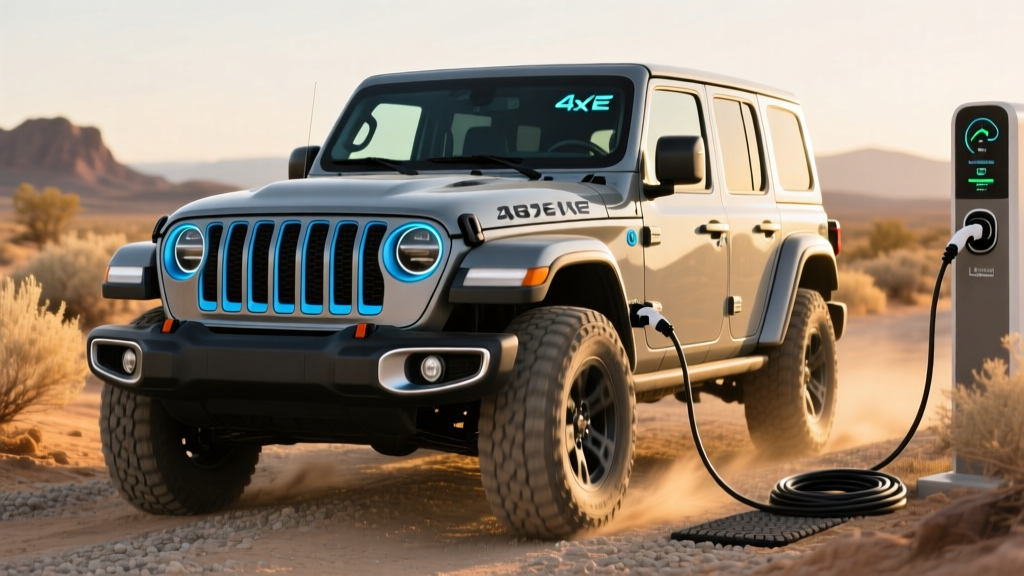
The Jeep Wrangler 4xe (pronounced "four-by-e") remains one of the most unusual plug-in hybrids on the market: a body-on-frame, solid-axle off-roader that can silently crawl trails on electric power and still tackle 400-mile road trips without range anxiety. For buyers searching for Jeep Wrangler hybrid MPG figures, the answer depends heavily on how you drive and whether you charge regularly.
Before we get into the numbers, let's clear up a common source of confusion: the Wrangler 4xe is a plug-in hybrid (PHEV), not a conventional hybrid (HEV). That distinction matters enormously for your wallet and daily routine.
HEV vs. PHEV: What's the Difference?
| Feature | Conventional Hybrid (HEV) | Plug-In Hybrid (PHEV) |
|---|---|---|
| Plugs in to charge? | No — charges via regenerative braking and engine | Yes — has a charge port for external charging |
| Electric-only driving | Minimal (typically under 1 mile at low speed) | Yes — 22 miles EPA on the Wrangler 4xe |
| Battery size | Small (~1-2 kWh) | 17.3 kWh (Wrangler 4xe) |
| Federal tax credit | None | Eligible under §30D (subject to sourcing/income rules) |
| Best for | Drivers who can't charge at home | Drivers with home/workplace charging access |
There is no conventional HEV version of the Wrangler. If you see "Wrangler hybrid," it means the 4xe PHEV. Jeep does offer the eTorque mild-hybrid system on some gas Wrangler trims, but that is a belt-starter-generator system that provides no electric-only driving and does not meaningfully change MPG.
Jeep Wrangler 4xe MPG: EPA Ratings and Real-World Numbers
The headline number for the 2026 Jeep Wrangler 4xe is 49 MPGe combined when operating in hybrid mode with a charged battery. MPGe (miles per gallon equivalent) is the EPA's way of combining electric and gasoline energy consumption into a single figure you can compare against gas-only vehicles. Once the battery is depleted and the 4xe operates as a conventional hybrid, the rating drops to 20 MPG combined.
| Driving Mode | City | Highway | Combined |
|---|---|---|---|
| Charge-sustaining (gas hybrid mode) | 20 MPG | 20 MPG | 20 MPG |
| Blended (electric + gas, full battery) | — | 49 MPGe | |
| Electric-only (no gas) | — | 49 MPGe / 22 mi range | |
Source: fueleconomy.gov — EPA estimates. Your actual results will vary based on driving style, terrain, temperature, and charging habits.
Real-World MPG: What to Actually Expect
The 4xe's boxy aerodynamics, heavy curb weight (~5,100 lbs), and all-terrain tires work against highway efficiency. Here's what owners and testers consistently report:
- City driving with regular charging: 35-45 MPGe is achievable if most trips fall within the 22-mile electric range and you charge nightly.
- Highway cruising (70+ mph): Expect 17-19 MPG in gas-only mode. The brick-like aero profile and aggressive tires hurt at speed.
- Cold weather (below 32°F): Electric-only range drops 20-30%, to roughly 15-17 miles. Gas mode MPG can dip to 16-18 due to cabin heating and reduced battery efficiency.
- Off-road/low-speed trail use: Electric-only mode excels here — silent, instant torque, zero emissions on the trail. Range isn't a concern at 3-5 mph.
The 4xe rewards short, chargeable commutes and punishes long highway slogs. If your daily round-trip commute is under 20 miles and you charge at home, you may use very little gasoline for months. If you regularly drive 200+ miles on the highway without charging, you're carrying 800+ pounds of battery you aren't using — and a gas-only Wrangler would return similar MPG without the price premium.
Electric-Only Range and Total Driving Range
The 2026 Wrangler 4xe provides an EPA-estimated 22 miles of electric-only range. That figure has remained consistent since the 4xe's introduction, as Jeep has not increased the battery pack size across model-year refreshes.
With the 17.2-gallon fuel tank and a full battery, the total combined range is approximately 370 miles — 22 electric plus roughly 348 on gasoline. That's enough for most road trips without excessive fuel stops, though it trails the ~500+ mile range of some more aerodynamic PHEV crossovers.
One practical note: the 4xe's electric range is best used at lower speeds. Highway driving at 75 mph can deplete the battery in under 18 miles, while stop-and-go city traffic or low-speed trail crawling can stretch it past 25 miles thanks to regenerative braking.
Powertrain, Battery, and Charging Specs
The Wrangler 4xe pairs a 2.0-liter turbocharged inline-four engine with two electric motor-generators and an eight-speed automatic transmission. The result is a combined output that outmuscles most gas Wrangler engines.
| Specification | 2026 Jeep Wrangler 4xe |
|---|---|
| Engine | 2.0L turbocharged I-4 |
| Electric motors | Two motor-generators (one integrated in transmission, one belt-driven) |
| Combined horsepower | 375 HP |
| Combined torque | 470 lb-ft |
| 0-60 mph | |
| Battery capacity | 17.3 kWh (NMC lithium-ion) |
| Usable battery capacity | ~14.7 kWh |
| Electric-only range | 22 miles (EPA) |
| Level 2 charging (240V) | ~7.2 kW onboard charger; 0-100% in ~2.5 hours |
| Level 1 charging (120V) | ~1.4 kW; 0-100% in ~12 hours |
| DC fast charging | Not supported |
| Charge port location | Driver-side front fender |
| Towing capacity | 3,500 lbs |
| Ground clearance | 10.8 inches (Rubicon trim) |
No DC fast charging. The 4xe cannot use public DC fast chargers (CCS, NACS, or CHAdeMO). It charges exclusively via AC — Level 1 (standard 120V outlet) or Level 2 (240V home or public AC charger). For a PHEV with a 17.3 kWh battery, this is a reasonable trade-off: a full charge takes about 2.5 hours on Level 2, which most owners complete overnight or during the workday. However, on a road trip, you cannot quickly "top up" the battery at a fast-charging station.
Pricing, Trims, and Federal Tax Credit Eligibility
The 2026 Jeep Wrangler 4xe is available across multiple trims, and pricing varies significantly:
| Trim | Starting MSRP (est.) |
|---|---|
| Willys 4xe | $51,790 |
| Sport S 4xe | $53,790 |
| Sahara 4xe | $56,790 |
| Rubicon 4xe | $59,790 |
| High Altitude 4xe | $63,290 |
Prices include destination charge. Actual MSRP may vary by dealer. Options packages can push Rubicon and High Altitude trims above $70,000.
Federal Tax Credit: §30D Rules for 2026
The Wrangler 4xe may qualify for a federal tax credit of up to $3,750 under the IRS §30D Clean Vehicle Credit, but eligibility is not automatic. Key requirements:
- MSRP cap: SUVs must be under $80,000 MSRP. All 4xe trims qualify at base, but heavily optioned trims may exceed the cap.
- Buyer income cap: Adjusted gross income must not exceed $150,000 (single), $225,000 (head of household), or $300,000 (married filing jointly).
- Battery sourcing requirements: The credit is split into two halves ($3,750 for critical minerals + $3,750 for battery components). Sourcing rules tighten annually. For 2026, verify current eligibility on IRS.gov or ask your dealer about point-of-sale transfer availability.
- Point-of-sale transfer: If eligible, you can transfer the credit to the dealer at purchase, reducing your out-of-pocket cost immediately rather than waiting for tax filing.
Important: Battery component and critical-mineral sourcing rules have tightened significantly since 2023. The Wrangler 4xe's credit amount may be $3,750 rather than the full $7,500, depending on current-year sourcing compliance. Always verify with your tax professional before relying on a specific credit amount.
Battery Warranty, Reliability, and Replacement Costs
Hybrid and PHEV battery longevity is consistently the top concern for buyers spending over $50,000. Here's what Jeep covers:
Wrangler 4xe Battery Warranty
- High-voltage battery warranty: 8 years / 100,000 miles (whichever comes first)
- Capacity retention threshold: Jeep warrants the battery against failure to hold a minimum charge capacity (typically ~70% of original). If the battery degrades below this threshold within the warranty period, Jeep will repair or replace it at no cost.
- Hybrid system components: The electric motors, power inverter, and onboard charger are also covered under the 8-year/100,000-mile powertrain warranty.
- Standard vehicle warranty: 3 years / 36,000 miles bumper-to-bumper; 5 years / 60,000 miles powertrain (engine and transmission).
Reliability track record: The 4xe powertrain has been in production since the 2021 model year, giving it a multi-year real-world track record. Common issues reported by owners and tracked by NHTSA have included software-related glitches (infotainment, hybrid-system warning lights) and occasional recalls for high-voltage battery inspection. The 2.0L turbo engine itself has a mixed reputation in the broader Stellantis lineup — some owners report oil consumption and turbo-related concerns at higher mileage.
Battery replacement cost: Out of warranty, a complete 4xe high-voltage battery replacement runs approximately $12,000 to $16,000 including parts and labor at a dealership. However, PHEV battery packs are modular — individual cell groups or modules can often be replaced for significantly less ($2,000-$5,000) if only a section has degraded. Catastrophic battery failure within the warranty period is rare; gradual capacity loss (to ~85-90% over 8 years) is more typical and may not trigger a warranty claim.
Who Should Buy the Wrangler 4xe — And Who Shouldn't
The Wrangler 4xe occupies a narrow but real niche. It makes sense for specific buyers and is a poor fit for others.
Choose the Wrangler 4xe If:
- You have home or workplace Level 2 charging and a commute under 22 miles round-trip
- You want serious off-road capability (solid axles, locking differentials, sway-bar disconnect on Rubicon) with silent electric trail crawling
- You need a vehicle that can do weekend adventures (towing, rock crawling, camping) and weekday commuting on electricity
- You want to reduce gasoline consumption without the range limitations of a full EV on long road trips
- You value the Wrangler's removable doors/roof and open-air experience
Consider Alternatives If:
- You don't have access to regular charging — without plugging in, you're paying a premium for a 20 MPG gas hybrid
- Your priority is maximum fuel economy — a Toyota RAV4 Prime (42 mi electric, 38 MPG gas) or a full EV like the Ford Mustang Mach-E (300+ mi range) will save far more on fuel
- You primarily drive on highways — the 4xe's aerodynamics and weight deliver poor highway MPG in gas mode
- You want low maintenance costs — the 4xe combines the complexity of a turbocharged engine, eight-speed automatic, two electric motors, high-voltage battery, AND solid-axle 4x4 drivetrain
- Interior refinement and on-road comfort are priorities — the Wrangler's solid axles and upright greenhouse mean a rougher, noisier ride than any unibody crossover
Hybrid vs. PHEV vs. Full EV: Which Fits You?
| Scenario | Best Choice |
|---|---|
| No home charging, long highway commutes, minimal off-roading | Gas Wrangler or conventional hybrid SUV (RAV4 Hybrid, etc.) |
| Home charging available, short commute, regular off-roading or towing | Wrangler 4xe PHEV |
| Home charging available, daily commuting, road trips under 300 mi | Full EV (Tesla Model Y, Ford Mach-E, Hyundai Ioniq 5) |
| Need off-road capability but want to minimize fuel costs without charging | There's no good HEV off-roader — consider the 4xe with a commitment to charge, or accept the gas Wrangler's fuel cost |
Frequently Asked Questions
How many MPG does the Jeep Wrangler hybrid get?
The 2026 Jeep Wrangler 4xe is rated at 49 MPGe combined when using both battery and gasoline, and 20 MPG combined in charge-sustaining (gas-only hybrid) mode. Real-world highway driving in gas mode typically returns 17-19 MPG, while city driving with regular charging can effectively use very little gasoline.
How far can the Wrangler 4xe go on electric power alone?
The EPA rates the 4xe at 22 miles of electric-only range. In real-world conditions, expect 15-17 miles in cold weather or at highway speeds, and up to 25 miles in warm-weather city driving with regenerative braking.
Can I charge the Wrangler 4xe at a Tesla Supercharger or DC fast charger?
No. The Wrangler 4xe does not support DC fast charging of any kind (CCS, NACS, or CHAdeMO). It charges via AC only — Level 1 (120V household outlet, ~12 hours for a full charge) or Level 2 (240V, ~2.5 hours). This is typical for PHEVs with smaller batteries.
Does the Wrangler 4xe qualify for the $7,500 federal tax credit?
The 4xe may qualify for up to $3,750 or $7,500 depending on 2026 battery-sourcing and critical-mineral compliance under IRS §30D rules. Buyer income caps ($150K single / $300K joint) and the $80,000 SUV MSRP cap also apply. The credit can be transferred to the dealer at point of sale if eligible. Verify current-year status on IRS.gov and with your tax professional.
Is the Wrangler 4xe reliable? What will a battery replacement cost?
The 4xe has been in production since 2021, providing a multi-year track record. The high-voltage battery is warrantied for 8 years/100,000 miles. Out-of-warranty full battery replacement costs approximately $12,000-$16,000, though partial module repairs are less expensive. The 2.0L turbo engine has a mixed long-term reliability record in the Stellantis lineup.
Does the Wrangler 4xe charge its battery while driving?
Yes. The 4xe uses regenerative braking and the engine to maintain battery charge in hybrid mode. There is also an "eSave" mode that prioritizes engine power to preserve battery charge for later electric-only use (useful for saving battery for a trail or a zero-emission zone). However, you cannot fully recharge the battery via the engine alone — plugging in is necessary for a full charge and to access the full 22-mile electric range.
How does the 4xe compare to the gas Wrangler on fuel cost?
If you charge nightly and your commute is under 22 miles, you could use less than 5 gallons of gas per month. At $3.50/gallon, that's under $18/month in fuel. A gas-only Wrangler (19 MPG combined) driving the same 450 monthly miles would burn ~24 gallons, or about $83/month. The 4xe saves roughly $65/month in that scenario — enough to recoup its price premium in 5-6 years, before factoring in any tax credit. Without charging, the 4xe's 20 MPG gas mode offers essentially no fuel-cost advantage over the gas Wrangler's 19 MPG.