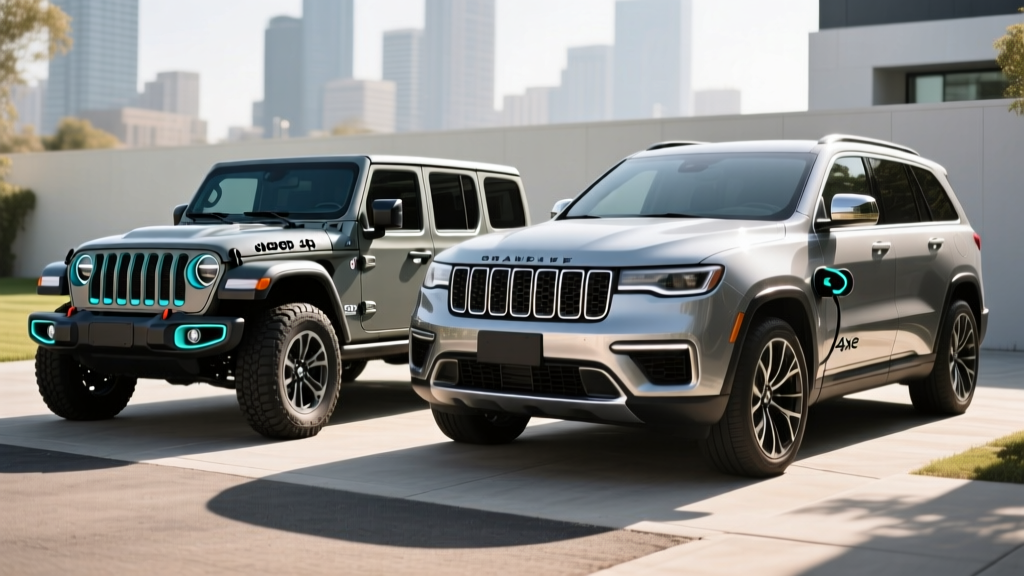
If you're shopping for a Jeep SUV hybrid, you're looking at plug-in hybrid electric vehicles (PHEVs) wearing the 4xe badge. For the 2026 model year, Jeep offers two electrified SUVs: the rugged Wrangler 4xe and the family-oriented Grand Cherokee 4xe. Both pair a turbocharged engine with electric motors and a battery you can recharge from a wall outlet — delivering short electric-only commutes and gas-engine range for weekend trail runs or road trips.
This guide breaks down exactly what each Jeep SUV hybrid delivers in real-world efficiency, charging practicality, powertrain output, pricing, and federal tax credit eligibility — so you can decide whether a 4xe fits your garage or whether a full EV or conventional hybrid makes more sense.
HEV vs PHEV: Why Every Jeep SUV Hybrid Is a Plug-In
Conventional Hybrid (HEV): Uses a small battery recharged only by regenerative braking and the engine. You never plug it in. Examples: Toyota RAV4 Hybrid, Honda CR-V Hybrid. Typical electric-only driving: less than 1 mile.
Plug-In Hybrid (PHEV): Carries a larger battery (typically 14–25 kWh) that you charge from an outlet or charger. Delivers meaningful electric-only range (20–50 miles) before the gas engine takes over. Examples: Jeep Wrangler 4xe, Grand Cherokee 4xe, Toyota RAV4 Prime.
Jeep does not currently sell a conventional HEV in the U.S. market. Every electrified Jeep SUV wears the 4xe badge and requires plug-in charging to unlock its full efficiency benefit. If you can't charge at home or work, a 4xe will still function as a heavy hybrid — but you'll forfeit the electric-only miles and much of the fuel-cost savings.
2026 Jeep Wrangler 4xe: MPG, Electric Range, and Powertrain
The Wrangler 4xe remains one of the few plug-in hybrid off-roaders on the market. Its body-on-frame construction, solid axles, and available locking differentials make it uniquely capable — but those same features impose an efficiency penalty compared to unibody crossovers.
| Specification | Value |
|---|---|
| Powertrain | 2.0L turbo I-4 + 2 electric motors, 8-speed auto |
| Combined Horsepower | 375 hp / 470 lb-ft torque |
| Battery (usable) | 17.3 kWh, NMC lithium-ion |
| EPA Electric-Only Range | 22 miles |
| EPA Combined MPGe (electric + gas) | 49 MPGe |
| EPA MPG (gas-only, combined) | 20 MPG (20 city / 20 hwy) |
| Total Combined Range | ~370 miles |
| Max AC Charging (Level 2) | 7.2 kW |
| DC Fast Charging | Not available |
| Level 2 Charge Time (0–100%) | ~2.5 hours |
| Level 1 Charge Time (120V) | ~12 hours |
| 0–60 mph | 6.0 seconds (estimated) |
| Towing Capacity | 3,500 lbs |
| Starting MSRP | ~$51,790 (Willys 4xe) |
Real-World Range Reality: The EPA rates the Wrangler 4xe at 22 electric-only miles. In mixed suburban driving at moderate temperatures, expect 18–22 miles. On the highway at 70+ mph, that drops to roughly 14–16 miles. In freezing weather with cabin heat running, plan for 12–15 electric miles. Once the battery depletes, the 20 MPG combined gas figure is realistic for mixed driving — though highway-only cruising may yield 21–22 MPG, and aggressive off-road or city driving can dip to 17–18 MPG.
According to fueleconomy.gov, the Wrangler 4xe's combined MPGe of 49 is respectable for a 5,000+ lb body-on-frame SUV, but it trails unibody PHEV crossovers significantly. The key advantage: no other PHEV matches its off-road capability.
2026 Jeep Grand Cherokee 4xe: MPG, Electric Range, and Powertrain
The Grand Cherokee 4xe targets buyers who want three-row-adjacent space (two-row configuration), a premium interior, and the ability to commute on electricity during the week while retaining gas-engine flexibility for longer trips.
| Specification | Value |
|---|---|
| Powertrain | 2.0L turbo I-4 + 2 electric motors, 8-speed auto |
| Combined Horsepower | 375 hp / 470 lb-ft torque |
| Battery (usable) | 17.3 kWh, NMC lithium-ion |
| EPA Electric-Only Range | 26 miles |
| EPA Combined MPGe (electric + gas) | 56 MPGe |
| EPA MPG (gas-only, combined) | 23 MPG (23 city / 24 hwy) |
| Total Combined Range | ~440 miles |
| Max AC Charging (Level 2) | 7.2 kW |
| DC Fast Charging | Not available |
| Level 2 Charge Time (0–100%) | ~2.5 hours |
| Level 1 Charge Time (120V) | ~12 hours |
| 0–60 mph | 6.0 seconds (estimated) |
| Towing Capacity | 6,000 lbs (properly equipped) |
| Starting MSRP | ~$60,490 (base 4xe) |
Real-World Range Reality: The Grand Cherokee 4xe's EPA-rated 26 electric miles translates to roughly 22–26 miles in real-world suburban driving. Highway speeds above 65 mph reduce that to 16–20 electric miles. In cold weather (below 32°F), expect 14–18 miles before the engine engages. Once operating as a hybrid, the 23 MPG combined rating is achievable; careful highway driving can return 25–26 MPG, while heavy city traffic may drop to 20–21 MPG.
The Grand Cherokee 4xe's aerodynamic advantage over the Wrangler is the primary reason it extracts 4 more electric miles and 3 more MPG from the same powertrain and battery. For buyers who don't need Wrangler-level trail capability, the Grand Cherokee delivers meaningfully better daily efficiency.
Charging Your Jeep 4xe: Level 1, Level 2, and What to Expect
Neither Jeep 4xe supports DC fast charging. All charging happens via AC — either a standard 120V household outlet (Level 1) or a 240V Level 2 home or public charger. This is typical for PHEVs with batteries under 25 kWh, but it means public fast-charging networks like Tesla Superchargers or Electrify America are irrelevant to your daily routine.
| Charging Level | Power | Miles of EV Range Added per Hour | Full Charge Time |
|---|---|---|---|
| Level 1 (120V household) | ~1.4 kW | ~3–4 miles/hr | ~12 hours |
| Level 2 (240V, 32A) | 7.2 kW (max) | ~15–18 miles/hr | ~2.5 hours |
| DC Fast Charge | N/A | N/A | Not supported |
Home charging setup: Most 4xe owners install a Level 2 wall connector on a 240V/40A circuit. Installation costs range from $500–$1,500 if your electrical panel has capacity, or $2,000–$4,000+ if a panel upgrade is required. The Jeep-branded Level 2 charger (manufactured by a third party) costs approximately $600–$700, but any J1772-compatible Level 2 unit from ChargePoint, Emporia, or Wallbox will work. A standard 120V outlet works for overnight charging if your daily electric commute is under 15 miles — though a full recharge takes roughly 12 hours.
Federal Tax Credit: Does the Jeep 4xe Qualify?
Under the current IRS §30D Clean Vehicle Credit rules, the Jeep Wrangler 4xe and Grand Cherokee 4xe have historically qualified for a partial or full federal tax credit — but eligibility is not guaranteed and depends on battery component sourcing, critical mineral requirements, MSRP caps, and buyer income limits that shift annually.
- MSRP Cap: SUVs must have an MSRP at or below $80,000. Most 4xe trims qualify; fully loaded Grand Cherokee Overland/Summit Reserve 4xe trims may approach or exceed this threshold.
- Buyer Income Cap: Adjusted gross income must not exceed $150,000 (single), $225,000 (head of household), or $300,000 (joint filers).
- Battery Sourcing: The credit is split into two halves — $3,750 for critical minerals and $3,750 for battery components. Sourcing requirements tighten each year; check current IRS guidance before purchasing.
- Point-of-Sale Transfer: You can transfer the credit to the dealer at purchase to reduce the sale price, rather than waiting to claim it on your tax return.
- Assembly: Both models are assembled in the U.S. (Toledo, OH for Wrangler; Detroit, MI for Grand Cherokee), satisfying the North American final assembly requirement.
Bottom line: Verify current eligibility on the IRS website and with your dealer before signing. Credit amounts and sourcing rules change frequently — do not assume a flat $7,500 credit. Consult a tax professional for your specific situation.
Battery Warranty, Reliability, and Replacement Cost
Jeep 4xe Hybrid Battery Warranty: Both the Wrangler 4xe and Grand Cherokee 4xe carry a hybrid battery warranty of 8 years / 100,000 miles (whichever comes first). In states that follow California Air Resources Board (CARB) emissions standards — including CA, NY, NJ, MA, and several others — the warranty extends to 10 years / 150,000 miles.
The warranty covers the high-voltage battery against defects and excessive capacity loss (typically defined as falling below 70% of original capacity). Jeep's 17.3 kWh pack uses NMC (nickel manganese cobalt) chemistry, which is proven in millions of PHEVs globally.
Replacement cost: If the battery fails outside warranty, replacement runs approximately $8,000–$12,000 including labor. However, catastrophic battery failure in modern PHEV packs is rare; most degradation is gradual. Owners who charge daily and avoid frequent 100% charges (the system has a built-in buffer to protect longevity) typically see minimal capacity loss over the first 5–7 years.
Reliability track record: The 2.0L turbocharged engine paired with the ZF 8-speed transmission and electric motors has been in production since the 2021 model year. Early-model-year Wrangler 4xe units (2021–2022) had some reported software and electrical gremlins, which Jeep addressed through recalls and OTA updates. By 2026, the powertrain is mature. Check current NHTSA recall data for any open campaigns on your specific VIN.
Jeep 4xe vs Full EV vs Conventional Hybrid: Which Fits You?
Choose a Jeep 4xe PHEV if:
- Your daily commute is under 25 miles round-trip and you can charge at home
- You regularly take long road trips or drive in areas with sparse charging infrastructure
- You need genuine off-road capability (Wrangler) or 6,000-lb towing (Grand Cherokee)
- You want to reduce fuel consumption without committing to full electric
Choose a full EV (BEV) if:
- You can charge at home and your daily driving is under 250 miles
- You want zero tailpipe emissions and the lowest per-mile "fuel" cost
- You don't need off-road capability or heavy towing
- You want minimal maintenance (no oil changes, no engine)
Choose a conventional hybrid (HEV) like the Toyota RAV4 Hybrid if:
- You cannot charge at home or at work
- You want better MPG than gas without any plug-in routine
- You prioritize lower upfront cost over electric-only driving
The honest trade-off with any Jeep SUV hybrid: these are heavy vehicles optimized for capability, not efficiency. A Toyota RAV4 Prime delivers 42 electric miles and 94 MPGe from a similar PHEV architecture because it's lighter and more aerodynamic. If efficiency is your top priority, the 4xe isn't the answer. If you need Jeep capability with some electric commuting, it's the only game in town.
Pricing Breakdown and Total Cost of Ownership
| Cost Factor | Grand Cherokee 4xe | Grand Cherokee Gas (V6) | Ford Explorer EV (est.) |
|---|---|---|---|
| MSRP (base) | $60,490 | $44,495 | $52,000 |
| Federal Tax Credit | Up to $7,500 | $0 | Up to $7,500 |
| Effective Purchase Price | ~$52,990 | $44,495 | ~$44,500 |
| Fuel/Energy (5 yr, 60k mi) | ~$4,200 | ~$8,500 | ~$3,000 |
| Maintenance (5 yr) | ~$3,500 | ~$4,000 | ~$1,800 |
| Insurance (5 yr est.) | ~$9,500 | ~$8,000 | ~$9,000 |
| 5-Year Total (excl. depreciation) | ~$70,190 | ~$64,995 | ~$58,300 |
The 4xe's fuel savings over the gas Grand Cherokee are meaningful — roughly $4,300 over five years — but don't fully offset the higher purchase price. The value proposition improves if your commute is short enough to run almost entirely on electricity, if electricity rates in your area are low, or if you qualify for the full tax credit. Insurance tends to be higher for PHEVs and EVs due to repair cost complexity; get a quote before committing.
Frequently Asked Questions
How many MPG does the Jeep Wrangler 4xe get?
The EPA rates the 2026 Wrangler 4xe at 20 MPG combined (20 city / 20 highway) when operating on gasoline alone after the battery is depleted. With a charged battery and short trips, the combined MPGe rating is 49 MPGe. Real-world results vary: highway-only driving may return 21–22 MPG, while aggressive city driving or off-roading can drop to 17–18 MPG.
How far can the Grand Cherokee 4xe go on electric only?
The EPA rates the Grand Cherokee 4xe at 26 miles of electric-only range. In real-world suburban driving, expect 22–26 miles. Highway driving at 70+ mph reduces this to 16–20 miles. Cold weather (below freezing) with cabin heat further reduces range to approximately 14–18 miles.
Does the Jeep 4xe qualify for the $7,500 federal tax credit?
Eligibility depends on current IRS §30D rules including battery sourcing requirements, buyer income limits, and MSRP caps. Both 4xe models are assembled in the U.S. and most trims fall under the $80,000 SUV MSRP cap. However, sourcing rules tighten annually. Always verify current eligibility at fueleconomy.gov and consult a tax professional before purchasing.
Can I charge a Jeep 4xe at a Tesla Supercharger or DC fast charger?
No. Neither the Wrangler 4xe nor Grand Cherokee 4xe supports DC fast charging. They accept AC charging only — via a standard 120V outlet (Level 1, ~1.4 kW) or a 240V Level 2 charger (up to 7.2 kW). This is typical for PHEVs with batteries under 25 kWh. A full Level 2 charge takes approximately 2.5 hours.
Is the Jeep 4xe reliable, and what does battery replacement cost?
The 4xe powertrain has been in production since 2021 and is now mature, with early software issues largely resolved. The high-voltage battery carries an 8-year/100,000-mile warranty (10 years/150,000 miles in CARB states). Out-of-warranty battery replacement costs approximately $8,000–$12,000. Catastrophic failure is rare; gradual capacity loss is typical, with most owners seeing minimal degradation in the first 5–7 years with normal charging habits.
Do I need to plug in the Jeep 4xe, or does it charge itself?
You must plug in a 4xe to access its electric-only range and maximum efficiency. The vehicle does regenerate some energy during braking and deceleration, but this only maintains the battery — it does not meaningfully recharge it. If you never plug in, the 4xe operates as a heavy conventional hybrid and returns roughly 20–23 MPG, negating much of its efficiency advantage and cost premium.
Pros
- Genuine off-road capability (Wrangler) with electric torque assist
- 22–26 electric-only miles covers most daily commutes
- No range anxiety — gas engine provides 370–440 mile total range
- 375 hp / 470 lb-ft delivers strong acceleration for heavy SUVs
- U.S. assembly; most trims eligible for partial or full §30D credit
- 8-year/100,000-mile battery warranty (10/150k in CARB states)
Cons
- Electric range and MPG trail lighter PHEV crossovers (RAV4 Prime: 42 mi, 94 MPGe)
- No DC fast charging — irrelevant for road-trip fast-charging networks
- High starting MSRP ($51K–$60K+) before incentives
- Gas-only MPG is mediocre (20–23 combined) due to vehicle weight
- Insurance premiums tend to be higher than gas-only equivalents
- If you can't charge at home, the PHEV premium is hard to justify