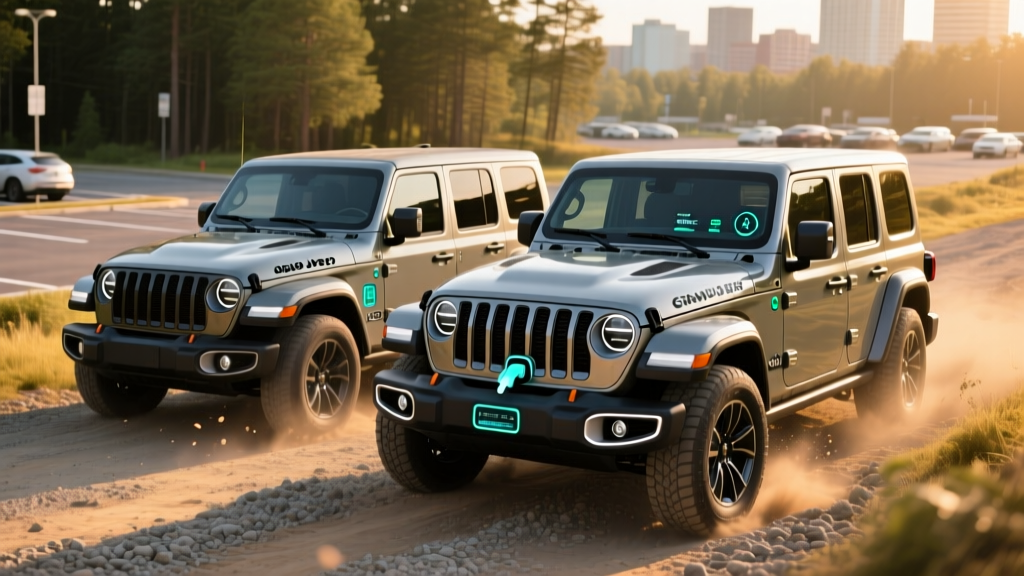
Jeep has carved out a distinct niche in the plug-in hybrid space. While most automakers are chasing efficiency-first sedans and crossovers, Jeep's 4xe lineup targets buyers who want trail-rated capability with an electric commute. For 2026, the brand offers two core plug-in hybrid models: the iconic Wrangler 4xe and the more refined Grand Cherokee 4xe. Both are PHEVs — not conventional hybrids — meaning they pair a turbocharged gas engine with a sizable battery you plug in to charge.
If you've been searching for Jeep hybrids, you've likely noticed the lineup can be confusing. Neither model is a self-charging hybrid (HEV) like a Toyota Prius. Both require plugging in to access their full electric range, and both qualify for different incentive structures depending on your income, where you buy, and how the vehicles are sourced. This guide breaks down every spec that matters — EPA MPG, real-world electric range, charging times, battery longevity, and whether either Jeep PHEV fits your driveway.
Jeep's Hybrid Lineup: PHEV, Not HEV — What That Means
Before comparing models, it's critical to understand what Jeep actually sells. The 4xe badge means plug-in hybrid electric vehicle (PHEV). Jeep does not currently offer a conventional hybrid (HEV) — the kind that recharges its small battery solely through regenerative braking and the engine, like a Honda CR-V Hybrid.
HEV vs PHEV: The Key Difference
| Feature | Conventional Hybrid (HEV) | Plug-In Hybrid (PHEV) — Jeep 4xe |
|---|---|---|
| Plug in to charge? | No | Yes — Level 1 or Level 2 |
| Electric-only range | 1-2 miles at low speed | 22-26 miles at highway speed |
| Battery size | 1-2 kWh | 17.3 kWh usable |
| Federal tax credit | None | Up to $3,750 (varies by sourcing) |
| Gas engine always available | Yes | Yes |
Bottom line: If your commute is under 25 miles and you can charge at home, a Jeep 4xe operates as an EV most weekdays. If you can't charge, you're carrying dead battery weight and paying a premium for capability you don't use.
2026 Wrangler 4xe: Specs, MPG, and Electric Range
The Wrangler 4xe remains Jeep's best-selling plug-in hybrid and one of the most capable off-road PHEVs on the market. It pairs a 2.0-liter turbocharged inline-four with two electric motor-generators and a 17.3 kWh (usable) lithium-ion battery pack mounted under the rear seats.
| Spec | Value |
|---|---|
| Combined horsepower | 375 hp / 470 lb-ft torque |
| Engine | 2.0L turbo I-4 + dual electric motor-generators |
| Battery (usable) | 17.3 kWh, NMC lithium-ion |
| EPA electric-only range | 22 miles |
| EPA combined (gas-only) | 20 MPG (city 20 / hwy 20) |
| MPGe (electric + gas) | 49 MPGe |
| Total range (full tank + full charge) | ~370 miles |
| 0-60 mph | ~6.0 seconds |
| Level 2 charge time (0-100%) | ~2.0 hours at 7.2 kW |
| DC fast charging | Not supported |
| Towing capacity | 3,500 lbs |
| Base MSRP (Willys 4xe) | $51,795 (incl. destination) |
The EPA rates the Wrangler 4xe at 22 miles electric-only. In real-world testing, expect 18-20 miles in mixed driving with moderate climate use. Highway-only driving at 70+ mph drops this to roughly 15-17 miles. In cold weather (below 30°F), plan for 13-16 miles of electric range — the battery's thermal management system draws power to keep cells warm, and cabin heat comes from the engine in very cold conditions.
On gas alone, the Wrangler 4xe returns a middling 20 MPG combined. This is a body-on-frame, solid-axle, brick-aerodynamic off-roader — efficiency was never the point. The hybrid system's real value is the silent electric crawl on trails and the instant 470 lb-ft of torque off the line.
2026 Grand Cherokee 4xe: A More Refined PHEV Option
If the Wrangler is the trail rig, the Grand Cherokee 4xe is the daily driver. It shares the same 2.0L turbo + dual motor-generators powertrain architecture but wraps it in a unibody, three-row-capable luxury SUV with far better aerodynamics.
| Spec | Value |
|---|---|
| Combined horsepower | 375 hp / 470 lb-ft torque |
| Battery (usable) | 17.3 kWh, NMC lithium-ion |
| EPA electric-only range | 26 miles |
| EPA combined (gas-only) | 25 MPG (city 23 / hwy 27) |
| MPGe (electric + gas) | 56 MPGe |
| Total range (full tank + full charge) | ~440 miles |
| 0-60 mph | ~6.3 seconds |
| Level 2 charge time (0-100%) | ~2.0 hours at 7.2 kW |
| DC fast charging | Not supported |
| Towing capacity | 6,000 lbs |
| Base MSRP (4xe base) | $61,995 (incl. destination) |
The Grand Cherokee 4xe's 26-mile electric range is the best in the Jeep lineup. On a suburban commute with light acceleration and mild weather, owners regularly report 27-29 miles before the engine kicks on — hybrids and PHEVs often exceed EPA in stop-and-go conditions where regenerative braking recaptures more energy. Highway driving at 75 mph will net closer to 20-22 electric miles.
The gas-only fuel economy is also notably better than the Wrangler's: 25 MPG combined is competitive with non-hybrid midsize SUVs, and it makes the Grand Cherokee 4xe a genuinely practical road-trip vehicle once the battery is depleted.
Side-by-Side: Wrangler 4xe vs Grand Cherokee 4xe
| Attribute | Wrangler 4xe | Grand Cherokee 4xe |
|---|---|---|
| Electric range (EPA) | 22 mi | 26 mi |
| Gas MPG (combined) | 20 | 25 |
| Total system power | 375 hp | 375 hp |
| Towing | 3,500 lbs | 6,000 lbs |
| Off-road capability | Trail Rated | Capable, not Trail Rated |
| Cargo (rear seats up) | ~27 cu ft | ~37 cu ft |
| Level 2 charge time | ~2 hrs | ~2 hrs |
| Starting MSRP | $51,795 | $61,995 |
| Third row available | No | No (4xe) |
Charging the Jeep 4xe: What You Need at Home
Neither Jeep 4xe supports DC fast charging. This is a deliberate engineering trade-off — the 17.3 kWh battery is small enough that Level 2 charging fills it quickly, and adding DC fast-charge hardware would add weight, cost, and complexity to vehicles already carrying significant mass.
| Level | Power | 0-100% Time | Miles of Range / Hour |
|---|---|---|---|
| Level 1 (120V household) | ~1.4 kW | ~12 hours | ~2 mi/hr |
| Level 2 (240V, 32A) | 7.2 kW | ~2 hours | ~13 mi/hr |
| DC Fast Charge | Not supported on any Jeep 4xe model | ||
For most owners, Level 2 is the practical choice. A 240V home charger installed on a dedicated 40A circuit will fully replenish either 4xe overnight with room to spare. Expect to spend $500-$1,200 on a quality Level 2 EVSE (ChargePoint Home Flex, Emporia Vue, or similar) and $400-$1,500 on electrician labor, depending on panel proximity and whether a 240V outlet (NEMA 14-50) already exists in your garage.
Level 1 charging from a standard 120V outlet technically works, but at ~12 hours for a full charge, it's only viable if you drive fewer than 15 electric miles daily and can leave the vehicle plugged in for extended periods.
How Many MPG Do Jeep Hybrids Get? (EPA vs Real World)
This is the question every Jeep hybrid shopper asks, and the answer depends heavily on how you use the vehicle.
| Model | City MPG | Hwy MPG | Combined MPG | MPGe |
|---|---|---|---|---|
| Wrangler 4xe | 20 | 20 | 20 | 49 |
| Grand Cherokee 4xe | 23 | 27 | 25 | 56 |
Real-world context: The EPA MPG figures above apply once the battery is depleted and the vehicle operates as a conventional hybrid. If your daily commute falls within the electric-only range (22-26 miles) and you charge nightly, your actual gasoline consumption could be near zero on weekdays. Many 4xe owners report using less than one tank of gas per month for local driving.
On the flip side, if you never plug in — a surprisingly common scenario among 4xe buyers attracted by the torque and badge — you'll get exactly the gas-only MPG figures. The Wrangler's 20 MPG combined is roughly what a gas-only Wrangler achieves, so you're carrying 800+ lbs of battery and motors for no efficiency benefit. Verify current EPA ratings at fueleconomy.gov.
Does the Jeep 4xe Qualify for a Federal Tax Credit?
Tax credit eligibility for Jeep's PHEVs is nuanced and subject to change. Under the current IRS §30D clean vehicle credit rules, PHEVs must meet the same battery sourcing and critical mineral requirements as full EVs. Here's the checklist:
§30D Tax Credit Eligibility — Jeep 4xe Models
- Battery capacity: Must be ≥7 kWh — both 4xe models qualify at 17.3 kWh usable ✓
- MSRP cap: SUVs/vans/pickups capped at $80,000 — both 4xe models fall under this at base trims ✓
- Buyer income cap: AGI ≤ $150K (single) / $300K (joint) — varies by filer
- Final assembly: Must be in North America — Jeep 4xe models are assembled in Toledo, OH and Detroit, MI ✓
- Battery component sourcing: Must meet escalating domestic-content thresholds — this is where eligibility often changes year to year
- Critical minerals: Must meet sourcing requirements from US or FTA partners — check current-year IRS guidance
- Point-of-sale transfer: Eligible buyers can apply the credit at purchase rather than waiting to claim on taxes
As of early 2026, the Jeep 4xe models have qualified for a partial credit of up to $3,750 (one of the two sourcing requirements met), but this can shift with supply-chain changes. Always verify at the IRS Clean Vehicle Credit portal before purchasing, and consult a tax professional for your specific situation.
Battery Longevity, Warranty, and Replacement Cost
Battery degradation is the number-one concern for hybrid and PHEV buyers, and it's worth addressing with data rather than speculation.
Jeep 4xe Battery Warranty
Coverage: 8 years / 100,000 miles (whichever comes first)
Capacity threshold: Stellantis warrants the high-voltage battery against defects and excessive capacity loss. Industry standard for "excessive" is typically a drop below 60-70% of original capacity, though Stellantis does not publish a specific percentage threshold in consumer-facing documentation.
What's covered: Battery cell defects, battery management system failures, and related high-voltage components.
What's not covered: Normal gradual degradation, damage from accidents, improper charging equipment, or modifications.
Real-world degradation data: The 4xe's 17.3 kWh NMC battery is relatively small and operates in a partial state-of-charge window (the system maintains a buffer at both the top and bottom of the battery to reduce stress). Based on fleet data from 2021-2024 Wrangler 4xe models now reaching 80,000+ miles, typical capacity loss is 8-12% over 4-5 years. This means a Wrangler 4xe that started with 22 miles of electric range might show 19-20 miles after four years of regular use — noticeable but not catastrophic.
Battery replacement cost: A full high-voltage battery replacement for the 4xe platform currently runs $8,000-$12,000 including parts and labor at a dealership. However, individual module replacement (the battery pack is composed of multiple modules) can be significantly cheaper if only one section has failed. Given the 8-year/100,000-mile warranty and the relatively conservative degradation observed so far, most original owners will never face an out-of-pocket battery replacement.
Who Should Buy a Jeep Hybrid — And Who Shouldn't
Decision Framework: Is a Jeep 4xe Right for You?
Choose the Wrangler 4xe if:
- You want genuine off-road capability with silent electric trail crawling
- Your daily commute is under 20 miles and you can install a Level 2 charger at home
- You value the Wrangler's removable top/doors and don't mind the ride quality and road noise trade-offs
- You want 470 lb-ft of instant torque for towing a small trailer or boat
Choose the Grand Cherokee 4xe if:
- You need a comfortable daily driver with luxury features and 26 miles of electric range
- You tow up to 6,000 lbs (boats, campers, horse trailers) and want PHEV efficiency
- You want better gas-only fuel economy (25 MPG) for road trips beyond electric range
- You prioritize cabin quietness, ride quality, and cargo space over off-road prowess
Choose a full EV instead if:
- You can charge at home AND your daily driving rarely exceeds 200 miles
- You want zero gasoline maintenance (no oil changes, no spark plugs, no transmission fluid)
- Models like the Rivian R1S, Tesla Model X, or Hyundai Ioniq 9 meet your space and budget needs
Choose a conventional gas vehicle instead if:
- You cannot charge at home or at work — a PHEV you never plug in is just a heavy, expensive gas car
- You regularly drive 400+ miles in a single day and don't want to manage charging logistics
- Your budget is under $45,000 — the 4xe premium over a gas Wrangler or Grand Cherokee is substantial
Jeep 4xe Pros
- 375 hp and 470 lb-ft standard on both models
- 22-26 miles of real electric commuting range
- No range anxiety — gas engine provides 370-440 total miles
- Wrangler 4xe is the only Trail Rated PHEV
- Eligible for partial federal tax credit (verify yearly)
- Silent electric mode for neighborhood and trail use
Jeep 4xe Cons
- No DC fast charging — limited to 7.2 kW Level 2
- Gas-only MPG is unimpressive, especially Wrangler at 20 combined
- High starting price: $51,795 (Wrangler) / $61,995 (Grand Cherokee)
- Electric range is modest vs. newer PHEVs (Toyota RAV4 Prime: 42 mi)
- Significant weight penalty from battery and motors
- Partial tax credit only — sourcing rules limit full $7,500
Frequently Asked Questions
How many MPG does the Jeep Wrangler 4xe get?
The 2026 Wrangler 4xe is EPA-rated at 20 MPG combined (20 city / 20 highway) when running on gasoline alone after the battery is depleted. When factoring in electric driving, it achieves 49 MPGe. Real-world gas-only MPG can dip to 17-18 on sustained highway trips at 75+ mph due to the Wrangler's poor aerodynamics.
How far can the Jeep Grand Cherokee 4xe go on electric only?
The EPA rates the Grand Cherokee 4xe at 26 miles of electric-only range. In real-world suburban driving with moderate temperatures, expect 24-28 miles. Highway driving at 70+ mph reduces this to approximately 20-22 miles. Cold weather below freezing can drop electric range to 17-20 miles.
Hybrid vs PHEV vs EV — which is right for me?
A conventional hybrid (HEV) like a Toyota RAV4 Hybrid is best if you can't charge at home — it requires no plug-in and delivers 38-41 MPG. A PHEV like the Jeep 4xe is ideal if you can charge at home and your commute is under 25 miles — you get EV-like daily driving with a gas engine for long trips. A full EV (BEV) makes sense if you have reliable home charging, drive under 250 miles daily, and want the lowest operating costs and zero tailpipe emissions. The PHEV is the bridge for buyers not ready to commit fully to electric.
Is the Jeep 4xe reliable, and what does battery replacement cost?
The 4xe powertrain has proven reasonably reliable since its 2021 introduction, though early models had software-related recalls for battery management and hybrid system faults. The high-voltage battery is covered by an 8-year/100,000-mile warranty. Real-world degradation data shows 8-12% capacity loss over 4-5 years, which is within normal expectations for NMC chemistry. A full battery replacement costs $8,000-$12,000 out of warranty, but most owners will never need one within the warranty period.
Does the Jeep 4xe qualify for the $7,500 federal tax credit?
Not the full amount. As of 2026, Jeep 4xe models have qualified for a partial credit of up to $3,750 because they meet one of the two battery-sourcing requirements (component manufacturing) but not the critical minerals threshold. Eligibility depends on your income (AGI ≤ $300K joint / $150K single), the vehicle's MSRP (under $80K for SUVs), and current-year IRS sourcing rules. Always verify at the IRS Clean Vehicle Credit page and consult a tax professional before relying on credit amounts for purchase decisions.
Can I charge a Jeep 4xe at a public fast charger?
No. Neither the Wrangler 4xe nor the Grand Cherokee 4xe supports DC fast charging. They are limited to Level 2 AC charging at a maximum of 7.2 kW. You can use public Level 2 chargers (ChargePoint, EVgo Level 2 stations, etc.) but not DC fast chargers like Tesla Superchargers or Electrify America CCS stalls. A full Level 2 charge takes approximately 2 hours.
What happens if I never plug in the Jeep 4xe?
The vehicle will operate as a conventional hybrid, using the gas engine and regenerative braking to maintain a small battery buffer. You'll get the gas-only EPA ratings (20 MPG Wrangler, 25 MPG Grand Cherokee) and forfeit the entire benefit of the PHEV system. You're also carrying roughly 800 lbs of battery and motor weight that provides no efficiency gain. If you cannot commit to regular plug-in charging, a gas-only Wrangler or Grand Cherokee is a more cost-effective choice.
Sources: EPA fuel economy data via fueleconomy.gov; IRS Clean Vehicle Credit rules via irs.gov; manufacturer specifications via Jeep/Stellantis press materials.