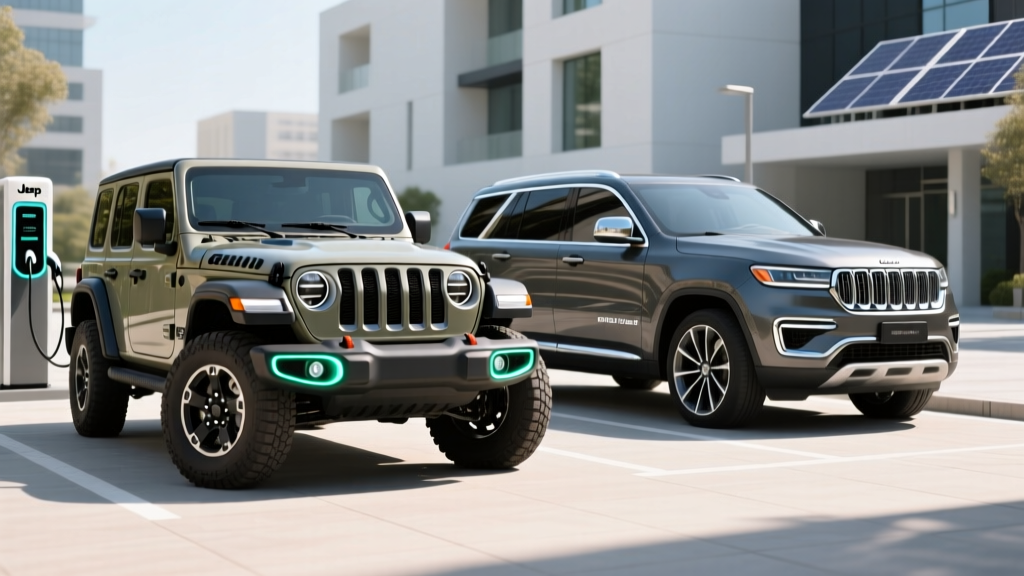
Jeep doesn't sell a conventional hybrid (HEV) in the United States. Instead, the brand's electrified strategy revolves entirely around plug-in hybrids — the 4xe (four-by-e) platform — fitted to its two highest-volume nameplates: the Wrangler 4xe and the Grand Cherokee 4xe. Both pair a turbocharged gasoline engine with an electric motor and a battery you can plug in to charge, delivering a short electric-only range before the hybrid powertrain takes over.
If you're researching "Jeep's hybrid" options, this guide breaks down exactly what each 4xe model delivers in EPA range, MPG, charging speed, powertrain output, and real-world usability — plus whether either qualifies for the federal tax credit in 2026.
HEV vs PHEV: Why Jeep Only Builds Plug-In Hybrids
Conventional Hybrid (HEV)
A standard hybrid — think Toyota RAV4 Hybrid — uses a small battery (1–2 kWh) that recharges only through regenerative braking and the engine. You never plug it in. It improves city MPG but offers zero electric-only driving.
Plug-In Hybrid (PHEV) — Jeep 4xe
A PHEV carries a much larger battery (17–18 kWh usable) that you can recharge from a wall outlet or public charger. It delivers 20–26 miles of pure electric driving, then operates as a conventional hybrid. Jeep's 4xe models fall in this category.
The distinction matters for your wallet and your commute. A PHEV can eliminate gasoline use entirely on short trips if you charge regularly, while an HEV simply sips less fuel no matter what. Jeep chose the PHEV route because its buyers demand off-road capability and towing — tasks where a small HEV battery provides minimal benefit.
Wrangler 4xe: Specs, Range, and MPG
| Spec | 2025/2026 Wrangler 4xe |
|---|---|
| Powertrain | 2.0L turbo I-4 + electric motor (integrated in 8-speed auto) |
| Combined Output | 375 hp / 470 lb-ft torque |
| Battery (usable) | 17.3 kWh NMC lithium-ion |
| Electric-Only Range (EPA) | 22 miles |
| Total Combined Range | ~370 miles |
| EPA MPG (hybrid mode) | 20 combined (49 MPGe with electricity) |
| EPA City / Highway (gas) | 20 city / 20 highway |
| Level 2 Charge Time (0–100%) | ~2 hours at 7.2 kW (Level 2, 240V) |
| DC Fast Charging | Not available |
| 0–60 mph | ~6.0 seconds |
| Towing Capacity | 3,500 lbs |
| Starting MSRP | ~$51,790 (Willys 4xe) |
Real-World Range & MPG Check
EPA sticker: 22 miles electric, 20 MPG gas combined.
Real-world expectation: Expect 18–20 miles of electric range in mixed driving, dropping to 14–16 miles in cold weather (below 35°F) due to cabin heating demands and battery impedance. In hybrid mode, owners frequently report 21–23 MPG in city driving (regen braking helps) but as low as 17–18 MPG on sustained highway runs at 75 mph — the Wrangler's brick-like aerodynamics and 5,000+ lb curb weight work against it.
The Wrangler 4xe uses a J1772 connector for Level 2 AC charging. There is no DC fast-charge port — a deliberate trade-off to preserve the Wrangler's ground clearance and approach/departure angles for off-road use. A full recharge on a standard 120V household outlet (Level 1) takes roughly 12 hours, so a 240V Level 2 home charger is strongly recommended.
Grand Cherokee 4xe: Specs, Range, and MPG
| Spec | 2025/2026 Grand Cherokee 4xe |
|---|---|
| Powertrain | 2.0L turbo I-4 + two electric motors (integrated in 8-speed auto) |
| Combined Output | 375 hp / 470 lb-ft torque |
| Battery (usable) | 17.3 kWh NMC lithium-ion |
| Electric-Only Range (EPA) | 26 miles |
| Total Combined Range | ~440 miles |
| EPA MPG (hybrid mode) | 23 combined (56 MPGe with electricity) |
| EPA City / Highway (gas) | 23 city / 24 highway |
| Level 2 Charge Time (0–100%) | ~2 hours at 7.2 kW (Level 2, 240V) |
| DC Fast Charging | Not available |
| 0–60 mph | ~6.0 seconds |
| Towing Capacity | 6,000 lbs |
| Starting MSRP | ~$60,490 (Base 4xe) |
Real-World Range & MPG Check
EPA sticker: 26 miles electric, 23 MPG gas combined.
Real-world expectation: The Grand Cherokee's sleeker profile and slightly lighter weight (relative to the Wrangler's aero penalty) translate to more consistent real-world numbers. Expect 22–25 electric miles in moderate temperatures and 22–24 MPG combined in hybrid mode. Highway cruising at 70–75 mph yields roughly 22–23 MPG. Cold weather still shaves 20–30% off electric-only range.
Like the Wrangler, the Grand Cherokee 4xe charges via J1772 at up to 7.2 kW on Level 2 AC — no DC fast charging. The battery is mounted under the rear seats, preserving cargo space but eliminating the spare-tire well (a tire-inflator kit is included instead).
Side-by-Side: Wrangler 4xe vs Grand Cherokee 4xe
| Attribute | Wrangler 4xe | Grand Cherokee 4xe |
|---|---|---|
| Electric Range (EPA) | 22 mi | 26 mi |
| Gas MPG Combined | 20 | 23 |
| MPGe | 49 | 56 |
| Horsepower | 375 hp | 375 hp |
| Towing | 3,500 lbs | 6,000 lbs |
| Off-Road Capability | Excellent (solid axles, lockers) | Good (independent suspension, air ride avail.) |
| Seating | 5 | 5 (7 with LWB) |
| Cargo (behind 2nd row) | ~29 cu ft | ~37.7 cu ft |
| Starting MSRP | ~$51,790 | ~$60,490 |
| Best For | Trail use, removable top, lifestyle | Family hauling, towing, comfort |
Federal Tax Credits and Incentives for Jeep 4xe Models
Under the IRS §30D Clean Vehicle Credit, qualifying new PHEVs can receive up to $3,750 (partial credit — the full $7,500 requires meeting both critical-minerals and battery-component sourcing thresholds). As of 2026, Jeep 4xe models' eligibility depends on battery-sourcing compliance, which Stellantis has adjusted across model years. The credit phases based on:
- MSRP cap: SUVs/vans/pickups must have an MSRP ≤ $80,000. Both 4xe models generally fall under this cap at base trims; high-option Grand Cherokee trims (Summit Reserve) may exceed it.
- Buyer income limits: AGI ≤ $150,000 (single), $225,000 (head of household), $300,000 (joint).
- Battery sourcing: Critical minerals and battery components must meet phased-in percentage thresholds from U.S. or FTA-partner countries. This determines whether you receive $3,750 or $7,500.
- Point-of-sale transfer: You can transfer the credit to the dealer at purchase, reducing the purchase price directly rather than waiting for a tax refund.
Always verify current eligibility on IRS.gov and confirm the specific VIN with the dealer before purchase — sourcing compliance can change between production runs.
Battery Warranty, Reliability, and Replacement Cost
Jeep 4xe Battery Warranty
Stellantis covers the 4xe high-voltage battery for 8 years / 100,000 miles (whichever comes first), with a capacity-retention threshold of 70%. If the battery degrades below 70% of original capacity within the warranty period, Jeep will repair or replace it at no cost. The powertrain (engine, transmission, electric motor) is covered for 5 years / 60,000 miles.
Reliability: The 2.0L turbo engine is a proven FCA/Stellantis unit shared across multiple models. The PHEV system adds complexity — two electric motors, high-voltage wiring, and a liquid-cooled battery pack — but Jeep has sold hundreds of thousands of 4xe units since 2021, and large-scale battery failures have been uncommon. Most reported issues involve 12V auxiliary battery drain (a separate, conventional car battery) and software glitches in the infotainment system rather than the high-voltage pack.
Out-of-warranty replacement cost: If the battery needs replacement after the 8-year window, expect a dealer-quoted price of $8,000–$14,000 for the battery module pack, plus $1,500–$3,000 in labor. Third-party hybrid-battery rebuild services may offer lower costs ($4,000–$7,000) as the 4xe platform ages and aftermarket support grows.
Who Should Buy a Jeep 4xe — and Who Shouldn't
Choose the Jeep 4xe if:
- You want genuine off-road capability (especially Wrangler) with some electric commuting
- Your daily commute is under 25 miles round-trip and you can charge at home
- You need towing (Grand Cherokee: 6,000 lbs) but aren't ready for a full EV
- You live in an area with sparse DC fast-charging infrastructure and need gas-engine range security
Choose a full EV instead if:
- Your commute exceeds 30 miles and you want to eliminate gas entirely
- You want DC fast charging for road trips (neither 4xe offers it)
- You prioritize lowest per-mile fuel cost — EVs at ~$0.04–0.06/mile vs 4xe at $0.10–0.15/mile in hybrid mode
- You want minimal drivetrain maintenance (no oil changes, no turbo, no 8-speed transmission fluid)
Choose a conventional gas Jeep if:
- You can't charge at home (apartment, no garage) — a PHEV you never plug in is just a heavier, thirstier gas car
- You frequently tow near max capacity on long highway trips (electric range evaporates under load)
- Upfront cost is the primary concern — 4xe trims carry a $4,000–$8,000 premium over gas equivalents
Jeep 4xe Pros
- Real off-road hardware (Wrangler) or 6,000-lb towing (Grand Cherokee)
- 22–26 miles electric handles most commutes gas-free
- 375 hp / 470 lb-ft provides strong passing and crawl torque
- Eligible for partial or full federal tax credit (verify per VIN)
- 8-year/100,000-mile battery warranty
Jeep 4xe Cons
- No DC fast charging — Level 2 only, ~2 hours for full charge
- Gas MPG is mediocre once the battery depletes (20–23 combined)
- Significant price premium over gas-only Wrangler/Grand Cherokee trims
- Electric range drops sharply in cold weather and under towing
- High-trim MSRPs may exceed the $80,000 federal tax credit cap
Charging a Jeep 4xe at Home: What You Need
| Item | Estimated Cost |
|---|---|
| Level 2 EVSE (240V, 32A–40A charger) | $350–$700 |
| Electrician labor (run 240V/50A circuit to garage) | $500–$2,000 |
| Permit & inspection | $50–$200 |
| Electrical panel upgrade (if needed, 100A→200A) | $1,500–$3,500 |
| Total (typical, no panel upgrade) | $900–$2,900 |
The Wrangler and Grand Cherokee 4xe both accept up to 7.2 kW on Level 2 AC charging (J1772 connector). This adds roughly 15–18 miles of electric range per hour of charging. A dedicated 240V/32A circuit is sufficient; a 50A breaker is standard for the installation. If your home electrical panel is already near capacity, budget for a panel upgrade — a licensed electrician should perform a load calculation before quoting.
Level 1 charging (120V household outlet) is included via the portable cordset and adds roughly 3–4 miles of range per hour — adequate for overnight top-ups if your commute is very short, but a full 0–100% charge takes 12+ hours.
Frequently Asked Questions
How many MPG does the Jeep Wrangler 4xe get?
The EPA rates the Wrangler 4xe at 20 MPG combined (20 city / 20 highway) in hybrid mode after the battery is depleted. In real-world driving, owners often see 21–23 MPG in city traffic (thanks to regenerative braking) but 17–18 MPG on sustained highway runs. When factoring in electric-only driving, the combined rating is 49 MPGe.
How far can the Grand Cherokee 4xe go on electric only?
The EPA rates the Grand Cherokee 4xe at 26 miles of electric-only range. In real-world conditions with moderate temperatures, expect 22–25 miles. Cold weather (below 35°F) can reduce this to 17–20 miles due to battery chemistry limitations and cabin-heating energy draw.
Does a Jeep hybrid need to be plugged in?
Yes — Jeep's 4xe models are plug-in hybrids (PHEVs), not conventional hybrids. You get the most benefit by plugging in nightly to recharge the 17.3 kWh battery. If you never plug in, the 4xe operates as a conventional hybrid using the engine and regenerative braking, but you'll get mediocre MPG (20–23 combined) and carry the dead weight of a battery you're not using. If you can't charge at home, a conventional hybrid from another brand may be a better fit.
Is the Jeep 4xe reliable?
Large-scale data since the 4xe's 2021 launch shows the high-voltage battery and electric motor system to be generally reliable. Most complaints center on 12V battery drain, software bugs, and occasional build-quality issues common to the Wrangler platform (wind noise, water sealing). The 8-year/100,000-mile battery warranty provides a strong safety net. Check NHTSA.gov for any open recalls on specific model years.
What does it cost to replace the Jeep 4xe battery?
Out-of-warranty battery replacement is estimated at $8,000–$14,000 for parts plus $1,500–$3,000 in labor, depending on the dealer and extent of module replacement needed. Within the 8-year/100,000-mile warranty, replacement is free if capacity drops below 70%. As the 4xe platform matures, third-party rebuild options should reduce this cost.
Does the Jeep 4xe qualify for the federal tax credit?
Potentially. Under IRS §30D, the 4xe may qualify for $3,750 or $7,500 depending on battery-sourcing compliance for the specific model year and production batch. The buyer must also meet income caps ($150K single / $300K joint) and the vehicle MSRP must not exceed $80,000. The credit can be transferred to the dealer at point of sale. Always verify eligibility at IRS.gov and confirm with your dealer for the exact VIN.
Can the Jeep 4xe DC fast charge?
No. Neither the Wrangler 4xe nor the Grand Cherokee 4xe supports DC fast charging. Maximum charge rate is 7.2 kW on Level 2 AC (J1772 connector), which fully recharges the battery in about 2 hours. This is a significant limitation for road-trip use — you cannot top up the battery at highway Electrify America or Tesla Supercharger stations.
Sources: EPA fuel economy data via fueleconomy.gov; IRS Clean Vehicle Credit rules at irs.gov; Jeep brand specifications at jeep.com.