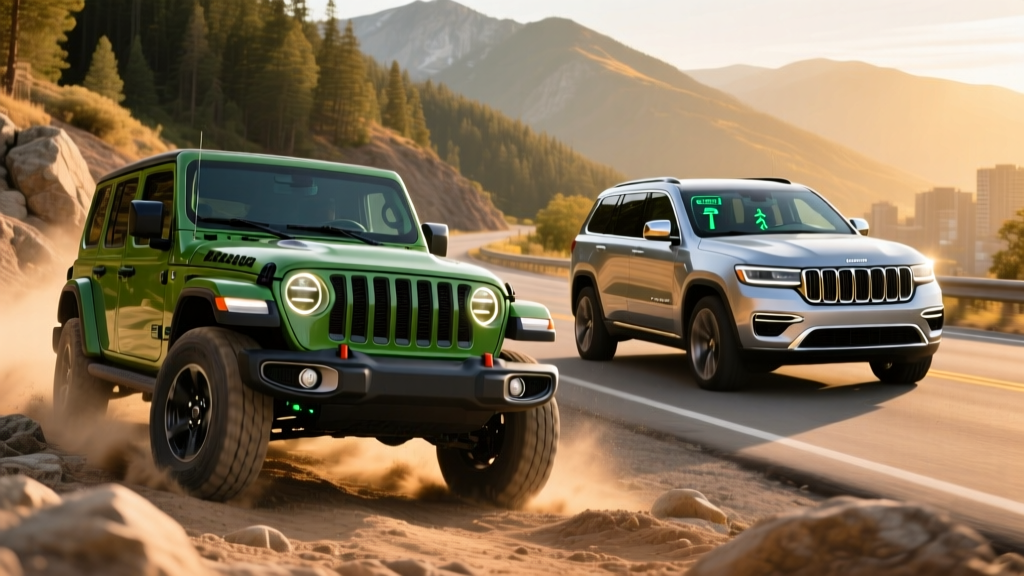
Jeep has carved out a distinct niche in the plug-in hybrid market: rugged, body-on-frame and unibody SUVs that can handle trails while delivering meaningful electric-only commuting range. For 2026, the brand's electrified lineup centers on two core models — the Wrangler 4xe and the Grand Cherokee 4xe — both using Jeep's PHEV architecture branded as "4xe" (pronounced "four-by-e"). These are not conventional hybrids you simply fill with gas. They're plug-in hybrids with usable battery packs, electric-only driving modes, and the ability to reduce daily fuel consumption to zero if your commute falls within their electric range.
This guide breaks down exactly what each Jeep PHEV delivers in real-world driving, how the powertrains work, what you'll pay, and whether a Jeep hybrid vehicle is the right bridge between a gas SUV and a full battery-electric vehicle for your situation.
Understanding Jeep's 4xe: PHEV, Not Conventional Hybrid
HEV vs PHEV — Where Jeep Fits
Conventional Hybrid (HEV): A small battery (typically 1–2 kWh) recharges through regenerative braking and the engine. You never plug it in. Examples: Toyota RAV4 Hybrid, Honda CR-V Hybrid. Electric-only driving is limited to very low speeds and short distances.
Plug-In Hybrid (PHEV): A larger battery (14–20+ kWh) that you charge by plugging into a wall outlet or Level 2 charger. Delivers 20–50 miles of electric-only range before the gas engine engages. Examples: Jeep Wrangler 4xe, Grand Cherokee 4xe, Toyota RAV4 Prime.
Jeep's 4xe models are PHEVs. You plug them in to unlock their full electric range. If you never plug in, they still function as conventional hybrids — but you'll miss the efficiency benefit you paid for.
Both the Wrangler 4xe and Grand Cherokee 4xe pair a 2.0-liter turbocharged inline-four engine with electric motors integrated into an eight-speed automatic transmission. The system can drive the vehicle on electric power alone, gasoline alone, or a combination of both, depending on the selected drive mode and battery state of charge.
2026 Wrangler 4xe: Range, MPG, and Powertrain Specs
The Wrangler 4xe remains the only plug-in hybrid convertible off-roader on the market. It trades some on-road refinement for capability that no competitor matches — and its PHEV powertrain makes daily commuting cheaper if you can charge at home.
| Spec | Value |
|---|---|
| Combined Horsepower | 375 hp |
| Combined Torque | 470 lb-ft |
| Engine | 2.0L turbo I-4 + two electric motors |
| Battery Capacity (gross / usable) | 17.3 kWh / ~14.7 kWh |
| Battery Chemistry | NMC (nickel manganese cobalt) |
| EPA Electric-Only Range | 22 miles |
| EPA Combined MPG (hybrid mode) | 20 MPG |
| EPA MPGe (electric + gas combined) | 49 MPGe |
| Total Combined Range (gas + electric) | ~370 miles |
| Level 2 Charging Time (0–100%) | ~2.5 hours at 7.2 kW |
| DC Fast Charging | Not supported |
| 0–60 mph | |
| Towing Capacity | 3,500 lbs |
| Battery Warranty | 8 years / 100,000 miles |
| Starting MSRP (Willys 4xe) | ~$51,790 |
Real-World MPG vs EPA Estimates
The EPA's 20 MPG combined figure for hybrid mode reflects the Wrangler's aerodynamic disadvantages — it's a boxy, solid-axle vehicle that pushes air at highway speeds like a brick. In real-world driving, owners consistently report:
- City / low-speed hybrid driving: 22–25 MPG (regenerative braking helps significantly in stop-and-go traffic)
- Highway at 70+ mph: 17–19 MPG (aerodynamic drag dominates)
- Electric-only commuting: 0 gallons used if your round trip is under ~20 miles and you charge daily
Cold weather reduces the 22-mile electric range to roughly 15–17 miles, as battery chemistry becomes less efficient and cabin heating draws from the pack. Preconditioning while plugged in helps preserve range in winter.
2026 Grand Cherokee 4xe: A More Refined PHEV Option
If the Wrangler 4xe is the off-road specialist, the Grand Cherokee 4xe is the family hauler. Built on the WL platform (shared with the Alfa Romeo Stelvio), it delivers better on-road manners, a quieter cabin, and slightly improved electric range.
| Spec | Value |
|---|---|
| Combined Horsepower | 375 hp |
| Combined Torque | 470 lb-ft |
| Engine | 2.0L turbo I-4 + two electric motors |
| Battery Capacity (gross / usable) | 17.3 kWh / ~14.7 kWh |
| Battery Chemistry | NMC |
| EPA Electric-Only Range | 26 miles |
| EPA Combined MPG (hybrid mode) | 23 MPG |
| EPA MPGe | 56 MPGe |
| Total Combined Range | ~440 miles |
| Level 2 Charging Time (0–100%) | ~2.5 hours at 7.2 kW |
| DC Fast Charging | Not supported |
| 0–60 mph | ~6.0 sec |
| Towing Capacity | 6,000 lbs (4xe models) |
| Battery Warranty | 8 years / 100,000 miles |
| Starting MSRP (base 4xe) | ~$60,490 |
The Grand Cherokee 4xe's 26-mile electric range is a practical improvement over the Wrangler's 22 miles, making it viable for more commuters. Its lower, more aerodynamic profile also means the hybrid-mode MPG holds up better on the highway — expect 21–23 MPG at 70 mph versus the Wrangler's 17–19.
Charging the Jeep 4xe at Home: What You Need
Neither Jeep 4xe supports DC fast charging. This is a deliberate engineering trade-off — the 17.3 kWh battery is small enough that Jeep determined Level 2 charging meets most owners' needs. Here's what to expect:
| Charging Level | Power | Time (0–100%) | Practical Notes |
|---|---|---|---|
| Level 1 (120V household outlet) | ~1.4 kW | ~12 hours | Works for overnight top-ups if you drive less than the electric range daily |
| Level 2 (240V, home wall charger) | 7.2 kW | ~2.5 hours | Recommended; a full charge in one evening session |
| DC Fast Charging | N/A | N/A | Not available on any 4xe model |
Home charging setup: Most 4xe owners benefit from a Level 2 wall connector on a 240V/40A circuit. Expect to pay $500–$800 for the charger hardware and $800–$2,000 for professional electrician installation, depending on panel proximity and local permit requirements. A licensed electrician should evaluate your panel capacity before installation — older homes with 100A service may need a panel upgrade ($1,500–$3,000+).
The 4xe uses a standard J1772 connector for AC charging. No adapter is needed for any public Level 2 station or home charger.
Tax Credits and Incentives for Jeep PHEVs
Under current IRS §30D Clean Vehicle Credit rules, the eligibility picture for Jeep 4xe models is nuanced:
- Battery capacity requirement: Both 4xe models exceed the 7 kWh minimum — ✓ qualified
- MSRP cap: SUVs must be under $80,000 MSRP. Most 4xe trims fall under this cap, but fully loaded Grand Cherokee 4xe Summit Reserve trims may exceed it — verify the specific trim's MSRP
- Buyer income limits: AGI must not exceed $150,000 (single), $225,000 (head of household), or $300,000 (joint filing)
- Critical minerals & battery sourcing: This is the biggest variable. The battery component and critical mineral sourcing requirements have tightened annually through 2026. Jeep's 4xe battery sourcing has been subject to change — check the current fueleconomy.gov credit lookup for the specific model year and build date before assuming eligibility
- Point-of-sale transfer: If eligible, you can transfer the credit to the dealer at purchase for an immediate price reduction, rather than waiting to claim it on your tax return
The credit amount can be up to $7,500, but partial credits ($3,750) apply if only one of the two sourcing requirements (critical minerals or battery components) is met. Always confirm current eligibility with your dealer and a tax professional before relying on the credit in your purchase budget.
Battery Warranty and Longevity
Both the Wrangler 4xe and Grand Cherokee 4xe carry an 8-year / 100,000-mile high-voltage battery warranty, consistent with federal emissions-related warranty requirements for PHEVs. The warranty covers battery capacity loss below a defined threshold (typically 60–70% of original capacity, per Stellantis terms).
For context, PHEV batteries experience less stress than full EV batteries because they operate in a narrower state-of-charge window — the vehicle's software maintains a buffer at the top and bottom of the pack. Real-world data from earlier 4xe models (2021–2024) suggests moderate degradation of roughly 5–10% over the first four years of typical use. Full battery replacement, if needed out of warranty, is estimated at $8,000–$12,000 including labor — a figure to factor into long-term ownership planning.
Side-by-Side: Wrangler 4xe vs Grand Cherokee 4xe
| Attribute | Wrangler 4xe | Grand Cherokee 4xe |
|---|---|---|
| EPA Electric Range | 22 miles | 26 miles |
| Hybrid MPG (combined) | 20 MPG | 23 MPG |
| Combined HP | 375 hp | 375 hp |
| 0–60 mph | ~6.0 sec | ~6.0 sec |
| Towing Capacity | 3,500 lbs | 6,000 lbs |
| Off-Road Capability | Best-in-class (solid axles, lockers, sway-bar disconnect) | Capable (available air suspension, Quadra-Trac) |
| Cargo Volume (behind 2nd row) | ~28.7 cu ft | ~37.7 cu ft |
| Starting MSRP | ~$51,790 | ~$60,490 |
| Best For | Trail enthusiasts who commute | Families who want PHEV efficiency + comfort |
Jeep 4xe vs Full EV vs Gas: Which Is Right for You?
Decision Framework
Choose the Wrangler 4xe if: You need serious off-road capability (Rubicon trails, rock crawling, overlanding), want to reduce commuting fuel costs with home charging, and accept the trade-off of a rougher on-road ride and lower highway MPG.
Choose the Grand Cherokee 4xe if: You want a family-oriented SUV with electric commuting range, need towing capacity (6,000 lbs), prefer a comfortable highway cruiser, and can charge at home nightly.
Choose a full EV (e.g., Rivian R1S, Tesla Model X) if: You have reliable home and workplace charging, rarely drive beyond 250+ miles in a single day without stopping, want to eliminate oil changes and engine maintenance, and don't need extreme off-road articulation.
Choose a conventional gas model (Wrangler 3.6L, Grand Cherokee 3.6L) if: You cannot charge at home, drive long rural routes regularly, want a lower purchase price, and prefer simpler mechanical systems with wider service availability.
Pros and Cons of Jeep Hybrid Vehicles
Pros
- 22–26 miles of electric-only range eliminates fuel use for short commutes
- 375 hp / 470 lb-ft delivers strong acceleration — more torque than the V6 gas models
- Electric motor provides instant low-end torque, ideal for off-road crawling in electric mode
- Regenerative braking extends range in city driving; real-world city MPG often exceeds EPA
- 8-year/100,000-mile battery warranty reduces long-term risk
- No range anxiety — gas engine covers long trips seamlessly
- Wrangler 4xe has no direct competitor as a PHEV convertible off-roader
Cons
- No DC fast charging — long road trips rely entirely on the gas engine
- Highway MPG in hybrid mode is modest (17–23 MPG) due to weight and aerodynamics
- $51,000–$60,000+ starting prices are steep; fully loaded trims push past $75,000
- PHEV battery adds ~600 lbs vs gas models, affecting handling and braking feel
- Tax credit eligibility is uncertain and subject to annual sourcing requirement changes
- Electric range drops to ~15–17 miles in cold weather (below 32°F)
- Interior tech and build quality lag behind competitors in the $60K+ segment
Frequently Asked Questions
How many MPG does the Jeep Wrangler 4xe get?
The EPA rates the 2026 Wrangler 4xe at 20 MPG combined in hybrid mode (after the battery is depleted). Real-world results vary: expect 22–25 MPG in city driving thanks to regenerative braking, but only 17–19 MPG at sustained highway speeds above 70 mph. The Grand Cherokee 4xe rates higher at 23 MPG combined, with real-world highway figures closer to 21–23 MPG.
How far can the Jeep 4xe go on electric only?
The Wrangler 4xe delivers 22 miles of EPA-rated electric-only range. The Grand Cherokee 4xe extends that to 26 miles. In cold weather (below freezing), expect a 20–30% reduction — roughly 15–17 miles for the Wrangler and 18–21 for the Grand Cherokee. For commutes within these distances and with daily home charging, you may go weeks without using gasoline.
Is the Jeep 4xe a conventional hybrid or a plug-in hybrid?
Both the Wrangler 4xe and Grand Cherokee 4xe are plug-in hybrids (PHEVs). They have a 17.3 kWh battery that charges via a J1772 plug. You can also drive them without plugging in — the engine and regenerative braking will maintain a small charge — but you'll forfeit the electric-only range and the efficiency benefit that justifies the higher purchase price.
Is the Jeep 4xe reliable, and what does battery replacement cost?
Stellantis's 4xe powertrain has been in production since the 2021 model year, giving it a five-year track record. Early models saw some software-related recalls and minor electrical gremlins, but the core powertrain and battery have proven durable. The 8-year/100,000-mile battery warranty covers significant capacity loss. Out-of-warranty battery replacement is estimated at $8,000–$12,000. The 2.0L turbo engine is shared with other Stellantis models and has a well-established service network. For reliability ratings, check IIHS and owner forums for the latest model-year data.
Does the Jeep 4xe qualify for the federal tax credit?
Eligibility for the §30D Clean Vehicle Credit (up to $7,500) depends on the specific model year, build date, battery sourcing compliance, MSRP cap ($80,000 for SUVs), and your income. The 4xe's battery capacity (17.3 kWh) meets the minimum threshold, but critical mineral and battery component sourcing requirements tighten annually. Before purchasing, verify the specific vehicle's eligibility on fueleconomy.gov and consult a tax professional. The credit can be transferred to the dealer at point of sale if all requirements are met.
Can I charge the Jeep 4xe at a public DC fast charger?
No. Neither the Wrangler 4xe nor the Grand Cherokee 4xe has a DC fast-charging port. They accept AC charging only — Level 1 (120V) or Level 2 (240V) via a standard J1772 connector. This is a limitation on road trips, where you cannot quickly top up the battery at highway charging stations. The gas engine handles all long-distance driving.
How long does it take to charge the Jeep 4xe at home?
On a 240V Level 2 charger at 7.2 kW, a full 0–100% charge takes approximately 2.5 hours. On a standard 120V household outlet (Level 1), a full charge takes roughly 12 hours. Most owners plug in when they get home and have a full battery by morning. A Level 2 home installation is strongly recommended to make daily charging practical.
Final Take: Who Should Buy a Jeep Hybrid Vehicle?
Jeep's 4xe models serve a specific buyer: someone who wants (or needs) the capability and image of a Jeep but also wants to reduce daily fuel consumption through home charging. The Wrangler 4xe is unmatched as an electrified off-roader — there is simply no other PHEV that can disconnect its sway bar, lock differentials, and crawl over rocks in near-silence on electric power. The Grand Cherokee 4xe fills a different role as a family SUV with genuine electric commuting range and strong towing capacity.
Neither is the most efficient PHEV on the market — the Toyota RAV4 Prime delivers 42 miles of electric range and 38 MPG in hybrid mode for significantly less money. But neither the RAV4 Prime nor any other PHEV can match the Jeep 4xe lineup for off-road capability, towing (Grand Cherokee), or the open-air experience (Wrangler).
If your lifestyle involves trails, towing, or simply wanting a rugged SUV that can commute on electricity, the Jeep 4xe vehicles remain compelling, purpose-built options. Just go in with clear eyes about the highway MPG limitations, the lack of DC fast charging, and the premium you'll pay for the combination of capability and electrification.