Yes, Jeep Makes Two Plug-In Hybrid SUVs for 2026
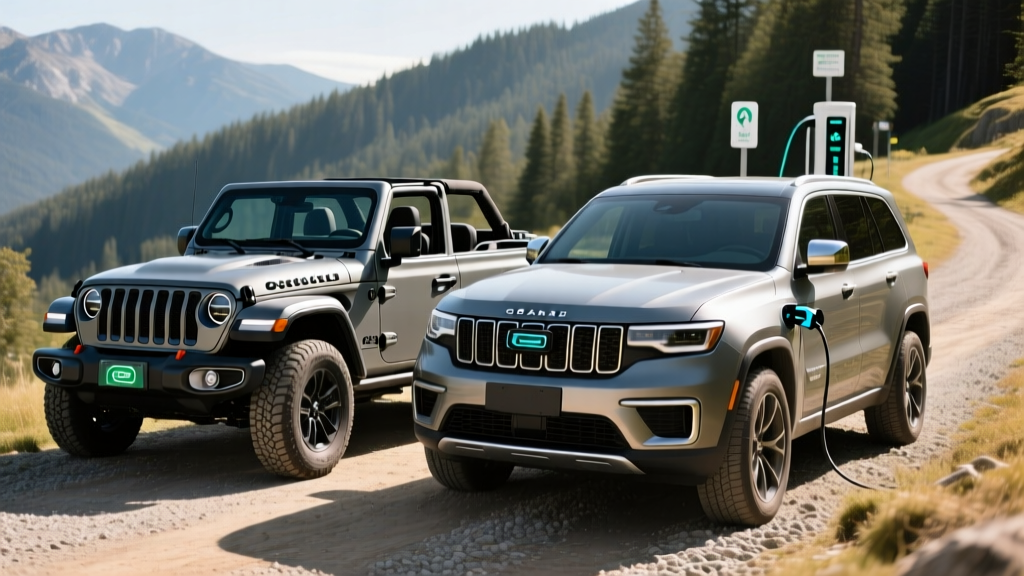
If you've been asking "does Jeep make a hybrid SUV?" the answer is yes — but with an important distinction. Jeep currently offers plug-in hybrid (PHEV) versions of two of its most popular models: the Jeep Wrangler 4xe and the Jeep Grand Cherokee 4xe. These are not conventional hybrids that simply recapture braking energy; they are plug-in systems with a usable battery pack that delivers real electric-only driving before the gasoline engine takes over.
Jeep does not currently sell a conventional hybrid (HEV) — the kind that never plugs in and operates like a Toyota RAV4 Hybrid. Instead, the 4xe (pronounced "four-by-e") badge designates Jeep's PHEV powertrain, which pairs a turbocharged gasoline engine with an electric motor and a battery you charge from a wall outlet or public charger.
HEV vs. PHEV: What's the Difference?
| Feature | Conventional Hybrid (HEV) | Plug-In Hybrid (PHEV) — Jeep 4xe |
|---|---|---|
| Plugs in? | No | Yes — Level 1 or Level 2 |
| Electric-only range | 0–2 miles at low speed | ~25 miles (EPA) |
| Battery size | 1–2 kWh | 17.3 kWh (usable ~14.8 kWh) |
| Fuel economy after battery depletes | Higher MPG combined | Moderate MPG (heavy vehicle) |
| Federal tax credit eligible | No | Up to $3,750 (see IRS rules) |
This guide covers both 4xe models, their real-world efficiency, what it costs to own one, and whether a Jeep PHEV is the right fit compared to a full EV or a gas-only SUV.
Jeep Wrangler 4xe: Specs, Range, and Efficiency
The Wrangler 4xe is the best-selling PHEV in America for good reason: it's the only plug-in hybrid that can handle serious off-road duty while offering electric-only commuting. For 2026, Jeep continues the 4xe powertrain across multiple Wrangler trims including Sport S, Willys, Sahara, Rubicon, and High Altitude.
| Spec | Value |
|---|---|
| Powertrain | 2.0L turbo I-4 + electric motor (integrated in 8-speed auto) |
| Combined horsepower | 375 hp / 470 lb-ft torque |
| Battery (gross / usable) | 17.3 kWh / ~14.8 kWh (NMC lithium-ion) |
| EPA electric-only range | 22 miles (Sahara 4dr); 21 miles (Rubicon) |
| EPA MPGe (electric + gas) | 49 MPGe combined |
| EPA MPG (gas only, battery depleted) | 20 city / 20 hwy / 20 combined |
| Total combined range | ~370 miles (electric + gas tank) |
| Level 2 charge time (0–100%) | ~2.5 hours at 7.2 kW (Level 2, 240V) |
| DC fast charging | Not available |
| 0–60 mph | |
| Towing capacity | 3,500 lbs |
| Starting MSRP (Sport S 4xe) | ~$51,790 (incl. destination) |
Real-World Range vs. EPA
The EPA rates the Wrangler 4xe Sahara at 22 miles electric-only. In real-world mixed driving at moderate temperatures, expect 18–22 miles on a full charge. Highway-speed driving at 70+ mph reduces electric range to roughly 14–16 miles. In cold weather (below 30°F), plan for 12–16 miles of electric range due to battery chemistry limitations and cabin heating demand.
Once the battery depletes, the Wrangler 4xe operates as a conventional hybrid, returning roughly 20 MPG combined. That's modest — the Wrangler's brick-like aerodynamics and 5,000+ lb curb weight work against it. Owners who rarely charge will see fuel economy similar to the gas-only 2.0L turbo Wrangler.
Jeep Grand Cherokee 4xe: The Family-Friendly PHEV
The Grand Cherokee 4xe applies the same PHEV concept to a more refined, family-oriented SUV. For 2026, it's available in Base, 30th Anniversary, Trailhawk, Overland, and Summit Reserve trims. The Trailhawk variant includes Jeep's Quadra-Drive II 4x4 system and an electronic limited-slip differential, making it the most off-road-capable Grand Cherokee ever built.
| Spec | Value |
|---|---|
| Powertrain | 2.0L turbo I-4 + electric motor (8-speed auto) |
| Combined horsepower | 375 hp / 470 lb-ft torque |
| Battery (gross / usable) | 17.3 kWh / ~14.8 kWh (NMC lithium-ion) |
| EPA electric-only range | 25 miles |
| EPA MPGe (electric + gas) | 56 MPGe combined |
| EPA MPG (gas only, battery depleted) | 23 city / 24 hwy / 23 combined |
| Total combined range | ~440 miles |
| Level 2 charge time (0–100%) | ~2.5 hours at 7.2 kW |
| DC fast charging | Not available |
| 0–60 mph | ~6.0 seconds |
| Towing capacity | 6,000 lbs (class-leading for PHEV SUVs) |
| Starting MSRP (Base 4xe) | ~$60,490 (incl. destination) |
The Grand Cherokee 4xe's superior aerodynamics and slightly lighter weight give it an edge over the Wrangler 4xe in both electric range and fuel economy after depletion. According to fueleconomy.gov, the Grand Cherokee 4xe achieves 56 MPGe combined when using both electric and gasoline power.
Charging the Jeep 4xe: What You Need to Know
Both Jeep 4xe models use a J1772 connector for AC charging and accept up to 7.2 kW on Level 2 (240V). Neither model supports DC fast charging — a notable limitation if you're accustomed to the rapid top-ups available on full EVs.
| Charging Level | Power | 0–100% Time | Notes |
|---|---|---|---|
| Level 1 (120V household) | ~1.4 kW | ~12 hours | Emergency/trickle only |
| Level 2 (240V home/public) | 7.2 kW | ~2.5 hours | Recommended for daily use |
| DC Fast Charge | N/A | N/A | Not supported on 4xe |
The 2.5-hour Level 2 charge time means most owners can fully recharge during a workday or overnight. A home Level 2 charger installation typically costs $500–$2,000 depending on your electrical panel capacity and run distance. Since the battery is only 17.3 kWh, you don't need the most expensive charger — a 32-amp or 40-amp unit is sufficient.
Jeep provides a complimentary Level 1 charging cord with each 4xe. For daily use, most owners invest in a Level 2 home charger (brands like ChargePoint Home Flex or Emporia Vue) to ensure a full battery every morning.
Pricing, Tax Credits, and Total Cost of Ownership
The 4xe premium over a gas-only Jeep is substantial — roughly $5,000–$7,000 more depending on trim. However, federal tax incentives can offset a portion of that cost.
Federal Tax Credit for Jeep 4xe (IRS §30D — 2026 Rules)
- Credit amount: Up to $3,750 for the Wrangler 4xe and Grand Cherokee 4xe (based on battery capacity ≥ 7 kWh but subject to critical mineral and battery component sourcing requirements)
- MSRP cap: SUVs must be under $80,000 MSRP — both 4xe models qualify on most trims
- Income cap: AGI must not exceed $150,000 (single) / $300,000 (joint) / $225,000 (head of household)
- Battery sourcing: A percentage of critical minerals and battery components must be sourced from the U.S. or FTA partners — this requirement tightens annually and may reduce or eliminate credit eligibility. Check the latest IRS eligible vehicle list before purchasing
- Point-of-sale transfer: You can transfer the credit to the dealer at purchase to reduce your out-of-pocket cost immediately
Note: Tax credit rules change frequently. Consult a tax professional and verify current eligibility on irs.gov before relying on any credit amount.
On the ownership-cost side, PHEV owners who charge daily and drive less than 25 miles between charges can operate almost entirely on electricity. At the U.S. average electricity rate of ~$0.16/kWh, a full charge of the 4xe's usable 14.8 kWh costs roughly $2.37 — equivalent to about $0.11 per mile. Compare that to the gas-only Wrangler at 20 MPG and $3.40/gallon, which costs about $0.17 per mile.
Battery Warranty, Reliability, and Replacement Costs
Jeep 4xe Hybrid Battery Warranty
Jeep covers the 4xe high-voltage battery with a 10-year / 100,000-mile warranty (8 years / 100,000 miles in states that don't follow California emissions standards). The warranty guarantees the battery will retain at least 70% of its original capacity during the coverage period. The conventional 12V auxiliary battery carries a separate 3-year/36,000-mile warranty.
PHEV battery degradation tends to be moderate because the system uses only a portion of the battery's total capacity (the buffer protects against full charge and full discharge cycles). Real-world data from early Wrangler 4xe owners (2021–2023 models) suggests 5–10% capacity loss over the first 3–4 years of regular use — well within the warranty threshold.
If a battery replacement is needed out of warranty, expect a cost in the range of $8,000–$12,000 including parts and labor. However, given the 10-year warranty coverage and typical PHEV battery longevity, most owners will never face this expense.
Reliability of the 4xe powertrain has been mixed. The electric motor and transmission integration have been generally trouble-free, but some owners have reported issues with the onboard charger and software glitches in the hybrid control system. Jeep has addressed several of these through recalls and TSBs. According to NHTSA, the 2022–2024 Wrangler 4xe had recalls related to battery pack assembly and high-voltage system shutdowns — worth verifying on any used example.
Who Should Buy a Jeep 4xe — And Who Shouldn't
Choose the Jeep 4xe If:
- You want electric commuting but need a serious off-road or towing-capable SUV
- Your daily commute is under 25 miles round-trip and you can charge at home
- You need 6,000-lb towing (Grand Cherokee 4xe) with better fuel economy than a gas V6
- You want to reduce fuel costs without committing to a full EV's range limitations
- You live in an area with limited public charging infrastructure
Choose a Full EV Instead If:
- You want zero gasoline expenses and lower maintenance (no oil changes, fewer moving parts)
- You have reliable home charging and your daily driving fits within 250–350 miles of EV range
- You want access to the full $7,500 federal tax credit (many EVs qualify for more than the 4xe's $3,750)
- You prioritize lower long-term operating costs over off-road capability
Choose a Gas-Only Jeep If:
- You rarely drive in stop-and-go traffic (where hybrids shine)
- You can't install a home charger and won't plug in regularly — a PHEV you never charge is just a heavier, more expensive gas car
- Your budget is tight and the 4xe premium isn't justified by your mileage
Jeep 4xe Pros
- Only PHEV with serious off-road capability (especially Wrangler Rubicon 4xe)
- 375 hp and 470 lb-ft torque — significantly more than gas-only 2.0L models
- 22–25 miles of electric-only range covers most commutes
- 6,000-lb towing on Grand Cherokee 4xe
- Eligible for partial federal tax credit (up to $3,750)
- No range anxiety — gas engine provides 370–440 total miles
Jeep 4xe Cons
- No DC fast charging — limits road-trip electric driving
- 20–23 MPG after battery depletion is unimpressive for a hybrid
- $5,000–$7,000 price premium over gas-only equivalents
- Battery pack adds ~600 lbs, reducing cargo space slightly
- Federal tax credit may be reduced or eliminated due to battery sourcing rules
- Level 1 charging alone takes 12+ hours — impractical as sole charge method
Frequently Asked Questions
How many MPG does the Jeep hybrid get?
The Grand Cherokee 4xe achieves 56 MPGe combined when using both electric and gas power, and 23 MPG combined after the battery is depleted. The Wrangler 4xe rates at 49 MPGe combined and 20 MPG combined on gas alone. These are EPA figures from fueleconomy.gov. In real-world city driving with regular charging, many owners report using very little gasoline during the workweek.
How far can the Jeep 4xe go on electric only?
The EPA rates the Grand Cherokee 4xe at 25 miles of electric-only range and the Wrangler 4xe at 21–22 miles depending on trim. Real-world results vary: expect 18–22 miles in moderate conditions, dropping to 12–16 miles in freezing temperatures or at sustained highway speeds.
Does the Jeep 4xe qualify for a tax credit?
The Jeep 4xe models may qualify for a federal tax credit of up to $3,750 under IRS §30D, depending on current battery sourcing requirements, your income, and the vehicle's MSRP. The credit amount has been reduced from the maximum $7,500 due to critical mineral and battery component sourcing rules that tighten each year. Always verify on the IRS eligible vehicle list before purchasing.
Is the Jeep 4xe reliable, and what does a battery replacement cost?
The 4xe electric drivetrain components have been generally reliable, though some model years have had software and onboard charger issues addressed through recalls. The high-voltage battery is covered for 10 years / 100,000 miles with a 70% capacity retention guarantee. Out-of-warranty battery replacement costs are estimated at $8,000–$12,000, but most owners will never need this service.
Hybrid vs. PHEV vs. EV — which is right for me?
A conventional hybrid (HEV) like the Toyota RAV4 Hybrid never plugs in and offers 35–40 MPG consistently — ideal if you can't charge at home. A PHEV like the Jeep 4xe offers 20–25 miles of electric driving plus a gas engine for longer trips — ideal if you can charge at home but need unlimited range and off-road or towing capability. A full EV (BEV) like the Ford F-150 Lightning or Rivian R1S eliminates gasoline entirely with 250–350+ miles of range — ideal if you have home charging and want the lowest operating costs. The PHEV is the bridge between the two worlds, and Jeep's 4xe lineup is specifically designed for buyers who refuse to compromise on capability.
Can I charge the Jeep 4xe at a public DC fast charger?
No. The Jeep Wrangler 4xe and Grand Cherokee 4xe do not support DC fast charging. They can only accept AC power through a J1772 connector at up to 7.2 kW on Level 2. You can use public Level 2 chargers (found at shopping centers, workplaces, and parking garages), but you cannot use CCS or NACS DC fast-charging stations.
Does Jeep make a conventional hybrid (non-plug-in)?
As of the 2026 model year, Jeep does not offer a conventional hybrid (HEV) in the U.S. market. All Jeep hybrid offerings are plug-in hybrids wearing the 4xe badge. If you want a Jeep with improved fuel economy but no plug, your closest option is the mild-hybrid eTorque system that was previously offered on the gas-only Wrangler and Grand Cherokee — though this provides only marginal efficiency gains and is not a true hybrid system.