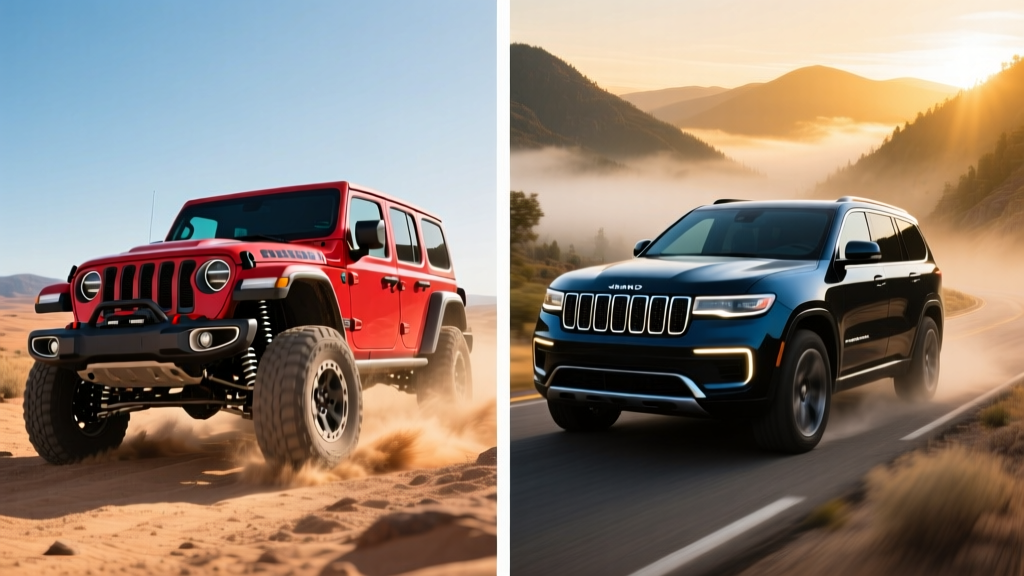
If you want off-road capability with some electric efficiency, Jeep's 4xe plug-in hybrid lineup is one of the few options that genuinely bridges both worlds. For 2026, the brand offers two core PHEV models: the iconic Wrangler 4xe and the more family-oriented Grand Cherokee 4xe. Neither is a conventional hybrid — both are plug-in hybrids (PHEVs) with meaningful electric-only range, larger batteries, and the ability to drive emissions-free on short trips before the gas engine kicks in.
This guide breaks down exact EPA figures, real-world expectations, battery specs, tax-credit eligibility, and who should actually consider Jeep hybrid cars versus a full EV or a standard gas model.
HEV vs PHEV: What Jeep Actually Offers
Before diving into specs, it's critical to understand what you're buying. Jeep does not currently sell a conventional hybrid (HEV) — the kind that recharges its small battery solely through regenerative braking and the engine, like a Toyota RAV4 Hybrid. Every electrified Jeep is a plug-in hybrid (PHEV) badged as "4xe."
| Feature | Conventional Hybrid (HEV) | Jeep 4xe Plug-In Hybrid (PHEV) |
|---|---|---|
| Battery Size | 1–2 kWh | 17.3 kWh (Wrangler) / 17.3 kWh (Grand Cherokee) |
| Electric-Only Range | 0 miles (assist only) | 22–26 miles |
| Needs Plug-In Charging? | No | Yes (for EV range; runs as hybrid if not plugged in) |
| Federal Tax Credit | No | Up to $3,750 (sourcing-dependent) |
| Best For | Drivers who can't charge at home | Drivers with home/workplace charging + short commutes |
The practical takeaway: if you can't plug in at home or work regularly, a 4xe still functions as a hybrid once the battery depletes, but you'll miss out on the electric-only miles and the bulk of the efficiency benefit. You won't be stranded — the gas engine takes over seamlessly.
2026 Jeep Wrangler 4xe: Specs, Range, and Efficiency
The Wrangler 4xe pairs a 2.0-liter turbocharged inline-four with two electric motor-generators and a 17.3 kWh lithium-ion battery pack (NMC chemistry). Total system output is 375 horsepower and 470 lb-ft of torque — more torque than the V-6 Wrangler Rubicon 392 in some configurations. Power routes through an 8-speed automatic and Jeep's proven 4x4 systems.
| Spec | 2026 Wrangler 4xe |
|---|---|
| EPA Electric-Only Range | 22 miles |
| EPA Combined MPGe (EV+Gas) | 49 MPGe |
| EPA MPG (Gas-Only, Combined) | 20 MPG |
| EPA City / Highway (Gas-Only) | 20 city / 20 highway |
| Total Combined Range | ~370 miles |
| Battery Capacity | 17.3 kWh (usable ~15 kWh) |
| Combined Horsepower | 375 hp |
| Combined Torque | 470 lb-ft |
| 0–60 mph | ~6.0 seconds |
| Level 2 Charging (240V) | ~2 hours (7.2 kW onboard charger) |
| DC Fast Charging | Not available |
| Base MSRP (Willys 4xe) | $51,790 |
| Rubicon 4xe MSRP | $57,790 |
2026 Jeep Grand Cherokee 4xe: Specs, Range, and Efficiency
The Grand Cherokee 4xe uses the same 2.0L turbo PHEV powertrain and 17.3 kWh battery, but the more aerodynamic, car-like crossover shape yields noticeably better efficiency. Total output is identical at 375 hp and 470 lb-ft. It's available in multiple trims from the base 4xe up to the Trailhawk 4xe for off-road-oriented buyers.
| Spec | 2026 Grand Cherokee 4xe |
|---|---|
| EPA Electric-Only Range | 26 miles |
| EPA Combined MPGe (EV+Gas) | 56 MPGe |
| EPA MPG (Gas-Only, Combined) | 23 MPG |
| EPA City / Highway (Gas-Only) | 23 city / 24 highway |
| Total Combined Range | ~440 miles |
| Battery Capacity | 17.3 kWh (usable ~15 kWh) |
| Combined Horsepower | 375 hp |
| Combined Torque | 470 lb-ft |
| 0–60 mph | ~6.0 seconds |
| Level 2 Charging (240V) | ~2 hours (7.2 kW onboard charger) |
| DC Fast Charging | Not available |
| Base MSRP | $54,995 |
| Trailhawk 4xe MSRP | $61,995 |
The Grand Cherokee 4xe's extra four miles of EV range and 7 MPGe advantage come down to lower weight, better aero, and a more efficient driveline calibration. For daily commutes under 25 miles, many owners report using little to no gasoline during the work week.
Side-by-Side: Wrangler 4xe vs Grand Cherokee 4xe
| Attribute | Wrangler 4xe | Grand Cherokee 4xe | Winner |
|---|---|---|---|
| EV Range | 22 mi | 26 mi | Grand Cherokee |
| MPGe | 49 | 56 | Grand Cherokee |
| Gas-Only MPG | 20 combined | 23 combined | Grand Cherokee |
| Off-Road Capability | Solid axles, sway-bar disconnect | Air suspension, Selec-Terrain | Wrangler (serious trails) |
| Cargo Space | 31.7 cu ft (behind rear seat) | 37.7 cu ft | Grand Cherokee |
| Towing Capacity | 3,500 lbs | 6,000 lbs | Grand Cherokee |
| Starting Price | $51,790 | $54,995 | Wrangler (by ~$3,200) |
| Removable Roof/Doors | Yes | No | Wrangler |
| Refinement / Ride | Truck-like, noisy at speed | Quiet, composed | Grand Cherokee |
Charging at Home: What to Expect
Neither Jeep 4xe supports DC fast charging — this is a Level 1 and Level 2 proposition only. The 7.2 kW onboard charger is adequate for overnight replenishment but means you won't be topping up quickly on road trips.
| Charging Level | Power | Time (0–100%) | Practical Notes |
|---|---|---|---|
| Level 1 (120V household) | ~1.4 kW | ~12 hours | Works for overnight if you drive <20 EV miles/day |
| Level 2 (240V, 32A) | 7.2 kW | ~2 hours | Recommended; standard home wall charger |
| DC Fast Charge | N/A | N/A | Not supported on any Jeep 4xe |
For most 4xe owners, a Level 2 home charger (typically $500–$700 for equipment, plus $500–$1,500 for professional installation depending on electrical panel proximity) is the sweet spot. You'll wake up to a full battery every morning, which is all you need given the 22–26 mile EV range. A standard 120V outlet will technically work but requires a full 12-hour cycle — fine for low-mileage days, frustrating if you forget to plug in.
One important note: kW (kilowatts) measures charging power — how fast energy flows in. kWh (kilowatt-hours) measures battery capacity — how much energy is stored. The 4xe's 17.3 kWh battery at a 7.2 kW charge rate fills in roughly 2.4 hours from empty (17.3 ÷ 7.2 ≈ 2.4), though onboard losses push real-world time closer to 2.5–3 hours.
Federal Tax Credits and Pricing Reality
The federal §30D Clean Vehicle Credit applies to qualifying PHEVs, but the rules have tightened significantly. For 2026, the key eligibility factors are:
- Battery sourcing requirements: Critical minerals and battery components must meet escalating domestic-content thresholds. Jeep 4xe models have historically qualified for a partial credit ($3,750), not the full $7,500, due to battery component sourcing.
- MSRP caps: SUVs and trucks must have an MSRP at or below $80,000. All 4xe trims clear this bar.
- Buyer income caps: AGI must not exceed $150,000 (single) or $300,000 (joint). Check your prior-year or current-year AGI — whichever is lower.
- Point-of-sale transfer: You can now transfer the credit to the dealer at purchase, reducing your out-of-pocket cost immediately rather than waiting for tax season.
- Manufacturer sales cap: Stellantis (Jeep's parent) has surpassed the 200,000-vehicle threshold, but the cap was removed under current law — so 4xe models remain eligible.
Based on current fueleconomy.gov data, both the Wrangler 4xe and Grand Cherokee 4xe have typically qualified for $3,750 in federal credit (half the maximum), reflecting the battery component sourcing rules. Always verify with your tax professional and the IRS's official credit calculator before purchasing — rules shift annually.
After a $3,750 credit, the effective starting prices drop to roughly $48,040 for the Wrangler 4xe and $51,245 for the Grand Cherokee 4xe. Some states offer additional rebates for PHEVs (California, Colorado, and others), but amounts and eligibility vary by jurisdiction — check your state energy office for current programs.
Battery Longevity, Warranty, and Replacement Cost
Real-world degradation data for Jeep 4xe packs is still maturing — the first Wrangler 4xes hit roads for the 2021 model year, giving us roughly five years of field data. Early reports from owner forums and fleet data suggest 5–8% capacity loss over the first 100,000 miles, which is within normal NMC battery behavior. The relatively small 17.3 kWh pack sees frequent charge cycles (many owners drain and recharge daily), but the battery management system maintains conservative charge buffers to protect longevity.
If the battery does need replacement outside of warranty, expect a cost in the range of $8,000–$12,000 for the pack itself, plus labor. This is a significant expense, though it's comparable to a major engine or transmission repair on a conventional vehicle. Most owners will never face this — the 8-year/100,000-mile warranty covers the vast majority of the vehicle's useful life for typical buyers.
The 12V auxiliary battery (a separate, conventional lead-acill or AGM battery that powers electronics when the high-voltage system is off) is a more common replacement item, typically every 3–5 years at $200–$350 installed.
Who Should Buy a Jeep 4xe — And Who Shouldn't
- You can charge at home (Level 1 or 2) and your daily commute is under 25 miles
- You want genuine off-road capability (especially Wrangler Rubicon 4xe)
- You need a vehicle that can tow (Grand Cherokee 4xe: 6,000 lbs)
- You want to reduce gas consumption without range anxiety on road trips
- You value the instant electric torque for low-speed trail crawling
- You drive under 250 miles daily and have reliable charging access
- You want zero tailpipe emissions and minimal maintenance
- You can access the full $7,500 federal credit on a qualifying BEV
- You don't need serious off-road or heavy-towing capability
- You can't charge at home or work
- You rarely drive short commutes (the PHEV premium won't pay back)
- You want the lowest possible purchase price
The 4xe makes the most financial sense when your daily driving falls within the electric-only range. A driver commuting 20 miles round-trip, five days a week, could use roughly 5 gallons of gasoline per month instead of 15–20 in a gas-only Wrangler — saving $50–$100 monthly depending on local fuel prices. Over a 5-year ownership period, that's $3,000–$6,000 in fuel savings, partially offsetting the 4xe's higher purchase price.
However, if you regularly drive 60+ miles per day and rarely plug in, the 4xe functions as a heavy hybrid with modest efficiency gains. The gas-only combined MPG of 20 (Wrangler) or 23 (Grand Cherokee) isn't bad for these vehicle classes, but it's not dramatically better than their non-hybrid counterparts. The value proposition shrinks without regular charging.
- 22–26 miles of zero-emission electric driving
- 375 hp / 470 lb-ft — strong acceleration and trail torque
- No range anxiety — gas engine covers long trips
- Retains Jeep's off-road DNA (especially Wrangler)
- Eligible for partial federal tax credit ($3,750)
- No DC fast charging — slow road-trip replenishment
- Heavy curb weight hurts gas-only MPG
- $50K+ starting price before incentives
- EV range drops noticeably in cold weather
- Only partial $3,750 credit, not the full $7,500
Frequently Asked Questions
How many MPG does a Jeep hybrid get?
The 2026 Wrangler 4xe achieves 49 MPGe (combined, using electric + gas) and 20 MPG combined once the battery is depleted. The Grand Cherokee 4xe rates at 56 MPGe combined and 23 MPG gas-only. Real-world city driving with a charged battery often exceeds EPA estimates because regenerative braking recovers more energy at lower speeds. Highway driving at 75+ mph will fall short — expect 17–18 MPG gas-only in a Wrangler at interstate speeds.
How far can a Jeep 4xe go on electric only?
The EPA rates the Wrangler 4xe at 22 miles electric-only and the Grand Cherokee 4xe at 26 miles. Real-world range varies: cold weather (below freezing) can reduce EV range by 20–30%, while gentle city driving in mild temperatures may add 2–3 miles. Neither vehicle supports DC fast charging, so road-trip EV replenishment isn't practical — plan to use gasoline on longer drives.
Hybrid vs PHEV vs EV — which fits me?
A conventional hybrid (HEV) suits drivers who can't charge at home and want better MPG without behavior change. A PHEV like the Jeep 4xe fits drivers with home charging and short commutes who also need long-range flexibility for road trips. A full EV (BEV) is ideal for drivers who can charge at home, drive under 250 miles daily, and want the lowest operating costs with zero tailpipe emissions. If you regularly tow over 5,000 lbs or tackle serious off-road trails, the 4xe PHEV is a stronger fit than current BEVs in the Jeep lineup.
Is the Jeep 4xe reliable, and what does a battery replacement cost?
The 4xe powertrain has proven reasonably reliable since its 2021 introduction, though early model years saw some software-related recalls and minor electrical issues tracked by NHTSA. The high-voltage battery is warrantied for 8 years/100,000 miles (10 years/150,000 in CARB states). Out-of-warranty battery replacement runs $8,000–$12,000. Most owners will not need this — degradation data shows 5–8% capacity loss over 100,000 miles, well within the warranty's 70% retention threshold.
Does the Jeep 4xe qualify for a tax credit?
Both the Wrangler 4xe and Grand Cherokee 4xe currently qualify for a $3,750 federal tax credit under IRS §30D rules, not the full $7,500. The reduction reflects battery component sourcing requirements. You must also meet income caps ($150K single / $300K joint AGI) and the vehicle MSRP must be under $80,000 (all 4xe trims qualify). The credit can be transferred to the dealer at point of sale for an immediate price reduction. Always verify current eligibility on the IRS Clean Vehicle Credit page and consult a tax professional — rules change annually.
Can I charge a Jeep 4xe at a Tesla Supercharger?
No. Jeep 4xe models use a standard J1772 connector for Level 2 AC charging and do not support DC fast charging at all. Tesla Superchargers (NACS connectors) provide DC fast charging, which the 4xe hardware cannot accept. You can charge at any public Level 2 station with a J1772 connector — ChargePoint, EVgo, and most workplace chargers will work.