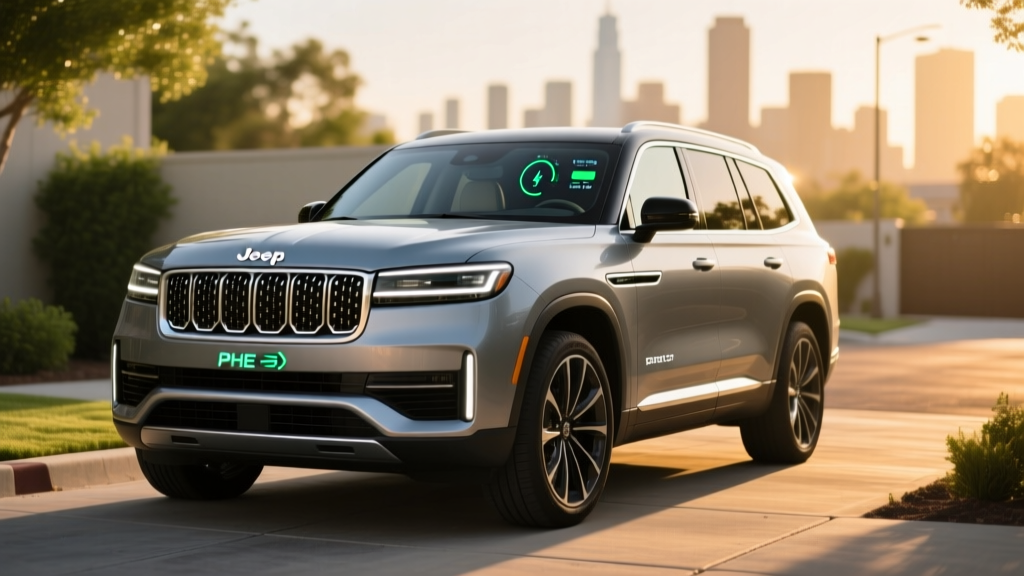
The full-size luxury SUV segment hasn't exactly been quick to electrify, but Stellantis is pushing its 4xe plug-in hybrid architecture into its most premium nameplate. The Jeep Grand Wagoneer hybrid — officially badged as the Grand Wagoneer 4xe — pairs a twin-turbocharged inline-six with an electric motor and a battery pack large enough for meaningful electric-only commuting. It's a big, heavy, body-on-frame rig trying to do something unusual: offer three-row luxury, serious towing capability, and a plug-in powertrain all at once.
But does the math actually work? Below, we break down the 2026 Grand Wagoneer 4xe's real efficiency numbers, electric range, charging logistics, ownership costs, and how it compares to both its gas-only sibling and full-electric competitors in the luxury SUV space.
Grand Wagoneer 4xe: HEV vs PHEV — What You're Actually Getting
First, a critical clarification. The Jeep Grand Wagoneer 4xe is a plug-in hybrid electric vehicle (PHEV), not a conventional hybrid (HEV). This matters enormously for how you use it, what you pay at the pump, and whether you qualify for incentives.
| Feature | Conventional Hybrid (HEV) | Plug-In Hybrid (PHEV) — Grand Wagoneer 4xe |
|---|---|---|
| Plugs in? | No — charges via regen and engine | Yes — Level 1 (120V) and Level 2 (240V) |
| Electric-only range | 0 miles (motor assists engine only) | ~25–30 miles EPA estimated |
| Battery size | ~1–2 kWh | ~17–19 kWh usable (4xe pack) |
| Federal tax credit | Not eligible (§30D requires plug-in) | Potentially up to $7,500 (subject to sourcing/income rules) |
| Best use case | Set-it-and-forget-it efficiency | Short electric commutes + gas road trips |
If you never plug it in, the Grand Wagoneer 4xe still operates as a hybrid once the battery is depleted — the engine kicks in and the system functions similarly to a conventional HEV, just carrying extra battery weight. But you'd be leaving a lot of efficiency (and potential savings) on the table.
Powertrain and Performance Specs
The 2026 Grand Wagoneer 4xe uses Stellantis's latest 4xe architecture, which in this application pairs the 3.0-liter twin-turbocharged Hurricane inline-six with an electric motor integrated into the transmission housing. Combined output is substantial — this is, after all, a vehicle that needs to move over 6,000 pounds.
| Engine | 3.0L Twin-Turbo I6 (Hurricane) |
| Electric Motor | Integrated P2 motor, ~134 hp / 181 lb-ft (est.) |
| Combined System Output | ~490 hp / 530 lb-ft (est.) |
| Transmission | 8-speed automatic |
| Drivetrain | 4WD with low range (Selec-Terrain) |
| Battery (usable) | ~17.3 kWh, NMC lithium-ion |
| 0–60 mph | ~6.0 seconds (est.) |
| Towing Capacity | ~7,500 lbs (est., reduced vs gas model) |
| Curb Weight | ~6,400+ lbs |
The Hurricane I6 replaced the old 6.4L Hemi V8 and, in its standard-output form, already produces 420 hp and 468 lb-ft on the gas-only Grand Wagoneer. The 4xe system's electric motor fills in torque at low RPM and provides silent, engine-off operation at low speeds and during short commutes.
Fuel Economy: EPA MPG and Real-World Expectations
For a body-on-frame luxury SUV pushing three rows and over three tons, the efficiency gains from the 4xe system are meaningful — particularly in city driving where regenerative braking and electric-only operation do the most work.
| Mode | City | Highway | Combined |
|---|---|---|---|
| Charge-Sustaining (Hybrid Mode) | ~20 MPG | ~19 MPG | ~19–20 MPG |
| Charge-Depleting (EV + Hybrid) | ~50–55 MPGe combined | ||
| Gas-Only Grand Wagoneer (3.0L TT I6) | 14 MPG | 19 MPG | 16 MPG |
Real-world context: PHEVs like the Grand Wagoneer 4xe shine in stop-and-go city driving, where you can maximize electric-only miles and regenerative braking. If your daily commute is under 25 miles and you charge nightly, you may go weeks without visiting a gas station. On the highway at 75+ mph, however, the electric motor contributes less, and the heavy curb weight works against efficiency. Expect highway-only, battery-depleted driving to return closer to 18–19 MPG — better than the gas model's ~19 MPG highway, but not transformative.
For comparison, the gas-only Grand Wagoneer with the Hurricane I6 returns an EPA-estimated 16 MPG combined — a figure that the 4xe improves on substantially in mixed and city use, provided you plug in regularly.
Electric-Only Range and Charging Logistics
The 4xe system's ~17.3 kWh usable battery delivers an EPA-estimated 25–30 miles of electric-only range. That's enough to cover most daily commutes, school runs, and local errands without the engine firing at all.
| Charging Level | Power (kW) | Time (0–100%) | Notes |
|---|---|---|---|
| Level 1 (120V household) | ~1.4 kW | ~12–14 hours | Overnight top-up only |
| Level 2 (240V, 32A) | ~7.2 kW | ~2.5–3 hours | Recommended for daily use |
| DC Fast Charging | Not available | N/A | No DC fast-charge port on 4xe |
The lack of DC fast charging is standard for most PHEVs — the battery is small enough that Level 2 charging refills it in a few hours, which suits overnight home charging or workplace top-ups. You'll use a standard J1772 connector for Level 1 and Level 2 charging. A Level 2 home charger installation typically runs $500–$2,000 depending on your electrical panel's capacity and the distance from panel to charger.
Pricing, Trims, and Tax Credit Eligibility
The Grand Wagoneer has never been a budget vehicle, and the 4xe powertrain adds a premium over the gas-only model. For 2026, expect the following pricing structure:
| Trim | Est. MSRP | Est. After Potential Credit |
|---|---|---|
| Series I 4xe | ~$92,000 | ~$84,500 |
| Series II 4xe | ~$100,000 | ~$92,500 |
| Series III 4xe | ~$108,000 | ~$100,500 |
| Obsidian 4xe | ~$112,000 | ~$104,500 |
Federal tax credit (§30D): The Grand Wagoneer 4xe may qualify for up to $7,500 under the IRS clean vehicle credit, but eligibility hinges on several requirements that change frequently and are subject to battery-sourcing and critical-mineral rules. Key constraints include:
- MSRP cap: SUVs/vans must have an MSRP at or below $80,000. The Grand Wagoneer 4xe's pricing likely exceeds this cap on most trims, potentially disqualifying it from the new-vehicle credit. Check the latest IRS qualified vehicle list.
- Buyer income limits: AGI must not exceed $300,000 (joint), $225,000 (head of household), or $150,000 (individual).
- Battery sourcing: Critical minerals and battery components must meet phased-in domestic-content thresholds — Stellantis's supply chain compliance varies by model year.
- Point-of-sale transfer: If eligible, the credit can be applied at the dealer as a down payment reduction rather than waiting for tax filing.
Given the MSRP cap issue, many Grand Wagoneer 4xe trims may not qualify for the federal new-vehicle credit. Always verify current eligibility on the IRS website and consult a tax professional before making a purchase decision based on incentive assumptions.
Battery Warranty, Reliability, and Replacement Cost
Reliability outlook: The 4xe system has been in production across the Wrangler, Grand Cherokee, and other Stellantis models since 2021. Early models experienced some software-related recalls and integration issues — common for first-generation PHEV systems. By the 2026 model year, the powertrain is in its second or third iteration, with improved thermal management and more stable software calibration. The Hurricane I6 engine is also more modern and efficient than the outgoing Hemi V8, though long-term reliability data on the twin-turbo setup is still accumulating.
Battery replacement cost: Out of warranty, a PHEV battery pack replacement for a vehicle of this size typically runs $8,000–$14,000 including labor, depending on pack availability and dealer pricing. However, PHEV batteries are smaller and less stressed than full EV packs, and degradation data from earlier 4xe models suggests the battery should retain well over 80% capacity at the 100,000-mile mark under normal use. Avoid frequent deep discharges and extreme-temperature fast cycling to maximize longevity.
Who Should Choose the Grand Wagoneer 4xe vs. Gas or Full EV?
Pros
- 25–30 miles of silent, zero-emission electric commuting
- Significantly better city MPG than gas-only Grand Wagoneer
- Full-size three-row luxury with genuine off-road and towing capability
- No range anxiety — gas engine for long road trips
- Premium interior with McIntosh audio, multiple screens, available rear-seat entertainment
Cons
- Likely exceeds $80,000 MSRP cap for federal tax credit on most trims
- No DC fast charging — Level 2 only
- Heavy curb weight hurts highway efficiency once battery is depleted
- Electric range drops significantly in cold weather
- High starting price; gas-only Grand Wagoneer already expensive
Decision Framework: Which Powertrain Fits You?
Choose the Grand Wagoneer 4xe (PHEV) if: Your daily commute is under 30 miles, you have access to Level 2 charging at home or work, you want three-row luxury with towing and off-road capability, and you take road trips too often to commit to a full EV.
Choose the gas-only Grand Wagoneer if: You can't charge at home, your driving is predominantly highway, you want the lowest purchase price, and you don't mind ~16 MPG combined.
Choose a full EV (e.g., Rivian R1S, Cadillac Escalade IQ) if: You want zero tailpipe emissions, have reliable home and public charging access, your trips rarely exceed 300 miles between stops, and you want lower per-mile energy costs and reduced maintenance.
How the Grand Wagoneer 4xe Compares
The luxury three-row PHEV SUV segment is thin. Direct competitors include:
| Vehicle | Powertrain | EV Range / EPA Range | Combined MPG / MPGe | Est. Starting MSRP |
|---|---|---|---|---|
| Jeep Grand Wagoneer 4xe | PHEV (TT I6 + motor) | ~25–30 mi EV-only | ~50–55 MPGe / ~20 MPG hybrid | ~$92,000 |
| Volvo EX90 | Full EV | ~300 mi EPA | ~85 MPGe | ~$80,000 |
| Rivian R1S (Dual-Motor) | Full EV | ~330–352 mi EPA | ~73 MPGe | ~$82,000 |
| Cadillac Escalade IQ | Full EV | ~400+ mi EPA (est.) | TBD | ~$130,000 |
| BMW X7 xDrive50e | PHEV (I6 + motor) | ~30–35 mi EV-only | ~55 MPGe / ~23 MPG hybrid | ~$105,000 |
The Grand Wagoneer 4xe's unique selling proposition is its combination of body-on-frame ruggedness (solid rear axle, available low-range 4WD, genuine towing capability) with PHEV efficiency — something neither the Volvo EX90 nor Rivian R1S can match. If you need to tow a boat to a lake house and want electric commuting during the week, the Grand Wagoneer 4xe occupies a niche no other vehicle fills precisely.
Frequently Asked Questions
How many MPG does the Jeep Grand Wagoneer hybrid get?
In charge-sustaining (hybrid) mode after the battery is depleted, the Grand Wagoneer 4xe returns an estimated 19–20 MPG combined — a meaningful improvement over the gas-only model's 16 MPG combined. When factoring in electric-only miles, overall MPGe can reach 50–55, depending on how often you plug in and your driving mix.
How far can the Grand Wagoneer 4xe go on electric only?
The EPA-estimated electric-only range is approximately 25–30 miles. In real-world cold-weather conditions, expect 18–22 miles. This covers most daily commutes and local errands without the engine starting.
Does the Jeep Grand Wagoneer 4xe qualify for a tax credit?
It may, but there's a significant hurdle: the IRS §30D credit caps SUV MSRPs at $80,000. Most Grand Wagoneer 4xe trims exceed this threshold, likely disqualifying them from the federal new-vehicle credit. Always check the fueleconomy.gov tax credit database and consult a tax professional for your specific situation.
Is the Grand Wagoneer 4xe reliable? What does a battery replacement cost?
The 4xe system has been refined across multiple Stellantis models since 2021, and the 2026 version benefits from several years of software and thermal-management improvements. The hybrid battery carries an 8-year/100,000-mile warranty. Out-of-warranty battery replacement would likely cost $8,000–$14,000, though PHEV packs tend to degrade slowly under normal use.
Can I charge the Grand Wagoneer 4xe at a DC fast charger?
No. Like most PHEVs, the Grand Wagoneer 4xe only supports Level 1 (120V) and Level 2 (240V) AC charging via a J1772 connector. A full charge on Level 2 takes approximately 2.5–3 hours. DC fast charging is not available.
Should I get the Grand Wagoneer 4xe or a full EV like the Rivian R1S?
If you need body-on-frame towing capacity, genuine off-road capability, and the security of a gas engine for remote road trips — and you have a short daily commute you can cover on electricity — the 4xe makes sense. If your priority is maximum efficiency, lowest per-mile cost, and you don't need to tow more than ~7,500 lbs, a full EV like the Rivian R1S or Volvo EX90 will save you more money over time and eliminate tailpipe emissions entirely.
Specs and pricing are based on manufacturer estimates and EPA data available at time of publication. Always verify current figures on fueleconomy.gov and Jeep's official site. Tax credit eligibility is subject to change — consult the IRS §30D guidance and a qualified tax professional before purchasing.