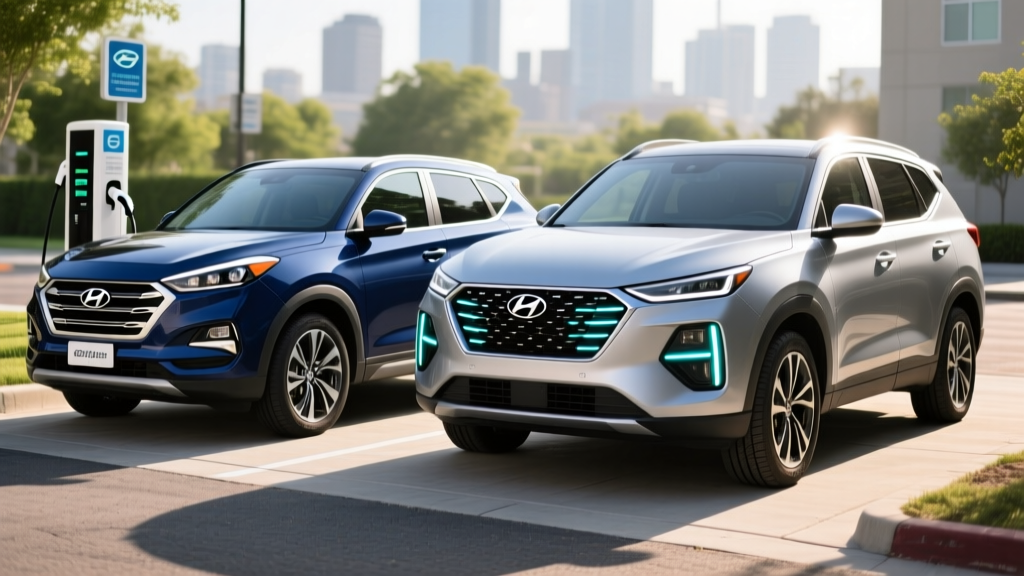
If you're searching for a Hyundai hybrid SUV, you have two strong candidates in the 2026 lineup: the compact Hyundai Tucson Hybrid (and its Tucson Plug-in Hybrid sibling) and the midsize three-row Hyundai Santa Fe Hybrid. Both use Hyundai's turbocharged hybrid powertrains, but they serve very different buyers — and the gap between the conventional hybrid (HEV) and plug-in hybrid (PHEV) versions matters more than most shoppers realize.
This guide breaks down every key spec — EPA MPG, electric-only range, battery size, charging, pricing, and federal tax-credit eligibility — so you can pick the right Hyundai hybrid SUV without guessing.
HEV vs PHEV: What's the Actual Difference?
Hyundai sells both conventional hybrids and plug-in hybrids under the Tucson nameplate. The Santa Fe is offered as a conventional hybrid only for 2026. Here's the core distinction:
Conventional Hybrid (HEV)
- No plug required. The small battery recharges through regenerative braking and the gasoline engine.
- Electric-only driving: Brief, low-speed assists — typically under 1 mile at very low speeds.
- Fuel economy advantage: Strongest in stop-and-go city driving where regen captures the most energy.
- No federal tax credit under current IRS §30D rules.
Plug-In Hybrid (PHEV)
- Plugs in like an EV. Larger battery (13.8 kWh usable in the Tucson PHEV) that you charge at home or at public Level 2 stations.
- Electric-only range: 32 miles EPA in the Tucson PHEV — enough for many daily commutes without burning gas.
- Operates as a hybrid once the battery depletes, so you never get stranded.
- May qualify for the §30D federal tax credit (up to $7,500, subject to income, MSRP caps, and battery-sourcing rules — details below).
Bottom line: If you can charge at home and your daily driving is under 30 miles, the PHEV gives you EV-like commuting with gas-engine backup for road trips. If you lack home charging access, the HEV delivers strong MPG with zero behavior change.
2026 Hyundai Tucson Hybrid: MPG, Range, and Powertrain
The Tucson Hybrid pairs a 1.6-liter turbocharged four-cylinder engine with an electric motor and a 6-speed automatic transmission. Combined output is 231 horsepower and 258 lb-ft of torque, routed through HTRAC all-wheel drive.
| Spec | Value |
|---|---|
| EPA MPG (City / Highway / Combined) | 38 / 38 / 38 |
| Powertrain | 1.6L turbo I4 + electric motor |
| Combined Horsepower | 231 hp |
| Drivetrain | HTRAC AWD (standard) |
| Battery | 1.49 kWh (lithium-ion polymer) |
| Cargo Volume | 38.7 cu ft (rear seats up) |
| Starting MSRP (Blue trim) | ~$34,500 |
| Federal Tax Credit | Not eligible (HEV) |
Per fueleconomy.gov, the Tucson HEV's 38 MPG combined is among the best in the compact hybrid SUV segment. In real-world driving, owners frequently report exceeding the EPA city figure — hybrids thrive in stop-and-go traffic where regenerative braking recaptures energy constantly. Expect 39–42 MPG in heavy urban driving and closer to 34–36 MPG on sustained highway trips at 75+ mph, where the engine does more of the work alone.
2026 Hyundai Tucson Plug-In Hybrid: Electric Range and Charging
The Tucson PHEV uses the same 1.6L turbo engine but pairs it with a more powerful electric motor (66.9 kW / 90 hp) and a significantly larger 13.8 kWh battery pack. Combined system output rises to 261 horsepower.
| Spec | Value |
|---|---|
| EPA Electric-Only Range | 32 miles |
| EPA MPGe (Electric + Gas) | 80 MPGe |
| EPA MPG (Gas-Only, Charge-Depleted) | 35 combined |
| Total Combined Range | ~400 miles |
| Powertrain | 1.6L turbo I4 + 66.9 kW motor |
| Combined Horsepower | 261 hp |
| Battery (Usable) | 13.8 kWh |
| Level 2 Charge Time (0–100%) | ~1 hr 45 min (at 7.2 kW) |
| DC Fast Charging | Not available |
| Starting MSRP (SEL trim) | ~$40,200 |
| Federal Tax Credit | Up to $7,500 (§30D, subject to eligibility) |
Real-World Electric Range Note: The EPA rates the Tucson PHEV at 32 miles electric-only. In mild weather (55–75°F) on flat suburban roads, expect 30–34 miles. In cold weather (below 35°F) or at sustained highway speeds above 65 mph, that drops to roughly 22–26 miles. Cabin heating draws heavily from the battery in winter — using heated seats instead of max HVAC can claw back 2–3 miles of range.
The Tucson PHEV does not support DC fast charging. You'll charge on a standard 120V outlet (Level 1, roughly 12 hours for a full charge) or a 240V Level 2 home charger (~1 hr 45 min). For most PHEV owners, plugging in overnight on Level 2 is the standard routine — you wake up to a full battery every morning.
2026 Hyundai Santa Fe Hybrid: Three-Row Efficiency
If you need three rows, the Santa Fe Hybrid is Hyundai's answer. It uses a 1.6L turbo hybrid system tuned for more torque, producing 230 horsepower combined. Unlike the Tucson, the Santa Fe is not offered as a PHEV for the 2026 model year.
| Driving Cycle | EPA MPG |
|---|---|
| City | 35 |
| Highway | 31 |
| Combined | 33 |
With a starting MSRP around $39,500 (SEL trim), the Santa Fe Hybrid undercuts hybrid three-row competitors like the Toyota Highlander Hybrid on price while offering a more modern interior. Real-world fuel economy tracks close to EPA in mixed driving; expect 31–34 MPG combined in typical suburban/highway use. City-heavy drivers may see 35–37 MPG thanks to regenerative braking at lower speeds.
The Santa Fe Hybrid's cargo volume is 14.4 cu ft behind the third row and 40.5 cu ft with the third row folded — practical for families but tighter than the Tucson HEV's 38.7 cu ft with only two rows to manage.
Hyundai Hybrid Battery Warranty and Reliability
Hybrid battery longevity is the top concern for buyers switching from conventional gas vehicles. Hyundai addresses this directly with one of the strongest warranties in the industry.
Hyundai Hybrid / PHEV Battery Warranty
- Original owner: 10 years / 100,000 miles (hybrid battery and hybrid system components)
- Subsequent owners: In many states, the 10-year/100,000-mile warranty transfers; in CARB states, it's mandated. Verify with your dealer.
- Hybrid system components: Covered under the same 10-year/100,000-mile powertrain warranty — includes the electric motor, inverter, and related electronics.
- General powertrain: 10 years / 100,000 miles (engine, transmission).
In practice, Hyundai's lithium-ion polymer hybrid batteries have shown strong durability. Unlike early-generation nickel-metal hydride packs from the 2000s, modern lithium-ion chemistries in Hyundai's hybrid system experience minimal degradation because the battery management system (BMS) keeps the state of charge within a narrow, protective window — typically between 30% and 70% SoC for the HEV. This shallow-cycling strategy dramatically extends cycle life.
Battery replacement cost: If you do need a replacement outside warranty, a Hyundai hybrid battery pack costs roughly $2,500–$4,500 (HEV) or $5,000–$7,500 (PHEV) including labor, based on current dealer pricing. However, reported out-of-warranty failures remain rare for models built after 2018.
Hyundai Hybrid SUV Tax Credit Eligibility
Not all Hyundai hybrid SUVs qualify for federal incentives. Here's the breakdown under current IRS §30D rules:
- Tucson HEV: Not eligible. Conventional hybrids do not qualify for the §30D New Clean Vehicle Credit.
- Tucson PHEV: Potentially eligible for up to $7,500, but you must meet all of the following:
- Buyer AGI under $150,000 (single) / $300,000 (joint)
- Vehicle MSRP under $80,000 (SUV cap — Tucson PHEV qualifies)
- Battery components and critical minerals must meet domestic-sourcing thresholds (these tighten annually through 2032)
- Vehicle must be assembled in North America (Tucson PHEV is built in Ulsan, South Korea — this may disqualify it depending on current-year sourcing rules; verify at fueleconomy.gov before purchasing)
- Santa Fe HEV: Not eligible. Conventional hybrid.
Point-of-sale transfer: If the Tucson PHEV qualifies, you can transfer the credit to the dealer at purchase, reducing your out-of-pocket cost immediately rather than waiting to claim it on your tax return. This is a significant cash-flow advantage — but only if the vehicle clears the assembly and sourcing requirements.
Always confirm eligibility with a tax professional and check the latest IRS guidance before finalizing a purchase. Rules change annually, and manufacturer sourcing compliance shifts as supply chains evolve.
Hybrid vs PHEV vs Full EV: Which Hyundai Fits You?
Choose the Tucson HEV if:
- You don't have access to home or workplace charging.
- You want maximum simplicity — no plugs, no apps, no charging planning.
- Your priority is low cost of ownership with strong MPG in city driving.
- Budget is a primary concern (starting ~$34,500, no credit dependency).
Choose the Tucson PHEV if:
- You can install a Level 2 charger at home (or have reliable workplace charging).
- Your daily commute is under 30 miles round-trip — you'll rarely burn gas on weekdays.
- You want EV-like quietness and instant torque for daily driving, but need gas-engine range for road trips.
- You qualify for the §30D credit, bringing the effective price closer to the HEV.
Choose a Full EV (e.g., Hyundai Ioniq 5) if:
- You want zero tailpipe emissions and the lowest per-mile fuel cost (electricity is typically $0.04–$0.06/mile vs. $0.12–$0.16/mile for gas in a 35-MPG hybrid).
- You have reliable home charging and access to DC fast chargers for road trips.
- You're ready to commit to EV ownership and understand cold-weather range trade-offs.
Choose the Santa Fe HEV if:
- You need three rows for family hauling.
- You want hybrid efficiency without changing your fueling habits.
- You're not ready for a PHEV or EV due to charging-access limitations.
Pricing and Trim Breakdown
| Model | Trim | MSRP (approx.) | Tax Credit | Effective Price |
|---|---|---|---|---|
| Tucson HEV | Blue | $34,500 | $0 | $34,500 |
| Tucson HEV | SEL Convenience | $37,900 | $0 | $37,900 |
| Tucson HEV | Limited | $41,200 | $0 | $41,200 |
| Tucson PHEV | SEL | $40,200 | Up to $7,500 | As low as ~$32,700* |
| Tucson PHEV | Limited | $45,500 | Up to $7,500 | As low as ~$38,000* |
| Santa Fe HEV | SEL | $39,500 | $0 | $39,500 |
| Santa Fe HEV | Limited | $45,900 | $0 | $45,900 |
*Effective price assumes full §30D credit eligibility. Verify current-year rules before purchase.
Pros and Cons at a Glance
Pros
- Tucson HEV achieves 38 MPG combined — best-in-class for AWD compact hybrid SUVs
- Tucson PHEV offers 32 miles electric-only, enough for most daily commutes
- Industry-leading 10-year/100,000-mile hybrid battery and powertrain warranty
- HTRAC AWD standard on all trims — no FWD-only base models
- Strong cargo space (Tucson: 38.7 cu ft; Santa Fe: 40.5 cu ft behind 2nd row)
- Competitive pricing, especially if PHEV qualifies for the $7,500 credit
Cons
- Tucson PHEV lacks DC fast charging — Level 2 only
- PHEV assembly in South Korea may disqualify it from §30D credit (verify yearly)
- Santa Fe HEV not available as a PHEV — no electric-only commuting option
- Highway MPG drops noticeably at 75+ mph (typical of all hybrids)
- Tucson PHEV cargo space slightly reduced vs HEV due to larger battery pack
- 6-speed automatic feels less refined than e-CVT competitors in some driving scenarios
Frequently Asked Questions
How many MPG does the Hyundai Tucson Hybrid get?
The 2026 Hyundai Tucson Hybrid is EPA-rated at 38 MPG city, 38 MPG highway, and 38 MPG combined. In real-world city driving with frequent stops, many owners report 39–42 MPG. Highway driving at sustained speeds above 70 mph typically yields 34–36 MPG.
How far can the Tucson Plug-In Hybrid go on electric only?
The EPA rates the Tucson PHEV at 32 miles of electric-only range. In mild weather on flat terrain, expect 30–34 miles. Cold weather (below 35°F) or highway-speed driving reduces this to roughly 22–26 miles. Once the battery depletes, the vehicle operates as a conventional hybrid at 35 MPG combined.
Does the Hyundai Tucson PHEV qualify for the $7,500 federal tax credit?
It may, but eligibility is not guaranteed. The §30D credit requires North American final assembly, battery-sourcing compliance, buyer income limits, and MSRP caps. Because the Tucson PHEV is assembled in South Korea, it has historically faced disqualification under the assembly requirement. Check the latest eligible vehicle list at fueleconomy.gov and consult a tax professional before relying on the credit.
Is the Hyundai hybrid battery reliable? What does replacement cost?
Hyundai's hybrid batteries are covered by a 10-year/100,000-mile warranty, one of the longest in the industry. Real-world failure rates for post-2018 Hyundai hybrid packs are low. Out-of-warranty replacement costs approximately $2,500–$4,500 for the HEV battery and $5,000–$7,500 for the PHEV battery, including labor.
Should I get the Hyundai hybrid or a full EV like the Ioniq 5?
If you have reliable home charging, drive under 30 miles daily, and want the lowest operating cost, a full EV like the Ioniq 5 (303 miles EPA range, ~$0.05/mile electricity cost) makes more financial sense long-term. If you lack home charging, frequently drive 300+ miles in a day, or live in an area with sparse DC fast-charging infrastructure, the Tucson Hybrid or PHEV gives you flexibility without range compromise.
Do I need to plug in the Tucson Hybrid (HEV)?
No. The conventional Tucson Hybrid charges its small 1.49 kWh battery through regenerative braking and the gasoline engine. You fuel it like any other gas car. Only the Tucson Plug-In Hybrid (PHEV) requires plugging in to access its 32-mile electric-only range.
Does the Santa Fe Hybrid come as a plug-in?
For the 2026 model year, the Hyundai Santa Fe is offered only as a conventional hybrid (HEV). There is no Santa Fe PHEV variant currently available in the U.S. market.