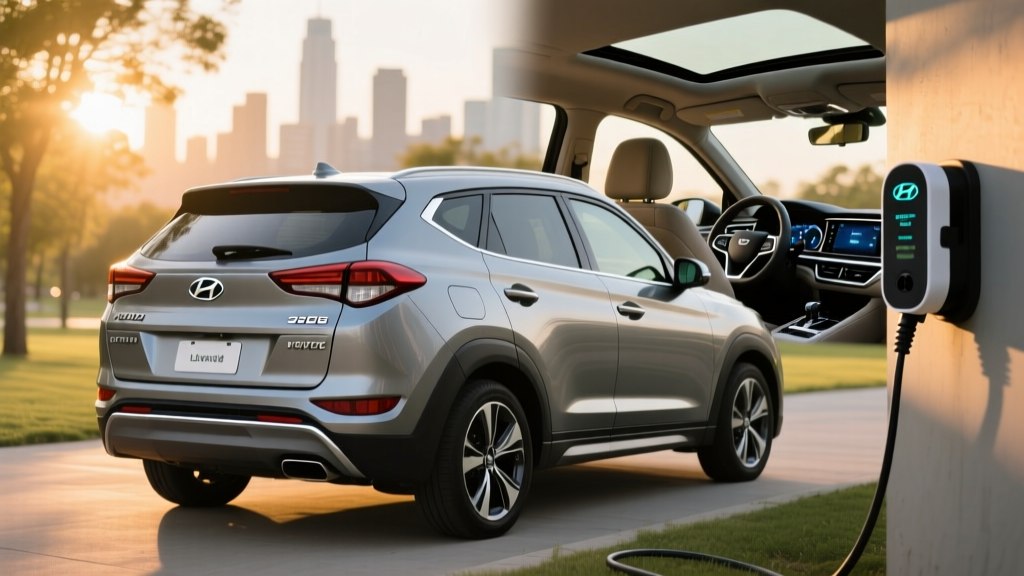
The compact hybrid SUV segment is crowded, but the 2026 Hyundai Tucson Hybrid SEL Convenience occupies a specific sweet spot: it pairs a proven 1.6-liter turbocharged hybrid powertrain with a mid-tier trim that bundles premium comfort features without pushing the price into luxury territory. For buyers who want hybrid efficiency without plugging in, this trim level delivers meaningful fuel savings alongside a well-equipped cabin.
This guide covers everything you need to decide whether the Tucson Hybrid SEL Convenience is the right electrified vehicle for your daily driving — including exact EPA fuel economy figures, real-world MPG expectations, the distinction between this conventional hybrid (HEV) and the Tucson Plug-in Hybrid (PHEV), battery longevity, and total cost of ownership.
HEV vs PHEV: Understanding the Tucson Hybrid Lineup
Hyundai sells two electrified Tucson variants, and confusing them is the most common buyer mistake. The Tucson Hybrid (HEV) and Tucson Plug-in Hybrid (PHEV) serve fundamentally different use cases.
| Feature | Tucson Hybrid (HEV) | Tucson Plug-in Hybrid (PHEV) |
|---|---|---|
| Drivetrain | 1.6L Turbo + Electric Motor (self-charging) | 1.6L Turbo + Larger Electric Motor |
| Needs to plug in? | No — regenerative braking and engine charge the battery | Yes — for electric-only driving |
| Electric-only range | N/A (motor assists engine at all times) | EPA-estimated ~33 miles |
| Battery capacity | ~1.49 kWh (small, buffer-style) | ~13.8 kWh usable |
| Combined horsepower | 231 hp / 271 lb-ft torque | 268 hp / 271 lb-ft torque |
| DC fast charging | No | No (Level 2 AC only, ~2 hours to full) |
| Federal tax credit (§30D) | Not eligible | Not eligible under current 2026 sourcing rules |
The key distinction: The Tucson Hybrid (HEV) — including the SEL Convenience trim — generates all its own electricity. You never plug it in. The 1.49 kWh battery is small by design: it buffers energy captured from regenerative braking and engine surplus, then deploys it for low-speed electric assist, smooth stop-start, and torque fill during acceleration. The Tucson PHEV, by contrast, offers roughly 33 miles of pure electric driving before the gasoline engine kicks in, but requires access to a Level 2 home charger to realize its efficiency advantage.
Fuel Economy: EPA Ratings and Real-World MPG
The 2026 Hyundai Tucson Hybrid carries an EPA-estimated 38 MPG combined (38 city / 38 highway) across all trims, including the SEL Convenience. This is a significant improvement over the gasoline-only Tucson, which returns approximately 28 MPG combined.
| Driving Scenario | EPA Estimate | Real-World Expectation |
|---|---|---|
| City driving | 38 MPG | 39–43 MPG (hybrids excel in stop-and-go) |
| Highway driving | 38 MPG | 34–37 MPG (aero drag reduces hybrid advantage) |
| Combined | 38 MPG | 36–40 MPG (varies by driving mix) |
| Cold weather (below 32°F) | — | 32–35 MPG (engine runs more for cabin heat) |
Real-world note: Hyundai's hybrid system is one of the better implementations for city-heavy commuters. The six-speed automatic transmission (no CVT drone) and robust low-end electric torque mean the Tucson Hybrid frequently exceeds its EPA city rating in urban driving with frequent stops. Highway efficiency is more modest — at sustained 70–80 mph speeds, the electric motor contributes less and the 1.6L turbo does more work. Expect roughly 34–37 MPG on long road trips at highway speeds.
In cold climates, expect a 5–10% fuel economy reduction. The gasoline engine must run longer to provide cabin heat (this hybrid lacks a standard heat pump, unlike the PHEV variant), and the battery's charge-discharge efficiency drops at low temperatures.
Powertrain and Performance Specs
| Specification | 2026 Tucson Hybrid SEL Convenience |
|---|---|
| Engine | 1.6L turbocharged 4-cylinder |
| Electric motor | 47.7 kW (64 hp), integrated into transmission |
| Combined output | 231 hp / 271 lb-ft torque |
| Transmission | 6-speed automatic |
| Drivetrain | HTRAC All-Wheel Drive (standard) |
| 0–60 mph | ~7.1 seconds |
| Towing capacity | 2,000 lbs (braked) |
| Fuel tank | 13.7 gallons |
| Total range | ~520 miles (combined) |
| Cargo volume | 38.7 cu ft (rear seats up) / 80.3 cu ft (folded) |
The Tucson Hybrid's 231 combined horsepower places it near the top of the compact hybrid SUV class. The turbocharged engine provides strong mid-range pull, while the electric motor eliminates the low-RPM lag typical of small turbocharged engines. The 6-speed automatic is a deliberate choice over a CVT — acceleration feels linear and natural, without the rubber-band sensation that plagues many hybrid competitors.
HTRAC all-wheel drive is standard on every Tucson Hybrid trim. The system uses the electric motor to modulate torque distribution between axles, providing confident traction in rain and light snow without the fuel-economy penalty of a traditional mechanical AWD system.
SEL Convenience Trim: What You Get for the Price
The SEL Convenience sits above the base Blue trim and the SEL trim, adding comfort and technology features that justify its position as the volume-selling Tucson Hybrid configuration for most buyers.
2026 MSRP: ~$37,250 (including destination). Key additions over the standard SEL trim include:
- Panoramic sunroof with power sunshade
- Leather-trimmed seats (heated front and rear, ventilated front)
- Power liftgate with hands-free smart open
- Hyundai Digital Key 2 (phone-as-key via NFC/UWB)
- 10.25-inch digital instrument cluster
- 10.25-inch infotainment touchscreen with wireless Apple CarPlay and Android Auto
- Bose premium audio system (8 speakers)
- Highway Driving Assist 2 (HDA2) — adaptive cruise with lane centering and lane-change assist
- Remote Smart Parking Assist
At approximately $37,250, the SEL Convenience undercuts comparably equipped hybrid competitors like the Toyota RAV4 Hybrid XLE Premium and Honda CR-V Hybrid Sport-L while offering more standard driver-assistance technology.
Hybrid vs PHEV vs Full EV: Which Tucson Fits Your Life?
Choose the Tucson Hybrid (HEV) — including SEL Convenience — if:
- You lack reliable access to home or workplace charging
- You drive 200+ miles regularly and don't want to plan charging stops
- You want lower fuel costs with zero behavioral change from a gas car
- Your annual mileage is 10,000–15,000 miles (savings of ~$600–$900/year vs. the gas Tucson at $3.50/gallon)
Choose the Tucson PHEV if:
- You have a garage or driveway where you can install a Level 2 charger
- Your daily commute is under 30 miles round-trip (you'll run on electricity most days)
- You want EV-like quiet operation for daily driving with gas-engine backup for road trips
- You value the additional 37 hp the PHEV powertrain provides
Choose a full EV (like the Hyundai Ioniq 5) if:
- You have home Level 2 charging and your daily driving stays under 250 miles
- You want the lowest per-mile energy cost (~$0.04–$0.06/mile on home electricity vs. ~$0.09–$0.11/mile for this hybrid)
- You want near-zero maintenance (no oil changes, no spark plugs, minimal brake wear from regen)
- You qualify for the full §30D federal tax credit on an eligible EV
For the majority of compact SUV buyers who rent or live in apartments without charging access, the Tucson Hybrid HEV is the pragmatic electrified choice. It requires no infrastructure investment, no route planning, and no behavioral change — just significantly better fuel economy.
Battery Longevity, Warranty, and Replacement Costs
Hyundai Hybrid Battery Warranty: 10 years / 100,000 miles (whichever comes first) for the hybrid battery pack. This applies to the original owner and is one of the strongest hybrid battery warranties in the segment.
Powertrain warranty: 10 years / 100,000 miles.
New vehicle limited warranty: 5 years / 60,000 miles.
The Tucson Hybrid's 1.49 kWh lithium-ion battery pack is far smaller than a full EV battery, and it operates within a conservative state-of-charge window (typically 20–80% SoC) managed by the vehicle's battery management system. This shallow cycling dramatically reduces degradation. Hyundai's hybrid battery packs have demonstrated strong longevity in real-world use — most owners report no measurable capacity loss within the warranty period.
Is the Tucson Hybrid reliable? Hyundai's 1.6L turbocharged hybrid powertrain has been in production since the 2022 model year with incremental refinements. The six-speed automatic transmission avoids the long-term durability questions that surround some CVT-equipped hybrids. According to NHTSA data, the Tucson Hybrid has no widespread powertrain-related recalls as of early 2026.
Battery replacement cost: If the hybrid battery fails outside warranty coverage, replacement currently runs approximately $2,500–$4,000 including labor at a Hyundai dealership. However, this scenario is uncommon within the first 150,000 miles based on fleet and owner data. The small battery size keeps replacement costs far lower than a full EV battery swap ($10,000–$20,000+).
Tax Credits, Incentives, and Total Cost of Ownership
Federal tax credit (§30D): The 2026 Hyundai Tucson Hybrid (HEV) does not qualify for the federal Clean Vehicle Credit. The §30D credit applies only to plug-in electric vehicles (BEVs and PHEVs) meeting specific battery-sourcing, critical-mineral, MSRP, and buyer-income requirements. Conventional hybrids are excluded from this credit under current IRS rules.
Tucson PHEV credit status: Even the Tucson Plug-in Hybrid does not currently qualify for the full §30D credit due to battery component and critical-mineral sourcing requirements that Hyundai has not met for this model as of the 2026 model year. Always verify current eligibility on the IRS Clean Vehicle Credit page before purchasing.
State and local incentives: Some states offer rebates or HOV-lane access for hybrids. Check your state's energy office or DMV for current programs — these vary significantly by jurisdiction and change frequently.
| Cost Factor (5 Years / 75,000 Miles) | Tucson Hybrid SEL Convenience | Tucson Gas SEL (AWD) |
|---|---|---|
| Purchase price (MSRP) | ~$37,250 | ~$33,500 |
| Fuel cost (15,000 mi/yr) | ~$5,200 (38 MPG, $3.50/gal) | ~$9,400 (28 MPG, $3.50/gal) |
| Estimated insurance (avg) | ~$7,500 | ~$7,000 |
| Maintenance (oil, filters, brakes) | ~$2,200 | ~$3,000 |
| Estimated 5-yr total cost | ~$52,150 | ~$52,900 |
The hybrid's fuel savings nearly offset its higher purchase price within five years. Beyond year five, the fuel-cost gap widens — and the hybrid's regenerative braking system reduces brake pad wear, lowering long-term maintenance costs. Hyundai's generous warranty coverage further protects against unexpected repair expenses during the first decade of ownership.
Pros, Cons, and Verdict
Pros
- 38 MPG combined EPA; often exceeds city rating in real-world stop-and-go driving
- 231 hp with strong low-end torque from electric motor assist
- HTRAC AWD standard — confident in rain and snow
- 10-year/100,000-mile hybrid battery and powertrain warranty
- SEL Convenience trim bundles premium features at a competitive price point
- No plug-in required — zero behavioral change from a gas vehicle
- HDA2 adaptive cruise with lane centering included standard
Cons
- Does not qualify for the §30D federal tax credit (HEV exclusion)
- Highway MPG drops to ~34–37 at sustained 75+ mph speeds
- Cold-weather fuel economy penalty of 5–10% without a heat pump
- 2,000-lb towing limit is modest for the class
- No DC fast charging capability (not applicable to HEVs, but limits PHEV variant)
- Cargo floor slightly higher than gas Tucson due to hybrid battery placement
Verdict: The 2026 Hyundai Tucson Hybrid SEL Convenience is one of the most complete compact hybrid SUVs available. It delivers genuine fuel savings without requiring any charging infrastructure, offers a well-appointed cabin at a reasonable price, and backs it all with Hyundai's industry-leading warranty. For buyers who want electrified efficiency but can't (or won't) plug in, this trim hits the right balance of value, technology, and real-world practicality.
Frequently Asked Questions
How many MPG does the Hyundai Tucson Hybrid SEL Convenience get?
The EPA rates the 2026 Tucson Hybrid at 38 MPG city, 38 highway, and 38 combined. In real-world city driving with frequent stops, many owners report 39–43 MPG thanks to aggressive regenerative braking and electric motor assist at low speeds. Highway driving at 70–80 mph typically returns 34–37 MPG.
Do I need to plug in the Tucson Hybrid?
No. The Tucson Hybrid (HEV) is a conventional hybrid — it charges its own small battery through regenerative braking and the gasoline engine. You fuel it like any other car. Only the Tucson Plug-in Hybrid (PHEV) requires plug-in charging to access its electric-only range.
How far can the Tucson PHEV go on electric only?
The Tucson Plug-in Hybrid offers an EPA-estimated 33 miles of electric-only range on its 13.8 kWh battery. Once depleted, it operates as a conventional hybrid. The PHEV charges via Level 2 AC in approximately 2 hours; it does not support DC fast charging.
Is the Hyundai Tucson Hybrid reliable, and what does battery replacement cost?
The Tucson Hybrid's powertrain has proven reliable since its 2022 introduction, with no widespread recalls. The hybrid battery is covered by Hyundai's 10-year/100,000-mile warranty. Out-of-warranty battery replacement costs approximately $2,500–$4,000, but most hybrid batteries last well beyond 150,000 miles with minimal degradation due to the conservative charge window managed by the BMS.
Does the Tucson Hybrid qualify for any federal tax credit?
No. The federal §30D Clean Vehicle Credit applies only to plug-in vehicles (BEVs and eligible PHEVs). Conventional hybrids like the Tucson HEV are not eligible. The Tucson PHEV also does not currently qualify under 2026 battery-sourcing rules. Check the IRS Clean Vehicle Credit page for the latest eligibility information, as rules can change.
Hybrid vs PHEV vs EV — which should I buy?
Choose the Tucson Hybrid (HEV) if you can't charge at home and want fuel savings with no lifestyle change. Choose the PHEV if you have home charging and a short commute (under 33 miles) — you'll drive on electricity most days. Choose a full EV if you have reliable charging, want the lowest per-mile cost, and your daily driving stays under 250 miles. The HEV is the lowest-risk, lowest-commitment electrified option.
How does the SEL Convenience compare to other Tucson Hybrid trims?
The SEL Convenience adds the panoramic sunroof, leather seats (heated/ventilated), Bose audio, power liftgate, Digital Key 2, and HDA2 over the standard SEL trim. It sits below the Limited trim, which adds features like a head-up display and surround-view camera. For most buyers, the SEL Convenience provides the best value-to-feature ratio in the Tucson Hybrid lineup.