The Hyundai Tucson has been a compact SUV staple for years, but its electrified variants—the conventional Tucson Hybrid (HEV) and the plug-in Tucson Plug-in Hybrid (PHEV)—deserve closer attention from buyers who want efficiency without fully committing to a battery-electric vehicle. With the 2026 model year bringing a refreshed design and updated tech, the Tucson lineup now offers something for nearly every electrification comfort level.
This guide breaks down everything you need to know: the Hyundai Tucson Hybrid interior, powertrain specs, real-world MPG, PHEV electric-only range, battery warranties, tax credit eligibility, and how to decide between the HEV, PHEV, and a full EV.
HEV vs. PHEV: Which Tucson Electrified Model Are We Talking About?
Before diving into specs, it's critical to understand the difference between the two Tucson electrified models. Hyundai sells both, and they serve different use cases.
| Feature | Tucson Hybrid (HEV) | Tucson Plug-in Hybrid (PHEV) |
|---|---|---|
| Plugs in? | No — self-charging via engine + regen | Yes — plug in to charge battery |
| Battery size | 1.49 kWh (small buffer) | 13.8 kWh usable |
| Electric-only driving | Brief, low-speed EV assist only | EPA-est. 33 miles EV-only |
| Total range | ~430+ miles (gas tank) | ~400+ miles (EV + gas combined) |
| Federal tax credit | Not eligible | Eligible up to $7,500 (§30D rules apply) |
| Starting MSRP (2026) | ~$33,400 | ~$39,900 |
The HEV is a "gas it and forget it" proposition—you never plug in, and the small battery charges via regenerative braking and the engine. The PHEV rewards you with roughly 33 miles of pure electric commuting before the gasoline engine kicks in, but it requires access to a plug (ideally a Level 2 home charger) to realize its full benefit.
Hyundai Tucson Hybrid Interior: Space, Tech & Daily Comfort
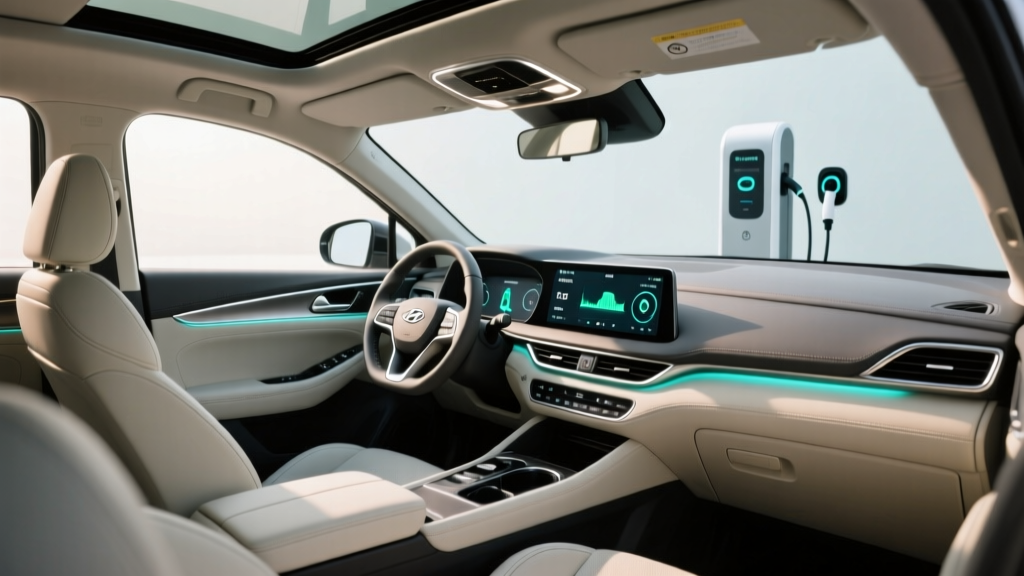
The keyword bringing many shoppers here is the Hyundai Tucson Hybrid interior, and for good reason. The 2026 Tucson retains the spacious, modernized cabin introduced with this generation, and the hybrid powertrain doesn't compromise cargo or passenger room in any meaningful way.
Dimensions & Cargo
Both the HEV and PHEV share the same interior volume. Rear-seat legroom measures approximately 41.3 inches—class-leading for the compact SUV segment. Cargo space behind the second row sits at roughly 38.7 cubic feet, expanding to about 80.3 cubic feet with the rear seats folded. The PHEV's larger battery is packaged beneath the floor and does not noticeably reduce cargo capacity compared to the HEV.
Infotainment & Displays
The 2026 Tucson features a standard 12.3-inch digital instrument cluster and a 12.3-inch touchscreen infotainment system running Hyundai's latest interface with wireless Apple CarPlay and Android Auto. Higher trims (SEL Convenience, Limited) add a head-up display, Bose premium audio, and Hyundai's Digital Key 2, which lets you unlock and start the vehicle with your smartphone.
Seating & Materials
Base Blue and SEL trims use a durable cloth and H-Tex (synthetic leather) combination. The Limited trim upgrades to genuine leather with ventilated front seats and heated rear seats. Fit and finish are a step above the Tucson's price point, with soft-touch materials on the dashboard and door uppers.
What the Hybrid Battery Takes Away (or Doesn't)
One of the most common questions we get: Does the hybrid battery eat cargo space? In the Tucson HEV and PHEV, the answer is essentially no. Hyundai packages the traction battery under the rear seat and cargo floor, preserving the flat load floor and the under-floor storage cubby. You won't notice a difference versus the gas-only Tucson in daily use.
Powertrain Specs: Horsepower, Engine & Electric Motor
Both Tucson electrified models pair a turbocharged 1.6-liter four-cylinder engine with an electric motor, but the outputs differ.
| Specification | Tucson HEV | Tucson PHEV |
|---|---|---|
| Engine | 1.6L turbo I-4 | 1.6L turbo I-4 |
| Electric motor | 47.7 kW (64 hp) | 72 kW (97 hp) |
| Combined system output | 232 hp / 271 lb-ft | 268 hp / 271 lb-ft |
| Transmission | 6-speed automatic | 6-speed automatic |
| Drivetrain | AWD (standard) | AWD (standard) |
| 0–60 mph (est.) | ~7.1 sec | ~6.3 sec |
| Towing capacity | 2,000 lbs | 2,000 lbs |
The PHEV's more powerful electric motor gives it a noticeable acceleration advantage, especially from a stop where electric torque fills in before the turbo spools. Both models come standard with all-wheel drive, a significant value add versus competitors that charge extra for AWD on hybrid trims.
Fuel Economy: EPA MPG & Real-World Expectations
This is where the Tucson HEV and PHEV diverge most sharply—and where buyer expectations need calibration.
| Model | City MPG | Highway MPG | Combined MPG | MPGe (PHEV EV mode) |
|---|---|---|---|---|
| Tucson Hybrid (Blue trim) | 38 | 38 | 38 | N/A |
| Tucson Hybrid (SEL/Limited) | 37 | 36 | 37 | N/A |
| Tucson PHEV | 35 (gas-only) | 35 (gas-only) | 35 (gas-only) | 80 MPGe |
Real-World MPG: What to Actually Expect
Hybrids typically exceed their EPA city estimates in stop-and-go driving because regenerative braking recaptures energy that a gas car wastes as heat. In our experience and aggregated owner data, Tucson HEV drivers in urban environments commonly report 39–42 MPG in city driving. Highway driving, however, is where hybrids lose their advantage—expect 33–35 MPG at sustained 70+ mph speeds, since the engine is doing most of the work without regen assist.
For the PHEV, the 35 MPG gas-only figure applies once the 33-mile EV buffer is depleted. If your commute is under 30 miles round-trip and you charge nightly, you may go weeks without visiting a gas station. But on a long road trip with a depleted battery, the PHEV's heavier curb weight means it can trail the lighter HEV by 2–3 MPG in gas-only mode.
PHEV Electric-Only Range, Charging & Battery Specs
The Tucson PHEV's headline feature is its ability to drive on electricity alone. Here's exactly what that looks like.
Electric-Only Range
The EPA rates the 2026 Tucson PHEV at 33 miles of electric-only range. In real-world conditions—mild weather, moderate speeds, flat terrain—owners frequently report 30–35 miles before the engine engages. In cold weather (below 35°F) or at sustained highway speeds, expect that to drop to roughly 25–28 miles. The cabin heater draws significant energy from the battery in winter.
Charging the PHEV
| Charging Method | Power | 0–100% Time | Notes |
|---|---|---|---|
| Level 1 (120V household outlet) | ~1.4 kW | ~10–11 hours | Works overnight for most commutes |
| Level 2 (240V home/public) | 7.2 kW | ~2 hours | Recommended for daily use |
| DC Fast Charging | Not supported | N/A | No CCS/CHAdeMO port on PHEV |
A critical note: the Tucson PHEV does not support DC fast charging. This is typical for plug-in hybrids—the battery is too small to benefit from high-power DC charging, and the added hardware cost isn't justified. You'll charge exclusively via Level 1 or Level 2 AC. A 240V Level 2 home charger is strongly recommended; a standard 120V outlet works but takes all night.
Battery: 13.8 kWh Usable
The PHEV's lithium-ion polymer battery pack stores 13.8 kWh of usable energy. Hyundai does not publish the cell chemistry publicly, but the pack uses a conventional NMC (nickel-manganese-cobalt) formulation common to PHEVs, optimized for daily shallow cycling rather than deep discharge longevity.
Battery Warranty, Reliability & Replacement Cost
Hybrid and PHEV buyers consistently rank battery longevity as a top concern. Hyundai addresses this with one of the strongest warranties in the industry.
Hyundai Hybrid/PHEV Battery Warranty
- Hybrid battery: 10 years / 100,000 miles (whichever comes first)
- Hybrid system components (motor, inverter, converter): 10 years / 100,000 miles
- Powertrain warranty: 10 years / 100,000 miles
- Bumper-to-bumper: 5 years / 60,000 miles
Source: Hyundai USA Warranty Coverage
What Does Battery Replacement Cost?
If your Tucson hybrid battery fails outside warranty (rare, based on current degradation data), a replacement pack from Hyundai currently runs between $3,000 and $5,000 including labor, depending on whether it's the smaller HEV pack or the larger PHEV unit. Third-party remanufactured options may become available as these vehicles age, potentially reducing cost to $2,000–$3,500.
Reliability Track Record
Hyundai's 1.6T hybrid powertrain has been in production since the 2022 model year across the Tucson, Santa Fe, and Kia Sorento lineups. Owner forums and aggregated reliability data show few systemic issues. The most commonly reported minor complaints involve infotainment glitches and occasional transmission shift hesitation—not battery or motor failures. According to NHTSA, there have been no major safety recalls specifically targeting the Tucson hybrid battery system as of early 2026.
Pricing, Trims & Tax Credit Eligibility
Here's what the 2026 Tucson Hybrid and PHEV lineup costs before any incentives.
| Trim | HEV MSRP | PHEV MSRP |
|---|---|---|
| Blue (base) | $33,400 | — |
| SEL | $35,100 | $39,900 |
| SEL Convenience | $37,600 | $42,400 |
| Limited | $40,200 | $45,900 |
Federal Tax Credit: PHEV Only
The Tucson Hybrid (HEV) does not qualify for any federal tax credit—it's a conventional hybrid with no plug.
The Tucson PHEV may qualify for the federal §30D Clean Vehicle Credit of up to $7,500, but eligibility depends on several factors that change frequently:
- MSRP cap: SUVs must be under $80,000 MSRP — all Tucson PHEV trims qualify.
- Buyer income cap: AGI must not exceed $150,000 (single), $225,000 (head of household), or $300,000 (joint filers).
- Battery sourcing: Critical minerals and battery components must meet phased-in domestic-content thresholds that tighten annually. Verify current-year compliance on the IRS's eligible vehicle list at fueleconomy.gov.
- Point-of-sale transfer: As of 2024+, you can transfer the credit to the dealer at purchase, reducing your out-of-pocket cost immediately rather than waiting for tax filing.
Important: Battery sourcing requirements have disqualified several PHEVs from the full credit in recent years. Always confirm the Tucson PHEV's current eligibility on IRS.gov before purchasing, or consult a tax professional. State-level incentives (California, Colorado, New York, and others) may stack on top.
Hyundai Tucson Hybrid vs. PHEV vs. Full EV: Which Should You Choose?
Choose the Tucson HEV if:
- You have no access to home or workplace charging.
- You want maximum fuel efficiency with zero behavior change—just gas up and drive.
- Your budget is tighter and you don't want to pay the ~$6,500 PHEV premium.
- You primarily drive in city traffic where hybrids shine (38+ MPG real-world).
Choose the Tucson PHEV if:
- You can install a Level 2 charger at home or have reliable workplace charging.
- Your daily commute is under 35 miles round-trip (you'll rarely use gas).
- You qualify for the federal §30D credit, narrowing the price gap with the HEV.
- You want EV-like daily driving with gas-engine flexibility for road trips.
Choose a Full EV (e.g., Hyundai Ioniq 5) if:
- You're ready to eliminate gas entirely and have reliable home charging.
- Your daily driving exceeds 33 miles but stays under 250 miles (within EV range).
- You want the lowest per-mile "fuel" cost and minimal maintenance (no oil changes, no engine).
- You want access to DC fast charging for road trips (150–350 kW capability).
Pros and Cons at a Glance
Pros
- Class-leading rear-seat legroom (41.3 in.)
- Standard AWD on all hybrid trims at no extra cost
- HEV achieves 38 MPG combined (EPA); often exceeds in city driving
- PHEV offers 33 miles EV-only—covers most commutes
- 10-year/100,000-mile hybrid battery warranty
- No cargo space compromise vs. gas Tucson
- Strong infotainment with dual 12.3-inch screens
Cons
- PHEV does not support DC fast charging
- HEV highway MPG drops to ~33–35 at 70+ mph
- PHEV carries a ~$6,500 premium over equivalent HEV trim
- Federal tax credit eligibility for PHEV subject to sourcing rules—confirm before buying
- 6-speed automatic (no CVT option) can feel less seamless than Toyota's hybrid system
- Towing limited to 2,000 lbs (below some competitors)
Frequently Asked Questions
How many MPG does the Hyundai Tucson Hybrid get?
The 2026 Tucson Hybrid (Blue trim) is EPA-rated at 38 MPG city, 38 highway, and 38 combined. SEL and Limited trims drop slightly to 37/36/37. In real-world city driving, many owners report 39–42 MPG thanks to aggressive regenerative braking. Highway driving at 70+ mph typically yields 33–35 MPG.
How far can the Tucson PHEV go on electric only?
The EPA rates the Tucson PHEV at 33 miles of electric-only range. Real-world results vary from about 25 miles (cold weather, highway speeds) to 35 miles (mild weather, city driving). Once the battery depletes, the gasoline engine engages and the vehicle operates as a conventional hybrid at roughly 35 MPG combined.
Does the Hyundai Tucson Hybrid qualify for a tax credit?
The conventional Tucson Hybrid (HEV) does not qualify for any federal tax credit. The Tucson Plug-in Hybrid (PHEV) may qualify for up to $7,500 under IRS §30D, subject to buyer income limits, MSRP caps (all Tucson PHEV trims qualify), and battery sourcing requirements that change annually. Always verify current eligibility at fueleconomy.gov or consult a tax professional before purchasing.
Is the Tucson Hybrid reliable, and what does a battery replacement cost?
The Tucson hybrid powertrain has shown strong reliability since its 2022 introduction, with no major battery-related recalls. Hyundai backs the hybrid battery and system components with a 10-year/100,000-mile warranty. Out-of-warranty replacement costs run $3,000–$5,000 depending on whether it's the HEV or PHEV pack. Third-party remanufactured options may reduce this as the fleet ages.
Do I need to plug in the Tucson Hybrid?
No. The Tucson Hybrid (HEV) is a conventional self-charging hybrid—it generates electricity through regenerative braking and the gasoline engine. You never plug it in. Only the Tucson Plug-in Hybrid (PHEV) requires plugging in to charge its larger battery and access its 33-mile EV-only range.
How does the Tucson Hybrid interior compare to the gas-only Tucson?
The Hyundai Tucson Hybrid interior is virtually identical to the gas-only Tucson in terms of passenger space, cargo volume, and technology. The hybrid battery is packaged under the floor and rear seats, so there is no meaningful loss of cargo space or rear-seat comfort. Trim levels, infotainment, and seating materials carry over directly.