Quick Verdict: A Practical Bridge to Electrification
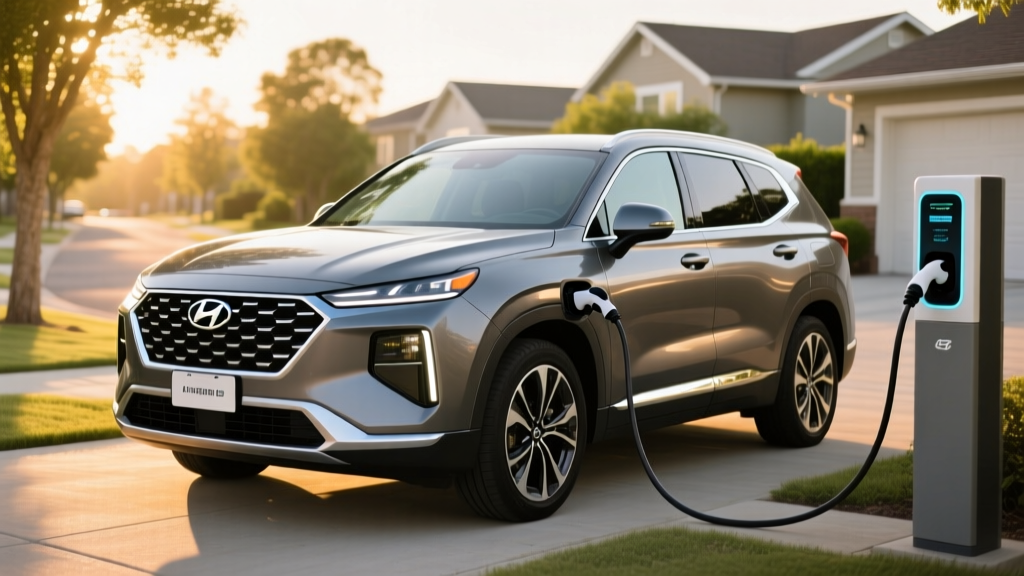
The 2026 Hyundai Santa Fe Plug-In Hybrid targets families who want electric commuting without range anxiety on road trips. With 33 miles of EPA-rated electric-only range, a combined 261 horsepower, and three-row seating, it fills a narrow but valuable niche. If your daily commute falls under 30 miles and you have access to Level 2 home charging, this PHEV can operate as a de facto EV most weekdays while retaining a 430+ mile total range for longer hauls. The trade-off: a modest 13.8 kWh battery that takes roughly 3.5 hours on Level 2 and no DC fast-charging capability.
HEV vs. PHEV: Understanding the Two Santa Fe Hybrids
Hyundai sells the Santa Fe in two electrified flavors, and confusing them is the most common buyer mistake.
| Attribute | Santa Fe Hybrid (HEV) | Santa Fe Plug-In Hybrid (PHEV) |
|---|---|---|
| Battery Size | 1.49 kWh | 13.8 kWh (usable ~11.5 kWh) |
| Plug-In Required? | No — self-charging via regen & engine | Yes — plug in for electric-only range |
| Electric-Only Range | ~1-2 mi at low speed | 33 mi (EPA) |
| Combined Horsepower | 232 hp | 261 hp |
| EPA Combined MPG/MPGe | 36 MPG combined | 79 MPGe (electric+gas) / 35 MPG (gas only) |
| Starting MSRP (2026) | ~$38,750 | ~$41,250 |
The core distinction: The conventional HEV never plugs in. It uses a small battery and regenerative braking to assist the gasoline engine, improving fuel economy. The PHEV carries a much larger battery that you charge by plugging in, enabling genuine electric-only driving for daily commutes before the gasoline engine engages as a range extender.
Fuel Economy and Electric-Only Range
| Metric | EPA Estimate | Real-World Expectation |
|---|---|---|
| MPGe (Electric + Gas Combined) | 79 MPGe | 70–85 MPGe depending on charge frequency |
| Gas-Only Combined MPG | 35 MPG | 32–37 MPG (city-favorable) |
| Gas-Only City MPG | 36 MPG | 34–40 MPG (hybrids excel in stop-and-go) |
| Gas-Only Highway MPG | 34 MPG | 30–34 MPG (aerodynamic drag at 70+ mph) |
| Electric-Only Range | 33 miles | 26–30 mi highway; 20–24 mi in freezing cold |
| Total Combined Range | ~430 miles | ~380–420 mi mixed driving |
Real-world note: Like all PHEVs, the Santa Fe Plug-In Hybrid rewards disciplined charging habits. If you charge nightly and commute under 30 miles, you may visit a gas station only on road trips. Let the battery deplete and the 2.5-liter four-cylinder engine takes over, returning a still-respectable 35 MPG combined — better than most non-hybrid midsize SUVs but far from the 79 MPGe headline number.
In cold weather (below 32°F), expect electric-only range to drop 20–30% due to cabin heating demands and reduced battery efficiency. Hyundai's heat pump system helps mitigate this, but physics wins in deep winter. Plan for roughly 22–26 electric miles on a January morning in Chicago.
Powertrain, Battery, and Charging Specs
| Specification | Detail |
|---|---|
| Engine | 1.6L turbocharged 4-cylinder (178 hp / 195 lb-ft) |
| Electric Motor | 90 kW permanent-magnet synchronous (120 hp / 258 lb-ft) |
| Combined System Output | 261 hp / 258 lb-ft |
| Transmission | 6-speed automatic |
| Drivetrain | HTRAC AWD standard |
| Battery Capacity (Gross) | 13.8 kWh (NMC chemistry) |
| Battery Capacity (Usable) | ~11.5 kWh |
| Level 1 Charging (120V) | ~1.4 kW — full charge in ~11 hours |
| Level 2 Charging (240V) | ~3.3 kW onboard charger — full charge in ~3.5 hours |
| DC Fast Charging | Not supported |
| Charge Port | J1772 (Level 1/2) |
| 0–60 mph | ~7.4 seconds (est.) |
| Towing Capacity | 2,000 lbs |
Charging reality check: The 3.3 kW onboard charger is the Santa Fe PHEV's most significant limitation. While competing PHEVs like the Toyota RAV4 Prime accept up to 6.6 kW on Level 2 (halving charge time), the Santa Fe needs a full 3.5 hours even on a dedicated 240V home charger. This isn't a dealbreaker for overnight charging — plug in when you get home, wake up to a full battery — but it means midday top-ups during short stops yield only modest gains (roughly 10 miles of EV range per hour of charging).
The absence of DC fast charging is standard for this PHEV class. No mainstream compact/midsize PHEV SUV currently offers DC fast charging; that capability remains reserved for full battery-electric vehicles.
Pricing, Trims, and Tax Credit Eligibility
The 2026 Hyundai Santa Fe Plug-In Hybrid is offered in two trims:
| Trim | MSRP | Key Features |
|---|---|---|
| SEL Premium | $41,250 | Heated front seats, power liftgate, 12.3" dual displays, HTRAC AWD, highway driving assist |
| Limited | $47,500 | Nappa leather, ventilated front seats, head-up display, surround-view monitor, premium audio |
Federal Tax Credit (§30D) — Current Rules
The Hyundai Santa Fe Plug-In Hybrid qualifies for a partial federal tax credit of $3,750 under current IRS §30D rules. It does not meet the full $7,500 threshold because its battery components do not fully satisfy the critical-minerals and battery-sourcing requirements that took effect in 2024 and tightened further through 2025–2026.
Eligibility requirements (verify at IRS.gov):
- Buyer AGI must not exceed $150,000 (single) / $300,000 (married filing jointly)
- Vehicle MSRP must not exceed $80,000 (SUVs/vans — Santa Fe qualifies)
- Credit is non-refundable — you must owe at least the credit amount in federal taxes
- Point-of-sale transfer available: apply the credit at the dealer to reduce your purchase price directly
- Battery sourcing requirements determine whether you receive $3,750 or $7,500 — the Santa Fe PHEV currently nets $3,750
State incentives vary significantly. California's CVRP, Colorado's state credit, and utility rebates may add $1,000–$5,000 depending on your jurisdiction. Check your state's energy office and local utility for current programs.
Battery Longevity, Warranty, and Replacement Cost
| Coverage | Terms |
|---|---|
| Hybrid/EV Battery Warranty | 10 years / 100,000 miles |
| Capacity Retention Threshold | Below 70% of original capacity |
| Powertrain Warranty | 10 years / 100,000 miles |
| Basic Vehicle Warranty | 5 years / 60,000 miles |
| Estimated Battery Replacement Cost (out of warranty) | $4,500–$7,000 (parts + labor) |
Hyundai's 10-year/100,000-mile hybrid battery warranty is among the strongest in the industry, matching or exceeding Toyota, Kia, and Ford. The warranty covers the 13.8 kWh traction battery if its capacity drops below 70% of its original state — a threshold that, based on historical NMC degradation data, most PHEV batteries will not reach within the warranty period under normal use.
Reliability outlook: The 1.6L turbocharged engine and 6-speed automatic are carryover components with years of field data. Hyundai's hybrid systems have proven durable in the Tucson PHEV and Ioniq lineages. The primary long-term ownership risk is not battery failure but the turbocharged engine's higher maintenance complexity compared to naturally aspirated alternatives. Follow the severe-service maintenance schedule if you frequently drive in stop-and-go or extreme-temperature conditions.
For context, data from IIHS and owner surveys show Hyundai's hybrid powertrains ranking mid-pack among mainstream brands — behind Toyota's dominant hybrid reliability record but ahead of several European competitors.
Driving Experience and Daily Usability
The Santa Fe PHEV's 261 combined horsepower makes it the quickest variant in the Santa Fe lineup, noticeably more responsive than the 232-hp HEV when merging onto highways or climbing grades. The electric motor's instant 258 lb-ft of torque fills in the low-end gap that turbocharged engines typically exhibit before the turbo spools up.
In EV mode, the cabin is quiet and acceleration is linear — ideal for neighborhood driving and school runs. Transition from electric to hybrid mode is seamless; most drivers won't notice the engine engaging unless they're watching the power-flow display.
Cargo and seating: The PHEV's battery pack is mounted beneath the floor, preserving the Santa Fe's standard cargo volume (approximately 36.4 cu ft behind the second row, 72.1 cu ft with both rear rows folded). Three-row seating remains standard, though the third row is best suited for children — a common midsize SUV compromise.
Who Should Choose the Santa Fe PHEV vs. a Full EV or Gas Car?
Choose the Santa Fe Plug-In Hybrid if:
- Your daily round-trip commute is 25–33 miles and you can charge at home overnight
- You take road trips of 300+ miles several times per year and don't want to plan around DC fast-charging stations
- You need three-row seating and AWD for family duty in snow-belt states
- You want to reduce fuel consumption by 60–80% on weekdays without committing to a full EV
- Your household has one vehicle that must serve all use cases
Choose a Full EV (e.g., Hyundai Ioniq 5, Kia EV9) if:
- You have reliable home Level 2 charging and your daily driving rarely exceeds 200 miles
- You want to eliminate oil changes, spark plugs, and exhaust-system maintenance entirely
- DC fast-charging infrastructure in your region is robust (Tesla Superchargers, Electrify America)
- You want the lowest per-mile "fuel" cost — electricity at $0.14/kWh costs roughly $0.04/mile vs. $0.12/mile for gasoline at $3.50/gal
Choose the Conventional Santa Fe Hybrid (HEV) if:
- You cannot install a Level 2 charger at home (apartment, street parking, no garage)
- You want hybrid fuel savings without changing your fueling habits at all
- The $2,500 price premium of the PHEV doesn't pencil out given your low annual mileage
Pros
- 33 miles EV range covers most commutes gas-free
- 261 hp — quickest Santa Fe variant
- Standard HTRAC AWD for all-weather confidence
- Three-row seating preserved despite battery pack
- 10-year/100,000-mile hybrid battery warranty
- $3,750 federal tax credit reduces effective price
Cons
- 3.3 kW onboard charger — slow Level 2 charging vs. RAV4 Prime (6.6 kW)
- No DC fast charging (class-typical limitation)
- Electric range drops to ~22 mi in cold weather
- Only qualifies for partial ($3,750) federal credit, not the full $7,500
- Limited trim starts at $47,500 — premium pricing for the top spec
- Towing limited to 2,000 lbs (below V6 competitors)
Frequently Asked Questions
How many MPG does the Hyundai Santa Fe Plug-In Hybrid get?
The EPA rates the 2026 Santa Fe PHEV at 79 MPGe when combining electric and gasoline operation. Once the battery is depleted, it operates as a conventional hybrid returning 35 MPG combined (36 city / 34 highway). Real-world gas-only MPG typically falls between 32–37 depending on driving conditions, with city driving often exceeding the EPA estimate thanks to regenerative braking.
How far can the Santa Fe PHEV go on electric power alone?
The EPA rates it at 33 miles of electric-only range. In real-world conditions, expect 26–30 miles during warm-weather highway driving and as low as 20–24 miles in freezing temperatures when the cabin heater draws heavily from the battery. For commutes under 25 miles round-trip, you'll rarely burn gasoline on weekdays.
Does the Santa Fe Plug-In Hybrid qualify for a tax credit?
Yes — it currently qualifies for a partial $3,750 federal tax credit under IRS §30D rules. It does not meet the full $7,500 threshold due to battery-sourcing requirements. Eligibility depends on your income (AGI caps: $150K single / $300K joint), and the credit can be transferred to the dealer as a point-of-sale discount. Always verify current rules at IRS.gov before purchasing, as sourcing requirements tighten annually.
Is the hybrid battery reliable, and what does replacement cost?
Hyundai covers the 13.8 kWh battery with a 10-year/100,000-mile warranty (capacity must not fall below 70%). NMC batteries in PHEV applications typically degrade 1–2% per year under normal use, meaning most owners will retain 85–90% capacity at 100,000 miles. Out-of-warranty replacement is estimated at $4,500–$7,000 including labor — a figure expected to decline as battery costs continue their long-term downward trend.
How long does it take to charge the Santa Fe PHEV at home?
On a standard 120V household outlet (Level 1), a full charge takes approximately 11 hours. On a 240V Level 2 home charger, expect roughly 3.5 hours. The onboard charger is limited to 3.3 kW, so even a 48-amp Level 2 station won't charge faster. There is no DC fast-charging capability.
Should I get the Santa Fe PHEV or a full EV like the Ioniq 5?
If you can charge at home, rarely drive more than 250 miles in a day, and have access to DC fast chargers for road trips, a full EV like the Ioniq 5 offers lower operating costs, stronger performance, and the full $7,500 federal credit. Choose the Santa Fe PHEV if you need three rows, can't reliably access public fast chargers, or regularly drive 400+ mile routes where charging stops would add significant travel time.
Do I have to plug in the Santa Fe Hybrid (non-PHEV)?
No. The conventional Santa Fe Hybrid (HEV) never plugs in. It charges its small 1.49 kWh battery through regenerative braking and the gasoline engine. Only the Plug-In Hybrid variant requires (and benefits from) external charging.