The midsize plug-in hybrid SUV segment has no shortage of contenders, but the 2026 Hyundai Santa Fe PHEV carves out a distinct position: boxy styling, standard all-wheel drive, and a usable electric-only range that covers most daily commutes without burning a drop of gasoline. For buyers who want electric driving on weekdays and gas-engine freedom on road trips — without the charging infrastructure demands of a full BEV — this three-row PHEV makes a compelling case.
Below, we break down every number that matters: EPA range and MPGe, real-world efficiency, charging times, powertrain output, pricing across trims, federal tax credit eligibility under current IRS §30D rules, and long-term battery reliability. If you're cross-shopping the Toyota RAV4 Prime, Kia Sorento PHEV, or Chrysler Pacifica PHEV, this guide gives you the exact data to decide.
HEV vs PHEV: Which Santa Fe Are We Talking About?
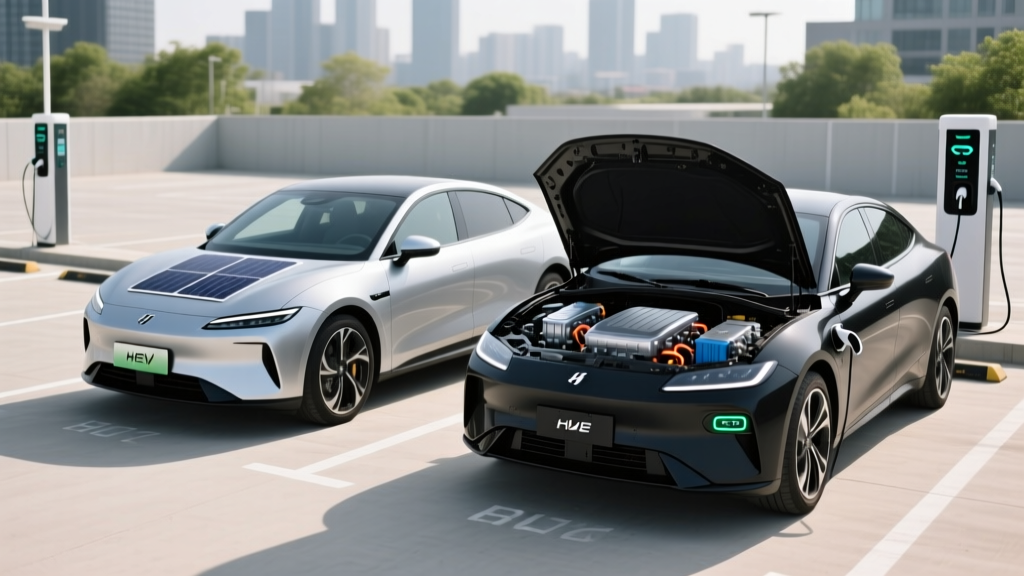
Hyundai sells the Santa Fe in three powertrain flavors for 2026, and confusing them is easy on a dealer lot. Here's the critical distinction:
| Attribute | Santa Fe Hybrid (HEV) | Santa Fe Plug-In Hybrid (PHEV) |
|---|---|---|
| Plug-in charging required? | No — self-charging via regen and engine | Yes — plug in to access electric-only range |
| Electric-only driving | Very limited (low-speed assist only) | EPA-est. 31 miles on battery alone |
| Battery capacity | ~1.49 kWh (small buffer) | 18.0 kWh usable (larger traction battery) |
| Combined horsepower | 232 hp | 261 hp |
| Federal tax credit eligible? | No | Potentially — see §30D details below |
| Starting MSRP (2026) | ~$40,200 | ~$47,100 |
The conventional HEV is the right pick if you have no access to any plug — at home or at work — and simply want better fuel economy than a gas-only SUV. The PHEV rewards you with 31 miles of silent, zero-tailpipe-emission driving, but only if you plug it in regularly. Drive a PHEV without ever charging it and you're hauling dead battery weight, netting worse fuel economy than the lighter HEV.
EPA Fuel Economy and Electric Range: The Numbers
The 2026 Santa Fe PHEV pairs a 1.6-liter turbocharged four-cylinder engine with a front-mounted electric motor and a 6-speed automatic transmission, routing power to all four wheels through Hyundai's HTRAC AWD system. Here's what the EPA says you should expect:
| Metric | Value |
|---|---|
| Electric-only range (EPA est.) | 31 miles |
| MPGe (electric + gas combined) | 79 MPGe |
| Gas-only MPG — City | 33 MPG |
| Gas-only MPG — Highway | 30 MPG |
| Gas-only MPG — Combined | 33 MPG (est. combined) |
| Total range (full battery + full tank) | ~430 miles |
| Fuel tank capacity | 12.4 gallons |
Once the battery depletes, the Santa Fe PHEV operates as a conventional hybrid. The 33 MPG combined figure is competitive with the segment — the RAV4 Prime returns 38 MPG in gas-only mode, while the Sorento PHEV (which shares this powertrain) lands at 34 MPG combined. Highway-heavy drivers should expect closer to 30 MPG after the battery is spent.
Charging: How Fast Does the Santa Fe PHEV Replenish?
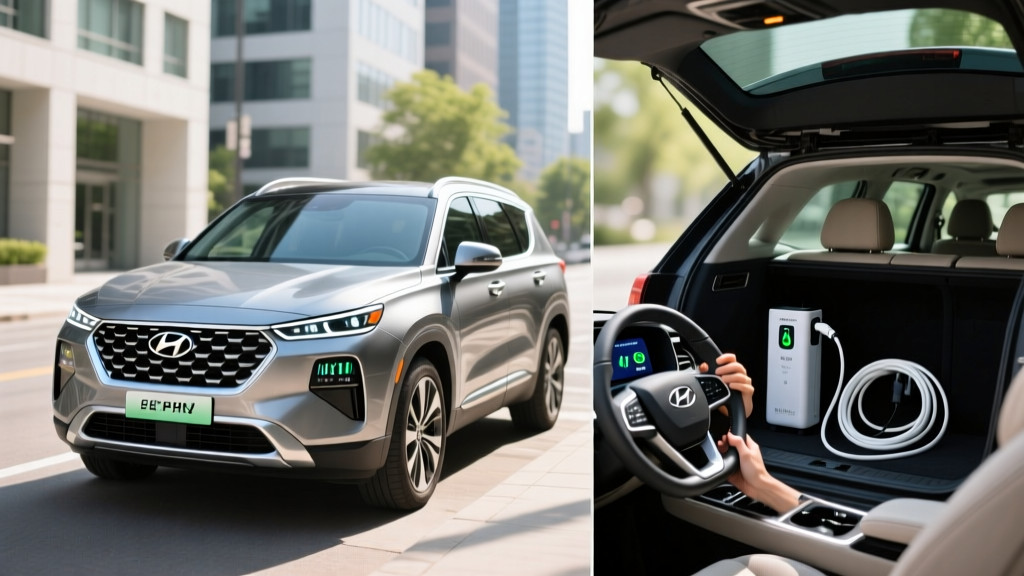
The 18.0 kWh battery (usable capacity) charges through three methods:
| Charging Level | Power (kW) | 0–100% Time | Notes |
|---|---|---|---|
| Level 1 (120V household outlet) | ~1.4 kW | ~13 hours | Emergency/trickle only; adds ~5 mi/hr |
| Level 2 (240V home or public) | ~7.2 kW (onboard charger max) | ~2.5 hours | Ideal for overnight home charging |
| DC Fast Charging | Not supported | N/A | No DC fast-charge port on this PHEV |
This is a key limitation: the Santa Fe PHEV does not support DC fast charging. You won't find a CCS or NACS connector here — only a J1772 port for Level 1 and Level 2 AC charging. For a PHEV with a relatively small 18 kWh battery, this isn't a dealbreaker for most owners (a 2.5-hour Level 2 charge fully tops it off overnight), but it means you can't quickly juice up at an Electrify America or Tesla Supercharger station on a road trip. On longer trips, the gas engine takes over seamlessly, so DC fast charging is less critical than it would be for a full BEV.
Home charging setup: Most Santa Fe PHEV owners will want a Level 2 home charger installed on a 240V circuit (typically a NEMA 14-50 outlet or hardwired wallbox). Budget roughly $500–$1,200 for a quality Level 2 charger (ChargePoint Home Flex, Emporia Vue, or Hyundai's own Wallbox unit) and $500–$2,000 for electrician installation, depending on your panel capacity and run length. If your home's electrical panel is maxed out, a panel upgrade can add $1,500–$3,000.
Powertrain and Performance Specs
| Specification | 2026 Santa Fe PHEV |
|---|---|
| Engine | 1.6L turbocharged GDI 4-cylinder |
| Engine output | 178 hp / 195 lb-ft torque |
| Electric motor output | 74 kW (~99 hp) |
| Combined system horsepower | 261 hp |
| Combined system torque | 258 lb-ft |
| Transmission | 6-speed automatic |
| Drivetrain | HTRAC AWD (standard) |
| 0–60 mph (est.) | ~7.4 seconds |
| Towing capacity | 2,000 lbs |
| Battery chemistry | Lithium-ion polymer (NMC) |
| Battery usable capacity | 18.0 kWh |
| Cargo volume (behind 2nd row) | ~36.4 cu ft |
| Cargo volume (behind 3rd row) | ~10.5 cu ft |
The 261-hp combined output gives the Santa Fe PHEV confident passing power and adequate merging acceleration. The electric motor's instant torque fills in the low-end gap that turbocharged engines typically exhibit before the turbo spools up, making around-town driving feel punchier than the horsepower number alone suggests. The trade-off versus a full BEV: you still feel the 6-speed automatic shift, whereas electric motors deliver seamless, single-speed acceleration.
One practical note on the third row: it's best suited for children or short trips. Adults will find legroom tight back there. If three-row space is a priority, the Kia Sorento PHEV offers similar mechanicals with slightly more generous third-row dimensions, while the Chrysler Pacifica PHEV is a minivan alternative with genuinely usable third-row seating.
Pricing, Trims, and Federal Tax Credit Eligibility
The 2026 Hyundai Santa Fe PHEV is offered in two trims:
| Trim | MSRP (incl. destination) |
|---|---|
| SEL Premium | ~$47,100 |
| Limited | ~$52,450 |
Both trims come well-equipped — the SEL Premium includes leatherette seating, a 12.3-inch dual-screen setup, wireless Apple CarPlay/Android Auto, Hyundai's SmartSense ADAS suite (adaptive cruise, lane-keeping, blind-spot monitoring), and heated front seats. The Limited adds Nappa leather, a head-up display, ventilated front seats, a premium Harman Kardon audio system, and a surround-view monitor.
Does the Santa Fe PHEV Qualify for the Federal Tax Credit?
Under IRS §30D rules, PHEVs can qualify for up to $7,500 in federal tax credits — but eligibility hinges on several requirements that change frequently. As of current rules, the Santa Fe PHEV's credit eligibility depends on:
- MSRP cap: SUVs must have an MSRP at or below $80,000. Both Santa Fe PHEV trims clear this threshold.
- Buyer income cap: Modified adjusted gross income must not exceed $150,000 (single), $225,000 (head of household), or $300,000 (joint filers).
- Battery component sourcing: A percentage of battery components must be manufactured or assembled in North America, and critical minerals must be sourced from the U.S. or free-trade-agreement partners. These thresholds tighten annually.
- Point-of-sale transfer: Eligible buyers can transfer the credit to the dealer at purchase, reducing the sale price directly rather than waiting to claim it on their tax return.
The Santa Fe PHEV has historically qualified for a partial or full credit depending on the model year's battery sourcing compliance. Because Hyundai assembles the Santa Fe in Georgia (at the Hyundai Motor Group Metaplant America), the vehicle itself is domestically built, but battery cell sourcing determines the critical-minerals and battery-component credit halves ($3,750 each). Always verify current-year eligibility on IRS.gov's clean vehicle credit page or ask your dealer for the IRS-qualified vehicle list before purchasing. Tax situations vary — consult a tax professional for personalized guidance.
State incentives may also apply. California's CVRP, Colorado's state credit, and various utility rebates can stack on top of federal incentives, though program availability and amounts vary by jurisdiction. Check your state energy office and local utility for current programs.
Battery Warranty, Reliability, and Replacement Costs
Hyundai's hybrid and PHEV battery track record is solid. The company has been selling hybrid powertrains since the Sonata Hybrid in 2011, and large-scale battery failure reports are uncommon. The 1.6L turbo engine and 6-speed automatic are conventional, proven components — no exotic CVT or unproven technology.
If the battery does need replacement outside of warranty, expect a cost in the range of $4,000–$7,000 for the pack itself, plus $500–$1,500 for labor, depending on the service center. However, PHEV batteries are smaller and less expensive to replace than full BEV packs (which can run $10,000–$20,000+). Individual module replacement — rather than a full pack swap — may also be an option at some specialist shops, reducing cost further.
For reliability data, the Santa Fe as a nameplate scores well in IIHS crash testing and has historically earned mid-to-upper-tier rankings in J.D. Power dependability studies. The PHEV variant adds complexity (electric motor, larger battery, onboard charger), but these are now mature technologies in Hyundai's lineup.
Who Should Choose the Santa Fe PHEV — And Who Shouldn't?
Choose the Santa Fe PHEV if:
- Your daily commute is under 30 miles round-trip and you can charge at home overnight
- You want electric driving for errands but gas flexibility for road trips without charging-route planning
- You need AWD and three rows (even if the third row is child-sized)
- You don't want to commit to a full BEV due to apartment living, unreliable public charging, or frequent long-distance travel
Choose the Santa Fe HEV (conventional hybrid) instead if:
- You have no reliable access to a plug — no garage outlet, no workplace charger
- Your budget is tighter and the ~$7,000 PHEV premium over the HEV doesn't pencil out in fuel savings
- You mostly drive highway miles where the PHEV's electric range offers minimal benefit
Choose a full BEV (e.g., Hyundai Ioniq 5, Tesla Model Y) instead if:
- You have home Level 2 charging and want zero gasoline expenses and minimal maintenance
- Your daily driving rarely exceeds 200 miles and you're comfortable with DC fast charging on road trips
- You want the lowest per-mile fuel cost and qualify for the full $7,500 federal credit on a BEV
The PHEV ownership math works best when you charge nightly and drive within the electric range on most days. A 25-mile round-trip commute, charged at home at $0.14/kWh (national average), costs roughly $0.07/mile on electricity versus $0.13/mile on gasoline at $3.50/gal and 33 MPG. Over 12,000 miles of mostly electric driving, annual fuel savings can reach $500–$800 versus the gas-only model — though the HEV hybrid also sips fuel efficiently, narrowing the gap.
How the Santa Fe PHEV Stacks Up Against Rivals
| Spec | 2026 Hyundai Santa Fe PHEV | Toyota RAV4 Prime | Kia Sorento PHEV |
|---|---|---|---|
| Electric range (EPA) | 31 mi | 42 mi | 32 mi |
| Combined HP | 261 hp | 302 hp | 261 hp |
| Gas-only MPG (combined) | 33 MPG | 38 MPG | 34 MPG |
| AWD standard? | Yes | Yes | Yes |
| Third row? | Yes (tight) | No | Yes |
| DC fast charge? | No | No | No |
| Starting MSRP | ~$47,100 | ~$44,500 | ~$50,000 |
| Battery warranty | 10 yr / 100k mi | 10 yr / 150k mi | 10 yr / 100k mi |
The RAV4 Prime remains the segment benchmark for electric range (42 miles) and gas-only efficiency (38 MPG), plus its 302 hp makes it the quickest of the three. However, it offers no third row, and its MSRP has crept upward as Toyota limits availability. The Sorento PHEV is the Santa Fe's corporate cousin — identical powertrain, similar pricing, slightly different styling and packaging. If you prefer the Kia's design or find better dealer availability, the driving experience is nearly identical.
Pros
- 31-mile electric range covers most commutes
- Standard AWD and three-row seating
- Competitive 33 MPG in gas-only hybrid mode
- Strong 10-year / 100k-mile battery warranty
- Boxy, distinctive styling stands out in the segment
- Comprehensive ADAS suite standard
Cons
- No DC fast charging capability
- Third row is child-sized only
- ~$7,000 premium over the HEV hybrid variant
- Gas-only MPG trails the RAV4 Prime by 5 MPG
- Electric range drops significantly in cold weather
- Federal tax credit eligibility depends on evolving sourcing rules
Frequently Asked Questions
How many MPG does the Hyundai Santa Fe PHEV get?
Once the battery is depleted, the Santa Fe PHEV operates as a conventional hybrid and returns an EPA-estimated 33 MPG combined (33 city / 30 highway). When factoring in electric-only driving, the combined rating is 79 MPGe. Real-world results vary: city drivers often see 34–36 MPG in hybrid mode thanks to regenerative braking, while sustained highway driving at 75+ mph typically yields 28–30 MPG.
How far can the Santa Fe PHEV go on electric only?
The EPA rates the 2026 Santa Fe PHEV at 31 miles of electric-only range. In real-world conditions, expect 26–29 miles in warm weather mixed driving and 20–24 miles in freezing temperatures. Gentle city driving below 45 mph can occasionally stretch the range to 33–34 miles. The total combined range (full battery + 12.4-gallon fuel tank) is approximately 430 miles.
Hybrid vs PHEV vs EV — which is right for me?
A conventional hybrid (HEV) needs no plug and is best for drivers without charging access who want better MPG. A plug-in hybrid (PHEV) like the Santa Fe PHEV offers 20–40 miles of electric driving for daily commutes plus a gas engine for longer trips — ideal if you can charge at home but don't want to plan road trips around charging stations. A full battery-electric vehicle (BEV) eliminates gasoline entirely and offers the lowest per-mile fuel cost, but requires reliable home or workplace charging and comfort with DC fast charging on road trips. If your daily driving stays under 30 miles and you have a garage outlet, the PHEV is an excellent middle ground.
Is the Hyundai Santa Fe PHEV reliable, and what does battery replacement cost?
Hyundai's PHEV powertrain has a strong reliability record, with the 1.6L turbo engine and electric motor being proven, mature components. The high-voltage battery is covered by a 10-year / 100,000-mile warranty (15 years / 150,000 miles in CARB states). Out-of-warranty battery replacement typically costs $4,000–$7,000 for the pack plus $500–$1,500 in labor — significantly less than a full BEV battery replacement. Widespread battery failures are rare based on owner reports and fueleconomy.gov data.
Does the Santa Fe PHEV qualify for a federal tax credit?
Under IRS §30D, the Santa Fe PHEV may qualify for up to $7,500 in federal clean vehicle credits, split into two halves ($3,750 for battery component sourcing and $3,750 for critical minerals sourcing). Eligibility depends on the buyer's income (capped at $150k single / $300k joint), the vehicle's MSRP (must be under $80k for SUVs — both trims qualify), and current battery-sourcing compliance, which changes annually. The credit can be transferred to the dealer at point of sale. Always verify current eligibility at IRS.gov before purchasing, and consult a tax professional for your specific situation.
Can I charge the Santa Fe PHEV at a Tesla Supercharger or DC fast charger?
No. The 2026 Santa Fe PHEV only supports AC charging via a J1772 connector — Level 1 (120V) and Level 2 (240V) only. There is no DC fast-charge port. A full charge on a Level 2 home charger takes approximately 2.5 hours. For a PHEV with a 31-mile electric range, most owners find overnight Level 2 charging fully sufficient.
Sources: EPA fuel economy data via fueleconomy.gov, Hyundai Motor America specifications, IRS §30D clean vehicle credit guidance at irs.gov. All pricing and specifications reflect 2026 model year information available at time of publication and are subject to change. Verify exact figures with your local Hyundai dealer.