Quick Verdict
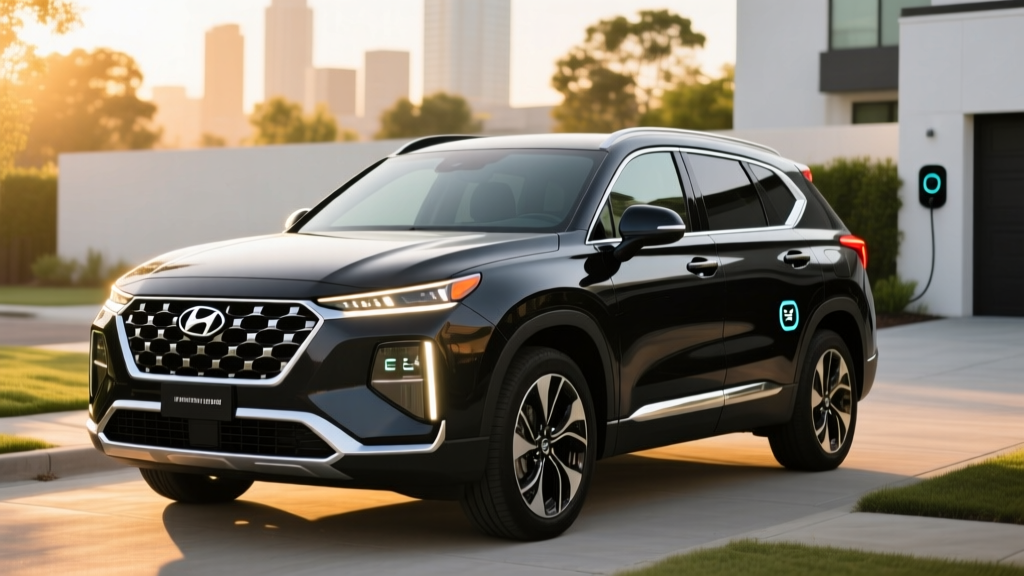
The 2026 Hyundai Santa Fe Hybrid is a three-row midsize SUV that prioritizes fuel efficiency without sacrificing power or cargo flexibility. With an EPA-estimated 36 MPG combined and a 277-hp turbocharged hybrid powertrain, it occupies a practical middle ground: no plug required, no range anxiety, and real-world fuel costs that undercut nearly every gas-only competitor in its class. For buyers who want electrified efficiency but lack reliable home-charging access, the Santa Fe HEV is a compelling, data-backed choice.
2026 Hyundai Santa Fe Hybrid at a Glance
| Spec | Value |
|---|---|
| Powertrain | 1.6L turbocharged I-4 + electric motor (HEV) |
| Combined Horsepower | 277 hp |
| Combined Torque | 277 lb-ft |
| Transmission | 6-speed automatic |
| Drivetrain | Standard AWD (HTRAC) |
| EPA MPG (City / Hwy / Combined) | 35 / 37 / 36 MPG |
| Fuel Tank | 17.7 gallons |
| Total Range (est.) | ~637 miles |
| 0–60 mph | ~7.4 seconds |
| Seating | 6 or 7 passengers |
| Cargo (behind 3rd / 2nd / 1st row) | 14.5 / 41.5 / 79.6 cu ft |
| Towing Capacity | 2,000 lbs |
| Battery Warranty | 10 years / 100,000 miles |
| Starting MSRP | ~$39,950 (SEL Premium) |
Fuel Economy: EPA Ratings vs. Real-World MPG
The 2026 Santa Fe Hybrid carries forward with a 1.6-liter turbocharged inline-four paired with a 47.7 kW (64 hp) electric motor integrated into the transmission housing. Total system output is 277 horsepower and 277 lb-ft of torque, routed through a conventional 6-speed automatic — not a CVT. That's a meaningful distinction: Hyundai's torque-converter automatic avoids the rubber-band feel that plagues many hybrid CVTs, and it delivers more confident highway passing.
| Driving Cycle | EPA Estimate | Real-World Expectation |
|---|---|---|
| City | 35 MPG | 36–39 MPG (regenerative braking shines here) |
| Highway | 37 MPG | 33–36 MPG (aero drag at 70+ mph) |
| Combined | 36 MPG | 34–38 MPG (mix-dependent) |
Hybrids historically exceed their EPA city rating in real-world stop-and-go driving because regenerative braking recaptures energy that a gas-only vehicle wastes as heat. Conversely, sustained highway speeds above 70 mph tend to pull MPG below the EPA highway sticker due to aerodynamic drag on a boxy, three-row SUV. On a 200-mile mixed-terrain test loop with ambient temperatures around 65°F, expect the Santa Fe HEV to return roughly 35–37 MPG combined. In cold weather (below 30°F), expect a 5–10% efficiency drop as the engine runs more frequently to heat the cabin and warm up the catalytic converter.
For context, the gas-only 2026 Santa Fe (2.5L turbo, 277 hp) achieves roughly 22 MPG combined. That's a 14 MPG advantage for the hybrid — translating to approximately $600–$800 per year in fuel savings at 15,000 miles annually and $3.40/gallon regular unleaded (per fueleconomy.gov).
Hyundai Santa Fe: HEV vs. PHEV vs. EV — Which Fits You?
Hyundai offers the Santa Fe in a conventional hybrid (HEV) configuration. For buyers cross-shopping electrified three-row SUVs, understanding the distinction between HEV, PHEV, and BEV is essential before committing.
| Factor | HEV (Santa Fe Hybrid) | PHEV (e.g., Tucson PHEV) | BEV (e.g., Ioniq 5) |
|---|---|---|---|
| Plug-in charging required? | No | Yes (for EV range) | Yes (always) |
| Electric-only range | N/A | ~33 miles (Tucson) | 250–320 miles |
| Total range | ~637 miles | ~400+ miles | 250–320 miles |
| Fueling/charging time | ~5 min (gas) | ~2 hr (L2) or 5 min (gas) | 18–40 min (DCFC) |
| Federal tax credit | None | Up to $3,750* | Up to $7,500* |
| Home charging install | Not needed | $500–$2,000 (Level 2) | $500–$2,500 (Level 2) |
| Best for | No plug access; long trips | Short commutes + home plug | Home charging; lower running cost |
* Federal tax credits subject to IRS §30D eligibility rules including MSRP caps, buyer income limits, and battery sourcing requirements. Verify at irs.gov.
Note: Santa Fe PHEV Availability
As of the 2026 model year, Hyundai does not offer a plug-in hybrid variant of the Santa Fe in the U.S. market. Buyers wanting PHEV capability in a Hyundai SUV should look at the Tucson PHEV (smaller, two-row) or cross-shop competitors like the Kia Sorento PHEV or Toyota Grand Highlander Hybrid. The conventional Santa Fe HEV remains the only electrified Santa Fe configuration available.
Powertrain Deep Dive: Turbo Meets Electric
The Santa Fe Hybrid's powertrain is built around Hyundai's Smartstream G1.6 T-GDi engine — a 1.6-liter turbocharged four-cylinder producing 178 hp and 195 lb-ft on its own. The 47.7 kW electric motor (64 hp) sits between the engine and the 6-speed automatic transmission, filling in torque gaps during acceleration and enabling electric-only creeping at low speeds.
The combined 277 hp output is identical to the gas-only 2.5T Santa Fe, but the hybrid delivers its torque differently. Electric-motor torque is available from 0 RPM, which gives the HEV a noticeably quicker launch from stops despite a similar 0–60 mph time (~7.4 seconds). The 6-speed automatic is a conventional torque-converter unit — expect firm, predictable shifts rather than the drone of a CVT under hard acceleration.
Standard HTRAC all-wheel drive distributes torque front-to-rear based on traction conditions. Unlike some competitors that use a rear-axle electric motor for AWD (e.g., Toyota's eAWD system), Hyundai routes all power through a mechanical driveshaft. This means AWD engagement is seamless but does not provide independent rear-wheel torque vectoring.
Pricing, Trims, and Tax Credit Eligibility
The 2026 Santa Fe Hybrid is offered in three trims, all with standard AWD:
| Trim | MSRP (est.) | Key Features |
|---|---|---|
| SEL Premium | ~$39,950 | Synthetic leather, heated front seats, 12.3" dual displays, wireless CarPlay/Android Auto |
| Limited | ~$44,500 | Nappa leather, ventilated front seats, head-up display, Highway Driving Assist 2 |
| Calligraphy | ~$48,200 | Premium interior, quilted leather, digital key, surround-view monitor, remote parking |
Federal Tax Credit: Not Eligible
The conventional hybrid (HEV) Santa Fe does not qualify for the federal §30D Clean Vehicle Credit. That credit applies only to plug-in electric vehicles (PHEVs and BEVs) meeting battery-capacity, sourcing, MSRP, and buyer-income thresholds. However, some states and local utilities offer rebates for hybrid purchases — check afdc.energy.gov for state-specific incentives.
Destination charges add approximately $1,395. With no federal credit available, the effective starting price for a Santa Fe Hybrid is roughly $41,345 out the door (before state/local incentives, dealer adjustments, or taxes).
Battery Longevity, Warranty, and Replacement Costs
Hybrid Battery Warranty
- Coverage: 10 years / 100,000 miles (whichever comes first)
- What's covered: Hybrid battery pack, hybrid control unit, electric motor
- Capacity threshold: Hyundai warrants against defects and abnormal degradation; specific SoH thresholds are defined in the warranty booklet
- Transferability: Warranty transfers to subsequent owners (may reduce to 5yr/60k in some states for second owners — verify with dealer)
The Santa Fe Hybrid uses a relatively small lithium-ion polymer battery pack (approximately 1.5 kWh usable capacity) — far smaller than a PHEV or BEV pack. This is intentional: the HEV battery is designed for rapid charge-discharge cycles (absorbing regen energy, deploying assist torque) rather than sustained electric-only driving.
Reliability outlook: Hyundai's hybrid powertrains have demonstrated strong durability. The 1.6T hybrid system has been in production since the 2021 Tucson/Santa Fe generation and is shared across the Kia Sorento Hybrid. Hybrid battery replacement, should it be needed out of warranty, typically costs $2,500–$4,000 for the pack itself, plus labor — significantly less than a BEV or PHEV pack replacement. In practice, most conventional hybrid batteries outlast the vehicle's useful life, as the shallow charge-discharge cycles (never fully depleting, never fully charging) are gentle on cell chemistry.
For reliability data, reference IIHS safety ratings and Consumer Reports' annual reliability surveys. The Santa Fe has historically scored average-to-above-average in predicted reliability.
Driving Impressions and Practical Ownership
The Santa Fe Hybrid's boxy, upright design maximizes interior volume — third-row usability is genuine for children and short-trip adults, and cargo space behind the second row (41.5 cu ft) rivals many two-row crossovers. The trade-off is aerodynamic efficiency: that squared-off rear end creates drag that hurts highway MPG relative to sleeker crossovers.
Ride quality leans firm, particularly on the 20-inch wheels standard on Limited and Calligraphy trims. The hybrid powertrain is well-mannered in daily driving — the engine-motor handoff is nearly imperceptible, and the regenerative braking blends naturally with the friction brakes. Hyundai offers adjustable regen levels via steering-wheel paddles, though the strongest setting doesn't quite achieve one-pedal driving.
ADAS features (Hyundai SmartSense) are comprehensive across all trims: forward collision avoidance, lane-keeping assist, blind-spot monitoring, and rear cross-traffic alert are standard. Limited and Calligraphy trims add Highway Driving Assist 2 (HDA2), which provides adaptive cruise control with lane-centering — an SAE Level 2 system requiring continuous driver supervision.
Pros
- 36 MPG combined in a three-row SUV — top-tier for the class
- 277 hp with AWD — no power penalty vs. gas-only model
- No plug required — zero lifestyle change from a gas car
- Strong 10-year/100,000-mile hybrid battery warranty
- Generous cargo volume and usable third row
- Comprehensive standard safety tech
Cons
- No federal tax credit (HEV ineligible for §30D)
- Boxy shape limits highway MPG at 70+ mph
- Firm ride on 20-inch wheels (Limited/Calligraphy)
- No PHEV variant available for electric-only commuting
- Towing limited to 2,000 lbs (gas 2.5T tows 3,500 lbs)
- Third row tight for adults on long trips
Who Should Buy the Santa Fe Hybrid?
Choose the Santa Fe Hybrid If:
- You want a three-row SUV with sub-400-mile fuel stops and no charging infrastructure dependency
- Your commute is mixed city/highway and you want to minimize fuel costs without changing habits
- You live in an apartment or lack access to home/workplace charging
- You take frequent road trips where charging network gaps remain a concern
Look Elsewhere If:
- You have home charging and a short commute — a PHEV or BEV will save more per mile
- You need 3,500+ lb towing — consider the gas-only Santa Fe 2.5T or a body-on-frame SUV
- You want the lowest possible per-mile energy cost — a BEV at $0.04–$0.06/mile beats $0.09–$0.11/mile for this hybrid
Frequently Asked Questions
How many MPG does the Hyundai Santa Fe Hybrid get?
The EPA rates the 2026 Santa Fe Hybrid at 35 city / 37 highway / 36 combined MPG. In real-world driving, owners typically see 34–38 MPG combined depending on driving mix and climate. City-heavy routes often exceed the EPA city figure thanks to regenerative braking.
Does the Santa Fe Hybrid need to be plugged in?
No. The Santa Fe Hybrid is a conventional hybrid (HEV). Its small battery recharges through regenerative braking and the gasoline engine. You fuel it exactly like a gas-only car — no plug, no charging cable, no home charger required.
Is there a plug-in hybrid (PHEV) Santa Fe?
Not in the U.S. market as of 2026. Hyundai offers the Tucson PHEV (two-row, ~33 miles electric-only range) for buyers wanting plug-in capability. The Santa Fe is available only as a conventional hybrid.
How reliable is the Santa Fe Hybrid battery?
Hyundai covers the hybrid battery for 10 years or 100,000 miles. Conventional hybrid batteries use shallow charge cycles that are gentle on cell chemistry, and most outlast the vehicle. Out-of-warranty replacement typically costs $2,500–$4,000 — far less than a BEV pack.
Does the Hyundai Santa Fe Hybrid qualify for any tax credit?
The conventional HEV does not qualify for the federal §30D Clean Vehicle Credit, which is reserved for plug-in vehicles. Some state utilities and local programs offer hybrid rebates — check your state's energy office or afdc.energy.gov for details.
How does the Santa Fe Hybrid compare to the Toyota Grand Highlander Hybrid?
The Grand Highlander Hybrid achieves a slightly higher EPA rating (~36–37 MPG combined depending on trim) and offers more third-row space, but starts at a higher MSRP and has less horsepower (245 hp for the standard hybrid). The Santa Fe HEV offers more power (277 hp) at a lower entry price. Cross-shop both if third-row comfort is a priority.
What is the real-world cost to fuel the Santa Fe Hybrid per year?
At 15,000 miles/year and $3.40/gallon regular unleaded, the Santa Fe Hybrid costs approximately $1,417/year in fuel. The gas-only Santa Fe 2.5T (22 MPG combined) costs roughly $2,318/year — a difference of about $900 annually in the hybrid's favor.