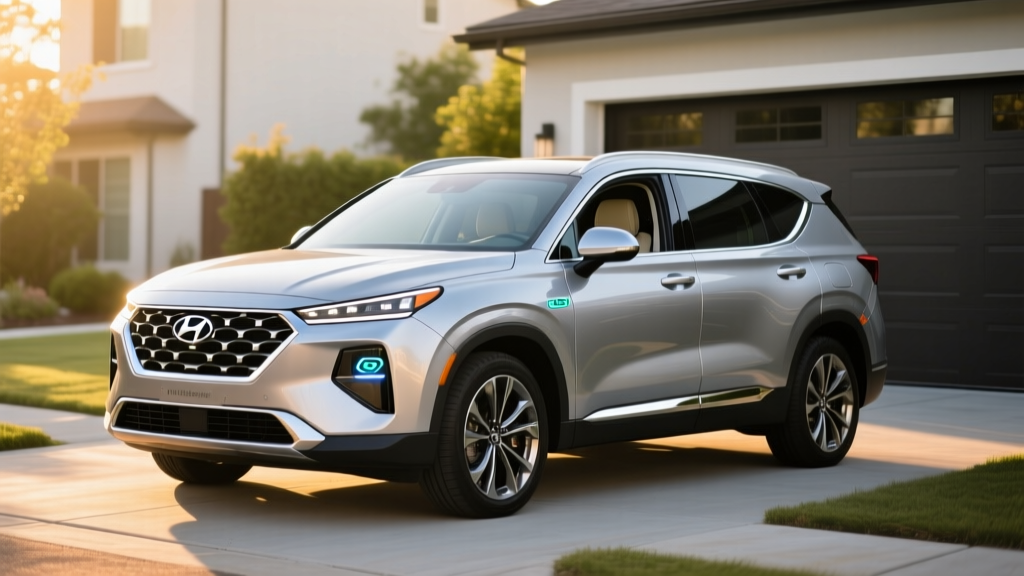
The Hyundai Santa Fe has long been a midsize SUV staple, but the current-generation model's boxy redesign and hybrid-first powertrain strategy have made it one of the most fuel-efficient three-row vehicles on the market. If you've been searching for detailed Hyundai Santa Fe Hybrid MPG data — not just the EPA sticker, but what you'll actually see on your commute — this guide covers every number that matters, from the conventional hybrid (HEV) to the plug-in hybrid (PHEV) variant.
For 2026, Hyundai continues to offer the Santa Fe in both HEV and PHEV configurations, each with distinct trade-offs in efficiency, electric-only range, pricing, and federal tax credit eligibility. We'll walk through both, with real-world context that spec sheets leave out.
HEV vs PHEV: Which Santa Fe Hybrid Are We Talking About?
Before diving into MPG figures, it's critical to distinguish the two hybrid systems Hyundai offers in the Santa Fe. They are fundamentally different vehicles with different use cases.
| Feature | Santa Fe HEV (Conventional Hybrid) | Santa Fe PHEV (Plug-In Hybrid) |
|---|---|---|
| Needs to plug in? | No — charges via regenerative braking and engine | Yes — plug in to access electric-only range |
| Battery size | ~1.49 kWh (small, self-charging) | ~13.8 kWh usable (larger, plug-in capable) |
| Electric-only driving | Brief low-speed assist only | ~30 miles EPA electric-only |
| Primary fuel | Gasoline (electric motor assists) | Electricity first, gasoline for longer trips |
| Federal tax credit | Not eligible for §30D new EV credit | Eligible — up to $7,500 (subject to IRS rules) |
| Best for | Drivers who can't charge at home | Drivers with home charging and short commutes |
If you don't have access to home or workplace charging, the HEV is the straightforward choice — it operates exactly like a gas car but with significantly better fuel economy. The PHEV rewards you with electric-only commuting but requires a plug to unlock its full advantage.
2026 Hyundai Santa Fe Hybrid MPG: EPA Ratings and Real-World Numbers
The conventional Santa Fe HEV pairs a 1.6-liter turbocharged four-cylinder engine with an electric motor for a combined system output of 230 horsepower. Power reaches all four wheels through a 6-speed automatic transmission (Hyundai's HTRAC AWD is standard on most trims).
| Configuration | City MPG | Highway MPG | Combined MPG |
|---|---|---|---|
| Santa Fe HEV AWD (EPA) | 35 | 31 | 34 |
| Santa Fe HEV FWD (EPA) | 36 | 35 | 36 |
| Santa Fe PHEV AWD (charge-sustaining) | 33 | 30 | 32 |
| Santa Fe PHEV (electric + gas combined) | 79 MPGe combined | ||
Source: EPA Fuel Economy. Figures reflect current model-year estimates.
Real-World MPG: What Owners Actually See
The Santa Fe HEV's EPA combined rating of 34-36 MPG is strong for a three-row SUV. But hybrid efficiency behaves differently than gas-only vehicles in practice:
- City driving: Hybrids typically exceed their EPA city ratings in real-world stop-and-go traffic. Expect 36-38 MPG in urban commuting with the HEV AWD, as regenerative braking recovers energy that a gas car wastes as brake heat.
- Highway driving: Hybrids lose their advantage at sustained high speeds. Expect 29-32 MPG on the highway at 70-75 mph — the electric motor contributes less, and the boxy Santa Fe design creates more aerodynamic drag than sleeker crossovers.
- Cold weather: Battery efficiency drops and the engine runs more often for cabin heat. Expect a 10-15% reduction in winter — roughly 30-32 MPG combined in freezing conditions.
- Mountainous terrain: Steep grades will push consumption to the mid-20s MPG, though regenerative braking on descents partially recovers the deficit.
Santa Fe PHEV: Electric-Only Range and Total Range
The Santa Fe Plug-In Hybrid uses a larger 1.6L turbo engine paired with a more powerful electric motor (90 kW / 121 hp) and a 13.8 kWh battery pack, for a combined system output of 261 horsepower. This gives the PHEV noticeably stronger acceleration than the HEV.
| Spec | Value |
|---|---|
| EPA electric-only range | ~30 miles |
| Total range (electric + gas) | ~430-450 miles |
| Battery capacity | 13.8 kWh usable |
| Level 1 charging (120V, 12A) | ~12 hours (full charge) |
| Level 2 charging (240V, 32A) | ~3.5 hours (full charge) |
| DC fast charging | Not available |
| Charge connector | J1772 (Level 1/2) |
Critical note: The Santa Fe PHEV does not support DC fast charging. This is typical for PHEVs — the battery is small enough that Level 2 charging overnight is sufficient. If you need DC fast charging for road trips, a full BEV like the Hyundai Ioniq 5 is the better fit.
The 30-mile electric range is meaningful for daily commuting. According to FHWA data, the average American drives roughly 37 miles per day. If your commute falls under 30 miles round-trip and you charge nightly, you may go weeks without the engine starting. On longer trips, the gasoline engine takes over seamlessly — no range anxiety, no charging-station hunting.
Powertrain and Performance Breakdown
| Specification | Santa Fe HEV | Santa Fe PHEV |
|---|---|---|
| Engine | 1.6L Turbo I-4 | 1.6L Turbo I-4 |
| Electric motor | 47.7 kW (64 hp) | 90 kW (121 hp) |
| Combined output | 230 hp / 271 lb-ft | 261 hp / 271 lb-ft |
| Transmission | 6-speed automatic | 6-speed automatic |
| Drivetrain | AWD standard (FWD available) | AWD standard |
| 0-60 mph (est.) | ~7.8 seconds | ~7.0 seconds |
| Towing capacity | 2,000 lbs | 2,000 lbs |
Neither variant is a performance SUV, but the PHEV's extra electric torque makes it feel noticeably more responsive in city driving and merging situations. Both use Hyundai's conventional 6-speed automatic rather than the CVT or e-CVT found in some competitors, which gives a more natural shift feel that many drivers prefer.
Pricing, Trims, and Tax Credit Eligibility
For the 2026 model year, Hyundai positions the Santa Fe Hybrid across several trims:
| Trim | HEV MSRP (est.) | PHEV MSRP (est.) |
|---|---|---|
| SE (base) | ~$39,500 | — |
| SEL Premium | ~$42,500 | ~$47,500 |
| Limited | ~$46,000 | ~$51,000 |
| Calligraphy | ~$49,500 | ~$54,500 |
Prices are approximate MSRP including destination. Verify with Hyundai's official configurator.
Federal Tax Credit: Does the Santa Fe Hybrid Qualify?
- Santa Fe HEV (conventional hybrid): Does NOT qualify for the §30D federal clean vehicle credit. This credit applies only to plug-in vehicles (BEVs and PHEVs).
- Santa Fe PHEV: May qualify for up to $7,500 under IRS §30D, but eligibility depends on multiple factors that change periodically.
For the PHEV, the IRS §30D credit has strict requirements as of 2026:
- MSRP cap: SUVs must have an MSRP at or below $80,000 (the Santa Fe PHEV clears this easily).
- Buyer income limits: Modified AGI must not exceed $150,000 (single), $225,000 (head of household), or $300,000 (joint).
- Battery sourcing: The critical minerals and battery component requirements have tightened annually since 2024. Hyundai-Kia's supply chain has adapted, but specific eligibility can shift. Always verify the current VIN-level status on fueleconomy.gov before purchasing.
- Point-of-sale transfer: If eligible, you can transfer the credit to the dealer at purchase, reducing your out-of-pocket cost immediately rather than waiting for tax filing.
Important: Tax credit rules are subject to change. Consult a tax professional and verify on irs.gov before making a purchase decision based on credit eligibility.
Battery Warranty, Reliability, and Replacement Costs
Hybrid battery longevity is consistently the top concern among first-time hybrid buyers. Here's what Hyundai provides:
| Coverage | Santa Fe HEV | Santa Fe PHEV |
|---|---|---|
| Hybrid battery warranty | 10 years / 100,000 miles | 10 years / 100,000 miles |
| Hybrid system components | 10 years / 100,000 miles | 10 years / 100,000 miles |
| Powertrain warranty | 10 years / 100,000 miles | 10 years / 100,000 miles |
| New vehicle warranty | 5 years / 60,000 miles | 5 years / 60,000 miles |
Hyundai's 10-year/100,000-mile hybrid battery warranty is among the best in the industry and matches the coverage offered by Toyota and Kia. This is significantly longer than the federal mandate of 8 years / 80,000 miles for emissions-related components.
Battery Replacement Cost (Out of Warranty)
If the hybrid battery fails outside warranty coverage (which is rare based on long-term fleet data):
- HEV battery replacement: Estimated $2,000-$3,500 (the HEV battery is small — ~1.49 kWh — making it relatively affordable).
- PHEV battery replacement: Estimated $5,000-$8,000 (the 13.8 kWh pack is larger and more complex).
For context, Hyundai's hybrid battery packs in the Tucson and Sonata have shown strong longevity in fleet data, with most units retaining 85-90% capacity at 100,000 miles. The nickel-metal-hydride (HEV) and lithium-ion polymer (PHEV) chemistries Hyundai uses are proven and conservative — they prioritize cycle life over energy density.
Santa Fe Hybrid vs. Full EV vs. Gas SUV: Which Is Right for You?
Choose the Santa Fe HEV if:
- You cannot install a home charger (apartment, street parking, no garage)
- You want maximum simplicity — no plugs, no charging apps, no range planning
- Your priority is the lowest possible fuel cost without changing your driving habits
- You regularly take long road trips and don't want to plan charging stops
Choose the Santa Fe PHEV if:
- You have home or workplace Level 2 charging access
- Your daily commute is under 30 miles round-trip (you'll rarely use gas)
- You want EV-like quietness and smoothness for daily driving, with gas backup for road trips
- You qualify for the §30D tax credit, bringing the effective price closer to the HEV
Choose a full BEV (e.g., Hyundai Ioniq 5, Kia EV9) if:
- You want zero tailpipe emissions and the lowest per-mile energy cost
- You have reliable home charging and access to DC fast chargers for road trips
- You want the maximum federal tax credit and lowest long-term maintenance cost
- You're ready to plan longer trips around charging infrastructure
Santa Fe HEV Pros
- 34-36 MPG combined — best in class for a 3-row SUV
- No charging required — drives like a gas car
- 620+ mile range per tank
- 10-year/100,000-mile hybrid warranty
- Spacious, boxy interior with usable third row
Santa Fe HEV Cons
- No federal tax credit eligibility
- Highway MPG drops below EPA in real-world testing
- 2,000-lb towing limit is modest for the segment
- Not as smooth or quiet as PHEV in electric mode
- AWD system adds weight vs. FWD competitors
Frequently Asked Questions
How many MPG does the Hyundai Santa Fe Hybrid actually get?
The EPA rates the 2026 Santa Fe HEV at 35 city / 31 highway / 34 combined (AWD) or 36/35/36 (FWD). In real-world city driving, many owners report 36-38 MPG thanks to regenerative braking. Highway driving at 70+ mph typically yields 29-32 MPG. Expect roughly 33-35 MPG in mixed daily driving.
How far can the Santa Fe PHEV go on electric power alone?
The EPA rates the Santa Fe PHEV at approximately 30 miles of electric-only range. This is sufficient for most daily commutes. Once the battery depletes, the vehicle operates as a conventional hybrid at roughly 32 MPG combined.
Does the Hyundai Santa Fe Hybrid qualify for a tax credit?
The conventional HEV does not qualify for any federal EV tax credit. The PHEV may qualify for up to $7,500 under IRS §30D, subject to buyer income limits ($150K single / $300K joint), MSRP caps ($80K for SUVs), and battery sourcing requirements. Verify current eligibility on irs.gov and fueleconomy.gov before purchasing. Some states offer additional credits for PHEVs — check your state's energy office.
Is the Santa Fe Hybrid reliable? What about battery replacement?
Hyundai's hybrid system has a strong reliability track record, backed by a 10-year / 100,000-mile hybrid battery and powertrain warranty. Out-of-warranty battery replacement costs roughly $2,000-$3,500 for the HEV and $5,000-$8,000 for the PHEV, but most hybrid batteries last well beyond 150,000 miles based on fleet data.
Do I need to plug in the Santa Fe HEV?
No. The conventional Santa Fe HEV charges its small battery entirely through regenerative braking and the gasoline engine. You fuel it like any other gas car. Only the PHEV variant benefits from being plugged in.
How does the Santa Fe Hybrid compare to the Toyota Highlander Hybrid?
The Toyota Highlander Hybrid achieves an EPA 35-36 MPG combined and offers similar three-row space. The Santa Fe HEV matches it on fuel economy but offers a more distinctive design, a more modern interior, and a longer warranty (10yr/100K vs Toyota's 10yr/150K hybrid battery but 3yr/36K base). The Highlander Hybrid has a slightly higher towing capacity (3,500 lbs vs 2,000 lbs). Both are excellent choices — the Santa Fe wins on warranty and interior tech; the Highlander wins on towing and long-term resale data.